

 Home
Home Chiang Mai(












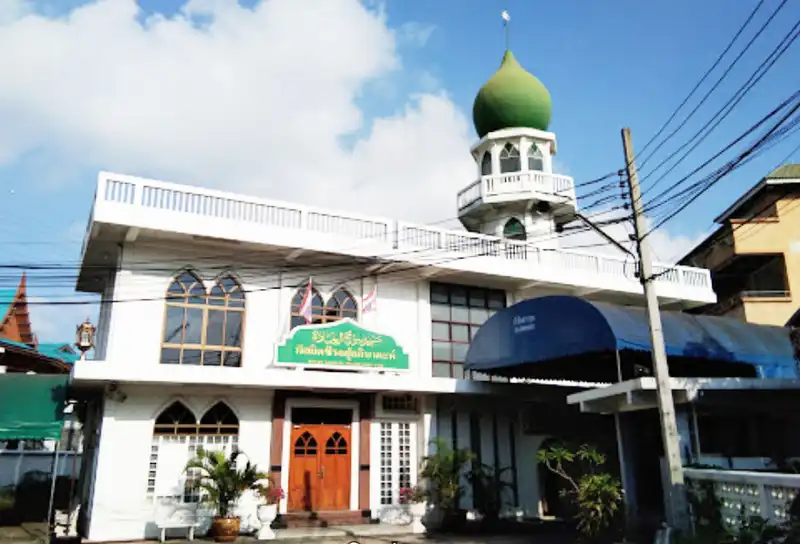
Siroyul Ibadah Mosque (Rama 9)
Rating: 4.4/5 (5 votes)
 Search By
  Map
Map 
 Have Map
  No Map
Bangkok attractions
Attractions in Thailand
Open Days: Daily (for religious activities; visitors are advised to contact / make an appointment in advance)
Opening Hours: Varies by prayer times and mosque activities – please call before you go
Siroyul Ibadah Mosque (Rama 9) / Pak Khlong Lat Phrao Mosque, Bangkok When people talk about the Rama 9 area, the picture that often comes to mind is a major road where traffic rarely shows mercy, surrounded by shopping centers, office buildings, and the fast-paced energy of a city that keeps expanding. Yet tucked inside the smaller lanes of the same neighborhood, there is a place that tells a much deeper story of how a community put down roots: Siroyul Ibadah Mosque (Rama 9), once widely known as “Pak Khlong Lat Phrao Mosque.” Located around Hua Mak in Bang Kapi, it stands as an anchor for people bound together by faith, family ties, and shared memories
The charm of this mosque is not only that it is a place to stop by for prayer, but that it reflects the formation of a Pattani Malay Muslim community that gradually moved into Bangkok to seek livelihoods, build homes, and create a shared space for religious life. Community accounts say that a number of Pattani families first settled in an area known as “Sam In.” As generations grew, descendants spread out to establish themselves in other neighborhoods—including Ban Pa, Khlong Trong, Na Ram, and various other places where waterways and older travel routes once connected people in very real, everyday ways
Among those descendants who moved outward, there is the story of Al-Marhum Haji Salaeh and Al-Marhumah To Riam Khamthetthong, who settled around the Pak Khlong Lat Phrao area and began by building a small “balai” (a simple communal hall) so that children and relatives could gather and perform ibadah together. That small wooden structure may look modest when compared to today’s cityscape, but for the community it was a “home of faith” that helped people stay connected instead of being scattered by the city’s too-rapid pace of change
What strengthened the community structure over time was a combination of kinship and the kind of mutual support older generations deeply understood. In the early period, nearly all congregants were relatives, and later some Muslims who had migrated from other places also built homes within the mosque’s waqf area. Meanwhile, families from other neighborhoods—such as Ban Pa, Ramkhamhaeng, and Khlong Trong, who traced back to the Sam In community—continued visiting and helping one another, traveling by boat and staying in touch over the years. It paints a vivid picture of Bangkok in a time when canals were major routes, and relationships could move forward on paddles and goodwill at the same time
The term “waqf” may not be familiar to everyone, but in essence it refers to dedicating property for religious purposes and the wider benefit of the community. This is one of the foundations that allows a mosque to remain stable and serve people across generations. Siroyul Ibadah Mosque stands on two connected land plots totaling approximately 2 rai 3 ngan 10 square wah. This land was endowed as waqf by Al-Marhum Haji Salaeh and Al-Marhumah To Riam Khamthetthong. While both were still alive, they appointed Al-Marhum Imam Haji Hasan Khamthetthong, their eldest son, to oversee continuing mosque affairs
After both had returned to the mercy of Allah, Al-Marhum Imam Haji Hasan Khamthetthong proceeded with transferring the ownership of both plots to become mosque property, completing the legal process. This mattered because it clarified the site’s status for religious activities and community programs, and it also helped the mosque expand its role into education and public benefit as time went on
Later, as the original balai area became too small for a growing community, the site was developed into a new mosque building in the form of a two-story concrete structure, which continues to be used today. Yet one detail that many people find meaningful is that the old wooden materials from the earlier balai did not simply disappear—they were reused to build the two-story Siroyul Ibadah School next door. The school is a traditional wooden hip-roof building, and it gives the impression that the community’s memories still stand right beside the newer structure
Education is another pillar that keeps this mosque “alive” beyond prayer times. The Siroyul Ibadah School uses its space in a clear, purposeful way: the upper floor is used for Qur’an teaching, while the lower floor is used for fardhu ‘ain instruction. In earlier years, teaching originally took place mainly within the mosque itself before gradually shifting into more suitable, dedicated spaces as student numbers and community activities grew
There is also a more recent historical detail that reflects changes in Thailand’s education system and regulations over time. During one period of registering the Siroyul Ibadah School, the government did not allow the mosque itself to hold the license as the school’s official owner. The community therefore used the name of Al-Marhum Imam Haji Hasan Khamthetthong as the license holder on behalf of the mosque, and coordination with the Ministry of Education helped move the process forward. Later, the government allowed mosques to hold such licenses under the current system. This story shows that the community’s commitment was not limited to religious practice, but also included building a learning foundation so that future generations could stand firmly in a big city while still keeping their roots
If you wish to visit as a traveler or someone interested in community history, the most important thing is to respect the rhythm of a sacred place. A mosque follows prayer times and community activities. Modest dress, appropriate speaking volume, avoiding disturbance during prayer, and asking permission before photographing certain areas are basic courtesies that help ensure a positive experience for both visitors and the people who use the mosque daily. If you hope to visit in a more educational way or bring foreign guests to learn about Muslim life in Bangkok, contacting the mosque in advance will help the community coordinate a more suitable visit
Getting There To reach Siroyul Ibadah Mosque (Rama 9), you can search for the mosque by its current name or by its former local name “Pak Khlong Lat Phrao Mosque,” then head into Rama 9 Soi 27, which connects into the community area. If you start from central Bangkok, you can take the MRT toward the Rama 9 zone and then continue by taxi or motorcycle taxi into the soi. If you are coming from the Ramkhamhaeng–Hua Mak direction, you can take public transport or drive along Rama 9 Road and turn directly into Soi 27. If driving, allow extra time for parking, as community streets can be congested, especially during key mosque activities and important prayer times
A practical way to plan your day is to treat the mosque as a “community learning stop,” then continue to nearby dining and strolling areas at nearby shopping centers, or move on to parks and larger activity venues on the eastern side of Bangkok. This kind of route suits both Bangkok residents who want to discover a new angle of their own city, and travelers who want to see more than the usual landmarks—while keeping the visit respectful and culturally mindful
| Place Name | Siroyul Ibadah Mosque (Rama 9) (Former name: Pak Khlong Lat Phrao Mosque) |
| Location | Rama 9 Soi 27, Rama 9 Road, Hua Mak Subdistrict, Bang Kapi District, Bangkok 10240 |
| Characteristics | A Pattani Malay-rooted Muslim community mosque in the Pak Khlong Lat Phrao area, serving both religious life and Islamic education (a school with Qur’an and fardhu ‘ain teaching) |
| Period | A community that grew through migration and expanding generations, later developed into a two-story concrete mosque still used today |
| Key Evidence / Context | Built on two connected waqf land plots totaling about 2 rai 3 ngan 10 square wah, with a neighboring school building made from reclaimed wood from the earlier balai |
| Name Origin | The former name reflects the location “Pak Khlong Lat Phrao,” while the current name reflects mosque identity and the Rama 9 area |
| Mosque Highlights | Community settlement history, the waqf foundation, the growth from a wooden balai to a two-story mosque, and the presence of Islamic education alongside daily worship |
| Current Status | Active community mosque (visitors are advised to contact in advance) |
| Contact Number | 02-319-8522 |
| Mosque Administrator | Mosque Committee (contact via the mosque phone number above) |
| Nearby Attractions (Approx. Distance) | The Nine Center Rama 9 – 3.5 km – 02-853-9000 Rajamangala National Stadium – 4.5 km – 02-186-7111 Ramkhamhaeng University – 5.0 km – 02-310-8196 The Mall Lifestore Bangkapi – 5.5 km – 02-173-1000 Suan Luang Rama IX Park – 8.0 km – 02-106-2674 |
| Nearby Restaurants (Approx. Distance) | Ramenga (The Nine Center Rama 9) – 3.5 km – 064-565-9581 You&I (The Nine Center Rama 9) – 3.5 km – 02-056-7832 Shinkanzen Sushi (The Nine Center Rama 9) – 3.5 km – 065-517-2265 Wine Connection (The Nine Center Rama 9) – 3.5 km – 02-056-7959 Ahmad Rosdee Restaurant (Rama 9 area) – 3.0 km – 081-811-4601 |
| Nearby Accommodations (Approx. Distance) | Zircon Hotel (Ramkhamhaeng 40) – 4.0 km – 02-732-0828 Bangkok Inter Place Hotel (Ramkhamhaeng 24) – 5.5 km – 02-319-0330 Nasa Vegas Hotel Bangkok (Ramkhamhaeng) – 7.0 km – 02-719-9888 The Platinum Suite Hotel – 7.5 km – 02-318-4884 The Grand Fourwings Convention Hotel Bangkok – 6.5 km – 02-378-8000 |
Frequently Asked Questions (FAQ)
Q: Where is Siroyul Ibadah Mosque (Rama 9) located?
A: It is in Rama 9 Soi 27, Rama 9 Road, Hua Mak Subdistrict, Bang Kapi District, Bangkok 10240.
Q: Is “Pak Khlong Lat Phrao Mosque” the same place as this mosque?
A: Yes. It is the former local name used by residents before the mosque became more widely known as Siroyul Ibadah Mosque (Rama 9).
Q: Can tourists visit the mosque?
A: The mosque is primarily an active place of worship. Visitors should dress modestly, follow proper etiquette, and call ahead to choose a suitable time around prayer and community activities.
Q: What makes this mosque special?
A: Its key highlights include the Pattani Malay community settlement story, the waqf foundation that supports the site, and the strong role of Islamic education alongside daily worship.
Q: Does the mosque have a school or Islamic teaching?
A: Yes. Siroyul Ibadah School is next to the mosque, and teaching includes Qur’an study and fardhu ‘ain instruction.
Q: When is the best time to visit without disturbing religious activities?
A: It is best to avoid key prayer periods and community activity times. Calling ahead is recommended so the visit can be suitable for both visitors and the community.
 Tel: 023189960
 Siroyul Ibadah Mosque (Rama 9) Map
 Category:
  Group:
  Tag: ●Siroyul Ibadah Mosque (Rama 9)●siroyul ibadah mosque ●rama 9 mosque ●pak khlong lat phrao mosque ●huamark mosque ●bang kapi mosque ●muslim community bangkok ●waqf in thailand ●quran school bangkok ●cultural travel bangkok ●mosques in bangkok Last Update: 2 MonthAgo
Comment
 Nearby Attractions
| Keyword (Advance) |
 Facebook Fanpage
 Region
 Art, Culture and Heritage
 Historical Sites and Monuments(
 Landmarks and Memorials(
 Royal Palace(
 Art, Craft Centres, Tradition(
 Museums(
 Historical Houses and The Ancient City(
 Art Gallery(
 Educational Places
 Museum for Study(
 Library(
 University
 Temple(
 Church(
 Other religious and spiritural sites(
 Research and Development
 Royal Project(
 Suburban Living
 Village, Community(
 Local Market(
 Floating Market(
 Nature and Wildlife
 River, Canal(
 Bays and Beaches(
 Other natural attractions(
 Entertainment and Agricultural
 Zoos and Aquariums(
 Animal camps and shows(
 Stadium(
 Farm, Parks, Gardens and Ecotourism(
 Amusement Park(
 Waterpark(
 Theater(
 Cinema(
 Shopping
 Shopping and Night Market(
 Department Store(
 Spas and Wellness
 Spas and Wellness(
 Restaurant
 Michelin Star(
 Accommodation
 Hotel(
 Call Customer Service in Tourism
 Call Customer Service in Tourism(
 Travel Articles, Recipes
 Travel Review, Food Review(
 Royal Thai Desserts, Traditional Dessert, Thai Dessert Recipes(
 Copyright 2012,