
lovethailand home >Central Travel Attractions >Bangkok Travel Attractions >Thon Buri >Wat Kanlaya > Wat Buppharam Worawihan (Wat Dokmai)
TL;DR: Wat Buppharam Worawihan (Wat Dokmai) is located at Thonburi, Bangkok (Wat Kalayanamit – Arun Ammarin Zone), open Daily, hours 07:00 – 17:00.
Wat Buppharam Worawihan (Wat Dokmai)
Open Days: Daily
Opening Hours: 07:00 – 17:00
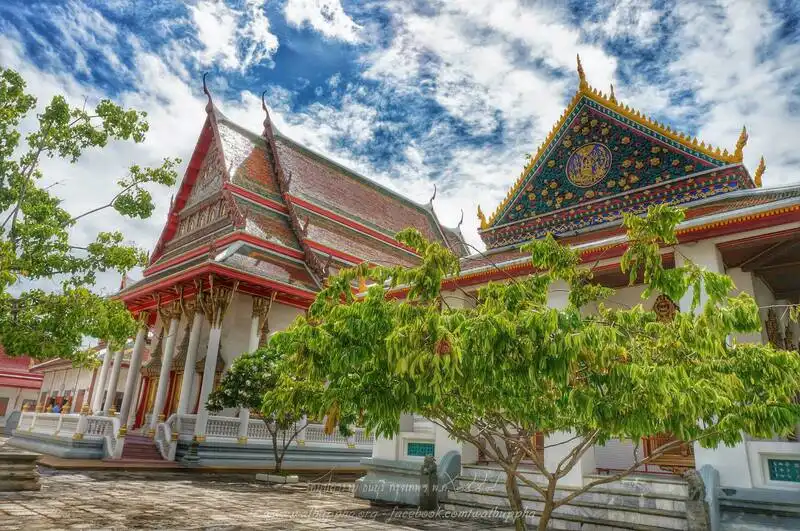
Wat Buppharam Worawihan (Wat Dokmai)If you want a Thonburi-side temple with a long historical timeline—the kind that can “tell the story of Bangkok through one place”—Wat Buppharam Worawihan (Wat Dokmai) is one of those temples where peace and the past feel inseparable. The temple began as an ancient monastery dating back to the Ayutthaya period. Its original name was “Wat Dokmai” (Flower Temple), and there is no clear evidence of who founded it. For a time it became abandoned, before gradually being revived through faith and the support of influential figures in the kingdom, eventually returning as a royal temple and once again becoming a community center along the canal network on the Thonburi side.
In the early Rattanakosin era during the reign of King Rama III, the temple underwent an important restoration led by Than Ying Chan, the principal wife of Somdet Chao Phraya Borom Maha Prayurawong (Dis Bunnag), because the temple was located near her residence. Later, toward the end of Rama III’s reign (B.E. 2391 / 1848 CE), Somdet Chao Phraya Borom Maha Sri Suriyawong (Chuang Bunnag) and Chao Phraya Thipakorawong (Kham Bunnag) carried out a major renovation. It is said that the temple had to be “rebuilt almost entirely” because the older structures were too deteriorated to restore in place. That restoration also received support from King Mongkut (Rama IV), who later bestowed the new name “Wat Buppharam,” the name still used today.
Another layer that makes Wat Buppharam especially interesting is the role of the Dhammayut order after the temple’s restoration. Somdet Chao Phraya (Chuang Bunnag) requested a Dhammayut monastic community from King Mongkut to take up residence and care for the temple, and the temple was then presented as a royal monastery. In an important period, Phra Amornmoli (Nop Phutthisanha Thera) served as the leading monk. This history means the temple was not simply a “temple near an elite household,” but a religious space with structure and continuity that connects clearly to broader transitions in Thai Buddhist history and the era’s changing society.
If you enjoy walking through temples and paying attention to details, the key permanent structures mentioned in records of the major restoration include the viharn, the ubosot, the sermon hall, historic brick residences (both two-story and single-story), and the temple walls. As you take in the overall layout, you can almost feel the “energy of rebuilding” that brought the temple back to strength and form. The charm of a temple like this is that it isn’t trying to be a museum; it is a living place—maintained, repaired, and actively used—with the flow of community life moving through it continuously.
However, Wat Buppharam also faced a heavy chapter in more recent history. During World War II, on 5 June B.E. 2487 (1944 CE), the temple was damaged by bombing. The ubosot, historic brick residences, sermon hall, and the temple walls were severely harmed beyond practical repair. Later, Phra Thamma Woralangkara (Klom Anupasa Thera), who was the abbot at the time, oversaw the rebuilding of the ubosot, sermon hall, monks’ quarters, and the walls. What you see today is therefore a kind of “lesson in restoration”—a reminder that the temple did not merely survive, but was actively rebuilt so it could return as a spiritual anchor for the neighborhood.
One of the clearest features of the rebuilt ubosot is the gable design, formed as the “Maha Suriyamonthon” emblem. The door and window arches and panels also incorporate important motifs such as the Maha Phichai Mongkut form and the Bua Kaew emblem. After the new ubosot was completed, the temple held a boundary consecration ceremony (phuk phatthasima) because the construction site had been moved from its original location. On 6 May B.E. 2507 (1964 CE), His Majesty King Bhumibol Adulyadej and Her Majesty the Queen presided over the ceremony. This moment is part of why Wat Buppharam is not only an old temple, but also a temple with a remembered “milestone of renewal” in modern Thai history.
In community life, Wat Buppharam continues to serve as a center for merit-making and Thai Buddhist traditions that follow the rhythm of the religious calendar—whether weekly observances, kathin ceremonies, pha pa offerings, or local community service activities. If you plan to visit, it’s worth walking slowly. Temples with deep layers of history tend to hide their details in quiet corners, and the slower you move, the more you can read the changing story of the city through the temple’s space.
Getting There The temple is on the Thonburi side of Bangkok and can be reached by both private car and public transport. If traveling by BTS, plan to get off in a Thonburi-side area where it’s convenient to connect toward the Wat Kalayanamit–Arun Ammarin zone, then continue by taxi or motorcycle taxi to Wat Buppharam. If driving, search for “Wat Buppharam Worawihan” on your map and allow extra time in the morning and evening, as some Thonburi roads can be slow—especially on merit-making days or during after-work hours.
| Place Name | Wat Buppharam Worawihan (Wat Dokmai) |
| Location | Thonburi, Bangkok (Wat Kalayanamit – Arun Ammarin Zone) |
| Key Characteristics | An ancient temple originally called Wat Dokmai (Ayutthaya period), heavily restored in the late reign of Rama III and renamed “Wat Buppharam” in the reign of Rama IV; later damaged during World War II before being rebuilt and returning as a strong community center |
| Period | Ayutthaya → Early Rattanakosin (Major Restoration in Rama III) → Renamed in Rama IV → Rebuilt After B.E. 2487 (1944 CE) |
| Highlights / Key Evidence | Ubosot (gable with Maha Suriyamonthon emblem), door/window arches and panels with Maha Phichai Mongkut form and Bua Kaew emblem, key permanent structures associated with major restoration, and traces of post-WWII rebuilding |
| Current Status | Open for worship and visits during operating hours, with ongoing community and temple activities |
| Contact Number | 02-465-2148 |
| Nearby Attractions (Distance) | Wat Prayurawongsawat Worawihan (0.5 km) Wat Kalayanamit Woramahawihan (1.3 km) Wat Arun Ratchawararam Ratchawaramahawihan (2.0 km) Pak Khlong Talat (2.4 km) ICONSIAM (2.8 km) |
| Popular Restaurants Nearby (Distance + Phone) | Khao Mon Zaab, Arun Ammarin 5 (0.3 km) Tel. 083-275-0962 Crispy Chicken Noodles, Lat Ya – Arun Ammarin Area (1.6 km) Tel. 094-596-5528 Wang Lang Market Restaurants (Wang Lang Zone) (2.6 km) Tel. 02-411-0864 Jae Ouan, Large Shellfish Hot Plate (Wang Lang Zone) (2.8 km) Tel. 099-225-2868 Made-to-Order Food at the Corner of Soi Buppharam (0.6 km) Tel. 094-596-5528 |
| Popular Accommodations Nearby (Distance + Phone) | Millennium Hilton Bangkok (2.9 km) Tel. 02-442-2000 ibis Bangkok Riverside (3.4 km) Tel. 02-659-2888 The Peninsula Bangkok (3.8 km) Tel. 02-020-2888 Avani+ Riverside Bangkok Hotel (7.0 km) Tel. 02-431-9100 Anantara Riverside Bangkok Resort (8.0 km) Tel. 02-476-0022 |
Frequently Asked Questions (FAQ)
Q: Is Wat Buppharam Worawihan open every day?
A: Generally, yes. Morning to early afternoon is ideal for a comfortable walk and a calmer atmosphere.
Q: What are the opening hours of Wat Buppharam Worawihan?
A: Generally 07:00 – 17:00.
Q: What was Wat Buppharam originally called?
A: It was originally called “Wat Dokmai” and dates back to the Ayutthaya period.
Q: What should I not miss at Wat Buppharam?
A: The story of the major restoration in the late reign of Rama III, the renaming in the reign of Rama IV, the post-WWII rebuilding history, and the ubosot details—especially the gable and the door/window motifs.
Q: How much time should I plan for a visit?
A: Plan at least 1–2 hours. If you like reading history and looking closely at architectural details, you may want longer.
Q: What should I wear when visiting Wat Buppharam?
A: Dress modestly. Avoid very short or overly tight clothing, and keep quiet—especially around the ubosot.
Tel : 024667046
 Tel : 024667046
 Category: ●Places of Worship
 Group: ●Temple
Last Update : 9 MonthAgo
 Last Update : 9 MonthAgo
 Click to Access the Navigation Map GPS
Wat Buppharam Worawihan (Wat Dokmai) Map
Recommend

 Art, Culture and Heritage
 Historical Sites and Monuments(3)
 Landmarks and Memorials(23)
 Royal Palace(13)
 Art, Craft Centres, Tradition(35)
 Museums(59)
 Historic Homes and Cities(3)
 Art Gallery(16)
 Educational Places
 Museum for Study(6)
 Library(4)
Temple(72)
Library(4)
Temple(72)
 Church(2)
 Mosque(67)
 Other Sacred Sites(8)
 Research and Development
 Royal Project(1)
 Suburban Living
 Village, Community(5)
 Local Market(9)
 Floating Market(2)
 Nature and Wildlife
 River, Canal(3)
 Bays and Beaches(1)
 Other natural attractions(1)
 Entertainment and Agricultural
 Zoos and Aquariums(5)
 Animal camps and shows(5)
 Stadium(9)
 Farms, Parks and Ecotourism(20)
 Amusement Park(1)
 Waterpark(4)
 Theater(7)
 Cinema(1)
 Shopping
 Shopping and Night Market(20)
 Department Store(7)
 Spas and Wellness
 Spas and Wellness(1)
 Restaurant
 Michelin Star(5)
 Accommodation
 Hotel(3)
 Call Customer Service in Tourism
 Call Customer Service in Tourism(1)
 Travel Articles, Recipes
 Travel Review, Food Review(41)
 Royal Thai Desserts and Recipes(56)


