
 Home
Home North(
 Chiang Mai(


Wat Ratchaphatikaram
Rating: 3.6/5 (5 votes)
 Search By
  Map
Map
 Have Map
  No Map
Bangkok attractions
Attractions in Thailand
Open Days: Generally open daily (it’s best to call ahead, especially if you wish to enter the ordination hall during ceremonies)
Opening Hours: Generally 08:00 – 17:00 (access to the ordination hall may be limited during chanting/ritual periods; please call to confirm)
Wat Ratchaphatikaram is a royal monastery in Bangkok’s Dusit area where the name isn’t just decorative—it’s basically the temple’s origin story. This temple was created through a “phatikam” act of replacement and restoration: rebuilding a renewed center of faith in place of an earlier temple that had fallen into abandonment until almost nothing of it remained. In the past, the site was known as Wat Som Kliang, located around the Vietnamese community behind Saint Gabriel’s College. Over time it became deserted, and local accounts describe how bricks from the old ruins were taken away for other construction, leaving very little trace of the original temple.
Later, King Nangklao (Rama III) granted royal support for a new temple to be built. The project was undertaken by Prince Isaret Rangsansan (later King Pinklao in the line of the Front Palace tradition), who built a “new temple” as a phatikam replacement for Wat Som Kliang and bestowed the new name “Wat Ratchaphatikaram.” The name conveys the idea of a temple made prosperous through a royal act of replacement—reviving and renewing what had been lost. Construction began in 1836 (B.E. 2379), and the temple was later registered as a royal monastery.
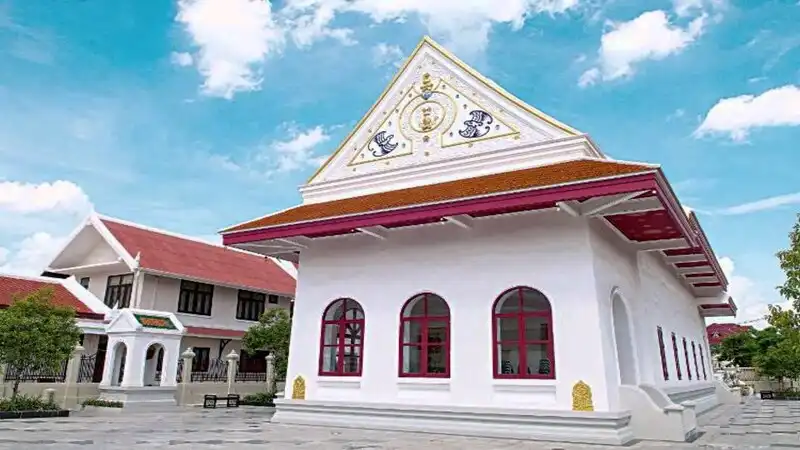
What gives Wat Ratchaphatikaram its unmistakable character is the ordination hall architecture, which blends Chinese and Vietnamese influences and deliberately avoids the typical Thai roof finials (such as chofa and bai raka) that many visitors expect. This reflects early Rattanakosin tastes from the reigns of Rama III to Rama IV, a period when Siam’s close relations and cultural exchange with China brought Chinese artistic elements into temple design and craftsmanship. There is also a tradition that Vietnamese artisans from the local community took part in constructing the ordination hall, which helps explain why the sculptural details and the ceiling paintings inside have such a distinct personality—and why they remain visible to this day.
Construction initiated in the reign of Rama III was not fully completed before his passing. In the reign of Rama IV, restoration and continuation followed under the patronage of the Front Palace, led by Krom Phra Ratchawang Bowon Wichaichan when he held the title Krom Muen Chanchai Bowonyot. Work continued into the early reign of Rama V, when the temple grounds were organized more systematically. Monastic residential structures affected by the cutting of Ratchawithi Road (historically known as Sanghi) were relocated to the north, and boundary walls were built to clearly define the temple precinct. Seen this way, the temple becomes a place that “grew alongside the city”—not merely a religious complex, but part of Bangkok’s evolving urban fabric across different eras.
The spiritual heart of the temple is the principal Buddha image in the ordination hall, known to devotees as Luang Pho Suk. This image follows Chiang Saen–Vientiane (Lao) artistic traditions, with a lap width of 69 cm and a height of 165 cm. It was cast in bronze described as “three kings” alloy, and features inlaid silver linework along the robe edges. The name “Suk” is associated with the warm, lustrous coppery-gold tone of the lips. In terms of form—from the ushnisha and facial contours to the base—it is often noted as sharing similarities with Luang Pho Sai of Nong Khai and Luang Pho Soem at Wat Pathum Wanaram in Bangkok. For many visitors, Luang Pho Suk stands out as both a revered sacred object and a historically significant Buddhist image.
Wat Ratchaphatikaram has been repaired and maintained over time, with a major restoration carried out from 1973 to 1974 (B.E. 2516–2517), carefully preserving the original style throughout. In later years, significant events further connected the temple to royal tradition and Buddhist devotional practice, including the enshrinement of royal remains associated with Rama IV and Rama V behind the ordination hall in 1994 (B.E. 2537). The temple also undertook the creation and enshrinement of large numbers of Buddha amulets as offerings and acts of gratitude, especially in remembrance of Somdet Phra Maha Wirawong (Win Dhammatharo, P.Th. 9), whose abbacy is widely associated with extensive building and restoration that helped the temple gain broader recognition.
As a Bangkok destination, the appeal of Wat Ratchaphatikaram lies in how it carries “city history” within its walls: traces of the old Vietnamese community, the idea of rebirth through phatikam replacement, and the Chinese–Vietnamese aesthetic that makes the ordination hall feel different from more familiar Thai temple silhouettes. It suits visitors who want a temple experience that is both devotional and quietly historical—especially if you prefer places that aren’t famous because they’re grand, but because they reward careful observation.
Getting There The temple is located on Ratchawithi Road in Bangkok’s Dusit District. Reaching the area is generally convenient for a city trip: visitors commonly come by private car, taxi, motorcycle taxi, or public buses that pass through the Dusit–Ratchawithi corridor. If you plan to enter the ordination hall specifically, it’s a good idea to call ahead to confirm suitable times, as access may be limited during ceremonies or chanting periods.
| Name | Wat Ratchaphatikaram (Royal Monastery) |
| Location | Ratchawithi Road, Wachira Phayaban Subdistrict, Dusit District, Bangkok |
| Key Characteristics | A temple created through “phatikam” replacement; Chinese–Vietnamese influenced ordination hall; principal Buddha image “Luang Pho Suk” in Chiang Saen–Vientiane style |
| Period | New temple construction began in 1836 (B.E. 2379, Rama III), with restorations continuing through Rama IV to early Rama V; major restoration in 1973–1974 (B.E. 2516–2517) |
| Key Evidence | Chinese–Vietnamese ordination hall form; ceiling paintings; Luang Pho Suk; records of the 1973–1974 major restoration and later significant events behind the ordination hall |
| Name Origin | “Ratchaphatikaram” refers to a temple made prosperous through a royal act of “phatikam” replacement, rebuilding in place of the former Wat Som Kliang |
| Travel | Accessible by private car, taxi, motorcycle taxi, and buses along the Dusit–Ratchawithi corridor; call ahead if you wish to enter the ordination hall |
| Current Status | An active community temple and a place for worship in the Dusit area |
| Contact Number | 02-243-5322 |
| Nearby Tourist Attractions with Distance | Wat Devaraj Kunchorn Worawihan — approx. 2.2 km — 02-281-2430 Wat Benchamabophit Dusitvanaram Ratchaworawihan — approx. 2.8 km — 092-939-5646 National Library (Tha Wasukri) — approx. 3.2 km — 02-280-9828 Wat Ratchathiwat Ratchaworawihan — approx. 4.6 km — 02-241-4679 Wat Intharawihan (Royal Monastery) — approx. 5.1 km — 02-282-0461 |
| Popular Restaurants Nearby with Distance | Steve Cafe & Cuisine (Thewet) — approx. 2.6 km — 02-281-0915 Krua Apsorn (Samsen Branch) — approx. 3.6 km — 082-292-0431 Pad Thai Thewet — approx. 3.1 km — 081-646-6154 DEVES EAT by sodasilly (Thewet Steak) — approx. 3.2 km — 080-448-6682 Samsen Villa (Phaya Thai) — approx. 4.9 km — 089-795-8801 |
| Popular Accommodations Nearby with Distance | The Raweekanlaya Bangkok Wellness Cuisine Resort — approx. 2.7 km — 02-628-5999 The Siam Hotel — approx. 3.8 km — 02-206-6999 Praya Palazzo — approx. 5.8 km — 02-883-2998 Royal Princess Larn Luang — approx. 6.3 km — 02-281-3088 Siam@Siam Design Hotel Bangkok — approx. 7.6 km — 02-217-3000 |
Frequently Asked Questions (FAQ)
Q: Which area of Bangkok is Wat Ratchaphatikaram in?
A: It is in the Dusit area on Ratchawithi Road, near the historic Vietnamese community zone and Saint Gabriel’s College, making it easy to include in a city itinerary.
Q: Why is it called “Wat Ratchaphatikaram”?
A: The name refers to a temple made prosperous through a royal act of “phatikam” replacement—rebuilt in place of the former Wat Som Kliang after the old site became abandoned.
Q: What is the temple’s architectural highlight?
A: The ordination hall blends Chinese and Vietnamese influences and does not use the typical Thai roof finials, giving the building a distinctly different silhouette and atmosphere.
Q: What kind of Buddha image is “Luang Pho Suk”?
A: It is the principal Buddha image in the ordination hall, in Chiang Saen–Vientiane style, cast in bronze with inlaid silver linework. The name “Suk” relates to the warm, lustrous tone of the lips.
Q: If I want to enter the ordination hall, what should I do?
A: It’s best to call ahead to confirm suitable times, as access may be limited during ceremonies or chanting periods.
Q: Who is this temple best suited for?
A: It suits visitors who want a devotional stop in the city and those who enjoy reading Bangkok’s history through architecture—from the Vietnamese community traces to the “phatikam” rebirth story and the Chinese–Vietnamese aesthetic you can still see on-site.
 Wat Ratchaphatikaram Map
 Category:
  Group:
  Tag: ●Wat Ratchaphatikaram●wat ratchaphatikaram ●wat ratchaphatikaram dusit ●wat ratchaphatikaram history ●wat som kliang ●luang pho suk ●luang pho suk wat ratchaphatikaram ●chinese vietnamese style ordination hall ●dusit temples bangkok ●buddhist temples bangkok ●things to do dusit bangkok Last Update: 3 MonthAgo
Comment
 Nearby Attractions
| Keyword (Advance) |
 Facebook Fanpage
 Region
 Art, Culture and Heritage
 Historical Sites and Monuments(
 Landmarks and Memorials(
 Royal Palace(
 Art, Craft Centres, Tradition(
 Museums(
 Historical Houses and The Ancient City(
 Art Gallery(
 Educational Places
 Museum for Study(
 Library(
 University
 Church(
 Mosque(
 Other religious and spiritural sites(
 Research and Development
 Royal Project(
 Suburban Living
 Village, Community(
 Local Market(
 Floating Market(
 Nature and Wildlife
 River, Canal(
 Bays and Beaches(
 Other natural attractions(
 Entertainment and Agricultural
 Zoos and Aquariums(
 Animal camps and shows(
 Stadium(
 Farm, Parks, Gardens and Ecotourism(
 Amusement Park(
 Waterpark(
 Theater(
 Cinema(
 Shopping
 Shopping and Night Market(
 Department Store(
 Spas and Wellness
 Spas and Wellness(
 Restaurant
 Michelin Star(
 Accommodation
 Hotel(
 Call Customer Service in Tourism
 Call Customer Service in Tourism(
 Travel Articles, Recipes
 Travel Review, Food Review(
 Royal Thai Desserts, Traditional Dessert, Thai Dessert Recipes(
 Copyright 2012,