
 Home
Home North(
 Chiang Mai(


Wat Pathum Wanaram Ratchaworawihan (Wat Sa Pathum)
Rating: 4/5 (6 votes)
 Search By
  Map
Map
 Have Map
  No Map
Bangkok attractions
Attractions in Thailand
Open Days: Daily
Opening Hours: 09:00 – 17:00
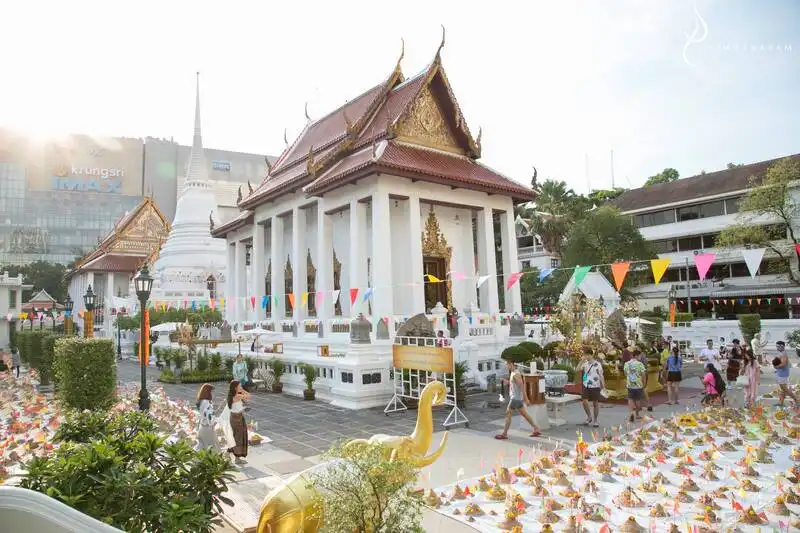
Wat Pathum Wanaram Ratchaworawihan (Wat Sa Pathum) If you’ve ever walked along Rama I Road and felt that this part of Bangkok moves only in a fast, city rhythm, one place that can instantly “slow your heartbeat” is Wat Pathum Wanaram Ratchaworawihan—better known to many as “Wat Sa Pathum.” The temple sits in the Pathum Wan area on Rama I Road, in a position that still feels surprising: right between the world of commerce and the world of faith, near the city’s major shopping districts and Siam Square. Yet once you step past the fence line, the atmosphere turns calm, soft, and grounded, with a “lotus pond” at the heart of the space, exactly as the name Sa Pathum quietly suggests.
Historically, this temple was built during the reign of King Mongkut (Rama IV), alongside a royal garden retreat outside the old city area that was known as “Sa Pathum.” Rama IV ordered the construction of the temple and presented it as a royal gift to Queen Debsirindra (Somdet Phra Thepsirindhra Borommarachini). He also invited Dhammayut monks from Wat Bowonniwet Vihara to reside here. From the beginning, Wat Pathum Wanaram therefore served as an important Dhammayut center in the very heart of the city, reflecting a forward-looking approach to placing temples within Bangkok’s evolving urban landscape.
A story that gives this temple a life beyond the simple phrase “built by Rama IV” is the account that, on certain occasions, Rama IV instructed monks to row boats around the lotus pond inside the temple to receive alms directly from the King himself and from royal consorts. This is more than a charming anecdote—it opens a window onto the relationship between the court, Buddhism, and the lotus-pond landscape that served as a real setting for ritual and daily practice at the time.
An architectural detail worth lingering over is the ubosot, especially its “doors and windows,” which feature stucco reliefs depicting local life: farmers plowing, fishing, and scenes framed by lotus ponds. These details function like a direct record of what the surrounding area was like when the temple was established. They allow today’s visitors to sense that, long before this became a dense commercial district, the Pathum Wan area had a background of agriculture and waterways that was tangible and real.
Beyond the ubosot, the temple’s vihara enshrines two significant Buddha images brought from Vientiane: “Phra Serm” and “Phra Saen.” Their importance goes beyond beauty or age; they anchor the temple in a shared Thai–Lao cultural world along the Mekong region. This becomes even more intriguing when viewed alongside the vihara murals that depict the story of “Si Thananchai” (or “Chiang Mieng”), a witty, humorous trickster tale widely known among Thai and Lao communities. In this way, the sacred space holds not only solemn religious dimensions, but also layers of “folk wisdom” that carry social intelligence through shared storytelling traditions.
The vihara murals are also a clear example of Rama IV-era painting that shows strong Western influence. A particularly striking scene for those interested in Bangkok’s urban history is the “iron bridge” with a wheel mechanism used to pull and open the bridge so boats could pass through. This type of bridge has since disappeared entirely. The painting therefore functions like a visual document of early Bangkok infrastructure—when the city still revolved heavily around waterways and boat travel—before urban form shifted more decisively toward roads and rail systems.
Wat Pathum Wanaram’s role extends beyond art into serious Buddhist education. In 1925 (B.E. 2468), Queen Savang Vadhana (Phra Phanvassa Ayika Chao) established a monastic school for Buddhist scripture studies here. Later, the royal remains (ashes) of Prince Mahidol of Songkla, the King’s father, were enshrined in the front section of this monastic school building. This makes the temple both a “place of learning” and a “place of national memory,” closely woven together within a single site.
If you want to visit with a fuller sense of depth, begin by walking around the lotus pond and taking in the overall atmosphere to slow yourself down. Then move to the ubosot to study the stucco details, before continuing to the vihara to spend time with Phra Serm and Phra Saen. After that, follow the murals carefully, especially the iron bridge scene that feels like a “historical photograph” translated into the language of painters. What you take away won’t be only beautiful images, but an understanding that even in the city’s core, Bangkok still keeps layers of time that can be read—if you pause long enough.
Getting There Reaching Wat Pathum Wanaram Ratchaworawihan is very convenient because it sits in Pathum Wan, an area connected by BTS lines and multiple skywalk routes. If you take the BTS, get off at Siam Station and walk onward to the temple in a short distance. You can also plan this as an “inner-city temple visit” and continue on foot to the Ratchaprasong area or the Bangkok Art and Culture Centre in the same route. For the best experience, consider visiting in the morning or late afternoon on weekdays to avoid the heaviest shopping-district crowds, so you can appreciate the temple’s atmosphere and artworks more fully.
| Name | Wat Pathum Wanaram Ratchaworawihan (Wat Sa Pathum) |
| Location | Rama I Road, Pathum Wan Subdistrict, Pathum Wan District, Bangkok |
| Characteristics | A central-city Dhammayut temple with an internal lotus pond; an ubosot decorated with stucco scenes of local rural life; a vihara with Rama IV-era murals and significant Buddha images brought from Vientiane |
| Period | Built in the reign of Rama IV; notable monastic education role established in 1925 (B.E. 2468) |
| Key Sacred Objects | Phra Serm and Phra Saen (brought from Vientiane), enshrined in the vihara |
| Name Origin | Linked to “Sa Pathum,” the lotus pond/royal garden retreat outside the old city area in the Rama IV period |
| Current Status | A royal temple in Bangkok, open for worship and visits |
| Contact Number (Verified) | 02-251-6478 |
| Latest Abbot | Phra Phromwachiraweti (Amorn Yanothayo) |
| Nearby Attractions (Approx. Distance) | Siam Paragon – approx. 1 km CentralWorld – approx. 1 km MBK Center – approx. 1 km Erawan Shrine (Ratchaprasong Intersection) – approx. 1 km Lumphini Park – approx. 3 km |
| Popular Restaurants Nearby (Approx. Distance + Phone) | Somboon Seafood (CentralWorld) – approx. 1 km – 02-090-6602 Nara Thai Cuisine (CentralWorld) – approx. 1 km – 02-613-1658 After You (Siam Paragon) – approx. 1 km – 02-610-7659 Greyhound Café (Siam Center) – approx. 1 km – 02-658-1129 Kouen Sushi Bar (Siam Square One) – approx. 1 km – 061-895-7777 |
| Popular Accommodations Nearby (Approx. Distance + Phone) | Novotel Bangkok on Siam Square – approx. 1 km – 02-209-8888 Pathumwan Princess Hotel – approx. 1 km – 02-216-3700 Centara Grand at CentralWorld – approx. 1 km – 02-100-1234 Siam@Siam Design Hotel Bangkok – approx. 2 km – 02-217-3000 Siam Kempinski Hotel Bangkok – approx. 1 km – 02-162-9000 |
Frequently Asked Questions (FAQ)
Q: What is Wat Pathum Wanaram Ratchaworawihan best known for?
A: It stands out as a Dhammayut temple in the city center with a notably tranquil lotus pond, along with artworks that depict “local life” through stucco reliefs on the ubosot’s doors and windows, and a vihara that enshrines Phra Serm and Phra Saen from Vientiane.
Q: How is this temple connected to King Rama IV?
A: Rama IV ordered its construction and presented it as a royal gift to Queen Debsirindra, and he invited Dhammayut monks from Wat Bowonniwet Vihara to reside here.
Q: Why are the ubosot doors and windows so interesting?
A: Because the stucco designs depict farmers plowing, fishing, and lotus-pond surroundings, reflecting the original landscape and local way of life around Sa Pathum at the time the temple was built.
Q: What are Phra Serm and Phra Saen, and why are they important?
A: They are significant Buddha images brought from Vientiane and enshrined in the vihara, serving as tangible evidence of shared Buddhist art and cultural connections between Thai and Lao communities in the Mekong region.
Q: What is the most convenient way to get to the temple?
A: It’s convenient via the BTS. Get off at Siam Station and walk a short distance. You can also plan a walking route that links Siam–Ratchaprasong–the Bangkok Art and Culture Centre in a single trip.
Q: What are the opening hours and how can I contact the temple?
A: It is generally open for visits during daytime hours, and the verified office contact number is 02-251-6478.
 Wat Pathum Wanaram Ratchaworawihan (Wat Sa Pathum) Map
 Category:
  Group:
  Tag: ●Wat Pathum Wanaram Ratchaworawihan (Wat Sa Pathum)●wat pathum wanaram ●wat sa pathum ●pathum wan temple ●dhammayut temple bangkok ●temple near siam ●temple near centralworld ●bangkok temple rama 1 ●phra serm phra saen ●rama iv era mural ●things to do in siam bangkok Last Update: 3 MonthAgo
Comment
 Nearby Attractions
| Keyword (Advance) |
 Facebook Fanpage
 Region
 Art, Culture and Heritage
 Historical Sites and Monuments(
 Landmarks and Memorials(
 Royal Palace(
 Art, Craft Centres, Tradition(
 Museums(
 Historical Houses and The Ancient City(
 Art Gallery(
 Educational Places
 Museum for Study(
 Library(
 University
 Church(
 Mosque(
 Other religious and spiritural sites(
 Research and Development
 Royal Project(
 Suburban Living
 Village, Community(
 Local Market(
 Floating Market(
 Nature and Wildlife
 River, Canal(
 Bays and Beaches(
 Other natural attractions(
 Entertainment and Agricultural
 Zoos and Aquariums(
 Animal camps and shows(
 Stadium(
 Farm, Parks, Gardens and Ecotourism(
 Amusement Park(
 Waterpark(
 Theater(
 Cinema(
 Shopping
 Shopping and Night Market(
 Department Store(
 Spas and Wellness
 Spas and Wellness(
 Restaurant
 Michelin Star(
 Accommodation
 Hotel(
 Call Customer Service in Tourism
 Call Customer Service in Tourism(
 Travel Articles, Recipes
 Travel Review, Food Review(
 Royal Thai Desserts, Traditional Dessert, Thai Dessert Recipes(
 Copyright 2012,