

 Home
Home Chiang Mai(










Mon Ngo Royal Project Development Center
Rating: 4/5 (6 votes)
 Search By
  Map
Map 
 Have Map
  No Map
Chiang Mai attractions
Attractions in Thailand
Open Days: Monday–Friday
Opening Hours: 08.00–16.30
Mon Ngo Royal Project Development Center is a Chiang Mai getaway that feels like you’re traveling and watching real community development happen in the same place. The heart of this destination isn’t just a scenic viewpoint on the mountain—it’s a working area of the Royal Project and royal initiative projects that reshaped local livelihoods to fit the mountains, watershed forests, and the needs of highland communities. It’s ideal for anyone who wants to rest in deep green landscapes while also understanding what agricultural tourism and community development actually look like on the ground.
The center was established in 1985 (B.E. 2528) by Mom Rajawongse Bhisadej Rajani, Chairman of the Royal Project Foundation, following a royal directive for officers to survey the area. At that time, Hmong highland communities were living by clearing forest for shifting cultivation, growing opium and other crops. A development plan was therefore designed to match community needs by promoting alternative crops to replace opium, in cooperation with multiple agencies, so the transition could truly work—in livelihoods, income, and long-term watershed protection.
Geographically, Mon Ngo Royal Project Development Center is located within the Mae Taeng National Reserved Forest. It is responsible for 17 villages and 451 households across 84.27 square kilometers (52,670 rai). Most residents are local people and Hmong. The terrain is mainly hills and complex mountain ranges, with very little flat land. The elevation is roughly 700–1,250 meters above sea level, and the average temperature is about 24°C. This overall setting makes the area suitable for a wide range of crops and perfect for learning what highland agriculture really means—how to live with the mountain, not against it.
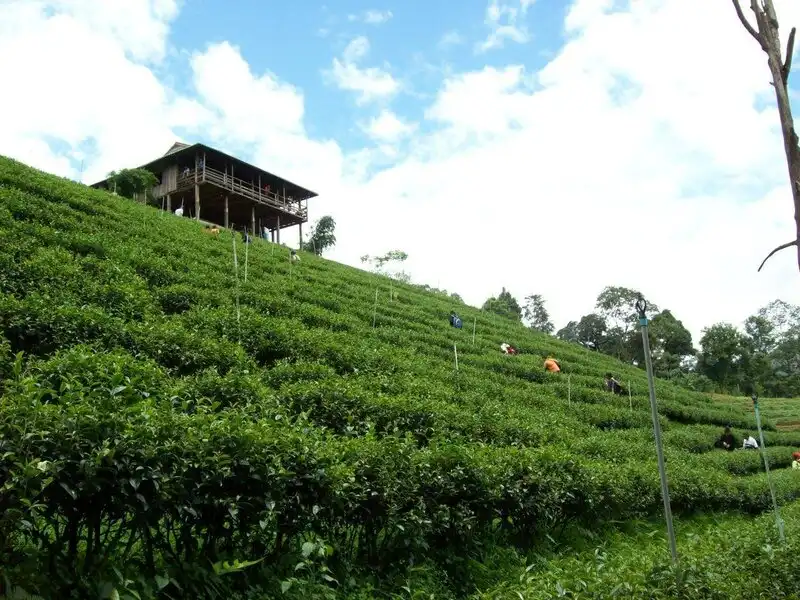
If you come for agricultural tourism, a signature experience is the beautiful view of Lung Dech tea plantations, followed by learning how to brew and taste tea, all the way to understanding tea processing and packaging at the Ban Pong Tong tea factory. It helps you see that a cup of tea doesn’t end at the drink—it begins at the plot, continues through raw-material handling, and becomes a real product that communities can build income from.
Another activity that farm-and-learning lovers often enjoy is visiting closed-system mushroom houses, such as Hungarian oyster mushrooms, Bhutan oyster mushrooms, and cottony mushrooms, along with seasonal promotion plots featuring crops like avocado, Arabica coffee, and Japanese pumpkin. Each visit can feel different because the highlights shift with the season and the mountain’s production cycles.
Beyond that, you can see large Cymbidium orchid plots in many colors, orange orchards tended by local farmers within the Royal Project area, and—for food culture—the harvesting and processing of miang, a local specialty. Watching miang from leaf collection to fermentation and then into dishes is a clear bridge between agriculture and everyday life.
On the nature side, many people consider the Mon Ngo viewpoint the highlight. Sitting at about 1,425 meters above sea level, it offers stunning layered mountain scenery and chances to see seas of mist, as well as sunrise and sunset with an expansive 360-degree panorama. If you arrive early, it becomes obvious why people gladly take the mountain road for this view.
Along the natural route, there are memorable spots such as “Nguak Pha” (a stalagmite formation shaped like a mermaid clinging to a cliff), the “Holy Spring Pool” (a seepage pool inside a cave with water year-round), and “Cliff Blood” (a substance found in rock crevices that locals believe can be used for healing). There is also “Tham Lom” (Wind Cave), where wind blows out continuously—standing at the entrance, you can clearly feel the mountain’s breath.
If you want something more active, another option is adventure rafting at Ban Sob Kai, where you can enjoy rich forest nature, distinctive rock formations, and stories of a massive ancient tree that fell naturally. Activities include bamboo rafting and rubber rafting; bamboo rafts are usually suspended during the rainy season, while rubber rafting can operate year-round depending on water conditions and provider safety management.
Culturally, the area connects with the Hmong New Year tradition known as “Kin Wor,” held during the 1st–3rd waxing days of the first lunar month, which typically falls in January each year. During this period, the community feels especially alive, clearly reflecting identity through clothing, games, and ritual meanings that younger generations are still working to carry forward.
If you visit Ban Mon Ngo, you may see traditional games such as ball tossing and spinning tops, Hmong embroidery, rice pounding with a traditional foot-operated mortar, and even a visit to the home of a former Hmong man once known for having the longest hair in the world—a story many people want to see for themselves. Meanwhile, local lowland communities have their own charm through traditional miang-making knowledge, leaf harvesting (miang and tea leaves), and local dishes such as miang leaf salad, a well-known specialty of the area.
Souvenirs here often revolve around “food with a story”: tea and coffee products, as well as women’s group items like tea-leaf health pillows and bold-flavored chili pastes. There are also carefully forged tools such as knives and hoes known for strength and durability. In addition, you can find local handicrafts like woven and embroidered textiles from Hmong communities, plus seasonal fruits such as avocado, oranges, lychee, and mango, including various processed fruit products.
For accommodation, Mon Ngo Royal Project Development Center offers guesthouses that can host around 15 visitors, as well as rental tents, and visitors may also bring their own tents. This suits travelers who want to sleep in cool highland air, but it’s wise to plan for warm clothing and a flashlight—especially from late year into early year when temperatures drop noticeably.
As for food, there is no restaurant service inside the center. Visitors can buy supplies at Mae Malai Market or pre-order meals with local women’s groups so ingredients can be prepared in advance. Often-recommended dishes include miang leaf salad, dok khae sausage (sai ua with dok khae), and vanilla syrup pumpkin. If you plan to stay overnight, bring drinking water and snacks, because shops are not as frequent on the way up as they are in town.
Getting There: From Chiang Mai city, take Highway 107 (Chiang Mai–Fang) for about 37 km. Before reaching Mae Malai Market and the turn toward Pai by about 2–3 km, you will find the bypass route on Highway 1095. Continue for about 12 km, then take the right-hand junction opposite Wat Sob Poeng, and drive about 17 km into Mon Ngo (the same route toward Wat Pha Ngam).
Practical driving notes: some sections are narrow and steep. Drive at a steady speed, use low gear on descents, and avoid driving at night if you’re not familiar with mountain roads because visibility is low and curves are continuous. In the rainy season, take extra care for slippery surfaces or occasional small landslides. Calling ahead for the latest updates before traveling can reduce risk and make the trip much smoother.
In the end, the charm of Mon Ngo Royal Project Development Center is being in a place where people work with the mountain while respecting it. You can see a community effort to shift from forest-damaging livelihoods to crops that can coexist with the ecosystem, and you can travel in a way that stays “light” on the land. If you visit with respect—keep noise down, leave no trash, and support local products thoughtfully—you’ll have a great trip and the place can remain healthy for those who come after.
| name | Mon Ngo Royal Project Development Center |
| location | Mueang Kai Subdistrict, Mae Taeng District, Chiang Mai 50150 |
| characteristics | Agricultural + nature + cultural tourism; Royal Project learning area; tea plots; closed-system mushroom houses; Cymbidium orchids; miang; sea-of-mist viewpoint |
| established | 1985 (B.E. 2528) |
| elevation | Area roughly 700–1,250 m above sea level (Mon Ngo viewpoint about 1,425 m) |
| open days & hours | Monday–Friday 08.00–16.30 |
| contact number | 095-675-3848 |
| travel (summary) | Highway 107 → bypass Highway 1095 → right junction opposite Wat Sob Poeng → about 17 km into Mon Ngo |
| current status | Open for visits (recommended to call ahead) |
| nearby tourist attractions with distance | Wat Tha Kham (Sob Poeng) — approx. 11.5 km Ban Sob Kai — approx. 10.5 km Mae Ngat Somboon Chon Dam — approx. 23.5 km |
| popular restaurants nearby | Baan Suan Chom Chan (Mae Taeng) — approx. 14.2 km — 053-047-111, 089-433-5819 |
| popular accommodations nearby | Mae Malai Hotel — approx. 16.4 km — 053-842620, 095-6106489 Mon Ngo Lan View Homestay — 093-145-5734 |
| facilities | Learning area / viewpoint / camping area (guesthouse and tents as provided by the center) |
Frequently Asked Questions (FAQ)
Q: Which days and what time is Mon Ngo Royal Project Development Center open?
A: The latest information indicates Monday–Friday, 08.00–16.30. It’s recommended to call ahead at 095-675-3848 before traveling.
Q: What type of vehicle is safest for visiting Mon Ngo?
A: Standard cars can go, but your vehicle should be in good condition (brakes and tires especially), and the driver should be comfortable on steep mountain roads. In the rainy season, be extra cautious about slippery and narrow sections.
Q: Is there a restaurant inside the center?
A: Generally, there is no restaurant service inside the center. Bring supplies, stop at Mae Malai Market, or pre-order meals with local women’s groups in advance.
Q: What are the best activities for learning-focused travelers?
A: Highlights include tea-plot learning, tea brewing and tasting, processing at the tea factory, closed-system mushroom houses, and seasonal crop plots such as avocado, Arabica coffee, and Japanese pumpkin.
Q: When is the best time to see mist at the Mon Ngo viewpoint?
A: Early morning in winter and in the late rainy season into early cool season often offers the best chances. Check weather conditions and plan to arrive before dawn for the best odds.
 Mon Ngo Royal Project Development Center Map
 Category:
  Group:
  Tag: ●Mon Ngo Royal Project Development Center●mon ngo royal project development center ●mon ngo ●royal project ●chiang mai travel ●mae taeng travel ●northern thailand travel ●agro tourism ●viewpoint mon ngo ●hmong village culture ●tea plantation tour Last Update: 2 MonthAgo
Comment
 Nearby Attractions
| Keyword (Advance) |
 Facebook Fanpage
 Region
 Art, Culture and Heritage
 Historical Sites and Monuments(
 Landmarks and Memorials(
 Royal Palace(
 Art, Craft Centres, Tradition(
 Museums(
 Educational Places
 Museum for Study(
 Educational Gardens, Farm(
 Training Center(
 University
 Places of Worship
 Temple(
 Mosque(
 Other religious and spiritural sites(
 Suburban Living
 Village, Community(
 Local Market(
 Nature and Wildlife
 National Parks and Marine Reserves(
 Mountain (Doi)(
 Dam, Reservoir, Lake(
 Waterfalls(
 Hot Springs(
 Caves(
 River, Canal(
 Other natural attractions(
 Entertainment and Agricultural
 Zoos and Aquariums(
 Animal camps and shows(
 Stadium(
 Farm, Parks, Gardens and Ecotourism(
 Waterpark(
 Theater(
 Outdoor and Adventure Activities(
 Shopping
 Shopping and Night Market(
 Restaurant
 Michelin Star(
 Michelin Guide(
 Call Customer Service in Tourism
 Call Customer Service in Tourism(
 Travel Articles, Recipes
 Travel Review, Food Review(
 Food Menu, North Recipes(
 Thai Desserts, North Recipes(
 Copyright 2012,