
lovethailand home >North Travel Attractions >Chiang Mai Travel Attractions >Mae Chaem >Kong Khaek > Wat Kong Khaek
TL;DR: Wat Kong Khaek is located at Kong Khaek Subdistrict, Mae Chaem District, Chiang Mai, open Daily, hours 06.00–18.00.

Wat Kong Khaek
Open Days: Daily
Opening Hours: 06.00–18.00
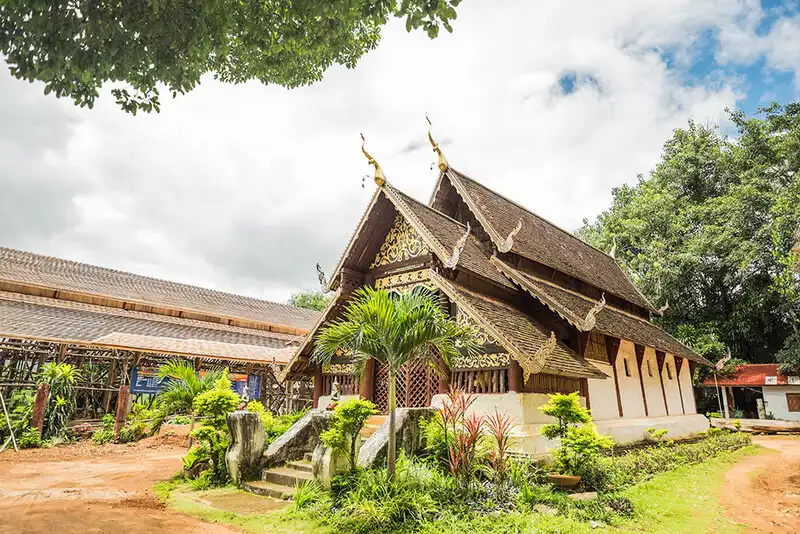
Wat Kong Khaek is a community temple in Mae Chaem District, Chiang Mai Province, whose importance lies in how clearly it reflects local history through art. The temple belongs to Ban Kong Khaek, an old settlement formed by migrants from several regions, including Mae Phrik in Lampang, Chiang Saen in Chiang Rai, Nan, and Chiang Kham. As these groups established a permanent community, religious spaces naturally followed, and Wat Kong Khaek became a shared spiritual center. Today, its wooden viharn and wall paintings stand as tangible evidence of how different traditions merged into a distinctly Mae Chaem identity.
The heart of Wat Kong Khaek is its viharn, believed to be over a century old. Local accounts link its construction to Lampang craftsmen who migrated to the area, bringing with them established skills and stylistic habits. This explains the viharn’s dual character: it carries the discipline and structure of urban-trained craftsmen, while adapting fully to local materials, tastes, and everyday religious use. The result is an architecture that feels both refined and deeply rooted in village life.
The temple’s most celebrated feature is its mural paintings along the upper wall band, known as the “kho song.” These murals form a continuous narrative frieze that circles the interior, guiding viewers through Buddhist stories. Rather than striving for courtly elegance, the painter emphasized clarity and momentum. Brushstrokes are sharp and energetic, with confident flicks that animate figures in scenes of the Buddha’s life, jataka tales, and celestial beings in dance. The lines seem to move, giving the paintings a sense of rhythm rather than static display.
In terms of artistic classification, the murals of Wat Kong Khaek are best understood as Lanna folk painting rather than court or academic styles. The artist’s priority was storytelling that villagers could immediately grasp. Composition favors sequential scenes, simplified backgrounds, and expressive gestures over complex perspective or shading. This visual language functioned effectively in a temple setting, where murals served as moral instruction and narrative guides for an audience that often learned through images rather than texts.
What makes Wat Kong Khaek especially interesting is that its folk character is not isolated or naïve. Compared with Lampang murals—often more orderly and detailed due to Burmese and urban influences—the Kong Khaek paintings relax formal constraints and heighten emotional expression. Faces and postures feel closer to everyday observation, and some roughness in execution appears intentional, helping the story read clearly from a distance. The emphasis is on flow and immediacy rather than perfection.
When compared with Tai Yai (Shan) mural traditions, which often invite viewers to linger over intricate details and layered narratives, Wat Kong Khaek remains firmly grounded in the Lanna folk approach. Here, line quality and movement dominate. The murals encourage viewers to follow the story smoothly around the viharn before returning to notice smaller details embedded in gestures, costumes, and spatial arrangement.
Beyond aesthetics, the murals carry strong anthropological value. Folk painters often unconsciously recorded their own world: clothing styles, hairstyles, modes of worship, dance postures, domestic objects, and even ideas of how humans and celestial beings should appear. These elements turn the viharn walls into a visual archive of Mae Chaem’s cultural landscape at a particular moment in time.
Getting There Wat Kong Khaek is located about 7 kilometers from Mae Chaem town along the Hot–Mae Chaem Road. From Chiang Mai city, travelers typically pass through Hot District before continuing to Mae Chaem. The road is mountainous and winding, so sufficient travel time and careful driving are advised. From Mae Chaem town, follow signs to Kong Khaek Subdistrict. Private vehicles are the most convenient option, while local taxis or hired transport can be arranged within Mae Chaem.
Visitors are encouraged to spend unhurried time inside the viharn. Reading the kho song murals slowly, as if paging through an illustrated manuscript, reveals their depth. To see them more clearly, focus on three aspects: the changing thickness and rhythm of the lines, the dynamic poses of dancers and narrative figures, and the way scenes flow into one another without rigid frames. These qualities show that the murals were created not merely to decorate, but to communicate stories with vitality and human warmth.
| Name | Wat Kong Khaek (Mae Chaem District, Chiang Mai) |
| Location | Kong Khaek Subdistrict, Mae Chaem District, Chiang Mai |
| Highlights | Century-old viharn and kho song murals with sharp, expressive brushwork depicting the Buddha’s life, jataka tales, and dancing celestial beings |
| Period | Lanna folk murals, mid-20th Buddhist century |
| Significance | Important example of Mae Chaem folk painting, reflecting cultural exchange and local identity |
| Travel | About 7 km from Mae Chaem town via the Hot–Mae Chaem Road |
| Current Status | Active community temple; visitors are welcome with respectful attire |
Frequently Asked Questions (FAQ)
Q: What makes the murals at Wat Kong Khaek special?
A: Their energetic brushwork and clear storytelling style represent a distinctive Mae Chaem folk interpretation of Lanna mural traditions.
Q: How do these murals differ from other Lanna temples?
A: They emphasize movement and narrative flow over formal elegance, making the stories easy to read and emotionally engaging.
Q: How much time should I allow for a visit?
A: About 30–60 minutes for focused viewing of the murals, or up to 1–1.5 hours including photography and exploration.
Q: Are there etiquette rules for viewing the murals?
A: Dress modestly, speak quietly, avoid touching the walls, and limit flash photography to help preserve the paintings.
 Category: ●Places of Worship
 Group: ●Temple
Last Update : 9 MonthAgo
 Last Update : 9 MonthAgo
 Click to Access the Navigation Map GPS
Wat Kong Khaek Map
Recommend

 Art, Culture and Heritage
 Historical Sites and Monuments(8)
 Landmarks and Memorials(5)
 Royal Palace(2)
 Art, Craft Centres, Tradition(43)
 Museums(24)
 Educational Places
 Museum for Study(2)
 Educational Gardens, Farm(5)
 Training Center(1)
Temple(79)
Training Center(1)
Temple(79)
 Mosque(2)
 Other Sacred Sites(17)
 Research and Development
 Royal Project(44)
 Suburban Living
 Village, Community(41)
 Local Market(14)
 Nature and Wildlife
 National Parks and Marine Reserves(16)
 Mountain (Doi)(21)
 Dam, Reservoir, Lake(26)
 Waterfalls(43)
 Hot Springs(12)
 Caves(11)
 River, Canal(6)
 Other natural attractions(14)
 Entertainment and Agricultural
 Zoos and Aquariums(2)
 Animal camps and shows(3)
 Stadium(1)
 Farms, Parks and Ecotourism(19)
 Waterpark(2)
 Theater(1)
 Outdoor and Adventure Activities(10)
 Shopping
 Shopping and Night Market(6)
 Restaurant
 Michelin Star(1)
 Michelin Guide(23)
 Call Customer Service in Tourism
 Call Customer Service in Tourism(1)
 Travel Articles, Recipes
 Travel Review, Food Review(15)
 Food Menu, North Recipes(30)
 Thai Desserts, North Recipes(17)


