
lovethailand home >North Travel Attractions >Chiang Mai Travel Attractions >Chai Prakan >Si Dong Yen > Wat Tham Tab Tao
TL;DR: Wat Tham Tab Tao is located at Ban Tab Tao, Sri Dong Yen Subdistrict, Chai Prakan District, Chiang Mai Province (Highway 107, km 120–121, approx. 3 km from junction), open Daily, hours Recommended 08.00–17.00.

Wat Tham Tab Tao
Open Days: Daily
Opening Hours: Recommended 08.00–17.00
Wat Tham Tab Tao is located in Ban Tab Tao, Sri Dong Yen Subdistrict, Chai Prakan District, Chiang Mai Province. The temple lies along the Chiang Mai–Fang route, between kilometer markers 120 and 121, with a left turn leading approximately 3 kilometers into the temple area. This ancient religious site has been associated with the local community for several hundred years and is known for combining a serene forest temple atmosphere with a limestone cave complex that forms the spiritual heart of the site.
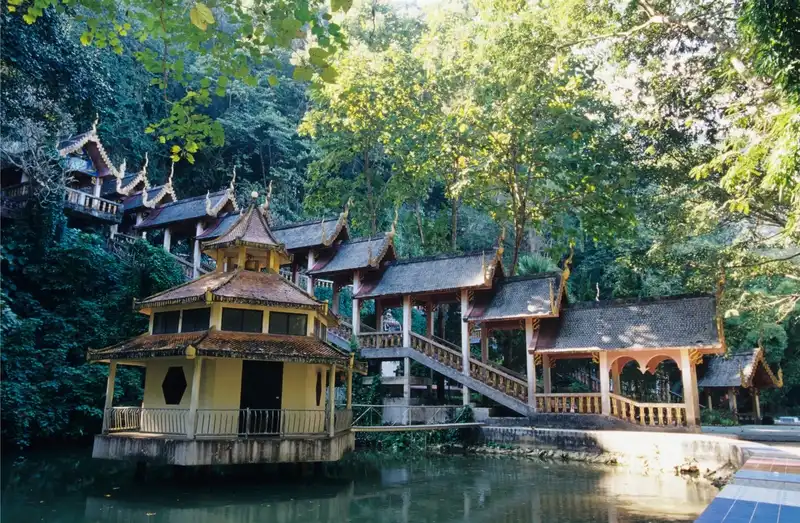
Upon arrival, visitors are greeted by a lush and peaceful environment with shaded resting areas, salas, and monks’ quarters scattered throughout the grounds. One of the most distinctive features of the temple is the Tripitaka Library Hall built in the middle of a pond, which enhances the tranquil atmosphere and encourages visitors to slow down before exploring the caves and hillside pathways.
The main highlight of Wat Tham Tab Tao is Tham Tab Tao Cave. Although smaller in scale than Chiang Dao Cave, it is widely regarded as equally beautiful. Inside, visitors will find natural limestone formations, softly lit chambers, and Buddha images enshrined for worship. The cave complex is traditionally described as consisting of two main sections: Tham Pha Khao and Tham Panjek, each offering a different experience in terms of light, space, and atmosphere.
Tham Pha Khao is generally considered more accessible, with stairways leading to a relatively open chamber illuminated by natural light filtering through openings in the mountain. Buddha images and religious elements are arranged along the route, allowing visitors to pay respects with ease. In contrast, Tham Panjek provides a deeper and more rugged experience, featuring narrower passages and darker interiors. Visitors are advised to bring a flashlight and proceed with caution, especially during or after the rainy season when surfaces may become slippery.
Beyond its natural appeal, Wat Tham Tab Tao carries layers of historical narrative. Although there is no definitive evidence indicating the exact period of its founding, local interpretations are drawn from architectural remains and important Buddha images within the temple. Most notable is a large reclining Buddha statue said to be over 9 meters in length, constructed from brick and mortar, coated with lacquer resin, and gilded with gold leaf. This style has been associated by some with Ayutthaya-period artistic influence, and the current abbot has suggested it may date to the reign of King Ekathotsarot.
Local oral traditions further connect the site to military movements in the early 17th century, particularly around 1592 CE. Elders in the community recount that Tham Tab Tao may once have served as a resting place for troops during campaigns passing through the mountainous routes of northern Thailand. While such accounts remain within the realm of local legend rather than documented history, they reflect the longstanding perception of the area as a strategic and spiritually significant point along mountain and border routes.
The surrounding landscape reinforces this perspective. The temple sits at the foothills of the Tab Tao mountain range, part of a chain of rugged hills separating Chai Prakan District from Chiang Dao District and forming part of the broader mountainous boundary between Thailand and Myanmar. This geography has shaped both travel routes and cultural exchange in the region for centuries.
An intriguing aspect of the site lies in its name. “Tab Tao” is believed to be a linguistic evolution of the word “Dap Tao,” meaning the extinguishing of ashes after forest fires. Over time, local pronunciation shifted, eventually becoming “Tab Tao.” For outsiders unfamiliar with the original meaning, the name came to be understood literally as “animal liver,” giving rise to the modern interpretation of “Tham Tab Tao.” This evolution reflects how place names in northern Thailand often preserve traces of environmental history and linguistic change.
Historical interest in the cave is further supported by accounts involving a Norwegian explorer named Mr. Carl Bock, who surveyed natural sites in Lanna during the late 19th century. His writings reportedly described the cave as a religious site of significance for over a century, noting the presence of a large reclining Buddha statue constructed of brick and plaster, coated with lacquer and gold leaf, which had already begun to deteriorate with age. Such external observations reinforce the idea that Wat Tham Tab Tao has long been recognized as a place of spiritual importance.
Getting There From Chiang Mai city, take Highway 107 toward Fang and Chai Prakan District. Between kilometer markers 120 and 121, turn left toward Ban Tab Tao and continue approximately 3 kilometers to reach the temple. The final stretch follows local roads through the community. Visitors should drive carefully, allow sufficient travel time, and prepare appropriate footwear, a flashlight, and drinking water if planning to explore the caves, particularly during the rainy season.
| Place Name | Wat Tham Tab Tao |
| Location | Ban Tab Tao, Sri Dong Yen Subdistrict, Chai Prakan District, Chiang Mai Province (Highway 107, km 120–121, approx. 3 km from junction) |
| Open Days | Daily |
| Opening Hours | Recommended 08.00–17.00 |
| Key Features | Forest temple setting, Tripitaka Library Hall in a pond, Tham Tab Tao Cave with Buddha images (Tham Pha Khao / Tham Panjek) |
| Period / Era | Exact founding period unknown; believed to be several hundred years old based on structures and local tradition |
| Important Evidence | Large reclining Buddha statue (approx. 9 m long) and the two main cave sections forming the religious core |
| Name Origin | Derived from “Dap Tao,” meaning extinguishing ashes after forest fires, later evolving linguistically into “Tab Tao” |
| Access | Chiang Mai – Chai Prakan via Highway 107; turn off at km 120–121 and continue approx. 3 km |
| Current Status | Open for worship and cave exploration (weather conditions should be checked during rainy season) |
| Contact Phone | +66 53 248 604 |
| Facilities | Parking area, resting salas, shaded grounds (flashlight recommended for cave visits) |
| Fees | No official entrance fee; donations welcome |
| Nearby Attractions (with distance) | Hinoki Land (approx. 3–5 km) Mae Thalop Reservoir (approx. 6–8 km) Doi Wiang Pha National Park (approx. 8–10 km) Kad Mueang Phi (approx. 4–6 km) Wat Chao Phrom Maharaj (approx. 9–11 km) |
| Popular Restaurants Nearby (distance + phone) | Ton Ta Kob Restaurant (approx. 8–12 km), Tel. 081-980-6759 Ko Lak Restaurant, Chai Prakan (approx. 6–10 km), Tel. 081-582-4444 Kusumacafe & Restaurant (approx. 10–15 km), Tel. 053-451-343, 089-999-7488 Je Meiy Yunnan Hot Pot (Fang–Ang Khang route) (approx. 35–55 km), Tel. 081-366-3010 Cafe de Mamana (approx. 10–15 km), Tel. 097-965-2628 |
| Popular Accommodations Nearby (distance + phone) | Thung Bua Din Homestay (approx. 5–8 km), Tel. 065-591-1468 Saeng Chan Resort, Chai Prakan (approx. 10–15 km), Tel. 088-2511-452 Happy Home Resort (approx. 10–18 km), Tel. 053-998-348 Saimoonbury Resort (approx. 10–20 km), Tel. 053-870-410, 081-884-0286 Baan Suan Ongun Sirisuk (The Room Sirisuk Vineyard Chai Prakan) (approx. 10–18 km), Tel. 092-398-8884, 098-750-0115, 086-919-9542 |
Frequently Asked Questions (FAQ)
Q: Is Wat Tham Tab Tao open every day?
A: Yes, it is generally open daily. Visiting between 08.00 and 17.00 is recommended for comfortable cave exploration.
Q: How many cave sections are there at Tham Tab Tao?
A: The site is traditionally described as having two main sections: Tham Pha Khao, which is brighter and easier to access, and Tham Panjek, which is deeper and darker.
Q: How does Tham Tab Tao compare to Chiang Dao Cave?
A: It is smaller in size but equally charming, with limestone formations, natural light zones, and Buddha images, making it ideal for a relaxed 1–2 hour visit.
Q: Where does the name “Tab Tao” come from?
A: The name evolved from “Dap Tao,” meaning extinguishing ashes after forest fires, which later transformed linguistically into “Tab Tao.”
Q: Who should be contacted for additional information?
A: Inquiries can be made by phone at +66 53 248 604.
 Category: ●Places of Worship
 Group: ●Temple
Last Update : 9 MonthAgo
 Last Update : 9 MonthAgo
 Click to Access the Navigation Map GPS
Wat Tham Tab Tao Map
Recommend

 Art, Culture and Heritage
 Historical Sites and Monuments(8)
 Landmarks and Memorials(5)
 Royal Palace(2)
 Art, Craft Centres, Tradition(43)
 Museums(24)
 Educational Places
 Museum for Study(2)
 Educational Gardens, Farm(5)
 Training Center(1)
Temple(79)
Training Center(1)
Temple(79)
 Mosque(2)
 Other Sacred Sites(17)
 Research and Development
 Royal Project(44)
 Suburban Living
 Village, Community(41)
 Local Market(14)
 Nature and Wildlife
 National Parks and Marine Reserves(16)
 Mountain (Doi)(21)
 Dam, Reservoir, Lake(26)
 Waterfalls(43)
 Hot Springs(12)
 Caves(11)
 River, Canal(6)
 Other natural attractions(14)
 Entertainment and Agricultural
 Zoos and Aquariums(2)
 Animal camps and shows(3)
 Stadium(1)
 Farms, Parks and Ecotourism(19)
 Waterpark(2)
 Theater(1)
 Outdoor and Adventure Activities(10)
 Shopping
 Shopping and Night Market(6)
 Restaurant
 Michelin Star(1)
 Michelin Guide(23)
 Call Customer Service in Tourism
 Call Customer Service in Tourism(1)
 Travel Articles, Recipes
 Travel Review, Food Review(15)
 Food Menu, North Recipes(30)
 Thai Desserts, North Recipes(17)


