
lovethailand home >North Travel Attractions >Chiang Mai Travel Attractions >Muang Chiang Mai >Chang Khlan > Wat Chang Kong
TL;DR: Wat Chang Kong is located at Loi Kroh Road, adjacent to Kamphaeng Din Road, Mueang Chiang Mai District, Chiang Mai Province, open Daily, hours 08.00–17.00.
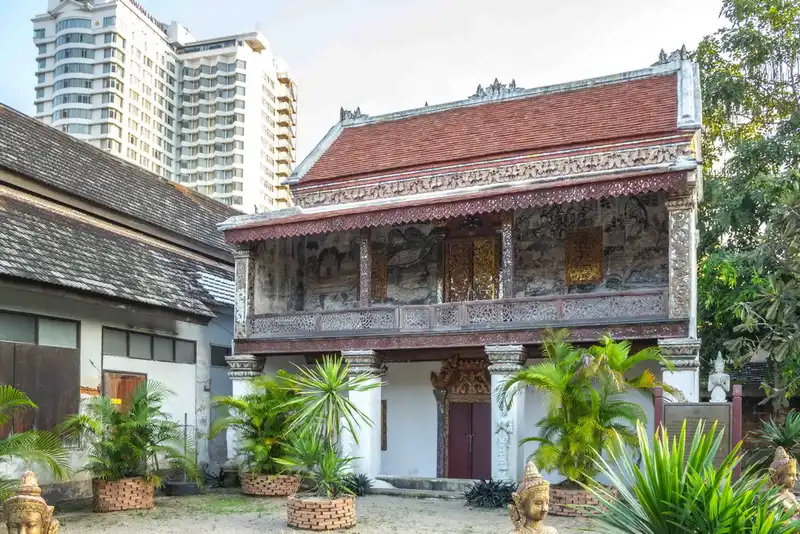
Wat Chang Kong
Open Days: Daily
Opening Hours: 08.00–17.00
Wat Chang Khong is a historic temple in Chiang Mai that reflects the story of traditional artisan communities and the migration of people from the Mekong River region into Lanna. The temple is located on Loi Kroh Road, adjacent to Kamphaeng Din Road, in an area that once formed an important settlement zone outside the old city walls. Its location illustrates how Chiang Mai gradually expanded from the inner moat area toward commercial and craft districts in the past.
Reaching Wat Chang Khong is straightforward and also offers insight into the city’s historical layout. From Tha Phae Gate, turn left onto Kachasan Road, then turn left again onto Loi Kroh Road. Upon reaching the intersection, turn left onto Kamphaeng Din Road. The temple is located on the left-hand side. This route closely follows the traditional paths that once connected the old city with surrounding artisan neighborhoods.
According to historical records, Wat Chang Khong was founded in 1900 CE by the Chang Khong community, a group of skilled artisans who migrated from Chiang Saen during the early Rattanakosin period. This migration was driven by political and social changes in the Upper Mekong region, leading many craftsmen to resettle in Chiang Mai. The name “Chang Khong” refers to gong makers, reflecting the community’s expertise in metalwork and the production of gongs, which played an important role in Lanna music and ritual life.
As a result, Wat Chang Khong is more than a neighborhood temple. It represents a sacred space where religion, craftsmanship, and community identity are deeply intertwined. Naming the temple after the occupation of its founders provides valuable evidence of the social role played by artisan groups in early Chiang Mai. The temple served as a spiritual center, a communal gathering place, and a setting for the transmission of craft knowledge across generations.
The most distinctive architectural feature of Wat Chang Khong is its ho trai, or scripture library. This two-story structure stands out from typical temples in Chiang Mai due to its elaborate decoration. The building is adorned with intricate stucco reliefs and delicately carved wooden panels, showcasing the high level of skill possessed by local craftsmen. The artistic style represents a blend of Chinese and Burmese influences, reflecting cultural exchange through trade and regional interaction during the late Lanna and early Rattanakosin periods.
The ho trai is elevated above ground level in accordance with traditional Lanna beliefs, protecting sacred Buddhist scriptures from moisture and pests. Beyond its practical function, the raised structure symbolizes the importance of the Tripitaka as the foundation of Buddhist teachings. The decorative motifs not only enhance the building’s visual appeal but also express the community’s openness to external influences, which were adapted and harmonized with local traditions.
On the exterior walls of the ho trai are mural paintings depicting the Ten Great Lives of the Buddha (Phra Chao Sip Chat), created by local folk artists. These murals narrate the final ten incarnations of the Bodhisattva before attaining enlightenment. The style is simple yet expressive, capturing the beliefs, worldview, and aesthetic sensibilities of local artisans. Remarkably, the murals remain well preserved, making Wat Chang Khong one of the few places in Chiang Mai where traditional folk mural art can still be seen in its original context.
Although Wat Chang Khong is not large or architecturally grand compared to major temples in Chiang Mai, its charm lies in its human-scale setting and the stories embedded within its structures. Situated close to popular areas such as Loi Kroh Road and the Chiang Mai Night Bazaar, the temple retains a quiet and reflective atmosphere. It is particularly well suited for travelers who wish to explore Chiang Mai beyond its main attractions and discover layers of local history rooted in everyday community life.
| Name | Wat Chang Khong |
| Location | Loi Kroh Road, adjacent to Kamphaeng Din Road, Mueang Chiang Mai District, Chiang Mai Province |
| Key Characteristics | Historic artisan community temple, two-story ho trai, Chinese–Burmese artistic influence, folk murals of the Ten Great Lives |
| Period | Late Lanna / Early Rattanakosin period (founded in 1900 CE) |
| Getting There | From Tha Phae Gate: Kachasan Road → Loi Kroh Road → Kamphaeng Din Road; the temple is on the left-hand side |
| Current Status | Open for worship and visits |
| Popular Restaurants Nearby (distance / phone) | Khao Soi Khun Yai (approx. 2.5 km) Tel. 053-213-244 Dash! Restaurant and Bar (approx. 1.2 km) Tel. 053-279-170 Huen Phen (approx. 1.8 km) Tel. 053-814-548 The Riverside Bar & Restaurant (approx. 2.3 km) Tel. 053-243-239 Chiang Mai Night Bazaar street food area (approx. 0.6 km) |
| Popular Accommodations Nearby (distance / phone) | Le Meridien Chiang Mai (approx. 0.7 km) Tel. 053-253-666 Shangri-La Chiang Mai (approx. 1.0 km) Tel. 053-253-888 Duangtawan Hotel Chiang Mai (approx. 0.8 km) Tel. 053-905-000 Mövenpick Suriwongse Hotel Chiang Mai (approx. 0.9 km) Tel. 053-270-051 Night Bazaar Inn (approx. 0.5 km) Tel. 053-818-181 |
Frequently Asked Questions (FAQ)
Q: When was Wat Chang Khong founded?
A: Wat Chang Khong was founded in 1900 CE by the Chang Khong artisan community that migrated from Chiang Saen.
Q: What makes Wat Chang Khong architecturally unique?
A: Its two-story ho trai decorated with Chinese–Burmese style stucco and wood carving, along with well-preserved folk murals depicting the Ten Great Lives of the Buddha.
Q: What type of visit is Wat Chang Khong suitable for?
A: It is ideal for visitors interested in local history, traditional craftsmanship, and quieter cultural experiences near the old city.
Q: How much time should visitors plan for a visit?
A: Around 45 minutes to 1 hour is sufficient to explore the temple, admire the architecture, and view the murals.
 Category: ●Places of Worship
 Group: ●Temple
Last Update : 10 MonthAgo
 Last Update : 10 MonthAgo
 Click to Access the Navigation Map GPS
 Art, Culture and Heritage
 Historical Sites and Monuments(8)
 Landmarks and Memorials(5)
 Royal Palace(2)
 Art, Craft Centres, Tradition(43)
 Museums(24)
 Educational Places
 Museum for Study(2)
 Educational Gardens, Farm(5)
 Training Center(1)
Temple(79)
Training Center(1)
Temple(79)
 Mosque(2)
 Other Sacred Sites(17)
 Research and Development
 Royal Project(44)
 Suburban Living
 Village, Community(41)
 Local Market(14)
 Nature and Wildlife
 National Parks and Marine Reserves(16)
 Mountain (Doi)(21)
 Dam, Reservoir, Lake(26)
 Waterfalls(43)
 Hot Springs(12)
 Caves(11)
 River, Canal(6)
 Other natural attractions(14)
 Entertainment and Agricultural
 Zoos and Aquariums(2)
 Animal camps and shows(3)
 Stadium(1)
 Farms, Parks and Ecotourism(19)
 Waterpark(2)
 Theater(1)
 Outdoor and Adventure Activities(10)
 Shopping
 Shopping and Night Market(6)
 Restaurant
 Michelin Star(1)
 Michelin Guide(23)
 Call Customer Service in Tourism
 Call Customer Service in Tourism(1)
 Travel Articles, Recipes
 Travel Review, Food Review(15)
 Food Menu, North Recipes(30)
 Thai Desserts, North Recipes(17)


