
 Home
Home North(
 Chiang Mai(


Ban Piang Luang
Rating: 3.1/5 (8 votes)
 Search By
  Map
Map 
 Have Map
  No Map
Chiang Mai attractions
Attractions in Thailand
Open Days: Daily
Opening Hours: All day (recommended to visit during daylight hours for easier travel and safety)
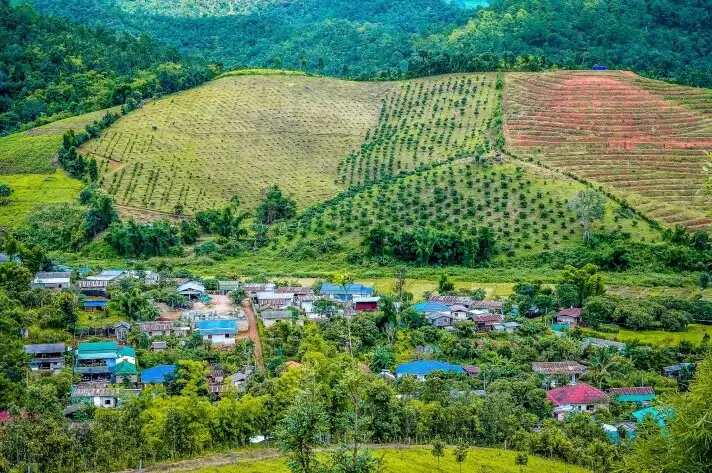
Ban Piang Luang in Wiang Haeng District, Chiang Mai, is a border community where the charm isn’t only the mountain air and scenery. What makes this place memorable is how everyday life sits at the intersection of three big forces at once: borderland trade at a local scale, ethnic identity shaped by migration, and modern life that constantly adapts to security and “edge-of-the-map” economics.
The first image many people hear about is that Ban Piang Luang lies along the Thai–Myanmar border, with local stories tied to crossings such as “Chong Lak Taeng.” In calmer periods, places like this have been viewed as temporary local trade points where nearby residents can cross to exchange goods. The practical thing to know is that you should not plan your trip around the assumption that crossing will definitely be possible, because opening/closure depends on the situation and official announcements. It’s smarter to visit Ban Piang Luang as a “border community destination” rather than a “border-crossing goal,” and you’ll enjoy what is truly central to the place without disappointment.
The core identity of Ban Piang Luang is its ethnic layering. It is often described as home to communities of Chinese Haw (Yunnanese Chinese) and Tai Yai (Shan). Some Chinese Haw groups settled in various northern Thai border areas within the broader political context of 20th-century China, while Tai Yai communities have long-standing cultural continuity with Shan State across the border. When these histories share the same landscape, what emerges is not just coexistence, but a blended border culture visible in language, food, ritual life, trade networks, and the way people interpret the world.
A detail often associated with Ban Piang Luang is cultural and language preservation. In many places, younger generations drift away from heritage languages over time, but Ban Piang Luang is frequently described as having evening Chinese-language learning in the community, alongside broader support contexts connected to education and cultural activities. Whether you visit for a short stop or a longer stay, the point is the same: this is not simply a scenic village, but a community that actively invests in passing cultural capital from one generation to the next.
If you want to understand Ban Piang Luang more deeply, pay attention to how “being a borderland” shapes economic habits and social thinking. In places where cross-border exchange has been part of life, people tend to be flexible, familiar with goods and ideas from multiple worlds, connected through extended networks, and comfortable adjusting to rules that can change. That is why Ban Piang Luang feels different from mountain villages that are defined mainly by forests or farming. This is a highland community that stays oriented toward relationships between places—always aware of movement, connection, and the outside world.
A good Ban Piang Luang experience often comes from slowing down. Walk through the village, notice the character of homes and family spaces, and try local food where Yunnanese-Chinese and Tai Yai influences may blend in everyday menus. Listen to how language shifts across contexts—standard Thai, northern Thai (Kham Mueang), Chinese, and Tai Yai—then let those small details build a clear mental picture: this is another Chiang Mai, beyond the city’s cafés and famous temples, where border history, migration, and cultural continuity are lived in real time.
To see the village’s distinctiveness, you can compare it gently with other northern border destinations. Places like Mae Sai or Chiang Saen often feel like busier commercial border towns with more formalized trade. Ban Piang Luang, in contrast, reads as “community-scale border life,” where relationships and rhythm can feel closer and slower. And compared with some well-known ethnic tourism villages that highlight staged cultural performances, Ban Piang Luang’s appeal tends to be the opposite: culture is not a show—it is simply happening as part of normal life. That naturalness is exactly why social-history travelers often leave impressed.
One practical note: travel time in Wiang Haeng is usually longer than many people expect, because roads are mountainous and winding. The easiest plan is to leave early from Chiang Mai city, carry water and small snacks, and build buffer time into the schedule. If you plan to use public transport, allow extra time because services can be limited and the journey may take several hours depending on conditions.
Getting There From Chiang Mai city, drive via Highway 107 (Chiang Mai–Fang), then turn left around the Mueang Ngai area onto Highway 1322 toward Wiang Haeng, continuing onward to Ban Piang Luang (the section from the turnoff toward Wiang Haeng is often described as about 72 km based on the provided route note). If traveling by public transport, you can take local service (commonly described as a white 6-wheel songthaew) from Chang Phueak area terminal on the Wiang Haeng–Piang Luang route, typically with morning departures and a multi-hour ride. It’s recommended to confirm the latest schedule before departure.
| Place Name | Ban Piang Luang, Wiang Haeng District, Chiang Mai |
| Location | Piang Luang Subdistrict, Wiang Haeng District, Chiang Mai (Thai–Myanmar border area) |
| Key Characteristics | Border community shaped by Chinese Haw and Tai Yai heritage; mountain-route lifestyle; culture, food, language, and local-scale border trade narratives |
| Period | A modern community formed through 20th-century migration contexts and long-standing cross-border cultural continuity, continuing to the present |
| Key Evidence | Often associated with local accounts of “Chong Lak Taeng” as a community-level trade crossing in calm periods (opening/closure should be checked via official announcements) |
| Name Origin | A border settlement whose stories reflect multicultural settlement and cross-area exchange, shaping language, food, and social networks |
| Open Days | Daily |
| Opening Hours | All day (recommended to visit during daylight hours) |
| Travel | Highway 107 then Highway 1322 to Wiang Haeng–Piang Luang (mountain roads; allow extra time). Public transport on the Wiang Haeng–Piang Luang route has limited trips; confirm schedules before departure. |
| Current Status | Open as a living community and cultural borderland destination (border-crossing conditions should always be verified through official updates) |
| Contact Number | - |
| Nearby Tourist Attractions With Distance | Wiang Haeng town area (market/center) – 20 km Viewpoints/mountain-route stops on Highway 1322 – 10 km Royal Agricultural Station Angkhang (Doi Angkhang) – 35 km Fang town area – 55 km Chiang Dao town area – 90 km |
| Popular Restaurants Nearby | (Verified phone numbers not available in the provided information, so they are omitted to avoid inaccuracies.) |
| Popular Accommodations Nearby | (Verified phone numbers not available in the provided information, so they are omitted to avoid inaccuracies.) |
| Facilities | - |
| Fees | - |
Frequently Asked Questions (FAQ)
Q: What kind of trip is Ban Piang Luang best for?
A: It’s best for travelers who like community life, borderland history, and ethnic cultural landscapes—people who want a lived-in place rather than a quick landmark stop.
Q: What ethnic communities are associated with Ban Piang Luang?
A: It is commonly described as shaped by Chinese Haw and Tai Yai communities, which is reflected in language, food, and everyday cultural practices.
Q: Can I cross the border via Chong Lak Taeng?
A: You shouldn’t plan assuming you can. Opening/closure depends on the situation and official announcements, so you must verify current status through official sources before traveling.
Q: When is the best time to visit?
A: Cooler months are usually the most comfortable, especially because mountain roads are easier to drive and the overall walking pace in the village feels more relaxed.
Q: What should I know if I use public transport?
A: Trips can be limited and travel time is long due to mountain roads. Confirm the latest departure times, allow buffer time, and bring essentials for the journey.
Q: How do I experience the “real system” of the community?
A: Slow down—walk, eat locally, listen to the mix of languages, and talk politely with people in the area. The borderland nature of the place reveals itself in small, everyday details.
 Ban Piang Luang Map
 Category:
  Group:
  Tag: ●Ban Piang Luang●ban piang luang ●wiang haeng ●chiang mai travel ●northern thailand travel ●border village ●chinese haw community ●shan community ●local border trade ●thailand myanmar border ●cultural tourism
Last Update: 3 MonthAgo
Tag: ●Ban Piang Luang●ban piang luang ●wiang haeng ●chiang mai travel ●northern thailand travel ●border village ●chinese haw community ●shan community ●local border trade ●thailand myanmar border ●cultural tourism
Last Update: 3 MonthAgo
Comment
 Nearby Attractions
| Keyword (Advance) |
 Facebook Fanpage
 Region
 Art, Culture and Heritage
 Historical Sites and Monuments(
 Landmarks and Memorials(
 Royal Palace(
 Art, Craft Centres, Tradition(
 Museums(
 Educational Places
 Museum for Study(
 Educational Gardens, Farm(
 Training Center(
 University
 Places of Worship
 Temple(
 Mosque(
 Other religious and spiritural sites(
 Research and Development
 Royal Project(
 Local Market(
 Nature and Wildlife
 National Parks and Marine Reserves(
 Mountain (Doi)(
 Dam, Reservoir, Lake(
 Waterfalls(
 Hot Springs(
 Caves(
 River, Canal(
 Other natural attractions(
 Entertainment and Agricultural
 Zoos and Aquariums(
 Animal camps and shows(
 Stadium(
 Farm, Parks, Gardens and Ecotourism(
 Waterpark(
 Theater(
 Outdoor and Adventure Activities(
 Shopping
 Shopping and Night Market(
 Restaurant
 Michelin Star(
 Michelin Guide(
 Call Customer Service in Tourism
 Call Customer Service in Tourism(
 Travel Articles, Recipes
 Travel Review, Food Review(
 Food Menu, North Recipes(
 Thai Desserts, North Recipes(
 Copyright 2012,