
lovethailand home >North Travel Attractions >Chiang Mai Travel Attractions >Mae Taeng >Mae Ho Phra > Bua Tong Waterfall and the Seven-Color Spring
TL;DR: Bua Tong Waterfall and the Seven-Color Spring, Chiang Mai attractions : Nature and Wildlife, Waterfalls.
Bua Tong Waterfall and the Seven-Color Spring
Open Days: Generally daily (may temporarily close based on official safety/restoration announcements in some periods)
Opening Hours: Generally 08:00 – 17:00
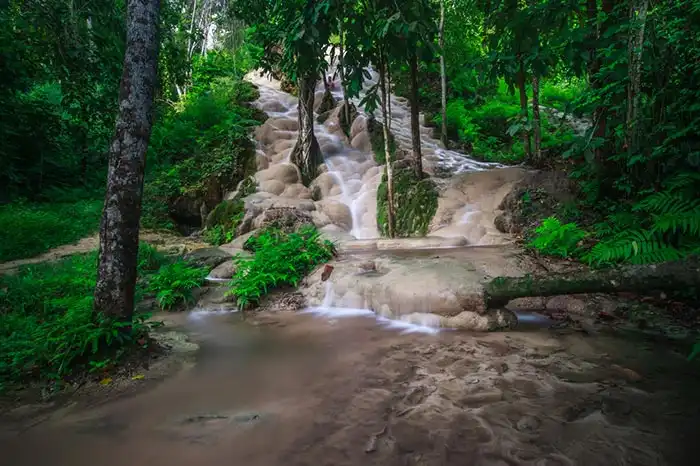
Bua Tong Waterfall and the Seven-Color Spring is a nature day trip that feels “weird enough to remember” but is still easy to do as a simple morning-to-evening outing from Chiang Mai city. People keep talking about this duo because it isn’t the kind of place that wins you over with sheer scale like a giant waterfall. It wins you over with that “nature-made-it” strangeness: milky-white rock that looks like it has been coated along the streambed, a surface you can actually climb on, and cool, clear mineral water bubbling up from underground before flowing out as a small waterfall.
Bua Tong Waterfall is a small limestone waterfall, but its “texture” is what turns it into something people talk about like a global oddity. Mineral water carrying calcium carbonate flows across the rock over long periods. As conditions change along the flow, calcium carbonate precipitates and coats the rock in a thin, pale layer that feels grippy underfoot. That creates the signature experience: you can climb up the waterfall itself (still watch for algae in some sections). From a travel perspective, it is one of those places where even people who usually avoid hiking end up wanting to try it at least once.
What makes Bua Tong different from a typical waterfall is that it is not just water spilling down a cliff; it is a mineral stream that keeps “building its own landscape” over time. Calcium deposits gradually shape the surface into steps, ridges, and ripples, almost like the rock is being poured and sculpted slowly by chemistry and time. When water flow is calmer and carbon dioxide escapes from the water more easily, precipitation tends to happen more readily. That is why the pale, chalky look becomes the area’s unmistakable signature.
The Seven-Color Spring is, in a sense, the “source” that makes the whole system possible. Cool mineral water rises from underground and feeds the mineral stream that eventually creates the coated limestone surface and the climbable waterfall experience. The “seven colors” name is often described as a visitor’s visual memory: depending on light angle, water depth, reflection, and subtle mineral films on the bottom, you may notice gentle shifts in tone. It is not a guaranteed rainbow every day, but the real highlight is seeing a mineral spring in its natural setting and understanding how underground processes connect directly to what you are walking on.
If you like the science side: this is a carbonate/limestone-linked water system. Rainwater seeping into the ground can dissolve carbon dioxide and form a weak carbonic acid, helping dissolve calcium from limestone along its underground path. When the spring water emerges and meets open air, carbon dioxide can escape, and calcium carbonate precipitates out, coating the surface as pale deposits (often discussed broadly as travertine/tufa depending on context). The same core mechanism appears in well-known limestone-deposit landscapes worldwide, even though each site looks different because flow rate, water chemistry, temperature, and terrain all vary.
If you want a global comparison: people often think of Pamukkale in Turkey (white carbonate terraces from mineral water), Plitvice Lakes in Croatia (carbonate barriers shaping cascades and small falls), or Mammoth Hot Springs in Yellowstone (large stepped mineral formations). Chiang Mai is on a totally different scale, of course, but the principle is related: mineral-rich water moves, deposits form, the terrain changes, and a unique landscape becomes the identity of the place.
For a satisfying visit, come early. You will climb and take photos without queues, and you will actually hear the forest and water instead of crowd noise. There are areas to sit and rest, but the rules that keep this place healthy are simple: take all trash back out, do not throw food scraps into the water, do not use soap/shampoo in the stream, and avoid footwear that could damage fragile mineral surfaces (especially hard, sharp soles). The deposits may look tough, but parts can be surprisingly delicate; repeated damage changes the natural forms over time.
Safety is straightforward: it is generally less slippery than many waterfalls, but it is not risk-free. Algae-covered spots can be slick, especially after rain or during busy periods. Treat it as a place you can climb, but only with attention and good footing. Avoid jumping from height, do not force your way up where flow is strong, and if heavy rain is building, step back. Mountain waters can change quickly.
One overlooked point is local water stewardship. Springs and mineral streams are sensitive systems. If upstream areas are damaged or polluted, the clear water you came for can degrade fast. Responsible travel here is not a slogan; it directly affects the ecosystem and the long-term reputation of Chiang Mai nature sites.
Getting there is commonly described via the Chiang Mai–Phrao route, using the junction near Km 42 as a general landmark before turning toward the park area in Mae Taeng District (you may see subdistrict naming vary across sources). Overall, it is very doable for a day trip by car, but you should still check road conditions during the rainy season and allow extra time because some segments are local roads.
If you want to make the day feel “worth it,” you can pair this trip with nearby nature and cultural stops in Mae Taeng/Phrao such as Mae Ngat Somboon Chon Dam or Wat Ban Den, or swing by a cafe/stay area around Kuet Chang to change the vibe. Still, the heart of the trip remains the climbable limestone waterfall experience and the cool mineral spring source in one place, which is rare to get so clearly in a single day.
| Name | Bua Tong Waterfall and the Seven-Color Spring (Bua Tong Waterfall – Seven-Color Spring National Park) |
| Location | Mae Ho Phra / Ho Phra Subdistrict, Mae Taeng District, Chiang Mai (often referenced via the Chiang Mai–Phrao route and a turnoff near Km 42) |
| Highlights | Bua Tong is a limestone waterfall coated by calcium carbonate deposits that create a grippy, climbable surface; the Seven-Color Spring is the cool mineral spring source feeding the mineral stream and the pale coated rock landscape |
| Area Context | A nature-recreation and limestone-geology site within a national park area, managed under safety and conservation guidelines |
| Key Evidence | Visitor information, contacts, and status updates are published via official national park channels and Tourism Authority of Thailand (TAT) references |
| Name Origin | Local naming for Bua Tong; “Seven-Color” is commonly explained through light/reflection and subtle mineral films that can shift the perceived tones (varies by season and light) |
| Travel | Drive from Chiang Mai toward Phrao, then follow signs/pin to the park area; total travel time is often around 1.5 hours depending on your start point and traffic; go early and avoid heavy rain periods |
| Current Status | Generally open, but may temporarily close for safety or restoration based on official announcements (especially in the rainy season) |
| Contact Number | Bua Tong Waterfall – Seven-Color Spring National Park: 093-193-3556 TAT Chiang Mai Office: 053-276-140 |
| Fees | Generally free entry (conditions may change; check official updates before travel) |
| Facilities | Parking, information/registration point, restrooms (season/management dependent), paths to viewpoints, resting/picnic areas (pack out all trash) |
| Nearby Attractions (Approx. Distance) | Wat Ban Den (25 km) Mae Ngat Somboon Chon Dam (30 km) Thai Elephant Conservation Center (Mae Taeng) (35 km) Mok Fa Waterfall (40 km) Chiang Dao Cave (55 km) Doi Luang Chiang Dao (65 km) |
| Popular Restaurants Nearby (Approx. Distance) | Kramfeine (28 km) Tel. 088-137-0543 Krua Sai Nathi (floating-raft dining) (30 km) Tel. 090-891-0805 PHU Forest Cafe & Restaurant (40 km) Tel. 085-449-2888 Pankled Coffee (40 km) Tel. 081-881-7308 The Giant Chiangmai (65 km) Tel. 053-317-677 |
| Popular Accommodations Nearby (Approx. Distance) | Monmaetang Resort (30 km) Tel. 097-925-9581 CherPue Chiangmai (30 km) Tel. 095-451-0095 Kaomai Lanna Resort (40 km) Tel. 053-481-201 NightSky HomeStay (40 km) Tel. 098-948-3299 Phusanfah Resort (45 km) Tel. 087-702-9888 Doi Bo Luang FIO (45 km) Tel. 092-586-9215 |
Frequently Asked Questions (FAQ)
Q: Is Bua Tong Waterfall really “not slippery”?
A: The calcium-carbonate-coated limestone is generally grippier than many typical waterfall rocks, which is why climbing is popular here. However, algae-covered sections can still be slick, so careful footing is always important.
Q: What is the Seven-Color Spring, and how is it different from the waterfall?
A: It is a cool mineral spring where water rises from underground and feeds the mineral stream system. Bua Tong Waterfall is the downstream section where the water flows over coated limestone, creating the climbable waterfall experience.
Q: When is the best time to visit?
A: Late rainy season into early cool season is often best for greener forest scenery and a stronger flow, but always check for temporary safety closures during heavy rain periods.
Q: Can I do this as a day trip from Chiang Mai city?
A: Yes. It is commonly done as a day trip. Leaving early helps you avoid crowds and gives you time to enjoy the area without rushing.
Q: What should I bring?
A: Grippy footwear (or water shoes), clothes that can get wet, a small towel, drinking water, and a bag to pack out all trash. Avoid using soap/shampoo in the stream to help protect the spring and its ecosystem.
 Category: ●Nature and Wildlife
 Group: ●Waterfalls
Last Update : 9 MonthAgo
 Last Update : 9 MonthAgo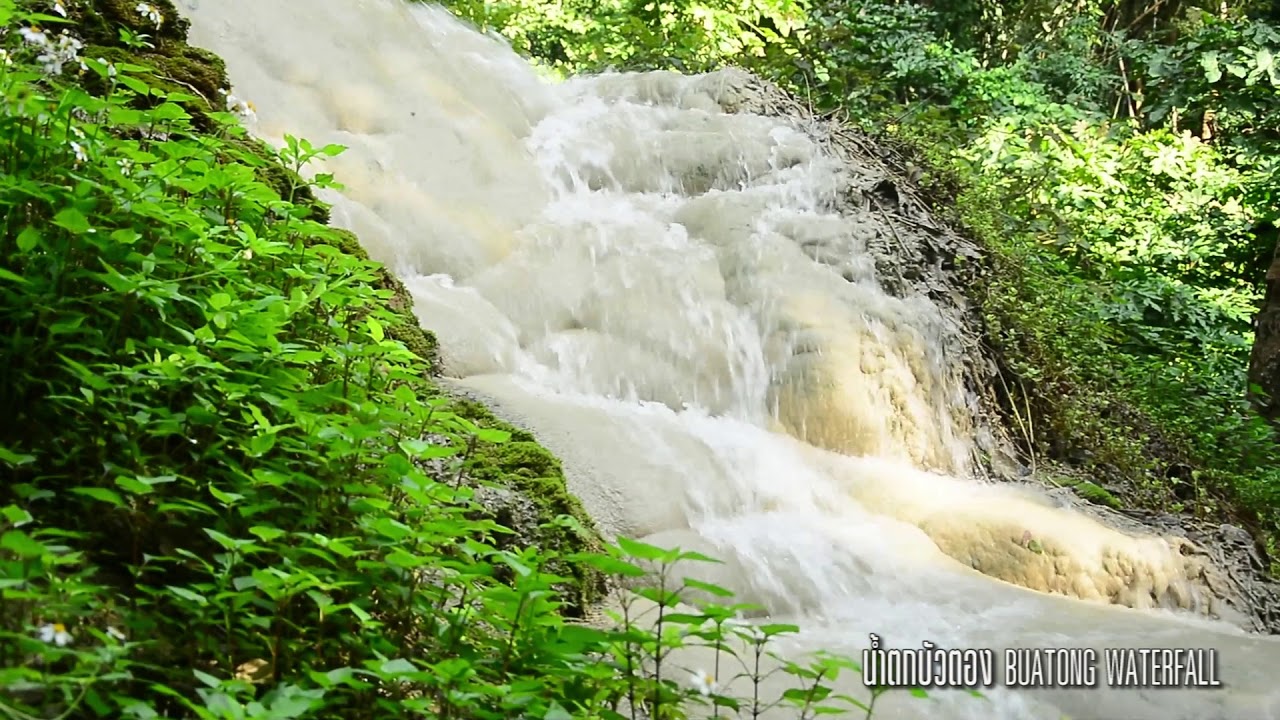
 Click to Access the Navigation Map GPS
Bua Tong Waterfall and the Seven-Color Spring Map
Recommend

 Art, Culture and Heritage
 Historical Sites and Monuments(8)
 Landmarks and Memorials(5)
 Royal Palace(2)
 Art, Craft Centres, Tradition(43)
 Museums(24)
 Educational Places
 Museum for Study(2)
 Educational Gardens, Farm(5)
 Training Center(1)
 Places of Worship
 Temple(79)
 Mosque(2)
 Other Sacred Sites(17)
 Research and Development
 Royal Project(44)
 Suburban Living
 Village, Community(41)
 Local Market(14)
 National Parks and Marine Reserves(16)
 Mountain (Doi)(21)
 Dam, Reservoir, Lake(26)
Waterfalls(43)
Dam, Reservoir, Lake(26)
Waterfalls(43)
 Hot Springs(12)
 Caves(11)
 River, Canal(6)
 Other natural attractions(14)
 Entertainment and Agricultural
 Zoos and Aquariums(2)
 Animal camps and shows(3)
 Stadium(1)
 Farms, Parks and Ecotourism(19)
 Waterpark(2)
 Theater(1)
 Outdoor and Adventure Activities(10)
 Shopping
 Shopping and Night Market(6)
 Restaurant
 Michelin Star(1)
 Michelin Guide(23)
 Call Customer Service in Tourism
 Call Customer Service in Tourism(1)
 Travel Articles, Recipes
 Travel Review, Food Review(15)
 Food Menu, North Recipes(30)
 Thai Desserts, North Recipes(17)


