

 Home
Home Chiang Mai(










Baan Pa Bong Piang
Rating: 5/5 (1 votes)
 Search By
  Map
Map 
 Have Map
  No Map
Chiang Mai attractions
Attractions in Thailand
Open Days: Daily (recommended to book/arrange accommodation in advance, especially during the rice-terrace season, and check the weather before traveling)
Opening Hours: Recommended 06.00–18.00 (ideal for walking and photography in the morning–evening light, and descending before dark)
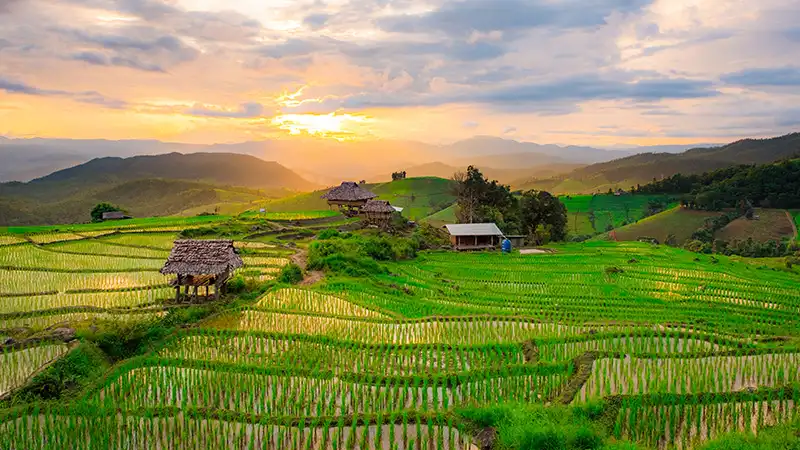
Ban Pa Bong Piang in Mae Chaem District, Chiang Mai, is a Pgakenyau (Karen) village known for both its breathtaking natural scenery and a simple way of life that still follows the rhythm of mountains, forests, and seasons. This is not just a “rice terrace photo spot”—it is a real place with real people, where rice fields mean food security and the terrace ridges are literal pathways of everyday community life.
The charm of Ban Pa Bong Piang becomes clear the moment you see its rice terraces stacked in layers along the mountainside. Unlike the wide flat paddies of the lowlands, these terraces reflect highland wisdom—how people made it possible for “mountains to grow rice.” Terraced farming slows down runoff, holds moisture, and improves cultivation on steep terrain. At the same time, it supports ecological balance because terraced rice cultivation is closely tied to careful water management and responsible stewardship of surrounding forest areas.
The village is especially beautiful during the agricultural seasons. In the rainy season, the mountains turn intensely green and the air feels fresh and damp; if your timing is right, you may see soft morning mist hovering over the terraces. When water sits in the paddies, the landscape can look like a mirror, making the curves of the terrace ridges stand out even more. During harvest, the scenery shifts into warm golden tones—perfect for anyone who wants to witness a stunning “livelihood landscape” that needs no extra staging.
What makes a visit to Ban Pa Bong Piang more meaningful than a simple “check-in” is understanding that this beauty is built on community labor and discipline. Many Pgakenyau villagers continue farming and living with nature while respecting local rules of the land. Good tourism here should be learning-based and respectful—walk only on paths the community has designated, do not step on terrace ridges, do not trample rice paddies for photos, and avoid loud noise early in the morning or late at night when villagers are resting.
If you want great photos while still respecting the community, the simplest approach is to shoot from higher angles along walkways or viewpoints that do not affect farmland. If you want photos of people with the terraces as a living backdrop, always ask for permission first. In some communities, being photographed without consent can feel uncomfortable even when visitors mean well. These small details are what make eco-conscious travel feel truly “real.”
Another important point is that highland conditions can change quickly, especially during rainy periods. Roads may become slippery, and thick fog can appear unexpectedly. If you drive yourself, keep your speed low, stay focused on bends and steep sections, and try to travel while there is still daylight—darkness in the mountains makes it harder to judge distance and road conditions. Mobile signal can be unstable in some spots, so it’s wise to prepare a backup communication plan and carry a flashlight or other essentials.
Accommodation in Ban Pa Bong Piang is typically simple homestays or small lodges that prioritize atmosphere over city-level amenities. Many places serve local meals, which is a great chance to taste seasonal ingredients and learn about local food culture. Visitors should prepare personal items well—such as warm layers (nights can be chilly), a rain jacket in the rainy season, insect repellent, and a power bank—because some places have limited electricity or keep things intentionally minimal to match the local context.
If you want a trip that feels full without being exhausting, it’s best to plan at least 1 night so you can experience the morning light and mist—often the most magical time in Ban Pa Bong Piang. With 2 nights, you can slow down enough to truly “listen to the place”: walk the ridges without rushing, observe everyday village life, and rest your eyes from the noise of the city in a deeper way.
Getting There From Mae Chaem town to Ban Pa Bong Piang, you’ll take winding mountain roads. Check weather conditions before you leave, especially during the rainy season, and drive carefully. If you are not familiar with mountain driving or don’t feel confident, it’s recommended to use a local vehicle service/hire a driver for safety and to reduce risks along the route.
Summary Table
| Name | Ban Pa Bong Piang (Mae Chaem District, Chiang Mai) |
| Location | Mae Chaem District, Chiang Mai |
| Highlights | A Pgakenyau (Karen) village renowned for rice terraces, mountain scenery, and a peaceful atmosphere—ideal for eco-conscious travel |
| Best Time to Visit | Rainy season–water-filled paddies–harvest season (choose based on the look you want and always check the weather) |
| Travel | Winding mountain roads from Mae Chaem; drive carefully and avoid traveling up/down after dark |
| Current Status | An eco-tourism village with homestays available (advance booking recommended) |
| Local Government Contact | Mae Chaem District Office 0 5348 5111 |
Table: Nearby Attractions (Distance & Phone Number)
| Nearby Attraction | Approx. Distance | Phone |
| Doi Inthanon National Park (Visitor Center) | Approx. 40–70 km (depends on your destination inside the park) | 0 5328 6729 |
| Kew Mae Pan (Nature Trail, Doi Inthanon) | Approx. 55–85 km (via Doi Inthanon route) | 0 5328 6729 |
| Mae Chaem Art & Culture (local cultural learning spot) | Approx. 20–40 km (based on Mae Chaem town area) | 092 993 2619 |
| Huen Lai Mueang Chaem (learning spot / Mae Chaem “teen jok” textiles) | Approx. 20–40 km (based on Mae Chaem town area) | 084 739 8378, 089 559 3928 |
| Op Luang National Park (Hot District) (optional stop on the way) | Approx. 90–130 km (depends on your route) | 081 602 1290 |
Table: Nearby Restaurants/Cafes (Distance & Phone Number)
| Restaurant/Cafe | Approx. Distance | Phone |
| Mae Chaem Gate Restaurant (Tha Pha Subdistrict) | Approx. 15–35 km (from Pa Bong Piang area toward Tha Pha/Mae Chaem) | 085 671 3061 |
| Sookjai Cafe&Restaurant (Chang Khoeng, Mae Chaem) | Approx. 20–40 km | 084 804 4698 |
| Ban Raan Cake by Nom Chaem Cafe | Approx. 20–40 km | 087 059 9763 |
| Kanom Nuch | Approx. 20–40 km | 081 586 5804 |
| Chan Som Noodles (Chang Khoeng area) | Approx. 20–40 km | 080 134 9946, 087 193 1567, 0 5348 5219 |
Table: Nearby Accommodations (Distance & Phone Number)
| Accommodation | Approx. Distance | Phone |
| Baan Pak Nong Nam Phu Pa Bong Piang | Approx. 0–3 km (within Pa Bong Piang area) | 093 220 6128 |
| Baan Hak Hao Pa Bong Piang | Approx. 0–3 km (within Pa Bong Piang area) | 097 992 7598 |
| Baan Pak Thay Na Pa Bong Piang | Approx. 0–3 km (within Pa Bong Piang area) | 086 336 8546 |
| Huen Ram Pa Bong Piang | Approx. 0–3 km (within Pa Bong Piang area) | 097 220 9998 |
| Come Home Mae Chaem (Inthanon-view stay / near local communities) | Approx. 15–40 km (depends on your starting point in Pa Bong Piang) | - |
Frequently Asked Questions (FAQ)
Q: When is the best time to visit Ban Pa Bong Piang?
A: If you love lush green scenery and mist, the rainy season is ideal. If you want golden rice fields, visit during harvest season. In all cases, check the weather and road conditions before traveling.
Q: Do I need to stay overnight to fully enjoy Ban Pa Bong Piang?
A: At least 1 night is recommended so you can experience the morning light and mist, and avoid rushing the journey.
Q: Is it difficult to drive up the mountain roads by myself?
A: The route is winding and can be steep, and during the rainy season it may be slippery. Drive carefully and avoid traveling up/down after dark. If you are not experienced with mountain driving, consider using a local vehicle service.
Q: Are there any rules for taking photos around the rice terraces?
A: Walk only on paths designated by the community, do not step on terrace ridges or enter rice paddies for photos, and always ask permission before photographing villagers.
Q: Do accommodations in Pa Bong Piang have full amenities?
A: Most are simple homestays focused on atmosphere. Prepare warm clothing, insect repellent, and a power bank to stay comfortable.
 Baan Pa Bong Piang Map
 Category:
  Group:
  Tag: ●Baan Pa Bong Piang●ban pa bong piang ●pa bong piang ●mae chaem rice terraces ●mae chaem travel ●chiang mai rice terraces ●pa bong piang homestay ●pa bong piang accommodation ●eco tourism chiang mai ●sunrise rice terraces thailand ●misty mountains mae chaem Last Update: 3 MonthAgo
Comment
 Nearby Attractions
| Keyword (Advance) |
 Facebook Fanpage
 Region
 Art, Culture and Heritage
 Historical Sites and Monuments(
 Landmarks and Memorials(
 Royal Palace(
 Art, Craft Centres, Tradition(
 Museums(
 Educational Places
 Museum for Study(
 Educational Gardens, Farm(
 Training Center(
 University
 Places of Worship
 Temple(
 Mosque(
 Other religious and spiritural sites(
 Research and Development
 Royal Project(
 Local Market(
 Nature and Wildlife
 National Parks and Marine Reserves(
 Mountain (Doi)(
 Dam, Reservoir, Lake(
 Waterfalls(
 Hot Springs(
 Caves(
 River, Canal(
 Other natural attractions(
 Entertainment and Agricultural
 Zoos and Aquariums(
 Animal camps and shows(
 Stadium(
 Farm, Parks, Gardens and Ecotourism(
 Waterpark(
 Theater(
 Outdoor and Adventure Activities(
 Shopping
 Shopping and Night Market(
 Restaurant
 Michelin Star(
 Michelin Guide(
 Call Customer Service in Tourism
 Call Customer Service in Tourism(
 Travel Articles, Recipes
 Travel Review, Food Review(
 Food Menu, North Recipes(
 Thai Desserts, North Recipes(
 Copyright 2012,