

 Home
Home Chiang Mai(










Kiew Lae Noi Community
Rating: 3.1/5 (14 votes)
 Search By
  Map
Map 
 Have Map
  No Map
Chiang Mai attractions
Attractions in Thailand
Open Days: Daily (it is recommended to contact the artisan group or sales points in advance if you wish to schedule a visit while craftsmen are working or if you want to place a special custom order)
Opening Hours: Recommended 08.00–17.00 (ideal for strolling, chatting, and shopping without rushing)
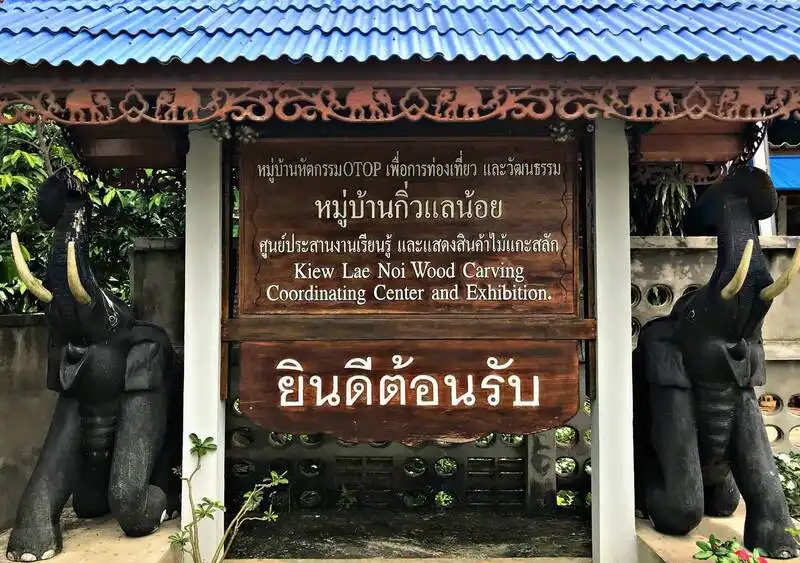
Ban Kiew Lae Noi Community in Chiang Mai Province is a village whose reputation is closely tied to “wood carving” in a way that goes far beyond souvenirs. It is craftsmanship and time—skills accumulated within the community until they became the identity of the place. If you have ever seen wooden elephants carved with graceful, flowing postures, or narrative panels such as Ramakien scenes that require both precision and patience, there is a strong chance that the roots of that craftsmanship connect to the artisan network in the San Pa Tong–Hang Dong area, where Ban Kiew Lae Noi is one of the most “densely concentrated” points in terms of both craftsmen and production.
The charm of Ban Kiew Lae Noi lies in how genuinely it is an artisan village. As you walk through, you can sense that craftwork here is not made only to be shown, but to sustain livelihoods and be carried forward as a profession. You will find wooden pieces ranging from small items suitable for travelers to large custom works made for homes, shops, or hotels. The most popular motifs are often “elephants” carved in many postures, as well as Thai ornamental patterns and narrative carvings that require the skill of controlling crisp lines while still preserving the softness of the wood’s surface. At a glance, many pieces may look similar, but up close you begin to see clear differences in skill level.
If you are interested in the community’s OTOP context, local information notes that the village’s wood carving products were selected under Thailand’s One Tambon One Product (OTOP) program in 2004. Examples frequently mentioned within the community include “Elephant Posture Sculptures” by the Woodcraft Cooperative Co., Ltd., as well as picture panels and auspicious plaques/signboards, Kinnara–Kinnari panels, and an elephant family set depicting life postures in a storytelling style. These examples show that Ban Kiew Lae Noi is not only a place to buy things, but also a place to observe how local craftsmen develop and how a community sustains itself in the handicraft market over time.
To travel here in a way that lets you “take something home and truly understand,” give yourself time to walk slowly and observe three things. First, the wood grain and surface finishing—good work will be consistent and smoothly finished. Second, the proportions of the elephant (or overall composition) should be balanced, not warped or out of shape. Third, look at the sharpness of lines and the depth variation of the carving, which reflects the artisan’s experience. If you intend to buy gifts or home decor, ask directly what type of wood it is, whether it is suitable for indoor or outdoor placement, and how it should be maintained. This helps ensure your purchase lasts, instead of becoming a beautiful piece that deteriorates too quickly.
Another reason this visit can feel meaningful is the chance to engage with the community respectfully—because this is a real working space, not a staged tourist set. If you want to photograph the work or the carving process, ask permission first, especially when craftsmen are working on fine details. Some pieces are custom orders, and clients may not want them shared before delivery. If you want to negotiate the price, do so politely, keeping in mind that “handmade” pricing is not only about materials, but also about labor and time. If your intention is to support the community, paying fairly is part of helping this skill survive.
Getting There From Chiang Mai city, there are two main routes to Ban Kiew Lae Noi. The first route uses the irrigation canal-side road from the city, passing through Hang Dong, then entering the San Klang and Nam Bo Luang subdistrict areas in San Pa Tong District, and continuing into Ban Kiew Lae Noi (the area includes a community center and OTOP product display/sales points). The second route uses the main Chiang Mai–Hot Road (Highway 108), passing the Airport Intersection, then continuing past the Hang Dong District Office for about 10 km to the irrigation canal intersection (BAAC San Pa Tong Junction). Turn right onto the canal-side road, pass through Yu Wa subdistrict, then continue for about 6 km. Based on local information, driving a private car is the most convenient option, especially if you plan to visit multiple places in one day.
If you want to make a half-day to one-day trip feel worthwhile, start in the morning by walking through the community and viewing the woodcraft. Begin by buying a small piece to “check the quality,” then decide on larger pieces if you like. At midday, move to a pleasant restaurant area in Hang Dong or Mae Hia. In the afternoon, continue to nearby learning-oriented attractions such as Royal Park Rajapruek or Chiang Mai Night Safari. End the day with a visit to Kad Sala Mae Kru Kham, another marketplace with a different style of woodcraft and home decor. This route lets you fit craftsmanship, community life, and major attractions into one connected itinerary.
| Name | Ban Kiew Lae Noi Community (Wood Carving Village), Chiang Mai Province |
| Location | San Pa Tong District, Chiang Mai (canal-side road zone – Yu Wa – Nam Bo Luang, based on the routes into the village) |
| Key Characteristics | An artisan wood-carving village known for elephant carvings and narrative carvings (e.g., Ramakien), with handicraft products and custom-made work |
| Context / Period | A contemporary craft community built on local artisan skills and elevated as OTOP products (local references mention a selection in 2004) |
| Key Evidence / Learning Points | Local carving demonstrations/workshop-style learning, and community OTOP product display and sales points |
| Name Origin | Named after the local settlement “Ban Kiew Lae Noi” in the San Pa Tong area |
| Current Status | The community continues its artisan livelihood and welcomes visitors for learning-style visits (coordination is recommended for a deeper, scheduled visit) |
| Coordinates (Latitude, Longitude) | 18.6333033, 98.8510278 |
| Contact Number | 089-950-7062 |
| Nearby Attractions (km.) & Phone Numbers | Kad Sala Mae Kru Kham (12 km) Tel. 053-290-120, 089-835-2449 Wat Kiew Lae Noi (6 km) Tel. 053-822-647 Royal Park Rajapruek (24 km) Tel. 053-114-110-2 Chiang Mai Night Safari (26 km) Tel. 053-999-000 The Good View (Chiang Mai city) (25 km) Tel. 053-241-866, 053-302-764, 099-271-0666 |
| Popular Restaurants Nearby (km.) & Phone Numbers | Rong Tharn Ruang Khao (17 km) Tel. 064-594-2277 Khao Mao–Khao Fang (Hang Dong) (24 km) Tel. 053-838-444, 053-020-322 The View Village (Mae Hia) (25 km) Tel. 053-904-406, 095-134-5919 The Good View (Chiang Mai city) (25 km) Tel. 053-241-866, 053-302-764, 099-271-0666 The View Village (additional contact) (25 km) Tel. 053-904-409 |
| Popular Accommodations Nearby (km.) & Phone Numbers | North Hill City Resort (25 km) Tel. 052-010-999 Veranda High Resort Chiang Mai – MGallery (38 km) Tel. 053-365-007 B2 Resort Boutique & Budget Hotel (Hang Dong) (28 km) Tel. 052-009-161 Rungtharn Ruangkhao Resort (San Pa Tong area) (17 km) Tel. 091-078-4618, 065-995-2955 Four Seasons Resort Chiang Mai (Mae Rim) (45 km) Tel. 053-298-181 |
| Facilities | The community area is suitable for walking and shopping. It is recommended to bring drinking water, a hat/umbrella, and allow time for conversations with craftsmen (a deeper visit should be scheduled in advance). |
Frequently Asked Questions (FAQ)
Q: What is Ban Kiew Lae Noi best known for?
A: It is best known for wood carving, especially elephant sculptures in many postures and narrative carvings such as Ramakien scenes. It is ideal for travelers who want to see real craftsmanship and purchase handmade work.
Q: How many hours should I plan for a worthwhile visit?
A: At least 2–4 hours is recommended for browsing and shopping at a relaxed pace. If you also want to include nearby attractions such as Royal Park Rajapruek or the Night Safari, plan it as a full one-day trip.
Q: Can I take photos of the carving process?
A: In many cases yes, but you should always ask permission first, especially for custom orders that may have limitations. It is also best to avoid close-up shots when craftsmen are working on fine details.
Q: How do I choose good quality wood-carving pieces?
A: Check the smoothness of the surface finishing, the balance of proportions, and the sharpness and depth variation of the carving lines. Ask clearly about the wood type and care instructions before buying, especially if the item will be placed in humid areas or exposed to sunlight.
Q: What is the best time to visit?
A: Morning to afternoon is recommended, as it is easier to speak with craftsmen and more comfortable for walking. If you want a deeper scheduled visit, contact the community in advance for confirmation.
 Kiew Lae Noi Community Map
 Category:
  Group:
  Tag: ●Kiew Lae Noi Community●ban kiew lae noi ●kiew lae noi village ●wood carving village chiang mai ●otop wood carving ●elephant wood carving ●san pa tong attractions ●handicraft village chiang mai ●wooden souvenirs chiang mai ●cultural tourism chiang mai ●local craft community Last Update: 2 MonthAgo
Comment
 Nearby Attractions
| Keyword (Advance) |
 Facebook Fanpage
 Region
 Art, Culture and Heritage
 Historical Sites and Monuments(
 Landmarks and Memorials(
 Royal Palace(
 Art, Craft Centres, Tradition(
 Museums(
 Educational Places
 Museum for Study(
 Educational Gardens, Farm(
 Training Center(
 University
 Places of Worship
 Temple(
 Mosque(
 Other religious and spiritural sites(
 Research and Development
 Royal Project(
 Local Market(
 Nature and Wildlife
 National Parks and Marine Reserves(
 Mountain (Doi)(
 Dam, Reservoir, Lake(
 Waterfalls(
 Hot Springs(
 Caves(
 River, Canal(
 Other natural attractions(
 Entertainment and Agricultural
 Zoos and Aquariums(
 Animal camps and shows(
 Stadium(
 Farm, Parks, Gardens and Ecotourism(
 Waterpark(
 Theater(
 Outdoor and Adventure Activities(
 Shopping
 Shopping and Night Market(
 Restaurant
 Michelin Star(
 Michelin Guide(
 Call Customer Service in Tourism
 Call Customer Service in Tourism(
 Travel Articles, Recipes
 Travel Review, Food Review(
 Food Menu, North Recipes(
 Thai Desserts, North Recipes(
 Copyright 2012,