
lovethailand home >North Travel Attractions >Chiang Mai Travel Attractions >Wiang Haeng >Piang Luang > Pak Sam Demo Station and Agriculture, Forestry, En..
TL;DR: Pak Sam Demo Station and Agriculture, Forestry, Environment Project, Chiang Mai attractions : Research and Development, Royal Project.

Pak Sam Demo Station and Agriculture, Forestry, Environment Project
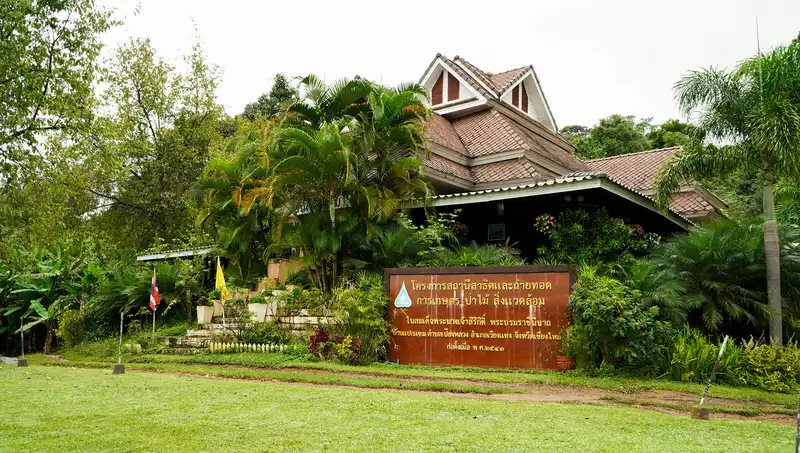
Open Days: Recommended to contact/arrange an appointment in advance (this is an active Royal Initiative fieldwork area with ongoing on-site operations)
Opening Hours: Recommended to visit in daytime, 08.30–16.30 (hours may change depending on field operations/season; please check before traveling)
Ban Paeksam Royal Initiative Demonstration and Training Station for Agriculture, Forestry, and Environment is a destination for travelers who want to see “watershed forest conservation sustained through livelihoods” without needing to imagine it. The Ban Paeksam area in Piang Luang Subdistrict, Wiang Haeng District, is both highland terrain and a borderland community layered with complex conditions—from water resources shaped by mountains, to watershed forests pressured by expanding farmland, to the broader dimension of community security near the border.
The project’s key starting point traces to the royal visit to Ban Paeksam on 6 February 2000. During the visit, the area and a potato field about 2 kilometers west of the village were observed, revealing a reality that “could not be left unattended.” Ban Paeksam and nearby areas serve as critical headwaters for several streams—Huai Hok Luang, Huai Na Yao, and Huai Na On—which flow into the Mae Taeng River system. If watershed forests continue to be encroached upon, it is not only green cover that is lost; it is the long-term resilience of drinking water, household water, and agricultural water for downstream communities that becomes increasingly fragile and difficult to restore.
At the time, forest areas were being cleared to expand potato farms, taro fields, and lychee orchards, with signs that clearing would accelerate as surrounding villages grew—including Ban Paeksam, Ban Hin Taeo, Ban Lak Taeng, and Ban Piang Luang. As livelihood pressure increases, forests are often the first to be pushed back to open land for cultivation. This is a familiar cycle in many headwater areas: “forests shrink for short-term income,” while the long-term cost is paid by the entire water system.
Because this is a border area, a security dimension also runs alongside these challenges—including vulnerability to drug-related issues and impacts from border regulations in neighboring countries, which can affect livelihoods and community safety. When communities lack stable livelihood options, social risks tend to expand. This is why the project does not only ask “what should we grow?” but also “how can people live with the forest without harming it, and how can the community be stable enough not to be pulled back toward risky choices?”
The core of the royal guidance is clear in 2 major directions. The first is agricultural development, with a demonstration and training station for agriculture, forestry, and environment that transfers technology and practical knowledge to residents who work and learn at the station. When residents “truly learn by doing,” the results can then be expanded back into their own farmland. The second direction is water resource development alongside forest conservation and restoration, ensuring sufficient water for household use and agriculture. This is watershed thinking that does not separate water from forests, and does not separate forests from livelihoods.
The station is located in Village No. 6, Piang Luang Subdistrict, Wiang Haeng District, Chiang Mai Province. The area sits at approximately 1,300 meters above mean sea level and about 700 meters from the border. The site was originally within the Chiang Dao National Forest Reserve and later became part of a national park designation; however, the station boundary has been officially excluded from the park area, allowing field operations and land management to proceed under clearer, more workable frameworks.
The station’s landscape is steep highland terrain, typical of Northern Thailand’s uplands, and its key water sources include Huai Hok Luang, Huai Na Yao, and Huai Na On. Steep slopes mean soil and water management must be more precise than in lowlands. If soil is easily eroded, yields become unstable; when yields are unstable, income is shaken; and livelihood pressure then loops back into renewed pressure on forests. A strong highland project must help communities “truly sustain themselves” economically while also “sustaining the land for the long run” in terms of natural resources.
Wiang Haeng’s climate can be extreme by season. The cold season (December–January) can be very cold; the hot season (February–April) can be very hot; and the rainy season is often wet with heavy rainfall. These conditions affect farming, livestock, and travel. If you visit for learning purposes, plan in line with the season: during rains, expect slippery roads and thick fog; during colder months, bring warm clothing and allow extra driving time in early mornings because visibility may drop.
For visitors, projects like this often feel different from typical tourist sites because this is a “working landscape” more than a “showcase.” The value of visiting lies in seeing the forest–water–food–income relationship as one connected picture. You begin to understand that a community’s water does not come from rain alone; it comes from forests that regulate moisture, from land use that prevents topsoil loss, and from livelihood options that do not force people to expand farmland into forests.
Because this is an actively operated fieldwork area, the best way to ensure a smooth visit is to contact and arrange in advance. This is not formality; it is respect for the rhythms of field operations and community schedules. It also helps visitors receive guidance that matches real-time conditions—such as suitable learning points, areas to avoid, or time windows when access is appropriate. Some periods may involve water-source maintenance or forest restoration tasks that require higher safety controls. Visiting with current information means you will “see more and risk less.”
If you want the journey to feel easier, plan more time than usual. Mountain routes naturally include curves and steep grades, and in the rainy season conditions can change quickly. Bring drinking water, personal medication, a rain jacket or windbreaker, and make sure you have a plan for communication signals—especially if traveling with children or older family members. Having a “rest-stop plan along the way” helps everyone enjoy the learning experience rather than feeling worn down by the road.
What makes this project meaningful as a trip that “has substance” is that it does not try to answer, in a short slogan, how to conserve forests. Instead, it answers with a practical path that helps people truly live well: building a learning hub, transferring technology to communities, expanding results back into household plots, while restoring forests and managing water so there is enough for daily life and farming. This is conservation that does not leave forests to carry people alone, but helps people and forests move forward together.
Getting There In general, you can plan from Chiang Mai city toward Wiang Haeng District, then continue to Piang Luang Subdistrict and Ban Paeksam. Available information notes that “from Ban Piang Luang to the Ban Paeksam station is about 11 kilometers” and “from Chiang Mai to the station is about 171 kilometers.” Please allow extra travel time because this is a highland route, and always check weather and road conditions before departing—especially during heavy fog and heavy rain.
| Name | Ban Paeksam Royal Initiative Demonstration and Training Station for Agriculture, Forestry, and Environment |
| Location | Village No. 6, Piang Luang Subdistrict, Wiang Haeng District, Chiang Mai Province (highland area near the border) |
| Highlights | A demonstration and training station transferring agricultural, forestry, and environmental knowledge to strengthen community livelihoods while conserving and restoring watershed forests and developing local water resources in a border highland context |
| Period | Initiated following the royal visit to Ban Paeksam on 6 February 2000, with royal guidance to establish the demonstration and training station |
| Key Evidence / Notes | A critical headwater area for Huai Hok Luang, Huai Na Yao, and Huai Na On, flowing into the Mae Taeng River system; forest clearing pressure for potato farms, taro fields, and lychee orchards; growth trends linked to nearby village populations; border-area context tied to community security considerations |
| Terrain / Elevation | Steep highland terrain; approximately 1,300 meters above mean sea level; about 700 meters from the border |
| Climate | Cold season (December–January) can be very cold; hot season (February–April) can be very hot; rainy season often brings heavy rainfall (plan travel by season) |
| Travel | Chiang Mai → Wiang Haeng District → Piang Luang Subdistrict → Ban Paeksam (noted information: Ban Piang Luang to the station about 11 km; Chiang Mai to the station about 171 km — allow extra time for highland roads and check weather/road conditions before departure) |
| Current Status | An active Royal Initiative project in a highland border area; recommended to contact/arrange in advance before visiting |
| Contact Number | Project head: 099-156-1044 |
| Official Coordination Unit | Huai Hong Khrai Royal Development Study Center (Forest Conservation and Community Development Project Center): 0-5328-2823 |
| Facilities | Field demonstration/training areas; water-resource development and forest restoration approaches (activities depend on current operations and access permissions) |
| Nearby Tourist Attractions | Si Long Sang Viewpoint (Piang Luang Subdistrict) Doi Dam Viewpoint Phra Borom That Saen Hai Mae Hat Waterfall Phra That Na Yang Temple Note: If you need distance in kilometers, it is best to check from your actual starting point on a map (mountain routes vary by the road you choose) |
| Popular Restaurants Nearby | food factory (wiang haeng) — tel. 063-228-2202 chomview coffee — tel. 093-278-7501 khrua piang luang — tel. 08-6665-6607 mon lan chang — tel. 097-918-0175 (when there are clearly verified sources for exact locations: distances in kilometers will be added in a later update) |
| Popular Accommodations Nearby | huen mok kham resort (ban piang luang) — tel. 053-476-190, 083-260-5222 chiang tung rooms — tel. 053-477-251, 089-835-4932, 082-895-6271 mueang haeng resort & spa — tel. 088-430-5658, 085-031-7753, 086-187-2805 khru ae homestay — tel. 087-179-4631 wiang haeng resort — tel. 082-281-1638, 089-289-5293 Note: If you need distance in kilometers, it is best to check from your actual starting point on a map to get the most accurate number |
Frequently Asked Questions (FAQ)
Q: Who is this project suitable for?
A: It suits travelers who want a quiet, meaningful Northern Thailand trip and enjoy learning about watershed forests, water resources, and highland livelihood development. This is not a typical check-in spot; it is a real fieldwork setting where you come to understand how things work on the ground.
Q: Why does Ban Paeksam need a “demonstration and training station”?
A: Because the area is a critical headwater zone and has faced pressure from forest clearing for farmland. The station’s role is to help communities learn suitable highland farming approaches and practical techniques, then expand results back into their own plots, alongside forest restoration and water development so both people and forests can thrive.
Q: How should visitors prepare for a visit?
A: Contact and arrange in advance, allow extra travel time, bring drinking water, a rain jacket or windbreaker, personal medication, and always check the weather. Mountain routes can be foggy and slippery in some seasons, especially during heavy rain.
Q: Where should I contact for official information?
A: You can call the project head using the number in the table, or coordinate with the Huai Hong Khrai Royal Development Study Center to confirm the latest access conditions and practical travel guidance before you go.
Q: When is the best time to visit?
A: If you prefer cooler air and comfortable scenery, late rainy season to early winter through winter is often ideal. Still, it is best to check forecasts and road conditions before departing—especially on days with heavy fog or heavy rain.
 Category: ●Research and Development
 Group: ●Royal Project
Last Update : 9 MonthAgo
 Last Update : 9 MonthAgo
 Click to Access the Navigation Map GPS
Pak Sam Demo Station and Agriculture, Forestry, Environment Project Map
Recommend

 Art, Culture and Heritage
 Historical Sites and Monuments(8)
 Landmarks and Memorials(5)
 Royal Palace(2)
 Art, Craft Centres, Tradition(43)
 Museums(24)
 Educational Places
 Museum for Study(2)
 Educational Gardens, Farm(5)
 Training Center(1)
 Places of Worship
 Temple(79)
 Mosque(2)
 Other Sacred Sites(17)
Royal Project(44)
Other Sacred Sites(17)
Royal Project(44)
 Suburban Living
 Village, Community(41)
 Local Market(14)
 Nature and Wildlife
 National Parks and Marine Reserves(16)
 Mountain (Doi)(21)
 Dam, Reservoir, Lake(26)
 Waterfalls(43)
 Hot Springs(12)
 Caves(11)
 River, Canal(6)
 Other natural attractions(14)
 Entertainment and Agricultural
 Zoos and Aquariums(2)
 Animal camps and shows(3)
 Stadium(1)
 Farms, Parks and Ecotourism(19)
 Waterpark(2)
 Theater(1)
 Outdoor and Adventure Activities(10)
 Shopping
 Shopping and Night Market(6)
 Restaurant
 Michelin Star(1)
 Michelin Guide(23)
 Call Customer Service in Tourism
 Call Customer Service in Tourism(1)
 Travel Articles, Recipes
 Travel Review, Food Review(15)
 Food Menu, North Recipes(30)
 Thai Desserts, North Recipes(17)


