
lovethailand home >North Travel Attractions >Mae Hong Son Travel Attractions >Muang Mae Hong Son >Mok Cham Pae > Wat Huai Khan
TL;DR: Wat Huai Khan is located at Moo 3, Mok Champae, Mueang Mae Hong Son, Mae Hong Son, open Daily, hours 08.00 - 17.00.
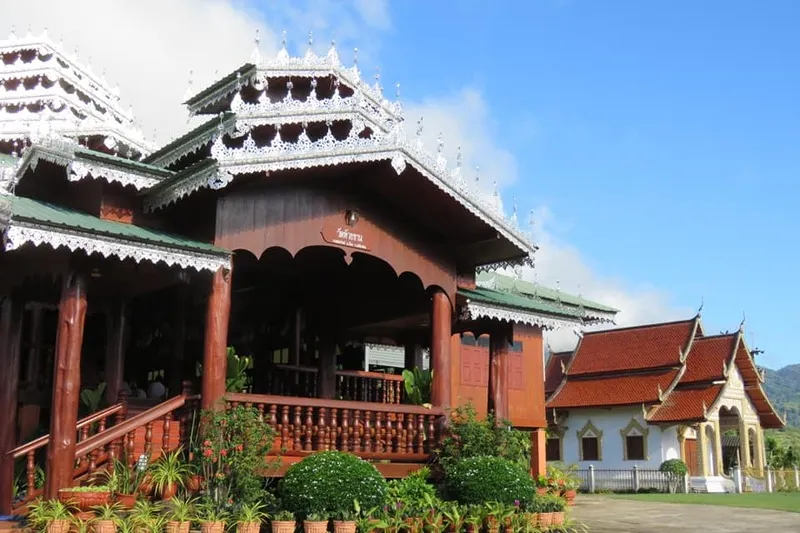
Wat Huai Khan
Open Days: Daily
Opening Hours: 08.00 - 17.00
Wat Huai Khan is a small but meaningful community temple in Moo 3, Mok Champae Subdistrict, Mueang Mae Hong Son District, Mae Hong Son Province. It may not be one of the large or widely publicized temples of Mae Hong Son, yet its importance is clear when viewed through the life of the village around it. This is a temple created through collective effort, sustained by local faith, and still active as a spiritual center for Ban Huai Khan today. For travelers who want to experience Mae Hong Son beyond its most famous scenic attractions, Wat Huai Khan offers a quieter and more grounded perspective.
The temple stands in Ban Huai Khan, a village in Mok Champae Subdistrict, along the broader travel zone that connects Mae Hong Son town with Ban Rak Thai, Pang Ung, and several other attractions. This makes the temple suitable as a cultural stop for travelers driving through the area. Its significance, however, goes far beyond convenience. Wat Huai Khan represents the relationship between community, religion, and shared local effort in a very direct way.
Wat Huai Khan occupies approximately 1 rai and 46 square wah, making it a relatively compact temple. This modest size is part of its character. Rather than impressing visitors through scale, the temple conveys a sense of closeness and authenticity. It feels like a temple that truly belongs to the village, one shaped by real use and local devotion rather than by monumental ambition.
The temple was established in 1979. It was built under the leadership of the village headman, Inchinta Phetphong, and required a construction budget of 278,950 baht. This recorded detail is important because it preserves the human story behind the temple’s creation. Wat Huai Khan was not simply declared into existence. It was planned, funded, and built through a concrete community effort. The presence of a named community leader in the temple’s history makes the story especially vivid and helps explain how deeply the temple is rooted in local social life.
Because the temple is relatively modern compared with some older temples in Mae Hong Son, its importance lies less in ancient chronology and more in what it reveals about community-building in the late twentieth century. It shows that even in more recent decades, local villagers still saw the temple as essential to village identity and collective life. The act of building a temple together reflects more than religion alone. It also reflects the desire to create a shared spiritual and social center for the community.
Today, the temple area functions as a compact community temple layout. Its important spaces include the main worship area for the principal Buddha image, a shared hall or multi-purpose structure used for merit-making and village religious activities, and an open temple yard that supports local ceremonies and community events. Even without monumental architecture, the temple clearly shows practical community use. This functional arrangement is part of its charm, because it reflects the real everyday role of a village temple rather than a highly formal or purely touristic presentation.
A major milestone in the temple’s development came when it received royal Wisungkhamasima on 29 May 2007. This formal designation matters in Buddhist administrative terms because it confirms a recognized sacred boundary for important monastic functions. In practical terms, it also signals that the temple had matured into a more established institution within the Thai Buddhist system. For current readers and visitors, this helps confirm that Wat Huai Khan is not only a village shrine-like space, but a properly recognized and functioning temple.
Wat Huai Khan is especially meaningful when viewed in relation to Ban Huai Khan itself. Publicly available information about the village indicates that the community has a history of more than a century and includes both Tai Yai and Pa-O cultural presence. A temple in such a village naturally becomes more than just a place of worship. It becomes a social anchor, a setting for merit-making, ritual continuity, and village-level moral life. This helps explain why the temple is still meaningful even though it does not rely on monumental architecture or large-scale tourist infrastructure.
Today, the temple is under the care of Phra Anon (Analayo), also publicly referred to as Phra Samu Anon Analayo. This current leadership is important because it confirms that Wat Huai Khan remains an active temple rather than a historical site without ongoing religious life. Recent publicly visible information related to the village and community religious activities also supports the view that the temple continues to function as a living center of local faith.
In recent years, Ban Huai Khan has continued to appear in public posts related to cultural and religious events, including local Sang Long traditions. This gives Wat Huai Khan a very current sense of relevance. It is not a forgotten or inactive place. Instead, it continues to exist within the rhythm of the community. For travelers interested in living culture rather than static heritage, this is one of the temple’s greatest strengths.
From a travel perspective, Wat Huai Khan is well suited to those who prefer slow travel and local insight. Many visitors pass through Mok Champae on the way to Ban Rak Thai, Pang Ung, or Phu Klon. Adding Wat Huai Khan to the journey creates a more balanced itinerary. It introduces a spiritual and communal dimension to a route otherwise dominated by scenic and recreational attractions. In that sense, the temple complements the surrounding travel landscape very well.
What makes the atmosphere here appealing is its straightforward simplicity. There is no sense of overproduction. The temple’s charm comes from its peaceful setting, the feeling of village continuity, and the knowledge that the place was built by local people for local religious life. Travelers who appreciate quiet temples often find this kind of environment more memorable than larger but more crowded destinations.
Wat Huai Khan is also helpful for understanding Mae Hong Son beyond postcard imagery. The province is famous for mist, mountain roads, pine landscapes, and lakeside villages, but its inner cultural life is also carried by local temples like this one. These are the places where community values become visible in everyday form. In Wat Huai Khan, that visibility comes through its modest scale, its documented founding, its present abbot, and its continuing presence in village religious life.
For visitors who prefer meaningful travel experiences, the temple is worth a respectful stop. It is not a place to rush through in search of quick photos alone. Instead, it is best appreciated by taking a moment to pay respects, observe the setting, and understand that the temple stands as a product of village effort and enduring faith. This slower style of visit often creates a deeper impression than more crowded landmarks.
In the broader context of Mok Champae travel, Wat Huai Khan works especially well as part of a route that also includes the Royal Project area of Pang Tong 3, Wat Mok Champae, Phu Klon Country Club, Ban Rak Thai, and Pang Ung. This makes the temple useful not only for people specifically looking for Buddhist sites, but also for those who want a more complete understanding of the region’s cultural and communal landscape.
Overall, Wat Huai Khan is a compact but highly meaningful temple. Founded in 1979 through village cooperation, formally strengthened by the granting of Wisungkhamasima in 2007, and still led by an active abbot today, it represents the role of the temple as the heart of community life. For travelers who want to explore Mae Hong Son with more attention to local culture, Wat Huai Khan is a worthwhile stop.
Getting There from Mae Hong Son town is relatively straightforward. Take Highway 1095 toward Mok Champae, then continue along the local road into Ban Huai Khan. Publicly available map information places the temple at approximately 19.46542, 97.96811. Travelers driving their own vehicle can easily combine Wat Huai Khan with Phu Klon, Ban Rak Thai, Pang Ung, and nearby community attractions in the same general route. As always in Mae Hong Son, mountain roads and curves mean that extra travel time and careful daylight driving are recommended.
| Name | Wat Huai Khan |
| Summary | A community temple of Ban Huai Khan, founded in 1979 through local cooperation, serving as a spiritual center for the village and a cultural stop in the Mok Champae travel route. |
| Location | Moo 3, Mok Champae, Mueang Mae Hong Son, Mae Hong Son |
| Address | Ban Huai Khan, Moo 3, Mok Champae Subdistrict, Mueang Mae Hong Son District, Mae Hong Son 58000, Thailand |
| Coordinates | 19.46542, 97.96811 |
| Highlights | Community-built temple, documented founding history, royal Wisungkhamasima, peaceful village atmosphere, and an active present-day role in Ban Huai Khan. |
| History | Founded in 1979 under the leadership of village headman Inchinta Phetphong with a construction budget of 278,950 baht. Received royal Wisungkhamasima on 29 May 2007. |
| Distinctive Features | A small temple closely connected to village life, with a principal worship area, a shared hall for merit-making and community use, and an open yard for religious and village events. |
| Current Status | An active temple with a public temple page and continuing religious-community activities. |
| Latest Abbot | Phra Anon (Analayo) / Phra Samu Anon Analayo |
| Official Page | Facebook: Wat Huai Khan | Mae Hong Son |
| Nearby Tourist Attractions | 1. Pang Tong 3 Royal Project about 1 km 2. Wat Mok Champae about 6 km 3. Phu Klon Country Club about 7 km, Tel. 053-282579, 085-0353152 4. Ban Rak Thai about 10 km 5. Pang Ung about 14 km, Tel. 084-3650776 |
| Nearby Restaurants | 1. Onsen by Phu Klon Country Club about 7 km, Tel. 053-282579, 085-0353152 2. MIWO SLOW BAR about 8 km, Tel. 096-774-7722 3. Rim Na Story about 9 km, Tel. 088-236-8733 4. Leewine Rukthai about 10 km, Tel. 089-262-1335, 089-552-9650 5. Ta Lao Sue Rukthai Resort Restaurant about 10 km, Tel. 089-557-2258 |
| Nearby Accommodations | 1. Rakthai Guesthouse about 10 km, Tel. 083-486-8060 2. Chenfong Rakthai Resort about 10 km, Tel. 081-764-1376 3. Baan Din Homestay, Pang Ung about 14 km, Tel. 085-416-4869 4. Phu Nam Rakthai Resort about 10 km, Tel. 082-669-9688 5. Nihao Rakthai Resort about 10 km, Tel. 062-312-1009, 097-210-5584 |
Frequently Asked Questions (FAQ)
Q: Where is Wat Huai Khan located?
A: Wat Huai Khan is located in Moo 3, Mok Champae Subdistrict, Mueang Mae Hong Son District, Mae Hong Son Province.
Q: When was Wat Huai Khan founded?
A: The temple was founded in 1979 under the leadership of village headman Inchinta Phetphong.
Q: When did Wat Huai Khan receive Wisungkhamasima?
A: It received royal Wisungkhamasima on 29 May 2007.
Q: Who is the current abbot of Wat Huai Khan?
A: The current abbot is Phra Anon (Analayo), also publicly identified as Phra Samu Anon Analayo.
Q: What kind of travelers would enjoy visiting Wat Huai Khan?
A: It is ideal for travelers who enjoy quiet community temples and want a deeper look at village life in Mae Hong Son.
Q: Can Wat Huai Khan be visited on the way to Ban Rak Thai or Pang Ung?
A: Yes. It is in the Mok Champae area and can be included conveniently in the same travel route as Ban Rak Thai, Pang Ung, and Phu Klon.
Q: What makes Wat Huai Khan special?
A: Its strongest appeal lies in its community-built history, peaceful atmosphere, and continuing role as the spiritual center of Ban Huai Khan.
 Category: ●Places of Worship
 Group: ●Temple
Last Update : 2 MonthAgo
 Last Update : 2 MonthAgo
 Click to Access the Navigation Map GPS
 Art, Culture and Heritage
 Historical Sites and Monuments(1)
 Landmarks and Memorials(1)
 Art, Craft Centres, Tradition(10)
 Museums(3)
 Educational Places
 Educational Gardens, Farm(1)
Temple(81)
Educational Gardens, Farm(1)
Temple(81)
 Other Sacred Sites(1)
 Research and Development
 Royal Project(4)
 Suburban Living
 Village, Community(19)
 Local Market(4)
 Nature and Wildlife
 National Parks and Marine Reserves(5)
 Mountain (Doi)(5)
 Dam, Reservoir, Lake(2)
 Waterfalls(12)
 Hot Springs(6)
 Caves(13)
 Flower Field(2)
 River, Canal(3)
 Other natural attractions(1)
 Entertainment and Agricultural
 Farms, Parks and Ecotourism(2)
 Shopping
 Shopping and Night Market(1)
 Travel Articles, Recipes
 Travel Review, Food Review(1)


