
lovethailand home >Central Travel Attractions >Lop Buri Travel Attractions >Phatthana Nikhom >Khok Salung > Khok Salung Thai Boeng Folk Museum
TL;DR: Khok Salung Thai Boeng Folk Museum is located at 99/3 Moo 3, Khok Salung Subdistrict, Phatthana Nikhom District, Lopburi 15140, open Every Day, hours 08.00 - 17.00 hrs.
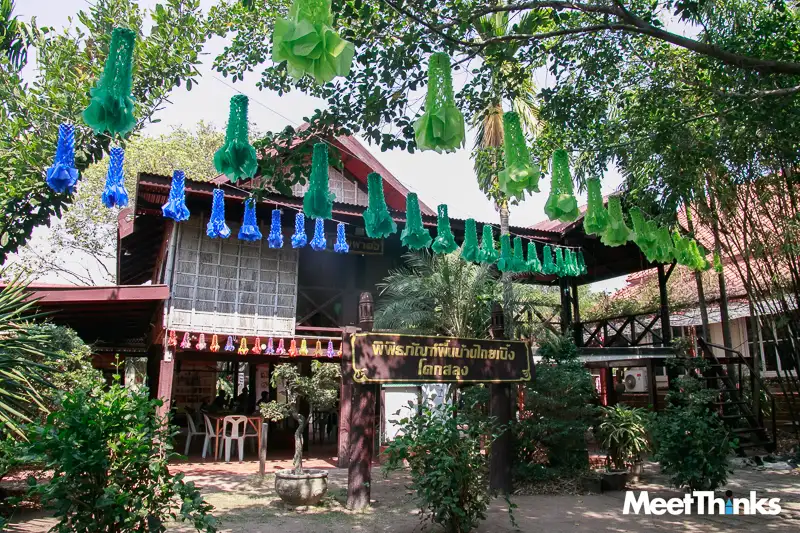
Khok Salung Thai Boeng Folk Museum
Open Days: Every Day
Opening Hours: 08.00 - 17.00 hrs.
Khok Salung Thai Boeng Folk Museum is a community museum located in Ban Khok Salung, Khok Salung Subdistrict, Phatthana Nikhom District, Lopburi Province. It is one of the important learning centers in the Pasak River Basin, clearly reflecting the community’s history, ethnic identity, and the traditional way of life of the Thai Boeng people. This place was not created solely from a tourism perspective, but from the determination of local people who wanted to preserve their roots amid the major changes that took place in the area after the construction of Pasak Jolasid Dam.
The origin of Khok Salung Thai Boeng Folk Museum is directly tied to the impact of the Pasak River Basin development project under the royal initiative. When some of the villagers’ traditional homes and farmlands were affected by the dam construction, the people of Khok Salung began to realize that if they did not work together to collect and preserve their belongings, tools, utensils, stories, language, and traditions, Thai Boeng culture, which had been passed down for generations, might gradually disappear along with the community’s original landscape.
For this reason, the villagers held a public hearing in 1998 and agreed to establish a Thai Boeng folk museum as a place to showcase their community identity and pass on their stories to younger generations. The museum officially opened in 2000, and since then it has become both a cultural heart of the Thai Boeng community and a learning center where outsiders can closely experience the real life of the community.
The distinctiveness of this museum lies in the way it tells the story of the Thai Boeng people through tangible objects. These include traditional houses, fishing tools, farming equipment, local clothing, red shoulder bags, checkered cloths, and the small household details that help visitors clearly picture Thai Boeng life in a concrete way, rather than learning only from labels or historical descriptions.
The Thai Boeng of Khok Salung are considered a group whose culture is closely related to that of the Thai Korat people, but who later settled in Lopburi and formed a distinct community of their own. What makes people easily recognize the Thai Boeng is their speech, which resembles Central Thai but carries a unique drawling accent, along with sentence-ending words that are instantly memorable, such as “boeng,” “toeng,” “woei,” or “dok.” This linguistic feature is not merely a way of speaking, but a marker of Thai Boeng identity passed down through everyday life.
Beyond language, clothing and everyday items are also part of the identity that the museum presents in an interesting way. Elderly women in the community often wear chong kraben trousers, a krajom blouse or an i-hiw blouse, drape a checkered cloth over the shoulder, enjoy chewing betel nut, and carry a red shoulder bag. Such images reflect a way of life connected to simplicity, practicality in daily work, and a form of beauty rooted in traditional community values, clearly different from urban society.
Another aspect that attracts attention is the surnames of people in the community. Many Thai Boeng people of Khok Salung have surnames that begin with or end in the word “Salung,” which has become an important signifier of kinship and community ties. This is not merely a small cultural detail, but also shows how strongly connected the Thai Boeng community is at both family and extended family levels.
Inside the museum, there is a reconstruction of a traditional Thai Boeng house, which is considered the heart of the exhibition. This house is a raised house with walls made from khro leaves and a pull-out staircase. The staircase is quite narrow and steep, but fully functional. Once visitors step inside, they will see an open terrace without a roof, used as a breezy communal family space. This spot vividly reflects the relationship among household members, as it served as the place where they gathered for dinner in the custom known as “kin khao lo.”
“Kin khao lo” does not simply mean sitting down to eat together. It is a family custom that allowed everyone to see one another, talk, and ask about each other’s well-being after a day’s work. In the past, Thai Boeng families usually cooked only one evening meal, then shared dishes with relatives in nearby homes and exchanged food with one another. This created very strong kinship bonds. The custom has declined as more people in the community have gone to work outside the village, but the museum still preserves the memory of this way of life very clearly.
The traditional khro-walled Thai Boeng house also reflects impressive wisdom in the use of natural materials. The walls are made from the khro palm, a type of palm tree known for its durability, lasting around 20–30 years. The wall structure has 3 layers: the outer layer is made of khro leaves to protect against sun and wind, the middle layer is made of vetiver, and the innermost layer is split bamboo. At first glance, it may seem like a simple vernacular house, but in reality it embodies practical building knowledge and adaptation to climate and living conditions.
Inside the house, the space is open without complicated room divisions. The owner stores bedding, pillows, and mosquito nets in an orderly way, and extra sleeping space can be arranged flexibly when guests come. Near the doorway and on the walls, people often hang their working tools, such as fish traps, casting nets, livestock bells, and hunting equipment like muskets and crossbows. These details show that the museum does not merely present the “appearance” of a Thai Boeng house, but also explains the way of thinking, the lifestyle, and the relationship between the home and the occupations of the people who lived there.
Visiting Khok Salung Thai Boeng Folk Museum is therefore not the same as simply looking at old objects in glass cases. It is an opportunity to step into the world of the Thai Boeng community through architecture, spoken language, clothing, household items, food, and shared memories of the people of Ban Khok Salung. Many visitors come here to learn about community life while also visiting nearby places such as Pasak Jolasid Dam, Khao Phaya Doen Thong Viewpoint, or agricultural tourism sites in Phatthana Nikhom District. This makes the museum both a cultural destination and a meaningful starting point for community-based travel.
Today, the museum still serves as a center for activities of the Thai Boeng cultural community of Ban Khok Salung, including welcoming study groups, weaving activities, basketry, traditional toys, making khanom bueng, and various forms of cultural tourism. It can therefore be said that this museum does not stop at preserving the past, but is also a living space where the past connects with the present. It helps the Thai Boeng continue to tell their descendants and visitors clearly, “Do not forget your roots, boeng.”
Getting There to Khok Salung Thai Boeng Folk Museum is most convenient by private car, using Ban Khok Salung, Khok Salung Subdistrict, Phatthana Nikhom District, Lopburi Province as the destination. The museum is located within the community and not far from Khok Salung Railway Station. Visitors who wish to make the most of their visit should contact the community in advance, because visitor information indicates that prior coordination is recommended, and arranging ahead of time will allow for a deeper and more organized learning experience about the community.
Overall, Khok Salung Thai Boeng Folk Museum is much more than an ordinary local museum. It is a place where the community preserves its own memories amid the physical and social changes brought by Pasak Jolasid Dam. It is therefore highly suitable for those who want to explore Lopburi on a deeper level than simply visiting famous landmarks, and for anyone who wants to understand what “community culture” truly looks like in real life in one area of the Pasak River Basin.
| Summary | A community museum that preserves the way of life, language, houses, clothing, and local wisdom of the Thai Boeng people of Ban Khok Salung. |
| Highlights | Traditional khro-walled house, stories of Thai Boeng life in the Pasak River Basin, Thai Boeng language and accent, the kin khao lo dining tradition, traditional working tools, and its role as a center of community activities. |
| History / Period | Villagers came together in 1998 after being affected by the construction of Pasak Jolasid Dam and established the museum to preserve Thai Boeng identity. It officially opened in 2000. |
| Address | 99/3 Moo 3, Khok Salung Subdistrict, Phatthana Nikhom District, Lopburi 15140 |
| Getting There | Traveling by private car is the most convenient. Use Ban Khok Salung, Phatthana Nikhom District, Lopburi Province as the destination. The museum is within the community and not far from Khok Salung Railway Station. It is recommended to contact the community in advance before visiting. |
| Open Days | Every Day |
| Opening Hours | 08.00 - 17.00 hrs. |
| Admission Fee | Free of charge |
| Facilities | Community learning area, exhibition houses, parking area, and cultural learning activities organized by the community when arranged in advance. |
| Zones | Traditional Thai Boeng khro-walled house, display area for household tools, storytelling area on Thai Boeng language and culture, and an activity courtyard for community learning. |
| Current Status | Still operating as a community museum and learning center of the Thai Boeng cultural community of Ban Khok Salung. |
| Nearby Tourist Attractions | 1. Khok Salung Railway Station – approx. 500 m. 2. Khao Phaya Doen Thong Viewpoint – approx. 7.3 km. 3. Pasak Jolasid Dam – approx. 15 km. 4. Pasak River Basin Museum – approx. 14 km. 5. Pasak Jolasid Dam Aquarium – approx. 14 km. |
| Nearby Restaurants | 1. Pee Jeab Fresh Coffee – approx. 300 m. Tel. 081-293-1114 2. Moo Tha Rim Nam – approx. 7.8 km. Tel. 089-093-8925 3. Tong'au Cafe & Restaurant – approx. 8.7 km. Tel. 098-943-5884 4. Punthai Coffee, PT Phatthana Nikhom – approx. 9.2 km. Tel. 065-732-7206 5. Rin Khao Kha Moo – approx. 10 km. Tel. 091-792-6056 |
| Nearby Accommodations | 1. Phattharaprapa Resort – approx. 13 km. Tel. 081-565-9503 2. Narai Hill Golf Resort & Country Club – approx. 18 km. Tel. 084-427-4003 3. Ban Wang Phrueksa Home Resort – approx. 19 km. Tel. 092-334-3393 4. Jampi Resort – approx. 20 km. Tel. 098-316-5509 5. Wang Sam Chai Resort – approx. 25 km. Tel. 095-884-8596 |
| Main Contact Number | 084-978-6782 (Khun Pratheep Onsalung) |
Frequently Asked Questions (FAQ)
Q: Where is Khok Salung Thai Boeng Folk Museum located?
A: The museum is located in Ban Khok Salung, Khok Salung Subdistrict, Phatthana Nikhom District, Lopburi Province.
Q: Why was Khok Salung Thai Boeng Folk Museum established?
A: The museum was established by villagers after they were affected by the construction of Pasak Jolasid Dam and wanted to preserve the culture, way of life, and identity of the Thai Boeng people for future generations.
Q: Who are the Thai Boeng people?
A: The Thai Boeng are a group of people in the Pasak River Basin with a distinct identity in language, accent, clothing, and way of life, with cultural ties to the Thai Korat people.
Q: What can be seen inside the museum?
A: Inside the museum, visitors can see a traditional Thai Boeng khro-walled house, working tools, household items, reconstructions of domestic life, and stories about the language, culture, and traditions of the Thai Boeng of Khok Salung.
Q: Is there an admission fee?
A: The museum currently does not charge an admission fee.
Q: What days and times is the museum open?
A: The museum is open every day from 08.00 - 17.00 hrs.
Q: What is “kin khao lo”?
A: Kin khao lo is the Thai Boeng custom of sitting together for dinner as a family, where everyone sees one another, talks, asks about each other’s well-being, and also connects with the tradition of sharing dishes with relatives.
Q: Where can I contact for more information?
A: For more information, you can contact Khok Salung Thai Boeng Folk Museum at 084-978-6782.
 Category: ●Art, Culture and Heritage
 Group: ●Museums
Last Update : 6 MonthAgo
 Last Update : 6 MonthAgo
 Click to Access the Navigation Map GPS
Khok Salung Thai Boeng Folk Museum Map
Recommend

 Historical Sites and Monuments(5)
 Landmarks and Memorials(3)
 Royal Palace(1)
 Art, Craft Centres, Tradition(7)
Museums(11)
Art, Craft Centres, Tradition(7)
Museums(11)
 Historic Homes and Cities(1)
 Places of Worship
 Temple(25)
 Other Sacred Sites(3)
 Suburban Living
 Village, Community(4)
 Floating Market(1)
 Nature and Wildlife
 National Parks and Marine Reserves(2)
 Mountain (Doi)(3)
 Dam, Reservoir, Lake(4)
 Waterfalls(5)
 Hot Springs(1)
 Caves(2)
 Flower Field(1)
 Entertainment and Agricultural
 Zoos and Aquariums(2)
 Farms, Parks and Ecotourism(4)
 Outdoor and Adventure Activities(1)


