
lovethailand home >North Travel Attractions >Chiang Mai Travel Attractions >Muang Chiang Mai >Si Phum > Kanom Sila Aon
TL;DR: Kanom Sila Aon. It is a Thai dessert made with rice flour. In general, roasted mung beans are cooked and crushed before eating. Northern Thai desserts that.

Kanom Sila Aon
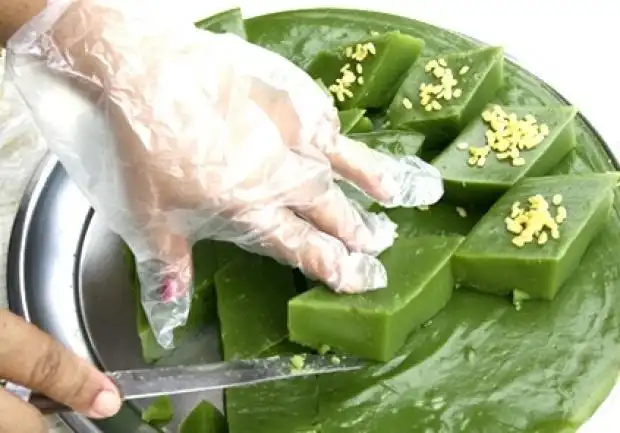
Kanom Sila Aon It is a Thai dessert made with rice flour. In general, roasted mung beans are cooked and crushed before eating. Northern Thai desserts that are similar to rhombuses. The uniqueness is that the texture of the powder is soft and sticky. easy to eat and delicious pandan fragrance Because they use pandan leaves as raw materials for making desserts. The Sila-on dessert is the people of Sawi District. of Chumphon Province, well known and is popular with the general public caused by attempts to modify and developed rhombuses that are difficult and easy to lose, until becoming more modern stone candy using locally sourced ingredients.
Khanom Sila On is a northern Thai dessert with similar appearance, color and taste to rhombus, but there will be differences in the sprinkles. The rhombus uses coconut sprinkles on top. As for Kanom Sila-on, it uses nuts to sprinkle over the dessert. The difference that is clearly seen is that the ingredients used by Khanom Sila-on contain coconut milk. While there is no rhombus, it has to be sprinkled with coconut to enhance its aroma only. Khanom Sila-on is made from rice flour. glutinous rice flour bean flour mixed together including a mixture of syrup and coconut milk In some areas it is called Kanom Sala-On or Kanom Sala-On, in some places it is simply called Khanom Thad. Khanom Sila-On has the following ingredients:
Thai desserts are unique in Thai national culture, namely, they are delicate and delicate in selecting raw materials by meticulous methods of making, delicious and sweet taste. and beautiful colors Appetizing appearance as well as elaborate methods.
Northern Thai dessert Most are made from glutinous rice. And most of them use boiling methods such as rice porridge, Hua Hok, Khanom Thien and Khanom Wong. They are usually made during important festivals such as Buddhist Lent Day or Songkran Day.
Desserts that are popularly made in almost all festivals are Candle candy or jok It is a snack that can be bought in general. Khanom Pat, which is similar to Kanom Sila. Eitu rice or red glutinous rice Khao Tan or Khao Tan, Khanom Kluea, a dessert that is eaten only during the winter, such as sesame rice, which is roasted sesame seeds pounded with sticky rice. If you add sugarcane juice, call it sesame seeds, sugarcane balls, ginkgo beans, edamame beans, narrow rice or kite crackers, boiled Luklan.
In Mae Hong Son Province Traditional desserts include Khanom Alawa, which is similar to Khanom Mo Kaeng, Khanom Peng Mong, which is similar to Khanom Alawa, but the flour is fermented first. Suay Tamin dessert is made from steamed glutinous rice. cane sugar and coconut milk During the period when there is a lot of cane sugar, 2 types of desserts are popularly made: sesame seeds, made from sugar cane sugar, simmered to be sticky like nougat and then mixed with sesame seeds, and pae yo, made from sugar cane sugar and peanuts. It looks like a cut bean, etc.
Ingredient
- 2 kg of rice
- Thao Yai Mom flour 300 g.
- 5 kg of granulated sugar
- 2 kg of palm sugar
- Pandan leaves 1 kg.
- 15 liters of freshly squeezed coconut milk
- Sliced peanuts garnished with sweet sila snack
- 20 liters of lime water
How to make Kanom Sila Aon
1. Start by preparing lime water. By fermenting lime water before 3 days to get lime water that is not coarse. and no mortar After that, collect lime water to make desserts. By preparing lime water in approximately 20 liters.
2. After that, start fermenting the rice in lime water for about 6 hours, then bring the rice flour to be milled. then set aside by blending pandan leaves with lime water Then squeeze the pandan juice. (Filter with some white cloth) set aside. then mix the flour By bringing rice flour, pandan juice and coconut milk to mix them together. Then put the pan Then bring all the flour mixture to the boil over medium heat. Then season with sugar and palm sugar. Continue chewing for about 2 hours or until the dough is sticky.
3. The last step, pour the dough into a mold or tray, then set aside to cool. and then cut into bite-sized pieces and sprinkle with grated coconut.
| Name | Khanom Sila On |
| Other Names | Salā On Dessert / Sala On / Tray Dessert |
| Category | Traditional Thai Dessert / Snack / Northern-style Thai Dessert |
| Similar Dessert | Similar to Thai Pandan Pudding (Khanom Piak Poon) |
| Main Ingredients | Rice Flour, Arrowroot Flour, Sugar, Palm Sugar, Pandan Leaves, Coconut Milk, Limewater, and Roasted Peanuts |
| Key Characteristics | Soft, chewy texture with a smooth consistency, green color from pandan, topped with roasted peanuts |
| Taste | Sweet, fragrant, creamy from coconut milk, with nutty flavor from peanuts |
| Texture | Soft, slightly elastic, smooth, and firm enough to cut into pieces when cooled |
| Difference from Piak Poon | Contains coconut milk in the batter and is topped with peanuts instead of shredded coconut |
| Topping | Roasted crushed peanuts (sometimes shredded coconut depending on local variation) |
| Main Aroma | Fragrant pandan and fresh coconut milk |
| Role of Limewater | Helps the dessert set properly and gives a firm yet chewy texture |
| Limewater Preparation Time | Prepared in advance for about 3 days to ensure clarity and remove sediment |
| Rice Soaking Time | Approximately 6 hours before grinding into flour |
| Key Process | Grinding rice, extracting pandan juice, mixing with coconut milk, and continuously stirring until thickened |
| Cooking Time | About 2 hours of continuous stirring over medium heat |
| Cooking Method | Stir-cooked in a pan, then poured into trays and left to set |
| Serving Style | Cut into bite-sized pieces after cooling and topped with roasted peanuts |
| Important Tip | Stir continuously to prevent lumps and ensure a smooth, even texture |
| Precaution | Too high heat or insufficient stirring may cause uneven cooking or burning |
Frequently Asked Questions (FAQ)
Q: What is Khanom Sila On?
A: Khanom Sila On is a traditional Thai dessert made from rice flour, coconut milk, sugar, and pandan juice. It is cooked until thick, poured into a tray, and cut into pieces before serving with roasted peanuts.
Q: What are its alternative names?
A: It may also be called Sala On dessert or simply a tray-style dessert, depending on the region.
Q: How is it similar to Piak Poon?
A: It has a similar chewy texture and pandan flavor, but differs in ingredients and toppings.
Q: What makes it different from Piak Poon?
A: Khanom Sila On contains coconut milk in the batter and is typically topped with peanuts instead of shredded coconut.
Q: Why is limewater used?
A: Limewater helps improve the texture, giving the dessert a firm yet soft and chewy consistency.
Q: Why must limewater be prepared in advance?
A: Allowing it to settle removes sediment and ensures only clear limewater is used, resulting in better texture.
Q: Why soak rice before grinding?
A: Soaking softens the rice, making it easier to grind into fine flour and improving the final texture.
Q: How long should it be cooked?
A: It typically requires about 2 hours of continuous stirring until the mixture becomes thick and smooth.
Q: How do you know when it is ready?
A: The mixture becomes thick, glossy, and smooth, holding its shape when poured into a tray.
Q: Why must it be stirred continuously?
A: Continuous stirring prevents lumps and ensures even cooking, resulting in a smooth texture.
Q: What topping is best?
A: Roasted peanuts are commonly used, adding a nutty flavor and texture contrast.
Q: How long can it be stored?
A: It is best consumed within one day. It can be refrigerated for 2–3 days, but texture may become firmer over time.
 Category: ●Travel Articles, Recipes
 Group: ●Thai Desserts, North Recipes
Last Update : 5 MonthAgo
 Last Update : 5 MonthAgo
Recommend

 Art, Culture and Heritage
 Historical Sites and Monuments(8)
 Landmarks and Memorials(5)
 Royal Palace(2)
 Art, Craft Centres, Tradition(43)
 Museums(24)
 Educational Places
 Museum for Study(2)
 Educational Gardens, Farm(5)
 Training Center(1)
 Places of Worship
 Temple(79)
 Mosque(2)
 Other Sacred Sites(17)
 Research and Development
 Royal Project(44)
 Suburban Living
 Village, Community(41)
 Local Market(14)
 Nature and Wildlife
 National Parks and Marine Reserves(16)
 Mountain (Doi)(21)
 Dam, Reservoir, Lake(26)
 Waterfalls(43)
 Hot Springs(12)
 Caves(11)
 River, Canal(6)
 Other natural attractions(14)
 Entertainment and Agricultural
 Zoos and Aquariums(2)
 Animal camps and shows(3)
 Stadium(1)
 Farms, Parks and Ecotourism(19)
 Waterpark(2)
 Theater(1)
 Outdoor and Adventure Activities(10)
 Shopping
 Shopping and Night Market(6)
 Restaurant
 Michelin Star(1)
 Michelin Guide(23)
 Call Customer Service in Tourism
 Call Customer Service in Tourism(1)
 Travel Review, Food Review(18)
 Food Menu, North Recipes(30)
Thai Desserts, North Recipes(17)
Food Menu, North Recipes(30)
Thai Desserts, North Recipes(17)


