
lovethailand home >North Travel Attractions >Phayao Travel Attractions >Chiang Kham >Rom Yen > Pha Daeng Cave
TL;DR: Pha Daeng Cave is located at Ban Pang Tham, Moo 9, Rom Yen Subdistrict, Chiang Kham District, Phayao Province, open Daily, hours According to Phu Sang National Park operating hours.

Pha Daeng Cave
Open Days: Daily
Opening Hours: According to Phu Sang National Park operating hours
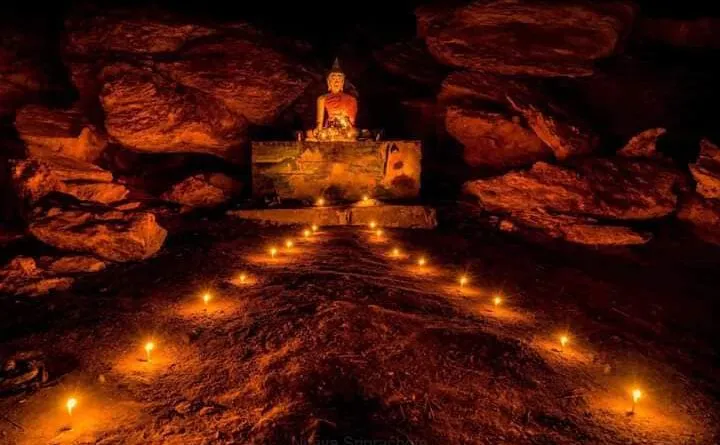
Pha Daeng Cave is a natural limestone cave located at Ban Pang Tham, Moo 9, Rom Yen Subdistrict, Chiang Kham District, Phayao Province. The cave is known for its limestone formations, beautiful stalagmites and stalactites, and a natural mountain setting surrounded by forest and limestone cliffs. Its entrance is about 10 meters wide, and the cave extends approximately 450–500 meters into the mountain. With no electric lighting inside, Pha Daeng Cave is best suited for prepared travelers who enjoy nature exploration, cave landscapes, geology, and quiet forest environments.
Pha Daeng Cave offers a different experience from the more familiar attractions of Phayao such as Kwan Phayao, temples, waterfalls, and mountain viewpoints. It brings travelers into the quieter side of Chiang Kham District, where limestone mountains, local forest, and rural communities remain closely connected. This cave is not simply a short sightseeing stop. It is a place where visitors can observe how water, minerals, darkness, and time have shaped the interior of a limestone mountain.
The geological character of Pha Daeng Cave is one of its main attractions. Inside the cave, stalagmites and stalactites have formed slowly through the deposition of calcium carbonate from water dripping through limestone. Some formations look like frozen curtains of water, while others appear as columns, spikes, and unusual natural shapes. These formations are delicate and take a very long time to develop, making them valuable natural features that must be protected.
Entering the cave gives visitors a clear sense of moving into a different world. Natural light gradually fades, the air becomes cooler and more humid, and sounds from outside disappear. The atmosphere inside is calm and still, with only footsteps, dripping water, or echoes moving through the chamber. This is part of the unique charm of cave travel. Unlike open viewpoints or waterfalls, caves require slower movement, careful observation, and a strong sense of caution.
The area around the cave entrance is also scenic. Pha Daeng Cave is surrounded by forested hills and limestone cliffs. From the cave entrance, visitors can see a dramatic limestone cliff opposite the cave, creating a memorable natural landscape. The cave is therefore attractive not only for its interior formations but also for the surrounding mountain and forest scenery.
The name “Pha Daeng” reflects the character of the cliff landscape in the area. It connects the cave with the limestone cliff and the local geography of Ban Pang Tham. For local communities, places like this often serve as natural landmarks, reference points, and memory sites. The name gives the cave a strong identity tied to its surrounding terrain.
Pha Daeng Cave is associated with Phu Sang National Park and is located about 1 km from National Park Protection Unit 1 (Pha Daeng). This connection helps provide a framework for conservation and visitor guidance. However, visitors should not expect a fully developed commercial cave with electric lights, paved walkways, and complete tourist infrastructure inside. The cave remains natural, and visitors must prepare properly before entering.
Before visiting the cave, travelers should contact Phu Sang National Park staff or local officers for updated information. This is especially important for visitors who want to explore deeper inside the cave. The cave floor may be damp, slippery, uneven, and dark. Traveling with park staff or a local guide who knows the route is strongly recommended. Visitors should stay together as a group and avoid walking alone into side passages or poorly lit areas.
Because there is no electric lighting inside Pha Daeng Cave, visitors should bring a reliable flashlight, a headlamp, and backup batteries. A mobile phone light should not be the only source of light because it may not be bright enough and can drain the battery quickly. Photographers should also protect their equipment from moisture and use lighting carefully so as not to disturb cave wildlife.
Proper footwear is essential. The cave floor can be wet, slippery, and uneven. Closed shoes with good grip or light hiking shoes are recommended. Flip-flops or smooth-soled shoes are not suitable. Clothing should allow easy movement and should be appropriate for damp and dusty conditions inside the cave.
The stalagmites and stalactites inside Pha Daeng Cave are fragile natural resources. Touching, climbing, writing on, or breaking formations can cause permanent damage. Visitors should appreciate the formations visually, keep a safe distance, and avoid moving or removing anything from the cave. Responsible cave tourism means entering the cave without leaving any trace behind.
The beauty of Pha Daeng Cave comes not only from its rock formations but also from the cave environment as a whole: darkness, cool air, humidity, silence, echoes, and the sense of being inside a mountain. The cave reminds visitors of geological time, which moves far more slowly than human life. Seeing these natural formations helps travelers appreciate the delicate processes that shape the underground world.
The surrounding area is suitable for nature study. Forest, limestone cliffs, and cave ecosystems are closely linked. The forest helps maintain moisture and stability around the cave, while the cave itself may provide habitat for insects, bats, and other small organisms adapted to darkness and humidity. Visitors should keep their voices low, avoid disturbing wildlife, and avoid shining strong lights directly at animals for long periods.
Rom Yen Subdistrict and Ban Pang Tham are suitable for quiet nature-based travel. This is not a crowded tourist zone with dense commercial development. The journey to Pha Daeng Cave is therefore best for travelers who are ready to respect natural conditions. Some local roads may be unpaved or less smooth than main highways, especially during the rainy season, but this simple route is part of the experience of reaching a natural cave site.
Getting There can begin from Chiang Kham District. Take Highway 1021 toward Rom Yen Subdistrict for about 15 km, then continue on the local route to Ban Pang Tham, Moo 9, and the Pha Daeng Cave area. Private car or motorcycle is the most convenient option. During the rainy season, road conditions should be checked before traveling because unpaved sections may become slippery.
Travelers starting from Mueang Phayao should first drive to Chiang Kham District, then continue to Rom Yen Subdistrict. The trip from Phayao city takes some time, so starting early is recommended. For a more relaxed schedule, visitors can stay overnight in Chiang Kham and visit the cave the next morning.
Travelers without private vehicles can reach Chiang Kham District first, then arrange local transport or a hired vehicle to Ban Pang Tham and the cave area. Return transportation should be arranged in advance because the cave is not on a frequent public transport route. Visitors should not enter the nature route without clear transportation arrangements.
The best time to enter the cave is in the morning or before noon. This allows enough time to prepare, explore safely, and return before evening. Entering late in the afternoon is not recommended because the cave has no natural light inside and the surrounding forest area can become dark quickly. If there is heavy rain or unstable weather, the trip should be postponed.
Visitors should follow the principle of entering only as far as conditions and preparation allow. If there is no flashlight, no suitable footwear, or no knowledgeable guide, visitors should not go deep into the cave. The cave entrance and surrounding limestone landscape can still be appreciated safely. Knowing one’s limits is an important part of responsible nature travel.
Recommended items include at least two light sources, spare batteries, non-slip shoes, drinking water, snacks, personal medicine, a trash bag, a small first-aid kit, and rain protection during the rainy season. Visitors who plan to take photographs should use simple equipment that can be handled safely in humid and low-light conditions.
Pha Daeng Cave is suitable for nature lovers, students, photographers, and travelers interested in geology and limestone caves. It is less suitable for visitors with walking difficulties, those uncomfortable in darkness, young children without close supervision, or travelers who need full facilities. Children should be supervised at all times because cave floors and rocks may be slippery.
Nearby attractions can be combined into a wider Chiang Kham and Phu Sang route. These include National Park Protection Unit 1 (Pha Daeng), Huai Pong Pha Waterfall, Wat Phra Nang Din, Wat Saen Mueang Ma, Phu Sang Waterfall, Phu Sang National Park, and Ban Huak. This route is suitable for travelers who want a mix of caves, waterfalls, mountains, temples, and local community scenery.
A one-day trip can begin from Chiang Kham in the morning, continue to Ban Pang Tham and Pha Daeng Cave, then visit nearby natural or cultural attractions in the afternoon. A two-day itinerary can include Phu Sang Waterfall, Doi Chom Dao, Ban Huak, and cultural sites in Chiang Kham. Staying overnight in Chiang Kham makes the trip easier and safer.
For food and accommodation, Chiang Kham town is a practical base. It has restaurants, cafes, resorts, hotels, and essential services. Staying in Chiang Kham allows visitors to enter the cave area in the morning and continue to other attractions without rushing.
Conservation is essential at Pha Daeng Cave. Visitors should carry out all trash, avoid leaving food scraps, never light fires inside the cave, avoid smoking, not write on cave walls, not touch cave formations, and keep noise low. These actions help preserve the cave’s beauty and protect the cave ecosystem.
Visitors should also avoid exploring deep or narrow sections without park staff or a local guide. Caves contain risks such as darkness, slippery ground, uneven surfaces, side passages, and limited airflow in some areas. Staying on recommended routes and avoiding uncertain areas will make the visit safer and reduce the chance of emergencies.
Pha Daeng Cave is beautiful because it remains natural. Its value lies in the limestone formations, the quiet cave environment, the surrounding forest, and the cliff landscape. Travelers who approach the cave with preparation and respect will gain more than photographs. They will gain an understanding of how slowly and delicately nature creates underground landscapes.
Overall, Pha Daeng Cave is a meaningful conservation-based attraction in Chiang Kham District, Phayao Province. It is best suited for travelers who want to experience a quieter natural route beyond the province’s mainstream attractions. With proper preparation, local guidance, and careful movement, Pha Daeng Cave can offer a memorable encounter with limestone geology, forest scenery, and the silent beauty of the underground world.
| Name | Pha Daeng Cave |
| Location | Ban Pang Tham, Moo 9, Rom Yen Subdistrict, Chiang Kham District, Phayao Province |
| Address | Ban Pang Tham, Moo 9, Rom Yen Subdistrict, Chiang Kham District, Phayao 56110 |
| Highlights | A limestone cave in Ban Pang Tham with beautiful stalagmites and stalactites, surrounded by forest and large limestone cliffs |
| Distinctive Features | The cave entrance is about 10 meters wide, and the cave extends approximately 450–500 meters into the mountain. There is no electric lighting inside |
| Name Origin | The name “Pha Daeng” reflects the distinctive limestone cliff landscape around Ban Pang Tham and the cave area |
| Travel Information | From Chiang Kham District, take Highway 1021 toward Rom Yen Subdistrict for about 15 km, then continue on the local road to Ban Pang Tham, Moo 9, and Pha Daeng Cave. Private car or motorcycle is recommended, and road conditions should be checked before traveling |
| Current Status | A natural attraction within the Phu Sang National Park area. Visitors should contact park officers before entering the cave |
| Open Days | Daily |
| Opening Hours | According to Phu Sang National Park operating hours |
| Facilities | No electric lighting inside the cave. Visitors should bring flashlights, backup lights, non-slip shoes, drinking water, snacks, and a first-aid kit |
| Main Areas / Zones | Cave entrance, cave chamber, stalagmite and stalactite areas, cave walls, limestone cliffs, surrounding forest, and National Park Protection Unit 1 (Pha Daeng) |
| Caretaker | Phu Sang National Park, Department of National Parks, Wildlife and Plant Conservation |
| Main Contact Number | 093-293-5099, 054-401-099 |
| Official Website / Official Page | Phu Sang National Park Official Facebook Page |
| Nearby Tourist Attractions | 1. National Park Protection Unit 1 (Pha Daeng), about 1 km 2. Huai Pong Pha Waterfall, about 20 km 3. Wat Phra Nang Din, about 24 km 4. Wat Saen Mueang Ma, about 25 km 5. Phu Sang Waterfall / Phu Sang National Park, about 47 km 6. Ban Huak, about 55 km |
| Nearby Restaurants | 1. Chiang Ban Rooftop X Cafe', about 24 km, Tel. 082-030-0717 2. Rong Tiam 88 Chiang Kham, about 25 km, Tel. 092-268-9161 3. Chedi Kham Chiang Kham, about 25 km, Tel. 097-254-9916 4. Hug Carp Cafe Chiang Kham, about 26 km 5. Local Restaurants In Chiang Kham Town, about 24 km |
| Nearby Accommodations | 1. Chiang Kham Grand Villa, about 24 km, Tel. 084-811-5585 2. Chiang Kham Hotel, about 25 km, Tel. 054-451-771 3. Chiang Kham Hom Hug Resort, about 26 km, Tel. 093-135-6191 4. Chom Tawan Resort Chiang Kham, about 27 km, Tel. 054-452-390 5. Chiang Kham Garden Resort, about 25 km, Tel. 054-451-453 6. Phu View Place, about 26 km, Tel. 080-848-8009, 081-163-2110 |
Frequently Asked Questions (FAQ)
Q: Where is Pha Daeng Cave located?
A: Pha Daeng Cave is located at Ban Pang Tham, Moo 9, Rom Yen Subdistrict, Chiang Kham District, Phayao Province, within the Phu Sang National Park area.
Q: What makes Pha Daeng Cave special?
A: It is a limestone cave with beautiful stalagmites and stalactites, extending approximately 450–500 meters into the mountain and surrounded by forest and limestone cliffs.
Q: Is there electric lighting inside Pha Daeng Cave?
A: No. There is no electric lighting inside the cave, so visitors should bring flashlights, headlamps, and backup batteries.
Q: Who is Pha Daeng Cave suitable for?
A: It is suitable for nature lovers, cave explorers, students, photographers, and travelers interested in limestone landscapes and quiet forest environments.
Q: Who should visitors contact before visiting Pha Daeng Cave?
A: Visitors should contact Phu Sang National Park or National Park Protection Unit 1 (Pha Daeng) for route information, safety guidance, and current conditions.
Q: How do visitors get to Pha Daeng Cave?
A: From Chiang Kham District, take Highway 1021 toward Rom Yen Subdistrict for about 15 km, then continue on the local road to Ban Pang Tham, Moo 9, and the cave area.
Q: When is the best time to visit Pha Daeng Cave?
A: Visitors should go in the morning or before noon on a clear day, allowing enough time to explore safely and return before evening. Heavy rain should be avoided.
Q: What nearby attractions can be visited with Pha Daeng Cave?
A: Nearby places include National Park Protection Unit 1 (Pha Daeng), Huai Pong Pha Waterfall, Wat Phra Nang Din, Wat Saen Mueang Ma, Phu Sang Waterfall, and Ban Huak.
 Category: ●Nature and Wildlife
 Group: ●Caves
Last Update : 4 MonthAgo
 Last Update : 4 MonthAgo
 Click to Access the Navigation Map GPS
Pha Daeng Cave Map
Recommend

 Art, Culture and Heritage
 Historical Sites and Monuments(4)
 Landmarks and Memorials(4)
 Art, Craft Centres, Tradition(1)
 Museums(2)
 Places of Worship
 Temple(39)
 Other Sacred Sites(5)
 Research and Development
 Royal Project(1)
 Suburban Living
 Village, Community(2)
 Local Market(4)
 National Parks and Marine Reserves(6)
 Mountain (Doi)(2)
 Dam, Reservoir, Lake(11)
 Waterfalls(8)
Caves(5)
Waterfalls(8)
Caves(5)
 River, Canal(3)
 Other natural attractions(5)


