
lovethailand home >Northeastern Travel Attractions >Loei Travel Attractions >Phu Kra Dueng >Si Than > Phu Kradueng National Park
TL;DR: Phu Kradueng National Park, Loei attractions : Nature and Wildlife, National Parks and Marine Reserves.

Phu Kradueng National Park
Open Days: Open For The Tourist Season From 1 October To 31 May Every Year / Closed For Forest Recovery From 1 June To 30 September Every Year
Opening Hours: Visitor Centers Generally 07.00 – 16.00 / Uphill Access Generally Until 13.00
Phu Kradueng National Park, Loei Province is one of Thailand’s most iconic nature destinations and one of the country’s classic hiking experiences. Located in Si Than Subdistrict, Phu Kradueng District, Loei Province, the park is famous for its flat-topped sandstone mountain, long uphill trail, pine forests, grasslands, evergreen forest, waterfalls, viewpoints, cliffs, camping atmosphere, and the powerful sense of achievement felt by those who reach the plateau on foot. For many Thai travelers, Phu Kradueng is not just a national park; it is a rite of passage. The journey up the mountain, the rest stops known as sam, the final climb to Lang Pae, the flat trail to Wang Kwang, sunrise at Pha Nok Aen, sunset at Pha Lom Sak, and nights in the cold mountain air together create one of the most memorable travel experiences in Thailand.
The park is popular because its natural setting is unusually diverse. Within one protected area, visitors can experience steep forest trails, highland pine forest, open grasslands, waterfalls, clear streams, red maple leaves in season, quiet ponds, cliff viewpoints, and long trails across a broad summit plateau. The lower section of the mountain gives a sense of effort and endurance, while the plateau above opens into a different world of cool air, sandy trails, pine trees, and distant views. This strong contrast between the climb and the summit is what makes Phu Kradueng special.
The word sam is central to the Phu Kradueng experience. Traditionally, it refers to a resting area where underground water or seepage may be found. For hikers, however, each sam is a welcome rest point during the uphill journey. Famous rest stops include Sam Haek, Sam Bon, Sam Kok Kok, Sam Kok Wa, Sam Kok Phai, Sam Kok Don, and Sam Khrae. During the tourist season, many of these points have food, drinks, fruit, snacks, and simple supplies. They allow hikers to rest gradually, recover energy, and continue the ascent at a manageable pace.
The main hiking route is challenging but well established. From the lower visitor center, hikers climb for a little over 5 kilometers to reach Lang Pae, the top edge of the plateau. From there, the trail becomes mostly flat for another 3 to 4 kilometers before reaching the Wang Kwang visitor center and campsite. The total distance is roughly 8 to 9 kilometers. The first part is the most physically demanding, with steep sections and long climbs. The final stretch before Lang Pae is especially memorable because it tests both the legs and the mind. Reaching Lang Pae is therefore one of the great emotional moments of the trip.
The beauty of hiking Phu Kradueng is not only at the destination. It is found along the way: the changing forest, the smell of earth, the voices of other hikers, the encouragement exchanged between strangers, the rest stops, the food stalls, and the feeling of slowly rising above the lowlands. Every sam becomes a small milestone. Every difficult section becomes part of the story. By the time visitors reach the upper plateau, they understand why Phu Kradueng remains one of Thailand’s most beloved mountains.
Pha Nok Aen is the most famous sunrise viewpoint on the mountain. It is located not far from Wang Kwang, making it accessible before dawn. Visitors usually wake up very early, walk through cold darkness, and wait quietly at the cliff edge for the first light of the day. When the sun rises, the lowlands, fields, and mountain ranges below gradually appear in golden light. In some mornings, mist fills the valleys, creating a calm and unforgettable scene. Near the trail to Pha Nok Aen, wild roses bloom in large groups around March and April, adding seasonal charm to the area.
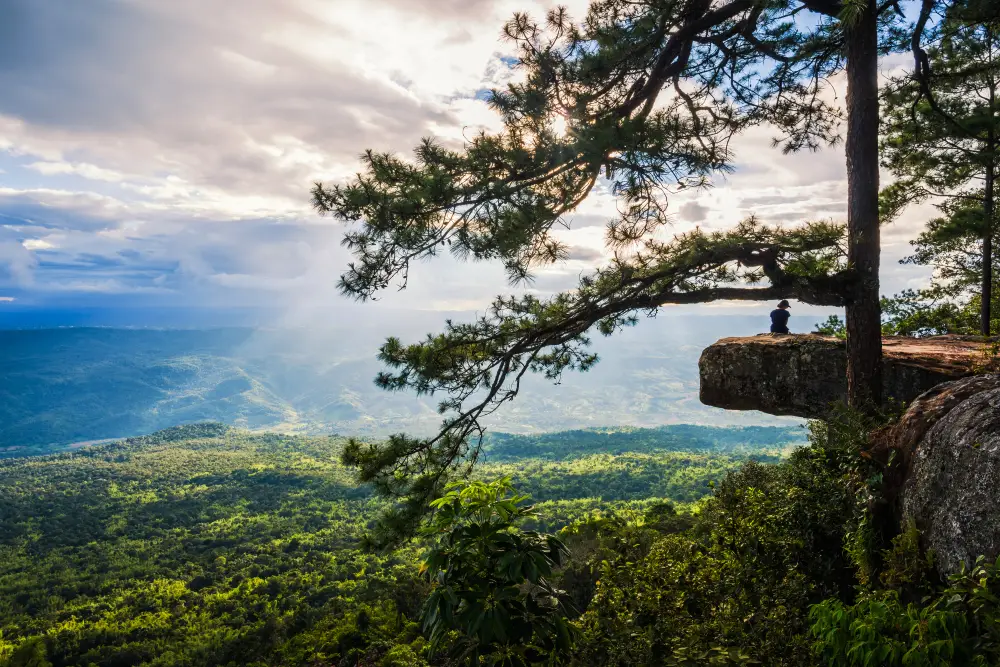
Pha Lom Sak is the most iconic sunset viewpoint of Phu Kradueng. It is a broad rocky cliff with a large pine tree standing near a projecting rock ledge. This composition has become one of the most recognizable images of the park. Photographers, hikers, and first-time visitors often make the long journey to this cliff for sunset. The route from Wang Kwang to Pha Lom Sak is long, so visitors must plan carefully, allowing enough time to go there and return safely after dark. A flashlight or headlamp is essential for the return walk.
Pha Mak Duk is another important viewpoint and is closer to Wang Kwang than Pha Lom Sak. It is a good option for visitors who want to enjoy a cliff view without walking too far. The viewpoint is also suitable for sunset, especially on the first evening after arriving at the plateau. Its accessibility makes it popular among hikers who are tired from the climb but still want to see a wide view before resting for the night.
The waterfalls of Phu Kradueng are another major part of the park’s identity. Famous waterfalls include Wang Kwang Waterfall, Phen Phop Mai Waterfall, Phon Phop Waterfall, Phen Phop Waterfall, Tham Yai Waterfall, Than Sawan Waterfall, Tham So Nuea Waterfall, and Tham So Tai Waterfall. These waterfalls are connected by forest trails and vary in size, atmosphere, and seasonal beauty. Some are most attractive during the rainy season and early cool season, while others are known for red maple leaves that cover the forest floor in late November and early December.
Tham Yai Waterfall is especially loved during the red maple season. When the leaves fall, the ground around the waterfall becomes covered in warm red tones, creating a rare seasonal scene in Thailand. This is one of the reasons many travelers return to Phu Kradueng during the early cool season. The waterfalls show that the park is not only about cliffs and viewpoints; it is also a forest landscape shaped by water, shade, and seasonal change.
Anodard Pond is a peaceful natural water body on the plateau. It is important both as a scenic stop and as part of the mountain ecosystem. Water sources on the plateau support wildlife and help maintain ecological balance. The atmosphere around the pond is calmer than the famous cliff viewpoints. It gives visitors a chance to experience the quieter side of Phu Kradueng, where forest, water, and silence are the main attractions.
The plateau contains several forest types, including pine forest, grassland, evergreen forest, and streamside vegetation. Walking from Wang Kwang toward different attractions reveals changing landscapes: open sandy trails, tall pine stands, shaded forest paths, wooden bridges, streams, and cliff edges. This diversity makes Phu Kradueng a strong nature-learning destination because visitors can clearly see how vegetation changes according to elevation, moisture, soil, and exposure.
Wildlife is part of the Phu Kradueng experience. Visitors may see sambar deer around Wang Kwang and may encounter signs of wild boar, jackals, or other animals in the forest. Wildlife should always be respected. Visitors should not feed animals, approach them, leave food near tents, or treat them as entertainment. Feeding wildlife can make animals dependent on people and can create safety problems for both animals and visitors.
Wang Kwang is the main visitor center and overnight base on the plateau. It has camping grounds, park accommodation, restaurants, welfare shops, toilets, showers, visitor services, and trail connections to major attractions. After reaching Wang Kwang, travelers arrange tents or accommodation, eat, rest, and plan the next day’s routes. During the tourist season, the area becomes a temporary mountain community where hikers, porters, vendors, and park staff share limited highland resources.
Porters are an important part of Phu Kradueng culture. They carry luggage from the lower park area to Wang Kwang, allowing hikers to walk with lighter day packs. The service also provides income for local people. Travelers should keep essential items with them, such as water, medicine, rain gear, warm clothing, valuables, and documents, while sending heavier items with porters. Bags should be packed securely and weighed clearly before being handed over.
On the plateau, visitors can travel by walking or by renting mountain bicycles when conditions allow. Walking gives a slower and more detailed experience, while bicycles help cover long distances such as the route to Pha Lom Sak. However, the trails can be sandy, rough, or muddy after rain. Cyclists should ride slowly and carefully, especially where hikers are also using the same route.
A good Phu Kradueng itinerary should allow at least 3 days and 2 nights. On the first day, visitors hike up, reach Wang Kwang, settle in, and perhaps walk to Pha Mak Duk. On the second day, they can wake early for Pha Nok Aen, then explore waterfalls, Anodard Pond, pine forest, and Pha Lom Sak at sunset. On the third day, they descend and return. A 2-day, 1-night trip is possible, but it can feel rushed and may not allow enough time to enjoy the plateau.
The park opens for tourism from 1 October to 31 May every year. It closes from 1 June to 30 September for forest recovery and rainy-season safety. The late rainy season and early cool season are good for waterfalls and forest freshness. The cool season is best for sunrise, mist, and cold weather. Around March and April, wild roses near Pha Nok Aen can bloom beautifully. Each period offers a different experience.
Preparation is essential. Visitors should bring hiking shoes or sturdy closed-toe shoes, warm clothing, rain gear, a headlamp or flashlight, personal medicine, blister plasters, insect repellent, a reusable water bottle, personal trash bag, and a backpack with appropriate weight. Those with heart problems, knee problems, blood pressure concerns, or respiratory conditions should assess their health carefully before hiking.
Food is available both along the uphill trail and around Wang Kwang during the tourist season. Prices on the plateau are higher than at the base because goods must be carried up the mountain. Visitors should understand this cost and plan their budget accordingly. Although food is available, hikers should still carry drinking water and light snacks between rest points.
Travelers should prepare for national park entrance fees, vehicle fees, porter fees, tent or accommodation costs, bedding rental, food, drinks, and transport from Pha Nok Khao or Phu Kradueng junction to the park. Actual costs depend on the number of days, luggage weight, accommodation choice, and services used. Booking accommodation or tents in advance is recommended during busy periods.
Getting There by public bus is straightforward. Travelers can take a Bangkok-Loei bus and get off at Ban Pha Nok Khao, a key transfer point near Phu Kradueng. From there, songthaews run to the national park office. Another option is to travel to Chum Phae and continue by bus to Pha Nok Khao, then transfer to the park. This route is widely used by hikers without private vehicles.
Traveling by train is also possible by getting off at Khon Kaen Railway Station, then continuing by bus to Pha Nok Khao and taking local transport to the park. This option requires more transfers, so schedules should be checked carefully. Travelers who want to hike up on the same day should arrive at the park early enough before the uphill access cutoff time.
By private car from Loei city, take Highway 201 toward Phu Kradueng. The distance is about 75 kilometers. Then turn right onto Highway 2019 for about 8 kilometers to reach the park office. Vehicles remain at the lower parking area while visitors hike to the plateau. The parking area is used by travelers who stay overnight on the mountain.
The lower park office is where visitors register, pay fees, arrange accommodation, rent tents or bedding, weigh luggage for porters, and prepare before starting the hike. Arriving late may prevent visitors from going up the mountain on the same day because the trail takes several hours and should not be started too late. Travelers coming from far away may stay near the park or at Pha Nok Khao the night before hiking.
Nearby services are available around Pha Nok Khao, Phu Kradueng junction, and Phu Kradueng town. Jay Kim at Pha Nok Khao is a well-known stop for buses, food, toilets, and transfers to the park. Around Phu Kradueng District, visitors can find local restaurants, resorts, homestays, and small guesthouses suitable for staying before or after the hike.
Nearby attractions such as Suan Hin Pha Ngam in Nong Hin District can be added before or after the Phu Kradueng hike. However, because the hike requires significant energy, extra sightseeing should be planned carefully. It is better to visit surrounding attractions before the climb or after descending and resting.
Phu Kradueng is also a strong example of community-linked tourism. The park supports income for porters, food vendors, transport operators, accommodation owners, and local residents. At the same time, tourism creates pressure on the mountain ecosystem. Visitors should reduce waste, use water carefully, keep noise low, follow park rules, and take responsibility for their belongings and trash.
For international travelers, Phu Kradueng offers a distinctive side of Thailand. It is not a beach, city, or temple destination. It is a mountain plateau with pine forest, waterfalls, cliffs, campsites, local porters, and long walking routes. The hike is physically demanding but accessible with preparation. It is best suited to travelers who enjoy nature, hiking, photography, and meaningful outdoor experiences.
In summary, Phu Kradueng National Park is a legendary natural destination in Loei Province. Its uphill trail, sam rest stops, Lang Pae, Wang Kwang campsite, Pha Nok Aen sunrise, Pha Lom Sak sunset, waterfalls, Anodard Pond, pine forest, and highland atmosphere create a travel experience that is both challenging and deeply rewarding. Phu Kradueng is not only a mountain to conquer. It is a place that teaches patience, preparation, respect for nature, and the value of reaching a destination step by step.
| Name | Phu Kradueng National Park |
| Location | Si Than Subdistrict, Phu Kradueng District, Loei Province |
| Address | Phu Kradueng National Park, Si Than Subdistrict, Phu Kradueng District, Loei 42180, Thailand |
| Coordinates | Approximately 16.8704, 101.8466 |
| Highlights | Uphill trail with sam rest stops, Lang Pae, Wang Kwang visitor center, Pha Nok Aen, Pha Lom Sak, Pha Mak Duk, Wang Kwang Waterfall, Phen Phop Mai Waterfall, Phon Phop Waterfall, Tham Yai Waterfall, Than Sawan Waterfall, Anodard Pond, pine forest, grasslands, and campsites on the plateau. |
| History | Phu Kradueng is one of Thailand’s most famous national parks and a classic hiking destination, known for its diverse ecosystems, sandstone plateau, waterfalls, pine forest, grasslands, and cliff viewpoints. |
| Name Origin | The name combines phu, meaning mountain, and kradueng, meaning bell or large bell in local language. The name is linked with local stories and echoing sounds in some parts of the mountain. |
| Distinctive Features | A flat-topped sandstone mountain with a large summit plateau, steep hiking trail, rest stops, visitor center, campsite, waterfalls, cliffs, viewpoints, and seasonal forest scenery. |
| Travel Information | Public buses stop at Ban Pha Nok Khao or Phu Kradueng junction, where songthaews connect to the park. By train, travel to Khon Kaen and continue by bus to Pha Nok Khao. By car from Loei city, take Highway 201 and turn onto Highway 2019 for about 8 km to the park office. |
| Current Status | Open as a national park, hiking route, camping destination, park accommodation area, waterfall area, viewpoint destination, and nature learning site. The park closes for forest recovery from 1 June to 30 September every year. |
| Open Days | Open For The Tourist Season From 1 October To 31 May Every Year / Closed For Forest Recovery From 1 June To 30 September Every Year |
| Opening Hours | Visitor Centers Generally 07.00 – 16.00 / Uphill Access Generally Until 13.00. Visitors should arrive early in the morning. |
| Fees | Thai Visitors: Adult 40 Baht, Child 20 Baht Foreign Visitors: Adult 200 Baht, Child 100 Baht Motorcycle 20 Baht, Car 30 Baht |
| Porter Service | Porters carry luggage from the lower area to Wang Kwang visitor center. The general rate is 30 Baht per kilogram. |
| Facilities | Lower visitor center, Wang Kwang visitor center, camping grounds, park accommodation, restaurants, welfare shops, toilets, showers, rest stops, food stalls along the trail, porter service, and seasonal bicycle rental on the plateau. |
| Main Areas / Zones | Lower Park Office And Registration Zone Uphill Trail And Sam Rest Stop Zone Lang Pae And Flat Trail To Wang Kwang Zone Wang Kwang Visitor Center And Campsite Zone Pha Nok Aen Sunrise Zone Pha Lom Sak Sunset Zone Pha Mak Duk And Southern Cliff Zone Wang Kwang, Phen Phop Mai, Phon Phop, Tham Yai, And Than Sawan Waterfall Zone Anodard Pond And Pine Forest Zone |
| Caretaker / Responsible Agency | Phu Kradueng National Park, Department of National Parks, Wildlife and Plant Conservation |
| Main Contact Number | Visitor Center 0-4281-0833 / Accommodation Or Tent Booking 0-4281-0834 |
| Accommodation / Tent Booking | National Park accommodation booking system at nps.dnp.go.th and direct contact with Phu Kradueng National Park. |
| Important Note | Start hiking in the morning, do not begin after the park’s cutoff time, prepare hiking shoes, warm clothing, rain gear, flashlight, and personal medicine, and follow all park announcements. |
| Recommended Season | October to May. The late rainy season is good for waterfalls and forest freshness, while the cool season is best for mist, sunrise, and cold mountain weather. |
| Nearby Tourist Attractions | 1. Pha Nok Aen, on the plateau, about 1.1 km from Wang Kwang, Tel. 0-4281-0833 2. Pha Mak Duk, on the plateau, about 2.5 km from Wang Kwang, Tel. 0-4281-0833 3. Tham Yai Waterfall, on the plateau, about 2.3 km from Wang Kwang, Tel. 0-4281-0833 4. Pha Lom Sak, on the plateau, about 9 km from Wang Kwang, Tel. 0-4281-0833 5. Anodard Pond, on the plateau, Tel. 0-4281-0833 6. Ban Pha Nok Khao Transfer Point, about 20 km from the park office 7. Suan Hin Pha Ngam, Nong Hin District, about 45 km |
| Nearby Restaurants | 1. Park Restaurants And Welfare Shops At The Lower Area And Wang Kwang, about 0 km, Tel. 0-4281-0833 2. Jay Kim Restaurant, Pha Nok Khao, about 20 km, Tel. 042-074265, 042-074249, 042-074259, 085-9284506 3. Phu Kradueng Chai Thung Restaurant, about 8 km, Tel. 063-2263629 4. Chao Pa Cafe & Camping, about 15 km, Tel. 095-1986485 5. Local Restaurants In Phu Kradueng Town Area, about 8–12 km |
| Nearby Accommodations | 1. Phu Kradueng National Park Accommodation And Campsite At Wang Kwang And Park Areas, Tel. 0-4281-0834 2. Ban Thip Suwan Resort, about 8 km, Tel. 081-9648419, 096-3544991 3. Baan Srisunon Homestay, about 8 km, Tel. 082-1162334, 095-1197515 4. The Creek Villa, Phu Kradueng District, about 10 km 5. Ouab Im Resort Phu Kradueng, about 10 km 6. Accommodations Around Ban Pha Nok Khao, about 20 km |
Frequently Asked Questions (FAQ)
Q: When is Phu Kradueng National Park open?
A: The park is open for the tourist season from 1 October to 31 May every year and closes for forest recovery from 1 June to 30 September every year.
Q: How long is the hike up Phu Kradueng?
A: The main route climbs a little over 5 km to Lang Pae, then continues on a mostly flat trail for about 3–4 km to Wang Kwang visitor center. The total distance is roughly 8–9 km.
Q: What is the entrance fee?
A: Thai visitors pay 40 Baht for adults and 20 Baht for children. Foreign visitors pay 200 Baht for adults and 100 Baht for children. Motorcycle fee is 20 Baht and car fee is 30 Baht.
Q: Is porter service available?
A: Yes. Porters carry luggage from the lower area to Wang Kwang visitor center. The general rate is 30 Baht per kilogram.
Q: Where are the best sunrise and sunset viewpoints?
A: Pha Nok Aen is the most popular sunrise viewpoint, while Pha Lom Sak is the iconic sunset viewpoint. Pha Mak Duk is another good viewpoint closer to Wang Kwang.
Q: How many days should travelers spend at Phu Kradueng?
A: At least 3 days and 2 nights is recommended so visitors can hike up without rushing and have enough time for Pha Nok Aen, waterfalls, Anodard Pond, Pha Lom Sak, and the descent.
Q: Can travelers go without a private car?
A: Yes. Travelers can take a Bangkok-Loei bus and get off at Ban Pha Nok Khao, or travel by train to Khon Kaen and continue by bus to Pha Nok Khao, then take a songthaew to the park office.
Q: What should visitors prepare before hiking?
A: Visitors should prepare hiking shoes, warm clothing, rain gear, flashlight or headlamp, personal medicine, drinking water, reusable bottle, personal trash bag, and a backpack with suitable weight for several hours of uphill walking.
Tel : 042871333, 042871458
 Tel : 042871333, 042871458
 Category: ●Nature and Wildlife
 Group: ●National Parks and Marine Reserves
Last Update : 3 MonthAgo
 Last Update : 3 MonthAgo
 Click to Access the Navigation Map GPS
Phu Kradueng National Park Map
Gellery
Recommend

 Art, Culture and Heritage
 Historical Sites and Monuments(2)
 Landmarks and Memorials(3)
 Art, Craft Centres, Tradition(2)
 Museums(4)
 Art Gallery(1)
 Educational Places
 Educational Gardens, Farm(2)
 Places of Worship
 Temple(16)
 Other Sacred Sites(8)
 Research and Development
 Royal Project(3)
 Suburban Living
 Village, Community(3)
 Local Market(1)
National Parks and Marine Reserves(5)
Local Market(1)
National Parks and Marine Reserves(5)
 Mountain (Doi)(10)
 Dam, Reservoir, Lake(7)
 Waterfalls(21)
 Caves(3)
 River, Canal(5)
 Bays and Beaches(1)
 Other natural attractions(1)
 Entertainment and Agricultural
 Farms, Parks and Ecotourism(8)
 Waterpark(1)
 Outdoor and Adventure Activities(2)
 Travel Articles, Recipes
 Travel Review, Food Review(1)


