
 Home
Home North(
 Chiang Mai(


Wat Hua Mueang
Rating: 3.1/5 (14 votes)
 Search By
  Map
Map 
 Have Map
  No Map
Uthai Thani attractions
Attractions in Thailand
Opening days: Daily
Opening hours: 08.00 - 17.00
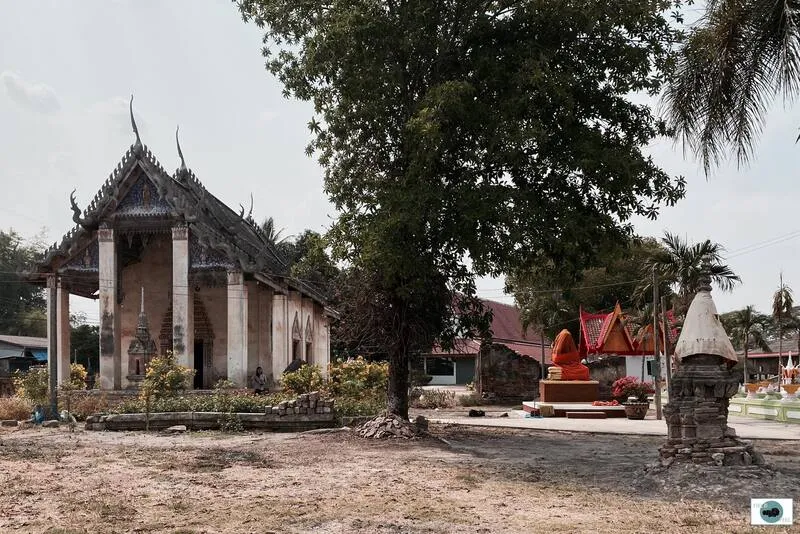
Wat Hua Mueang is located in Ban Uthai Kao, Moo 2, Tambon Uthai Kao, Nong Chang District, Uthai Thani Province, under the jurisdiction of the Maha Nikaya Buddhist order. The temple occupies a land area of 10 rai, 3 ngan, and 30 square wah (approximately 16,120 square meters), with land title deed No. 4725. The temple boundaries are as follows: to the north, it is adjacent to a pathway and a public canal; to the south, it borders a public road and neighboring houses; to the east, it is next to land No. 28,109 and residential areas; to the west, it adjoins a pathway and a public canal. Additionally, there are four monk endowment plots totaling 18 rai and 50 square wah (land title deeds No. 4730, 4731, 4732, and 4733), all located within Tambon Uthai Kao.
The temple is situated on a lowland plain. The main structures include an ordination hall (ubosot) measuring 7 meters wide and 15 meters long, constructed in 1687 BE (approx. 1144 CE) with large brick and mortar foundations. The sermon hall (ho suat) is 12 meters wide and 20 meters long, built in 1974 BE (1931 CE) as a wooden structure. The temple also has seven monk residences, made of wood or half-brick and half-wood construction, and a refectory hall for sacred objects. Within the ubosot, the principal Buddha image is in the Maravijaya posture, accompanied by numerous other Buddha images in various sizes and postures. Several ancient chedis (stupas) are also present within the temple grounds.
Wat Hua Mueang was established around 1681 BE (1238 CE) according to oral historical accounts. At that time, local residents of Uthai Kao, together with the provincial officials of Uthai Thani, collaborated to build the temple. Its location at the northern entrance to the town gave the temple its name, “Hua Mueang,” meaning “town frontier.” Over time, the temple experienced periods of prosperity and decline. Today, it is a flourishing temple recognized as a model temple for development by government authorities. It has received the royal designation of Wisungkhamasima, with a sacred boundary measuring 7 meters wide and 15 meters long. Currently, the temple houses 55 resident monks and 21 novice monks.
Wat Hua Mueang has long been a center for Buddhist education, offering studies in Buddhist scriptures since 1916 BE (1873 CE). It also hosted a local reading room and a government primary school, making it an important community hub for learning and religious practice.
The temple has had four abbots throughout its history. The first was Luang Pu Phueng (circa 1900–1920 BE), followed by Luang Pho Phrom (1920–1959 BE), Phra Ajarn Samphao (1959–1974 BE), and currently, Phra Kru Uppakarn Kowit, who has served since 1975 BE.
Architecturally, the temple demonstrates Thai art styles from various periods. The ancient ubosot, wooden monk residences, and newly built sermon hall reflect both traditional and modern elements. The presence of numerous chedis and Buddha images showcases the continuation of Buddhist rituals and local devotion over centuries.
Wat Hua Mueang also serves as a center for cultural education, attracting visitors and scholars interested in Thai heritage. Visitors can observe religious practices, architectural beauty, and community activities, making the temple a living representation of Uthai Thani’s cultural and spiritual heritage.
In summary, Wat Hua Mueang is significant not only for its religious and historical value but also as a center for education and cultural preservation. It embodies the continuity of local faith, the development of Thai Buddhist practices, and the architectural and cultural identity of Uthai Thani Province, serving as a model for community-centered temple development.
 Wat Hua Mueang Map
 Category:
  Group:
  Tag: ●Wat Hua Mueang●wat hua mueang ●uthai thani temple ●historic temple uthai thani ●buddha image maravijaya posture ●ancient chedi ●uthai thani tourist attraction ●important temple uthai thani ●ubosot wat hua mueang ●monk residence ●sermon hall ●buddhism in uthai thani ●thai culture ●thai art ●thai tradition
Last Update: 6 MonthAgo
Tag: ●Wat Hua Mueang●wat hua mueang ●uthai thani temple ●historic temple uthai thani ●buddha image maravijaya posture ●ancient chedi ●uthai thani tourist attraction ●important temple uthai thani ●ubosot wat hua mueang ●monk residence ●sermon hall ●buddhism in uthai thani ●thai culture ●thai art ●thai tradition
Last Update: 6 MonthAgo
Comment
 Nearby Attractions
| Keyword (Advance) |
 Facebook Fanpage
 Region
 Art, Culture and Heritage
 Historical Sites and Monuments(
 Landmarks and Memorials(
 Art, Craft Centres, Tradition(
 Museums(
 Other religious and spiritural sites(
 Suburban Living
 Village, Community(
 Local Market(
 Nature and Wildlife
 National Parks and Marine Reserves(
 Mountain (Doi)(
 Dam, Reservoir, Lake(
 Waterfalls(
 Hot Springs(
 Caves(
 Flower Field(
 River, Canal(
 Islands(
 Other natural attractions(
 Entertainment and Agricultural
 Farm, Parks, Gardens and Ecotourism(
 Shopping
 Shopping and Night Market(
 Copyright 2012,