
lovethailand home >North Travel Attractions >Lampang Travel Attractions >Ngao >Ban Rong > Ngao Community Art Center
TL;DR: Ngao Community Art Center is located at No. 33, Ban Khoi, Ban Rong Subdistrict, Ngao District, Lampang Province, open Please Contact In Advance, hours Please Contact In Advance.

Ngao Community Art Center
Open Days: Please Contact In Advance
Opening Hours: Please Contact In Advance
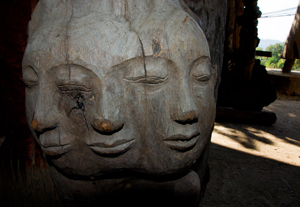
Ngao Community Art Center, also known as Ban Chang Luang or Ban Jang Luang, is located at No. 33, Ban Khoi, Ban Rong Subdistrict, Ngao District, Lampang Province. It is an important community art site connected with woodcarving, local craftsmanship, and the artistic vision of Khru Kham Ai Detduangta, the founder of the center. The site was created to collect and display his woodcarving works and to serve as a place for art training, especially in wooden sculpture and carving. Although the large wooden building that once made the center famous was later destroyed by fire, the story of Ban Chang Luang remains deeply meaningful as part of Lampang’s community art heritage.
Ban Chang Luang reflects the power of local craftsmanship in northern Thailand. Woodcarving is a demanding art form that requires knowledge of wood, proportion, form, tools, texture, patience, and long practice. Khru Kham Ai Detduangta founded the center not only to display his own works but also to create a learning space where local people could gain artistic skills and use them as a livelihood. This gives the site social meaning beyond its role as an art display venue.
The most memorable feature of Ban Chang Luang was its large wooden structure designed to resemble an elephant. Almost every part of the building was decorated with artistic woodwork in a unified style. The building functioned as a storage and exhibition space for carved wooden works, but it was also an artwork in itself. Its elephant-like form connected the center with the cultural symbolism of elephants in northern Thailand, forests, wood, and the life of local communities.
The name Ban Chang Luang carries symbolic meaning. In northern Thai usage, “chang” or “jang” refers to an elephant, while “luang” suggests greatness or importance. The name therefore reflects both the appearance of the great wooden elephant-like house and the founder’s ambition to create a significant art center for the community. It is not merely a place name, but a statement of imagination, craftsmanship, and artistic pride.
Before the fire, Ban Chang Luang displayed many woodcarvings by Khru Kham Ai. Visitors could see carved forms, animal figures, decorative patterns, wooden sculpture, and works inspired by local life and belief. Each piece represented many hours of labor and skill. Woodcarving cannot be rushed. The artist must understand grain direction, the strength of the wood, the depth of cutting, and the balance between rough shaping and fine detail.
The fire that damaged the main wooden building was a major loss for community art. Around 50 to 60 woodcarving works were destroyed. This loss was not only the loss of objects. It was the loss of time, memory, technical skill, and evidence of a local artist’s effort to build a community art center. Even so, the story of Ban Chang Luang remains important because it reminds visitors of the need to document, protect, and preserve fragile local art heritage.
In the context of art history, Ban Chang Luang is a strong example of a creative space outside major urban centers. Ngao District is not widely known as a mainstream art destination, yet one local artist was able to create a distinctive art environment with deep identity. This shows that art does not exist only in large museums or formal institutions. It can also grow from a craft teacher, a rural community, local materials, and the desire to build occupational opportunities through creativity.
Khru Kham Ai Detduangta is central to the meaning of the place. He was not only a maker of carved works but also someone who saw woodcarving as a vocational path. Woodcarving can add value to natural material, turning wood into art, decoration, and livelihood. If local people are trained properly, the skill can become a source of income, preserve craft knowledge, and create pride in local ability.
The idea of using Ban Chang Luang as a training school was therefore important. Wooden sculpture requires long-term learning. Students must learn wood types, tool use, design, rough shaping, detailed carving, surface finishing, and artistic judgment. A local training center allows younger people to access craft knowledge more easily and helps prevent the knowledge of master carvers from disappearing over time.
Ban Chang Luang also reflects the relationship between woodcraft and Ngao District. Ngao is a district of mountains, forests, and routes between Lampang and Phayao. Woodcraft in such a place has meaning beyond decorative art. It is connected with the forest, natural materials, and the lives of local people. Good woodcarving should begin with respect for wood, careful use of materials, and the ability to transform natural resources into lasting cultural value.
Although the original building is no longer intact in the way it once was, the site still has value as a lesson in the fragility of artistic heritage. Many heritage sites are appreciated only when they remain complete and beautiful. Ban Chang Luang shows another side: art heritage must be cared for, recorded, transmitted, and protected. Without continuous preservation, works created over a lifetime can be lost in a short time.
Visitors interested in Ban Chang Luang should understand that it is not a regular museum with guaranteed daily visitor service. Several sources preserve the site’s story and contact details, but because the main building was affected by fire and the condition of the site may change over time, travelers should call in advance before visiting. Advance contact helps confirm whether the area can be visited, whether a caretaker is available, and what conditions apply.
The journey to Ban Chang Luang follows Highway No. 1 on the Ngao – Phayao route. From Ngao town, continue for about 20 km toward Phayao. The center is on the right-hand side in the Ban Khoi area of Ban Rong Subdistrict. The distance from Lampang city is about 103 km. Private car travel is the most practical option because the site is outside Ngao town and may require careful stopping or turning along the main road.
Getting There from Lampang city is straightforward but requires time. Take Highway No. 1 toward Ngao District, then continue on the Ngao – Phayao route for about 20 km beyond Ngao town. When reaching Ban Khoi in Ban Rong Subdistrict, look for the location on the right-hand side. Travelers should check road conditions, weather, and safe stopping points before the trip, especially if they are not familiar with the route.
Ban Chang Luang can be combined with other places in Ngao District. Nearby and related attractions include Ngao town, Wat Chong Kham Royal Monastery, Saphan Yong, the open-air cinema museum, Tham Pha Thai, Lom Phu Khiao, Mae Kae Waterfall, Kao Fu Waterfall, and Pang La Elephant Care Center. Ngao is often seen as a route between Lampang and Phayao, but it has its own cultural and natural attractions that reward slower travel.
Tham Pha Thai is one of the best-known natural attractions in Ngao District. It can be combined with Ban Chang Luang for a route that includes both community art and limestone cave scenery. Wat Chong Kham in Ngao town offers a religious stop, while the open-air cinema museum adds a vintage cultural experience. These places show that Ngao has more than forests and roads; it also has craft, temples, memory, and local creativity.
Lom Phu Khiao is another popular natural destination in Ngao, known for its striking green water in a natural setting. Travelers can combine it with Ban Chang Luang if time and road conditions allow, but distances between attractions in Ngao can be significant. A slower itinerary is recommended so that each place can be visited safely and meaningfully.
Food options are easier to find in Ngao town than near Ban Khoi itself. Travelers should plan meals in advance. Restaurants and cafes in Ngao include Khun Phranai Restaurant, Thana Cafe, Laab Ruean Ngoen, Rai Decha Restaurant, Tiao Ruea Komin, and other local food shops. Stopping in Ngao town before or after visiting Ban Chang Luang is usually more convenient than expecting many restaurants close to the center.
Accommodation is also best found in Ngao town or along main travel routes. Options include Ngao Village Resort And Farm Stay, LD Hotel & Residences, Somphon Resort, and other local accommodations in Ngao. Travelers who want more facilities can stay in Lampang city and make a full-day trip, or continue toward Phayao and stay there if Ban Chang Luang is part of a longer route.
Visitors should behave respectfully. Ban Chang Luang is a place of art, memory, and craftsmanship, not simply a photo backdrop. Do not enter restricted areas, touch remaining works or structures without permission, climb on structures, or leave litter. If a caretaker or local person provides information, listening respectfully is important because the site contains personal, artistic, and community history.
For those interested in woodcarving, a visit to Ban Chang Luang should be seen through both what remains and what has been lost. The site once held many works and carried the dream of becoming a training school for local artists. The fire destroyed many pieces, but the concept of using art to create livelihoods remains powerful. It reminds visitors that traditional craft can be part of real life, not only decoration or collection.
Ban Chang Luang is therefore worth recording and studying as part of Lampang’s community art heritage. It is the story of a local artist who used wood, imagination, and determination to create a large artistic space in Ngao District. It is also a lesson about master craftsmen, the beauty of carved wood, the importance of art transmission, and the need to preserve vulnerable cultural heritage.
Overall, Ngao Community Art Center or Ban Chang Luang remains one of Lampang’s most meaningful art-related places. Even though the original physical condition of the main building has changed after the fire, the story of Khru Kham Ai Detduangta, the carved wooden works, the elephant-shaped house, and the vision of a local art training school still deserves attention. For travelers interested in community art, woodcarving, local craftsmanship, and the cultural history of Ngao, Ban Chang Luang offers knowledge, emotion, and inspiration.
| Name | Ngao Community Art Center / Ban Chang Luang / Ban Jang Luang |
| Location | No. 33, Ban Khoi, Ban Rong Subdistrict, Ngao District, Lampang Province |
| Address | No. 33, Ban Khoi, Ban Rong Subdistrict, Ngao District, Lampang 52110 |
| Highlights | Community art center and woodcarving collection founded by Khru Kham Ai Detduangta, formerly known for its large elephant-shaped wooden building before it was damaged by fire |
| History | Founded by Khru Kham Ai Detduangta to collect his woodcarving works and develop the site as an art training school, especially for wooden sculpture and carving to create local occupations |
| Name Origin | The name Ban Chang Luang or Ban Jang Luang is linked with the large wooden building designed to resemble an elephant and the symbolic importance of the site as a community art center |
| Distinctive Features | Elephant-shaped wooden structure, woodcarving works, wooden sculpture, and the concept of using art training to create local livelihoods |
| Travel Information | Use Highway No. 1 on the Ngao – Phayao route, continue about 20 km beyond Ngao town, and look for the center on the right-hand side. It is about 103 km from Lampang city and private car travel is recommended. |
| Current Status | The large wooden exhibition building was destroyed by fire, causing around 50 – 60 woodcarving works to be damaged. Visitors should contact in advance to confirm current access conditions. |
| Open Days | Please Contact In Advance |
| Opening Hours | Please Contact In Advance |
| Fees | Please Contact Before Visiting |
| Facilities | Community art area, woodcarving-related area subject to current conditions, parking where available, and restaurants or accommodations in Ngao town |
| Main Areas / Zones | Former elephant-shaped wooden house area, Khru Kham Ai woodcarving collection area, wood sculpture learning area, and Ban Khoi community area |
| Caretaker / Founder | Khru Kham Ai Detduangta, founder of Ngao Community Art Center and initiator of the woodcarving art training concept |
| Main Contact Number | 054-220-380, 054-365-229 |
| salakhanyi@yahoo.com | |
| Visitor Guidelines | Contact before visiting, do not enter restricted areas, do not touch works or structures without permission, do not climb, do not litter, and respect the site as a place of art and craft memory. |
| Nearby Tourist Attractions | 1. Ban Khoi, Ban Rong Subdistrict, about 0 km 2. Ngao Town Center, about 20 km 3. Wat Chong Kham Royal Monastery, about 22 km 4. Saphan Yong Ngao, about 22 km 5. Open-Air Cinema Museum, about 24 km 6. Tham Pha Thai, about 35 km 7. Lom Phu Khiao, about 45 km |
| Nearby Restaurants | 1. Local Food Shops In Ban Khoi / Ban Rong, about 0 – 5 km 2. Khun Phranai Restaurant, Ngao Town, about 22 km, Tel. 054-329-505 3. Thana Cafe, about 22 km, Tel. 098-749-5717 4. Laab Ruean Ngoen, about 22 km 5. Rai Decha Restaurant, about 22 km 6. Tiao Ruea Komin, about 22 km |
| Nearby Accommodations | 1. Ngao Village Resort And Farm Stay, about 22 km, Tel. 081-095-9069 2. LD Hotel & Residences, about 22 km, Tel. 086-658-4768, 093-905-4744 3. Somphon Resort, about 22 km 4. Local Accommodations In Ngao Town, about 20 – 25 km 5. Accommodations In Lampang City, about 103 km 6. Accommodations In Phayao, about 55 – 70 km |
Frequently Asked Questions (FAQ)
Q: Where is Ngao Community Art Center or Ban Chang Luang located?
A: It is located at No. 33, Ban Khoi, Ban Rong Subdistrict, Ngao District, Lampang Province, along Highway No. 1 on the Ngao – Phayao route.
Q: Who founded Ban Chang Luang?
A: Ban Chang Luang was founded by Khru Kham Ai Detduangta, a local woodcarving artist and craft teacher who wanted to create a community art and woodcarving training center.
Q: What made Ban Chang Luang special?
A: Its most distinctive feature was a large wooden building designed to resemble an elephant, formerly used to display woodcarving works by Khru Kham Ai Detduangta.
Q: Is Ban Chang Luang still in its original condition?
A: No. The large wooden exhibition building was damaged by fire, and around 50 to 60 woodcarving works were destroyed. Visitors should contact in advance to confirm current access conditions.
Q: What are the opening hours of Ban Chang Luang?
A: Visitors should contact the site in advance because current access and visiting conditions may vary.
Q: How can travelers get to Ban Chang Luang?
A: Use Highway No. 1 on the Ngao – Phayao route. From Ngao town, continue about 20 km toward Phayao. The center is on the right-hand side and is about 103 km from Lampang city.
Q: Who should visit Ban Chang Luang?
A: It is suitable for visitors interested in woodcarving, community art, local craftsmanship, wooden sculpture, and the use of art as a local vocational skill.
Q: What nearby attractions can be visited after Ban Chang Luang?
A: Nearby places include Ngao town, Wat Chong Kham Royal Monastery, Saphan Yong, the open-air cinema museum, Tham Pha Thai, and Lom Phu Khiao.
Tel : 05422 0380 ,05436 5229
 Tel : 05422 0380 ,05436 5229
  Category: ●Suburban Living
 Group: ●Village, Community
Last Update : 5 MonthAgo
 Last Update : 5 MonthAgo
 Click to Access the Navigation Map GPS
Ngao Community Art Center Map
Recommend

 Art, Culture and Heritage
 Historical Sites and Monuments(2)
 Landmarks and Memorials(5)
 Art, Craft Centres, Tradition(10)
 Museums(4)
 Historic Homes and Cities(1)
 Places of Worship
 Temple(86)
 Other Sacred Sites(9)
 Research and Development
 Royal Project(2)
Village, Community(3)
Royal Project(2)
Village, Community(3)
 Local Market(2)
 Nature and Wildlife
 National Parks and Marine Reserves(6)
 Mountain (Doi)(4)
 Dam, Reservoir, Lake(11)
 Waterfalls(15)
 Hot Springs(1)
 Caves(12)
 Flower Field(1)
 River, Canal(1)
 Bays and Beaches(1)
 Other natural attractions(4)
 Entertainment and Agricultural
 Animal camps and shows(1)
 Farms, Parks and Ecotourism(2)
 Outdoor and Adventure Activities(2)
 Shopping
 Shopping and Night Market(2)
 Spas and Wellness
 Spas and Wellness(1)
 Travel Articles, Recipes
 Travel Review, Food Review(1)


