
lovethailand home >Central Travel Attractions >Lop Buri Travel Attractions >Phatthana Nikhom >Phatthana Nikhom > Salakaphat Tradition
TL;DR: Salakaphat Tradition, Lop Buri attractions : Art, Culture and Heritage, Art, Craft Centres, Tradition.
Salakaphat Tradition
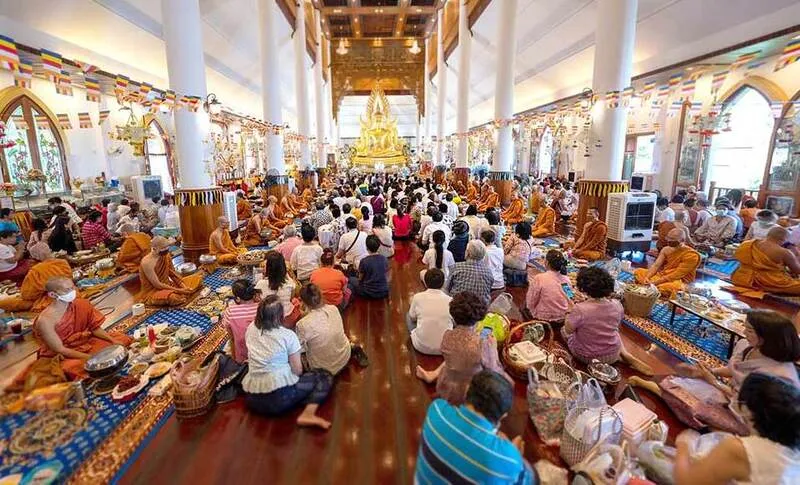
Open Days: According to the merit-making schedule of each temple and community
Opening Hours: According to local announcements
The Salakaphat Tradition Meaning, Origins, Rituals, and the Value of a Merit-Making Festival That Unites Faith, Community, and Folk Wisdom in a Single Ceremony. The Salakaphat tradition is one of the merit-making traditions with profound meaning in Thai culture because it is not merely the act of bringing food or offerings to monks, but a ritual that reflects the concept of fair giving, communal generosity, and the equitable distribution of offerings. The heart of this tradition lies in allowing monks to draw lots before receiving offerings, which makes Salakaphat different from ordinary food offerings that are often directed to specific monks. This tradition is therefore at once a religious ceremony, a social value system, and a cultural heritage practice that clearly reveals the wisdom of Thai people in the past.
The original significance of Salakaphat lies in the intention to ensure that monks have food to eat and sufficient daily necessities to support monastic life and the practice of discipline and meditation. This tradition is rooted in a belief story from the Buddha’s time, when a severe famine once occurred and villagers found it difficult to gather enough food to offer to the monks. When the amount of food was too small to offer to every monk, the villagers respectfully asked the Buddha whether they could make the offering by allowing the monks to draw lots to determine the recipients. The Buddha granted permission, and this idea then became the foundation of the Salakaphat tradition that has continued ever since.
When examined more deeply, this tradition has value beyond solving the problem of insufficient food offerings in times of hardship. It reflects Buddhist thought that emphasizes equality and non-attachment. The donors do not choose which monk to offer to according to personal preference, but instead allow the result to depend on the lot. Whichever monk draws the lot of a particular donor then receives the offering from that person. Such a principle makes giving impartial, prevents favoritism, and helps ensure that monks receive offerings more evenly. It is therefore a tradition that harmoniously combines compassion, wisdom, and religious order.
Although the Salakaphat tradition shares the same core throughout Thailand, the methods of preparation and the names used may differ by region. In the North, it is known as “Tan Kuay Salak,” an important tradition among Lanna communities. In the Northeast, a closely related custom is called “Bun Khao Sak” or “Khao Salak.” In the Central region, the name “Thawai Salakaphat” remains in common use. These differences show that the same tradition can adapt to the context of each locality, while its core remains the same: making offerings by drawing lots before receiving them.
In some areas of the Central region, especially in Saraburi Province, the Salakaphat tradition has a particularly distinctive local form. Large offering baskets are woven from bamboo and decorated beautifully with colored paper, then filled with food or monastic necessities. If the donor or local artisans have greater skill, they may place a long pole about 6 meters high in the center of the basket and create tiered umbrella-like layers, forming what is called a “salak tree.” These structures combine height, delicacy, and artistic beauty. When the festival day arrives, the baskets or salak trees are brought together at the temple, creating a merit-making event that is both sacred and visually striking.
The distinctive character of these salak trees or offering baskets means that in some places Salakaphat is not simply an act of presenting offerings, but also a true stage for local artisans to display their skills. Bamboo weaving, structural assembly, paper decoration, arranging food and goods, and constructing layered umbrella tiers all require knowledge, craftsmanship, and creativity from the community. The merit-making festival thus becomes a space where religion and folk art work together beautifully, while also helping to preserve traditional skills that might otherwise fade over time.
The general ritual form of Salakaphat may vary in detail, but in principle the donors prepare food, fruit, household goods, or monastic necessities and place them in baskets or other prepared containers. Lots marked with names or numbers are then made and attached. On the festival day, these baskets or salak trees are brought together at the temple. Monks are invited to deliver a sermon on the merits of Salakaphat. After the sermon, the donors recite the offering formula, and the monks draw lots. Whichever monk draws a particular donor’s lot then goes to receive the offering at that person’s basket or salak tree. The donor presents the offering, receives a blessing, and pours ceremonial water to dedicate merit in the customary way.
One important point is that the Salakaphat ceremony makes merit-making feel like a truly participatory activity. Those who attend are not merely onlookers, but play roles from the preparation stage onward, including preparing the goods, making the baskets, writing the lots, organizing the offerings, and participating in the actual presentation ceremony. This gives the event a strong sense of movement and creates the feeling that it is truly a “community festival,” rather than simply a temple ritual separated from daily life.
From a religious perspective, Salakaphat is important because it still preserves its original purpose clearly: supporting monks by providing food and the necessary items for monastic life. This tradition reflects the relationship between laypeople and the Sangha in Buddhism, where both sides support one another. Monks practice and spread the Dharma, while laypeople offer the four requisites so that monks can live appropriately. Salakaphat is therefore one of the mechanisms within Buddhist society that keeps the cycle of faith and mutual support in motion.
Viewed more broadly, this tradition also has a strong social role because it is a merit-making event that brings people together effectively. The donors must prepare offerings, family members must help, local artisans must create baskets or salak tree structures, and villagers often come to observe, assist, or join in the merit-making. This creates an atmosphere of cooperation and solidarity. The event is therefore not just a religious activity, but also a moment when the community gathers again. The temple becomes a center for meeting, helping one another, and expressing a shared local identity.
In terms of atmosphere, Salakaphat is often a lively and beautiful event, especially in areas where salak trees or offering baskets are decorated with great skill. Inside the temple grounds, one finds colorful paper ornaments, neatly arranged offerings, and people attending together in unity. Children learn by watching, adults take part in organizing the event, and elders pass on the meaning of the tradition to younger generations. Altogether, this makes Salakaphat more than just one item on the religious calendar. It becomes a moment of shared memory for the whole community.
This tradition is also closely connected to the agricultural seasons. In many places, Salakaphat is held toward the end of the rainy season and the beginning of the cool season, when fruit and crops are abundant. Villagers can then conveniently bring seasonal produce to make merit, whether local fruits, dried foods, or necessary household goods. This shows that Salakaphat does not stand apart from real life, but is closely tied to the rhythms of nature and agricultural living. When nature is abundant, the merit-making festival becomes all the more ready and flourishing.
Although the original purpose of Salakaphat came from a context of scarcity, in the present day, when food and goods are much more plentiful, the tradition has not disappeared. On the contrary, it continues to be preserved in many places because its meaning has expanded from solving an immediate problem to becoming a tradition that unites faith, brings people together, and preserves local identity at the same time. Salakaphat has thus become a merit-making tradition that people still wish to join, even though it is no longer needed to address hunger in the same way as before.
Another particularly clear value of this tradition is the preservation of folk wisdom. In many places, the beauty of the salak trees and offering baskets has become a symbol of local craftsmanship. The more important the event is, the more carefully villagers create beautiful salak trees. This helps sustain skills such as weaving, decoration, and handicraft work that could easily fade if they had no practical role in real life. Salakaphat is therefore both a merit-making event and a breathing space for folk art at the same time.
In terms of cultural tourism, Salakaphat has great potential because it offers a religious narrative, a clearly defined ritual, artistic expression through salak trees and baskets, and a living community atmosphere. Visitors do not simply come to watch a ceremony of offering, but also learn about the concept of giving, equality in receiving offerings, and the relationship between temple and community. However, participation in such an event should always be grounded in respect. The tradition should not be seen merely as a picturesque backdrop for photography, but understood as a living religious and cultural heritage.
For those interested in attending a Salakaphat event, the most important thing is to check the schedule of the temple or community in each area before traveling. This tradition does not have one fixed nationwide date, but depends on local custom and the decision of the host temple. Once the date is known, visitors can make travel plans. They should dress politely, behave respectfully within the ritual area, and avoid disturbing the moment when monks are drawing lots or receiving offerings. If one enters the event with the mindset of a learner rather than simply a consumer of festivals, the beauty of this tradition becomes much deeper and clearer.
In conclusion, the Salakaphat tradition is an important example of a Thai tradition that began from practical necessity but developed into a merit-making event with many layers of value at the same time. These include religion, fairness in giving, the collective strength of the community, the preservation of folk wisdom, and cultural beauty. No matter how much the world changes, this tradition still performs an essential role: it helps support the monks, helps people make merit together, and preserves a space in Thai society where faith, art, and community can work together with dignity.
Getting There If you wish to learn about the Salakaphat tradition, you should begin by checking which temple or community plans to organize the event that year, since this tradition does not take place on a fixed date like an ordinary tourist attraction. Instead, it is tied to the merit-making calendar and local customs of each area. Interested visitors should ask the temple, local cultural offices, or local administrative organizations before making the trip. Once the schedule is confirmed, they can then plan their journey into the area, dress politely, respect the ritual, and participate with an understanding of the merit-making context, so that the journey becomes a genuine cultural learning experience rather than merely a brief visit.
| Summary | Salakaphat is a merit-making tradition in which offerings are presented to monks only after the monks draw lots to determine which donor’s offering they will receive. It originated from the idea of distributing food fairly during times of scarcity and continues to be practiced in many regions of Thailand. |
| Highlights | Its main highlight is the lot-drawing system of offering, which reflects fairness in giving. In some areas, beautifully crafted baskets or salak trees are created, making the event a merit-making tradition with a strong dimension of folk art. |
| History / Period | It is rooted in a Buddhist-era account of famine, when villagers did not have enough food to offer every monk and therefore presented food by having monks draw lots. It later developed into a local tradition in many regions. |
| Regional Names | In the North it is called Tan Kuay Salak, in the Northeast it is called Bun Khao Sak, and in the Central region it is known as Salakaphat. |
| Location | It is not tied to a single place, but is a tradition found in many temples and communities throughout Thailand, especially in the North, the Northeast, and some areas of the Central region such as Saraburi. |
| Open Days / Opening Hours | Held according to the merit-making schedule of each temple and community, with time based on local announcements. |
| Key Rituals | Donors prepare food or monastic necessities in baskets or containers, attach lots, bring them together at the temple, listen to a sermon on the merit of Salakaphat, recite the offering formula, and then the monks draw lots and receive offerings according to the drawn lot. |
| Craftsmanship Highlights | In some places, such as Saraburi, large bamboo baskets are woven and decorated into salak trees or multi-tiered umbrella structures, helping preserve traditional weaving and folk art. |
| Getting There | You should first check which temple or community plans to organize the event that year, then ask the temple or local authorities for details before traveling. |
| Current Importance | It remains an important merit-making event that brings people together, preserves faith, maintains local identity, and helps keep traditional craftsmanship alive in contemporary society. |
| Visitor Information | Visitors should dress politely, behave respectfully within the ritual space, observe the sermon and lot-drawing process appropriately, and participate with the understanding that this tradition is a merit-making event with deep religious and cultural significance. |
Frequently Asked Questions (FAQ)
Q: What is the Salakaphat tradition?
A: It is a merit-making tradition in which food or offerings are presented to monks only after the monks draw lots to determine which donor’s offering they will receive, making the act of giving fair and evenly distributed.
Q: What is the origin of the Salakaphat tradition?
A: It is rooted in a Buddhist-era account of food scarcity, when villagers presented food by allowing monks to draw lots so that the offerings would be distributed fairly and in an orderly way among the monks.
Q: Are Tan Kuay Salak and Salakaphat the same?
A: In essence, they belong to the same group of traditions, meaning offering by lot drawing. The North calls it Tan Kuay Salak, the Central region calls it Salakaphat, and the Northeast has a closely related form known as Bun Khao Sak.
Q: When is Salakaphat usually held?
A: It is generally held toward the end of the rainy season and the beginning of the cool season, or at whatever time each community sets according to its temple customs and local tradition.
Q: What is distinctive about Salakaphat in some local areas?
A: In some places, especially in the Central region such as Saraburi, large baskets or salak trees are created from bamboo and decorative materials, turning the event into a merit-making festival with a particularly strong folk art dimension.
Q: Is Salakaphat still important today?
A: Yes, it remains very important because even though it no longer arises from famine as in the past, it still brings people together, preserves faith, maintains community identity, and helps protect traditional craftsmanship.
Q: How should visitors prepare if they want to learn about the Salakaphat tradition?
A: They should check the schedule with the temple or community before traveling, dress politely, remain respectful in the ritual area, and participate with reverence for the religious and cultural meaning of the merit-making event.
 Category: ●Art, Culture and Heritage
 Group: ●Art, Craft Centres, Tradition
Last Update : 6 MonthAgo
 Last Update : 6 MonthAgo
Recommend

 Historical Sites and Monuments(5)
 Landmarks and Memorials(3)
 Royal Palace(1)
Art, Craft Centres, Tradition(7)
Royal Palace(1)
Art, Craft Centres, Tradition(7)
 Museums(11)
 Historic Homes and Cities(1)
 Places of Worship
 Temple(25)
 Other Sacred Sites(3)
 Suburban Living
 Village, Community(4)
 Floating Market(1)
 Nature and Wildlife
 National Parks and Marine Reserves(2)
 Mountain (Doi)(3)
 Dam, Reservoir, Lake(4)
 Waterfalls(5)
 Hot Springs(1)
 Caves(2)
 Flower Field(1)
 Entertainment and Agricultural
 Zoos and Aquariums(2)
 Farms, Parks and Ecotourism(4)
 Outdoor and Adventure Activities(1)


