
 Home
Home North(
 Chiang Mai(


Erawan Cave
Rating: 4.2/5 (5 votes)
 Search By
  Map
Map 
 Have Map
  No Map
Lop Buri attractions
Attractions in Thailand
Open Days: Daily
Opening Hours: Please check before traveling
Erawan Cave in Lopburi Province is a natural attraction distinguished in many dimensions, including geology, archaeology, religion, and ecology. It is located in Chong Sarika Subdistrict, Phatthana Nikhom District, an area of major limestone mountains and one of Lopburi’s most significant natural zones. Erawan Mountain is a center of diverse natural resources and remains notably rich in ecological abundance.
Erawan Mountain is a limestone mountain formed from the accumulation of marine organism remains hundreds of millions of years ago. Over time, movements of the earth’s crust uplifted the seabed and created the mountain seen today. The limestone structure led to the formation of cavities, caves, and underground waterways in large numbers. Surveys have found that Erawan Mountain contains more than 15 caves, reflecting the complexity of the natural system in this area and making it an important site for geological study.
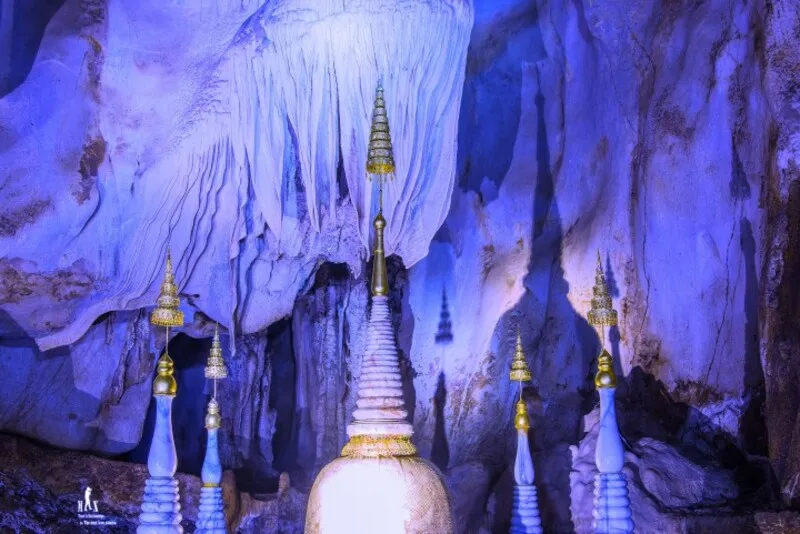
One of the most remarkable features of Erawan Cave is the discovery of a cave with beautiful stalactites and stalagmites that are still actively growing. This cave is considered a “young cave” or a cave with fresh mineral formations, meaning that the stalactites and stalagmites continue to develop from the steady accumulation of minerals carried by dripping water through the rock layers. As a result, the shapes of these formations continue to change over time, representing a living natural process rather than a fixed and unchanging structure.
Inside the cave is a large chamber that visitors can walk into and explore. The air inside remains cool throughout the year because the cave structure retains temperature very well. This coolness helps visitors feel relaxed, almost as if they were inside a naturally air-conditioned room. Deeper inside, there are connecting tunnels, and the third tunnel is especially important because a large number of sacred relics were found there.
The relics found inside Erawan Cave hold religious significance. Phra Ajahn Sombat Phuripanyo, together with his disciples, conducted a ceremony to enshrine the relics in 5 marble stupas so that they could become a place of worship and a spiritual center for visitors. The inside of the cave is therefore both a natural attraction and a spiritual site at the same time.
In archaeological terms, the Erawan Mountain area is highly significant. Fragments of pottery approximately 2,500 to 3,000 years old have been discovered here, indicating that ancient humans once used this area as a dwelling place or for certain activities. In addition, fossils such as shell remains about 292 million years old have also been found, reflecting the ancient past when this area was once under the sea and providing important scientific evidence.
Erawan Mountain is also a center of biodiversity, with surveys recording several rare plant species such as yellow mok rachini, freshwater mangrove, and cotton tree, along with a variety of wild animals. Of particular importance is the dancing wren-babbler, an endemic species found in only a few places in the world. Khao Phra Bat Noi in Saraburi Province is its main habitat, and Erawan Mountain is the second location where it has been found, making this area highly significant in ecological terms.
The overall atmosphere of Erawan Cave gives a sense of adventure and discovery. Visitors can experience the beauty of stalactites and stalagmites, the cool air inside the cave, and the quiet surroundings that naturally help calm the mind. Exploring the cave is therefore both a travel experience and a learning experience at the same time.
Today, Erawan Cave is considered one of Lopburi’s promising natural attractions, especially for travelers interested in nature, cave exploration, and geology. Although it has not yet become a large-scale commercial tourism site, the integrity and natural character of the area are exactly what make it stand out from other destinations.
Getting There Erawan Cave can be reached via routes in Phatthana Nikhom District, heading toward Chong Sarika Subdistrict, which is near Pasak Jolasid Dam. Private transportation is recommended because the final section passes through mountainous terrain and may be difficult to access. Traveling during daylight hours is advisable for the greatest safety and convenience.
Visitors planning a trip should prepare suitable equipment such as shoes appropriate for rough terrain, a flashlight for exploring inside the cave, and drinking water. Caution is also necessary because some parts of the cave may be slippery or dark, and visitors should avoid touching or damaging the stalactites and stalagmites that are still growing.
| Name | Erawan Cave |
| Overview | A limestone cave on Erawan Mountain in Chong Sarika Subdistrict, Phatthana Nikhom District, Lopburi Province. It is a natural attraction with more than 15 caves, growing stalactites and stalagmites, and strong geological, archaeological, and religious value. |
| Highlights | A young cave with fresh mineral formations, actively growing stalactites and stalagmites, a large chamber, cool year-round air, sacred relics in the tunnel, and fossils hundreds of millions of years old. |
| History / Era | Pottery fragments dating back about 2,500–3,000 years and fossils such as shells about 292 million years old have been found here, reflecting both geological changes and ancient human settlement in the area. |
| Address | Chong Sarika Subdistrict, Phatthana Nikhom District, Lopburi Province, Thailand |
| Getting There | From Lopburi city, head toward Phatthana Nikhom District and continue into Chong Sarika Subdistrict near Pasak Jolasid Dam. Private transportation is recommended because the final section is a mountain road. |
| Open Days | Daily |
| Facilities | Walking path inside the cave, relic worship area, natural surroundings, and resting points along the route |
| Zones | 1. Erawan Mountain Zone 2. Cave Cluster Zone with More Than 15 Caves 3. Interior Tunnel Zone 4. Sacred Relic and Marble Stupa Zone 5. Ecosystem and Rare Plant Zone |
| Nearby Attractions | 1. Pasak Jolasid Dam (approx. 12 km) 2. Wang Kan Lueang Waterfall (approx. 18 km) 3. Wat Khao Somphot (approx. 30 km) 4. PB Valley Vineyard (approx. 25 km) 5. Lopburi Sunflower Fields (approx. 20 km) |
| Nearby Restaurants | 1. Krua Khuen Pasak Tel: 081-946-5724 2. Baan Suan Phatthana Nikhom Restaurant Tel: 089-742-8891 3. Krua Lung Rong Tel: 081-780-3210 4. Lam Narai Restaurant Tel: 089-989-5566 5. Phatthana Nikhom Isan Larb Restaurant Tel: 085-662-4141 |
| Nearby Accommodations | 1. Pasak Hillside Resort Tel: 036-792-441 2. Narai Grand Hotel Tel: 036-631-137 3. Ton Palm Inn Tel: 036-632-309 4. Phatthana Resort Tel: 089-900-1122 5. Chai Badan Resort Tel: 094-552-0888 |
Frequently Asked Questions (FAQ)
Q: Where is Erawan Cave located?
A: It is located in Chong Sarika Subdistrict, Phatthana Nikhom District, Lopburi Province.
Q: What is special about Erawan Cave?
A: It has actively growing stalactites and stalagmites, and there are more than 15 caves on Erawan Mountain.
Q: What is the air like inside the cave?
A: It is cool and comfortable throughout the year, almost like a naturally air-conditioned room.
Q: Does it have historical importance?
A: Yes. Pottery dating back 2,500–3,000 years and fossils about 292 million years old have been found in the area.
Q: Who is it suitable for?
A: It is suitable for nature travelers, cave explorers, and people interested in geology.
 Erawan Cave Map
 Category:
  Group:
  Tag: ●Erawan Cave●erawan cave lopburi ●erawan cave phatthana nikhom ●limestone cave lopburi thailand ●cave exploration lopburi ●natural cave thailand lopburi ●stalactite cave thailand ●caves near pasak jolasid dam ●phatthana nikhom attractions ●lopburi nature travel ●cave tourism thailand Last Update: 19 HourAgo
Comment
 Nearby Attractions
| Keyword (Advance) |
 Region
|
 Muang Lop Buri(
 Copyright 2012,