
 Home
Home Chiang Mai(






Hosophon Sin Museum
Rating: 4.3/5 (4 votes)
 Search By
  Map
Map 
 Have Map
  No Map
Lop Buri attractions
Attractions in Thailand
Open Days: Every day
Opening Hours: 08.30 - 16.30
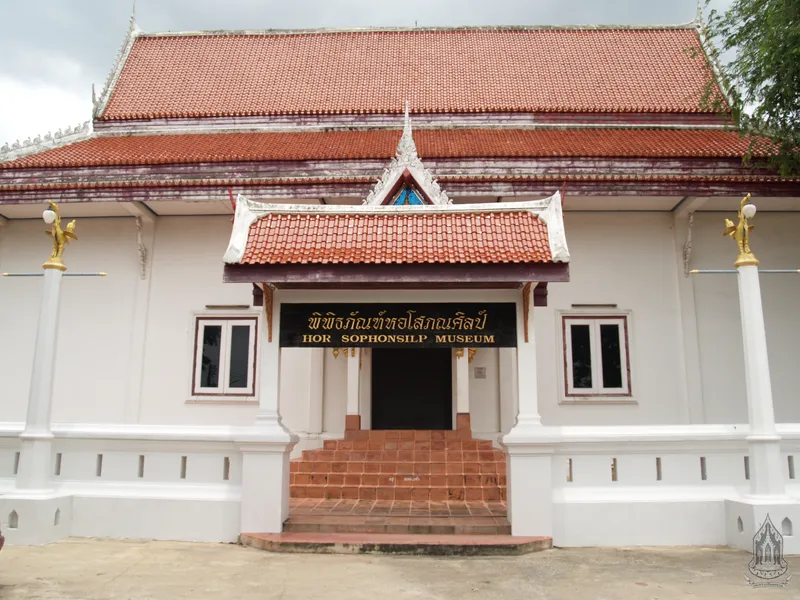
Hosophon Sin Museum is an important learning center in Lopburi Province, quietly located within Wat Choeng Tha in Mueang Lopburi District, and it has a distinct charm that clearly sets it apart from ordinary museums. It is not merely a place that gathers antiquities or old objects, but a space that reflects the world of Buddhism in a deeper and more tangible way through exhibitions about the Buddha, the Dhamma, and the Sangha, together with actual objects related to the temple and the way monks lived in the past. Once visitors step into this museum, they are not simply looking at objects, but gradually reading the history, faith, and wisdom of Buddhist society through things that once had a real life within the context of the temple.
The location of the museum within Wat Choeng Tha adds great meaning to the visit. Wat Choeng Tha itself is an old temple in Lopburi with historical and artistic importance. It stands on the eastern bank of the Lopburi River and lies within the old city area closely connected to Phra Narai Ratchaniwet. The relationship between the temple and the city is therefore no coincidence, but reflects how this temple has long been part of the structure of the historic city. Hosophon Sin Museum is thus not merely an exhibition building inside a temple, but something like a chamber of memory for Wat Choeng Tha and the surrounding community.
Hosophon Sin Museum was established in 1997 through the initiative of Phra Khru Sophon Thammarat, or Luang Por Asrom Dhammathipo, who was the abbot of Wat Choeng Tha at that time. It was created as a place to gather and display valuable religious, artistic, and historical objects that were old treasures of the temple as well as personal belongings of the abbot himself. The founding of the museum inside the temple therefore had a very clear purpose: to preserve important objects that were scattered within the temple context and turn them into a learning center accessible to later generations, while transforming faith once embedded in actual daily use into a body of knowledge that people could jointly see and understand more clearly.
The outstanding feature of this museum lies in the way it presents the Buddha, the Dhamma, and the Sangha in a carefully ordered framework of thought. The objects are not placed separately without meaning, but are arranged in a way that helps visitors understand how each item is related to the world of Buddhism. The Buddha as the center of faith, the Dhamma as the core of teaching, and the Sangha as those who preserve and practice the religion are all explained through objects, religious art, and cultural evidence actually held within the museum. A visit here therefore feels like walking through the basic structure of Thai Buddhist society without relying too heavily on abstract explanation.
One of the key centers of the exhibition is the display of monastic requisites and items used by monks, objects that many people may recognize at a glance but may not fully understand in depth. Inside the museum there are displays of the triple robe, monastic robes, alms bowls, and ceremonial fans, all of which directly reflect the way monks live. The robe is not merely cloth for wearing, but a symbol of renunciation and entrance into monastic life. The alms bowl is not merely a container for food, but is tied to the system of dependence and mutual support between monks and laypeople. The ceremonial fan, meanwhile, reflects roles in ritual, ecclesiastical rank, and the system of honor within the Thai monastic order.
Seeing these monastic requisites in the museum helps visitors understand Buddhism in a more tangible dimension. What may once have been known only broadly through ritual or belief gradually becomes clearer as a structured way of life in which monks live with discipline and with objects closely connected to their practice. Each item did not arise without reason, but was designed or selected to suit the monastic life and the ideal of simplicity according to Buddhist principles. The displays in Hosophon Sin Museum therefore transform what once seemed familiar into deeper cultural and religious knowledge in a very compelling way.
In addition to monastic requisites, the museum also displays religious objects of great artistic and historical value, such as a preaching pulpit, Tripitaka cabinets, scripture cabinets, and glazed ceramic ware. These objects open another dimension of Buddhism as a highly refined cultural system, because they relate not only to ritual, but also reflect craftsmanship in woodwork, lacquer and gilding, painted decoration, and the use of art in the service of religion. The pulpit and the Tripitaka cabinets in particular often reveal the skill of local craftsmen in different periods very clearly.
The pulpit is an object with meaning beyond being merely a seat for preaching. It is a symbolic platform of the Dhamma itself. The making of an ornate pulpit is therefore not simply for beauty, but also a way of honoring the teaching. Tripitaka cabinets and scripture chests function in the same way. These are not only places for preserving Buddhist knowledge, but also works of art that reflect how deeply Thai people in the past valued the preservation of the Dhamma. Visitors interested in art history will immediately see that the religious objects in this museum are valuable not only in terms of faith, but also as evidence of taste, craftsmanship, and the beliefs of people in each era.
Another especially interesting section is the display of painted cloths depicting the Mahavessantara Jataka, which expands the visitor’s experience from the world of three-dimensional objects into the world of Buddhist painting. Painted religious cloths have long been important artistic media in Thai society, especially when used to tell Jataka stories such as the Mahavessantara Jataka, which has played a major role in Thai Buddhist culture. These painted cloths are not merely decorative or sacred objects, but also media for teaching the Dhamma, narrating moral stories, and cultivating ideals of sacrifice, compassion, and merit.
When the Mahavessantara Jataka painted cloths are displayed within Hosophon Sin Museum, visitors have the opportunity to appreciate both artistic beauty and religious substance at the same time. The details of the images, the composition, the characters, the clothing, and the atmosphere of each scene all serve as evidence reflecting the worldview of Thai society in the past, while also showing that religious art has never been separate from the moral cultivation of the people.
The museum also includes displays about the future Buddha, Phra Sri Ariya Maitreya, which form another important axis of belief among Thai Buddhists. The inclusion of a space devoted to Phra Sri Ariya Maitreya allows visitors to see that Buddhism, in the perception of Thai communities, does not look only to the past and present, but also contains a dimension of the future and of hope. The belief in the next Buddha serves as a framework of faith that gives meaning to virtuous conduct, the practice of Dhamma, and the accumulation of merit, all of which are seen as having significance for rebirth in the age of Phra Sri Ariya Maitreya in the future.
The charm of Hosophon Sin Museum lies not only in the displayed objects, but also in the atmosphere of viewing them within Wat Choeng Tha itself. Wat Choeng Tha is an old temple in Lopburi located in an area of considerable historical weight. Once inside the temple, visitors can sense the calm of an old urban temple, with both the aura of religion and the atmosphere of a traditional community. Viewing a museum in such a setting creates an experience very different from visiting a modern museum in a closed building, because what is seen inside the museum extends outward into the real temple grounds, the actual ordination hall, and a living culture of devotion that still breathes in the present day.
In terms of value, Hosophon Sin Museum is highly significant for preserving Buddhist heritage and local history, because many of the objects displayed in museums of this kind are things that, if not intentionally collected and preserved, could easily be lost, scattered, or gradually slip from the memory of the community. Having a museum within the temple is therefore like creating a system against forgetting, allowing things once used in ritual or stored within the temple to come alive again in the form of “knowledge” that can be passed on.
For those interested in cultural tourism, Hosophon Sin Museum is a very attractive site because it adds another dimension to visiting Lopburi. Many people know Lopburi mainly through Phra Narai Ratchaniwet, Phra Prang Sam Yot, or San Phra Kan, but Hosophon Sin Museum reveals another side of the province: the world of Buddhist learning, temple art, and community memory. Visiting this place therefore adds another layer of understanding to a trip through this historic city. It not only provides beautiful photographs, but also adds substance and depth to the journey.
Hosophon Sin Museum is open every day from 08.30 to 16.30 and there is no admission fee. The main contact number is 036-618388. The museum is located within Wat Choeng Tha, Tha Hin Subdistrict, Mueang Lopburi District, Lopburi Province, which makes it convenient to include in a trip together with other important places in Lopburi town. Visitors should dress politely, since the museum is located within a temple compound, and should take their time to view the exhibitions calmly in order to fully understand the details of what is on display.
Getting There Hosophon Sin Museum is located within Wat Choeng Tha, Tha Hin Subdistrict, Mueang Lopburi District, Lopburi Province, in the old city area that is easy to reach from the Lopburi town center. If traveling by private car, visitors can use map navigation directly to Wat Choeng Tha. Those arriving by train or bus can continue by local transport once they reach the town center, or plan a connected route linking other important attractions nearby. Because of its urban location, a visit to Hosophon Sin Museum works well either as a half-day trip or as part of a one-day route combining temples, ancient monuments, and museums in Lopburi.
| Summary | Hosophon Sin Museum is a museum within Wat Choeng Tha in Lopburi Province, displaying the history of Wat Choeng Tha, the Buddha, the Dhamma, the Sangha, monastic requisites, and important Buddhist objects. |
| Highlights | Its key highlight lies in the display of Buddhist objects within a real temple setting, helping visitors understand faith, monastic life, and religious art in greater depth. |
| History / Period | The museum was established in 1997 through the initiative of Phra Khru Sophon Thammarat (Asrom Dhammathipo) in order to collect and display valuable antiquities of Wat Choeng Tha and his personal items. |
| Address | Wat Choeng Tha, Tha Hin Subdistrict, Mueang Lopburi District, Lopburi Province 15000 |
| Getting There | Located inside Wat Choeng Tha in Lopburi town, it is easy to reach from the town center and can be combined with visits to nearby historical attractions. |
| Open Days / Opening Hours | Every day, 08.30 - 16.30 |
| Admission Fee | No admission fee |
| Facilities | Exhibition space within the museum inside Wat Choeng Tha |
| Zones | Wat Choeng Tha history zone, Buddha-Dhamma-Sangha zone, monastic requisites zone, Buddhist utensils zone, Mahavessantara Jataka painted cloth zone, and Phra Sri Ariya Maitreya zone |
| Nearby Attractions | 1) Phra Narai Ratchaniwet, approximately 0.6 km 2) Phra Prang Sam Yot, approximately 0.8 km 3) San Phra Kan, approximately 0.9 km 4) Vichayen House, approximately 1.0 km 5) Prang Khaek Shrine, approximately 1.1 km |
| Nearby Restaurants | 1) Nom-Cup-D, approximately 0.5 km, Tel. 092-624-6663 2) FLEEK Cafe, approximately 0.6 km, Tel. 095-492-3100 3) Pad Thai Nai Yot (Na Suan Racha), approximately 0.6 km, Tel. 086-013-2543 4) Baan Sahai Cafe, approximately 0.7 km, Tel. 090-924-7147 5) Lopburi Traditional Tom Yum Noodles, approximately 0.9 km, Tel. 089-801-9422 |
| Nearby Accommodations | 1) Nett Hotel Lopburi, approximately 1.0 km, Tel. 036-411738 2) Windsor Park Resort, approximately 1.6 km, Tel. 036-422-554 3) Home Place Lopburi, approximately 1.8 km, Tel. 036-770585 4) Lopburi Inn Resort, approximately 3.5 km, Tel. 036-420777 5) HOP INN Lopburi, approximately 4.0 km, Tel. 063-205-7368 |
| Main Contact Number | 036-618388 |
Frequently Asked Questions (FAQ)
Q: Where is Hosophon Sin Museum located?
A: It is located inside Wat Choeng Tha, Tha Hin Subdistrict, Mueang Lopburi District, Lopburi Province.
Q: What can visitors see inside Hosophon Sin Museum?
A: The museum displays the history of Wat Choeng Tha, the Buddha, the Dhamma, the Sangha, monastic requisites such as robes, alms bowls, ceremonial fans, preaching pulpits, Tripitaka cabinets, scripture cabinets, ceramics, Mahavessantara Jataka painted cloths, and materials related to Phra Sri Ariya Maitreya.
Q: On which days is Hosophon Sin Museum open?
A: It is open every day from 08.30 to 16.30.
Q: Is there an admission fee for Hosophon Sin Museum?
A: No, there is no admission fee.
Q: What is the highlight of Hosophon Sin Museum?
A: Its main highlight lies in the display of Buddhist utensils and sacred art within a real temple setting, allowing visitors to understand the world of the Buddha, the Dhamma, and the Sangha more clearly.
Q: Who is this museum suitable for?
A: It is suitable for those interested in Buddhism, Thai religious art, local history of Lopburi, and cultural travelers who want more than photography alone.
Q: How should visitors prepare for a visit to the museum?
A: Visitors should dress politely because the museum is located inside a temple, take time to walk through the exhibits calmly, and may also plan a connected trip with other important attractions in Lopburi town.
 Tel: 036618388
 Hosophon Sin Museum Map
 Category:
  Group:
  Tag: ●Hosophon Sin Museum●hosophon sin museum ●wat choeng tha museum ●buddhist museum lopburi ●wat choeng tha lopburi ●buddhist artifacts museum thailand ●buddhist relics museum ●lopburi cultural attractions ●future buddha maitreya thailand Last Update: 2 DayAgo
Comment
 Nearby Attractions
| Keyword (Advance) |
 Facebook Fanpage
 Region
 Historical Sites and Monuments(
 Landmarks and Memorials(
 Royal Palace(
 Art, Craft Centres, Tradition(
 Historical Houses and The Ancient City(
 University
 Places of Worship
 Temple(
 Other religious and spiritural sites(
 Suburban Living
 Village, Community(
 Floating Market(
 Nature and Wildlife
 National Parks and Marine Reserves(
 Mountain (Doi)(
 Dam, Reservoir, Lake(
 Waterfalls(
 Hot Springs(
 Caves(
 Flower Field(
 Entertainment and Agricultural
 Zoos and Aquariums(
 Farm, Parks, Gardens and Ecotourism(
 Outdoor and Adventure Activities(
 Copyright 2012,