
 Home
Home North(
 Chiang Mai(


The Thai Public Prosecutors Museum
Rating: 3.8/5 (5 votes)
 Search By
  Map
Map 
 Have Map
  No Map
Bangkok attractions
Attractions in Thailand
Open Days: Monday – Friday (Closed on Saturdays, Sundays, and Public Holidays)
Opening Hours: 09:00 – 16:00
The Thai Public Prosecutors Museum is located on the 11th floor of the Office of the Attorney General on Ratchadaphisek Road, Bangkok. It is a specialized learning space that presents the evolution of Thailand’s public prosecution institution from the Ayutthaya period to the present day. Rather than being designed for leisure or entertainment, the museum functions as a space of state memory, where law, the justice system, and major historical cases are presented directly to the public.
The distinctive character of the Thai Public Prosecutors Museum lies in its location “within an active working space” of the Office of the Attorney General. Unlike standalone museum buildings, visiting the museum requires entering an actual government office. The overall atmosphere is quiet, formal, and restrained, reflecting the nature of the exhibitions—which focus on state authority, legal interpretation, and social responsibility.
In terms of its role, the museum does more than preserve historical objects and documents. It serves to “explain the identity of the Thai public prosecution institution” to the public, clarifying that prosecutors are not merely courtroom litigators but a fundamental mechanism of the state that connects law, justice, and sovereignty.
The exhibition narrative begins with the development of the public prosecution function in Thai society, starting from the Ayutthaya era, when judicial processes were closely linked to the royal court and traditional customs. It continues through the early Rattanakosin period, when legal systems became more formally organized, and into the emergence of a modern prosecution system influenced by Western legal concepts in the late 19th century.
During Siam’s legal reform period, the separation of prosecutorial functions from the judiciary marked a significant turning point. The museum explains how the establishment of the public prosecution institution formed part of the broader effort to build a modern state, in which law became an instrument of governance rather than a direct expression of personal authority.
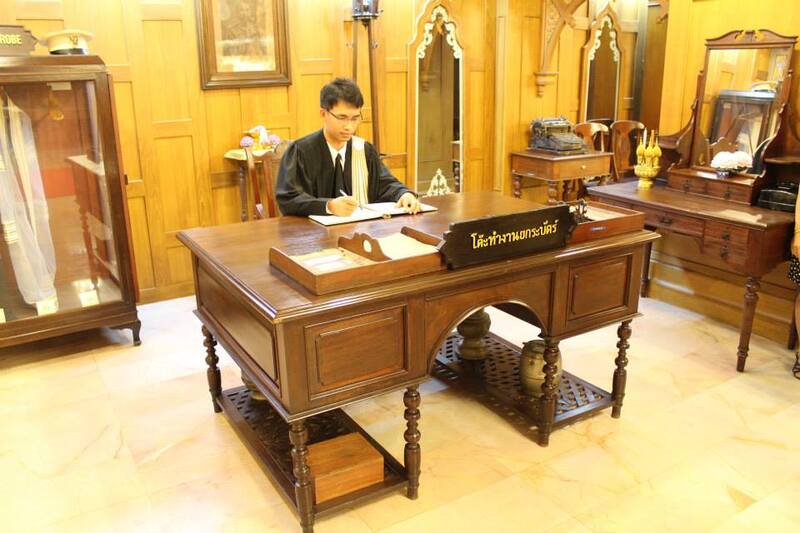
The displayed artifacts include ancient law books, original legal documents, tools, and uniforms collected from provincial public prosecutor offices across the country. These items are not presented merely as collectibles, but as evidence reflecting the working practices of prosecutors in different eras, from handwritten documentation to modern administrative systems.
One aspect that gives the Thai Public Prosecutors Museum strong historical and political significance is its presentation of landmark legal cases. These cases are not displayed in a sensational manner, but are contextualized within the role of prosecutors and the legal system of the Thai state at specific moments in history.
The October 6, 1976 case is one of the most important examples illustrating the complexity of law and state power. The museum presents this case as an event that challenged ideas of justice, accountability, and the limits of legal authority during a period of political crisis. Visitors are not provided with definitive answers, but are instead encouraged to question the role of judicial institutions in society.
Another case featured is the Cherry Ann case, a criminal case that attracted widespread public attention. Its inclusion demonstrates the role of prosecutors in high-profile cases, from evidence collection and indictment to navigating pressure from media coverage and public opinion.
Overall, the Thai Public Prosecutors Museum functions as an institutional learning space where visitors can see that law is not merely a written code, but a product of social context, political conditions, and power relations at different points in time. This is a museum that does not dictate what is right or wrong, but instead opens space for reflection and interpretation.
In practical terms, the museum is particularly suitable for legal professionals, students, academics, and members of the public interested in political and legal history. The interior environment is quiet and formal, and not suited for rushed visits or casual photography. Visitors are encouraged to allow sufficient time and approach the exhibits with careful attention.
Getting There The museum can be reached by MRT, alighting at Thailand Cultural Centre Station, followed by a short walk or local transport. It is also accessible by private car via Ratchadaphisek Road. Visitors are advised to check parking availability and building regulations in advance, as the site is within a government complex.
| Name | Thai Public Prosecutors Museum |
| Location | 11th Floor, Office of the Attorney General, Ratchadaphisek Road, Bangkok |
| Admission Fee | Free admission |
| Nearby Attractions | Thailand Cultural Centre (0.8 km) |
| Nearby Accommodation | Swissotel Bangkok Ratchada (1.2 km), Tel. 02-694-2222 |
| Nearby Restaurants | Thailand Cultural Centre Restaurants (0.8 km), Tel. 02-247-0023 |
Frequently Asked Questions (FAQ)
Q: Which days is the Thai Public Prosecutors Museum open?
A: The museum is open from Monday to Friday and closed on Saturdays, Sundays, and public holidays.
Q: Is there an admission fee?
A: Admission is free of charge.
Q: How can group visits be arranged?
A: Groups are required to submit an official request letter to the relevant academic services center at least three days in advance.
Q: Who is this museum suitable for?
A: The museum is suitable for visitors interested in legal history, political history, and the role of the justice system in Thai society.
 Tel: 025412951
 The Thai Public Prosecutors Museum Map
 Category:
  Group:
  Tag: ●The Thai Public Prosecutors Museum●thai public prosecutors museum ●legal museum bangkok ●thailand legal history museum ●office of the attorney general thailand ●thai justice system museum ●prosecution history thailand ●legal heritage museum thailand ●political history museum bangkok Last Update: 2 MonthAgo
Comment
 Nearby Attractions
| Keyword (Advance) |
 Region
|
 Phra Nakhon(
 Copyright 2012,