
 Home
Home North(
 Chiang Mai(


The Royal Monument of King Vajiravudh (Rama VI)
Rating: 4.4/5 (5 votes)
 Search By
  Map
Map 
 Have Map
  No Map
Bangkok attractions
Attractions in Thailand
Open Days: Daily
Opening Hours: Generally 04:30 – 22:00 (Hours may change due to announcements/special events. Please check the latest updates before visiting.)
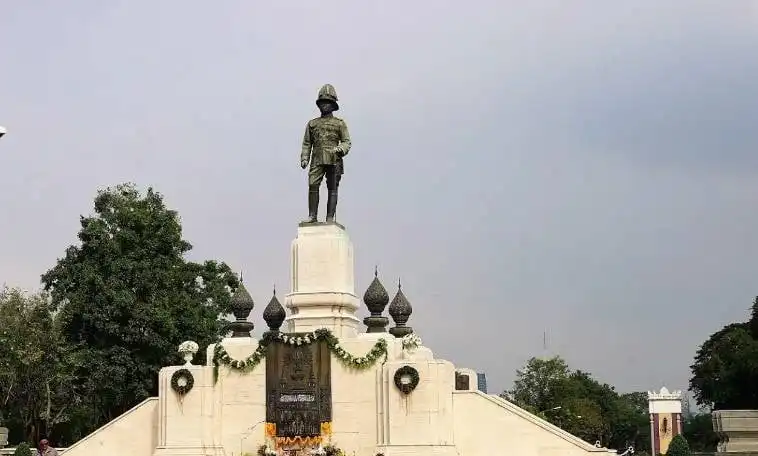
The Royal Monument of King Vajiravudh (Rama VI) in Lumphini Park is the kind of landmark that feels different once you step close—not just a photo spot, but a shared memory of the city. In the middle of Silom–Sathorn, it gives people a quiet pause to look back at history and pay respects in an accessible public space.
What makes this monument truly special is not only the dignity of the royal statue itself, but also the story of its creation—a reflection of collective effort and devotion. It began with an alumni initiative and grew into a wider public contribution, leading to the decision to place it where people could visit and pay respects conveniently.
The creation of the royal monument of King Vajiravudh (Rama VI) was initiated by the Vajiravudh College Alumni Association as early as 1932. The original idea was to raise funds from alumni to build the monument and install it within Vajiravudh College. However, as the news spread, many loyal citizens who recognized His Majesty’s great royal grace donated substantial funds. With the plan no longer limited to the school, the Association concluded that the monument should stand in a public place where people could easily come to pay respects, and that the project should be proposed for government consideration and implementation.
At that time, the government under Prime Minister Field Marshal Plaek Phibunsongkhram approved the project and proceeded under the Prime Minister’s Office announcement on creating a royal statue as a monument to honor King Vajiravudh, dated 9 January 1939. One passage states that the Cabinet, having deliberated together, agreed it was appropriate to create a royal statue of His Majesty the Great King Vajiravudh in remembrance, in recognition of his outstanding virtues and royal duties that brought immense benefit to the nation’s history—as a lasting memorial of the Thai people’s loyalty and gratitude, and as an enduring symbol that honors Thailand for generations to come.
Accordingly, it was unanimously resolved to create monuments for eight great monarchs: King Ramkhamhaeng the Great; King Ramathibodi I (King Uthong); King Phrom the Great; King Borommatrailokkanat; King Naresuan the Great; King Taksin of Thonburi; King Narai the Great; and King Rama VI (King Vajiravudh). Each monument would be placed in a province associated with the origins or key foundations of each monarch’s legacy.
Because devoted groups were already raising funds to create a monument in King Rama VI’s honor, and because Bangkok Municipality was planning to renovate Lumphini Park—originally established to commemorate his reign—the Cabinet considered it especially fitting to install his statue in Lumphini Park at that time. Therefore, the Cabinet resolved to proceed with King Rama VI’s monument as the first project, aiming to complete and inaugurate it on 1 January 1940 at Suan Siwalai within the Grand Palace. The casting began with the head, followed by the body. The full casting was completed on 7 June 1941, marking the first time in the Rattanakosin era that such a large-scale statue was successfully cast domestically; previously, large monuments typically required casting overseas, particularly in Europe.
For the casting and finishing of this royal statue, the Fine Arts Department assigned Professor Silpa Bhirasri to design, sculpt, and oversee the casting. The head was cast first, then the body. The full statue was completed on 7 June 1941—the first successful domestic casting of a large monument of this scale in the Rattanakosin era. Bangkok Municipality was responsible for constructing the pedestal base and the surrounding landscape design.
Based on photographic evidence and records, it is assumed that the original chamfered square pedestal base was later raised in height to better balance the proportions of the statue, giving the monument a more dignified presence. Aerial photographs also indicate that the fountain pool in front of the monument was originally circular, unlike the present rectangular design.
As for the statue itself, there are no alternative assumptions that differ from its current appearance. Overall, it remains in very good condition. What can be observed is some uneven patina and discoloration caused by weather, rain, dust, and bird droppings—suggesting that cleaning, patination, and surface protection may not have been carried out for some time.
From an urban history perspective, placing the monument inside a major public park in the heart of Bangkok means its role extends beyond ceremonial occasions. It becomes part of everyday life: people pass by while exercising, families stroll through, and visitors who simply want a calm moment to pay respects can do so without needing a formal event.
Another interesting point is the tradition of laying wreaths and paying royal tribute on significant occasions—especially around the anniversary of King Rama VI’s passing (25 November), when agencies and members of the public may come to honor him here. On such days, the atmosphere can feel slightly more formal, while ordinary days are generally quieter and more relaxed—ideal for those who prefer an unhurried visit.
Getting There This area is exceptionally convenient by public transport because it sits in the city center. You can get off at BTS Sala Daeng or MRT Si Lom and walk into Lumphini Park via the main pedestrian routes (the overall walking distance is not far). If you are traveling by car or taxi, set your destination to “Lumphini Park” and choose a drop-off point along Rama IV Road or the Silom side depending on traffic. Early morning and late afternoon are the most comfortable times to walk—the light is pleasant and the heat is less intense.
Before paying respects, it is recommended to dress modestly, keep your voice low, avoid climbing onto the base, and take care on surfaces that may be slippery after rain—especially around the forecourt and near the fountain/pool area—so your visit stays respectful, safe, and considerate of others sharing the park.
| Name | The Royal Monument of King Vajiravudh (Rama VI) |
| Location | Lumphini Park, Pathum Wan, Bangkok |
| Characteristics | A major city-center monument in a public park, suitable for paying respects, learning urban history, and extending a trip into the Silom–Sathorn area |
| Period | Concept initiated in 1932; full casting completed in 1941 (as described in the creation record above) |
| Tradition / Related Ceremony | Royal tribute and wreath-laying on significant occasions (e.g., the anniversary of his passing on 25 November), held from time to time |
| Travel | BTS Sala Daeng / MRT Si Lom, then walk into Lumphini Park; by car/taxi set destination to Lumphini Park (avoid rush hours if possible) |
| Current Status | Open for visiting/paying respects in line with Lumphini Park opening hours |
| Contact (Lumphini Park) | 02 252 7006 |
| Nearby Attractions (Approx. Distance) | Lumphini Park (within the park) – 0.1 km – 02 252 7006 King Power Mahanakhon – 1.2 km – 02 677 8721 Bangkok Art and Culture Centre (BACC) – 2.6 km – 02 214 6630 Queen Sirikit National Convention Center (QSNCC) – 3.0 km – 02 229 3000 One Bangkok – 1.0 km – 02 021 9999 |
| Nearby Restaurants (Approx. Distance) | Somtum Der Sala Daeng – 0.8 km – 082 294 2363 Eat Me Restaurant – 0.6 km – 02 238 0931 Le Du – 1.0 km – 092 919 9969 Vertigo (Banyan Tree Bangkok) – 0.8 km – 02 679 1200 Baan Khanitha & Gallery (Sathorn) – 1.2 km – 02 675 4200 |
| Nearby Accommodations (Approx. Distance) | Dusit Thani Bangkok – 0.2 km – 02 200 9000 Crowne Plaza Bangkok Lumpini Park – 0.2 km – 02 632 9000 Banyan Tree Bangkok – 0.8 km – 02 679 1200 The Standard, Bangkok Mahanakhon – 1.2 km – 02 085 8888 SO/ Bangkok – 1.3 km – 02 624 0000 |
Frequently Asked Questions (FAQ)
Q: Where is the King Rama VI royal monument located in Bangkok?
A: It is located inside Lumphini Park in the Silom–Sathorn area, and it is easy to reach by BTS/MRT or by car.
Q: What time is best to visit?
A: Early morning or late afternoon is most comfortable. The light is beautiful and the atmosphere tends to be calmer than midday.
Q: Are there any related ceremonies or traditions here?
A: Royal tribute and wreath-laying may be held on significant occasions from time to time, especially around 25 November (the anniversary of his passing).
Q: What should I wear and how should I behave when paying respects?
A: Dress modestly, keep your voice low, avoid climbing onto the base, and keep the area clean to respect the place and other visitors.
Q: If I have limited time, what should I visit nearby?
A: Good options include King Power Mahanakhon, BACC, QSNCC, or exploring the Silom–Sathorn neighborhood depending on your style.
 The Royal Monument of King Vajiravudh (Rama VI) Map
 Category:
  Group:
  Tag: ●The Royal Monument of King Vajiravudh (Rama VI)●king rama vi monument ●vajiravudh monument lumphini park ●rama vi statue bangkok ●lumphini park monument ●things to do near lumphini park ●how to get to lumphini park ●silom sathorn attractions ●restaurants near lumphini park ●hotels near lumphini park ●bangkok historical monuments
Last Update: 3 MonthAgo
Tag: ●The Royal Monument of King Vajiravudh (Rama VI)●king rama vi monument ●vajiravudh monument lumphini park ●rama vi statue bangkok ●lumphini park monument ●things to do near lumphini park ●how to get to lumphini park ●silom sathorn attractions ●restaurants near lumphini park ●hotels near lumphini park ●bangkok historical monuments
Last Update: 3 MonthAgo
Comment
 Nearby Attractions
| Keyword (Advance) |
 Region
|
 Phra Nakhon(
 Copyright 2012,