
lovethailand home >Central Travel Attractions >Bangkok Travel Attractions >Taling Chan >Khlong Chak Phra > Wat Kanchana Singhasns Worawihan
TL;DR: Wat Kanchana Singhasns Worawihan, Bangkok attractions : Places of Worship, Temple.
Wat Kanchana Singhasns Worawihan
Open Days: Daily (it’s best to call ahead, especially if you want to enter the inner areas during ceremonies)
Opening Hours: Generally 08:00 – 17:00 (access to certain inner areas may vary depending on monastic duties or temple activities)
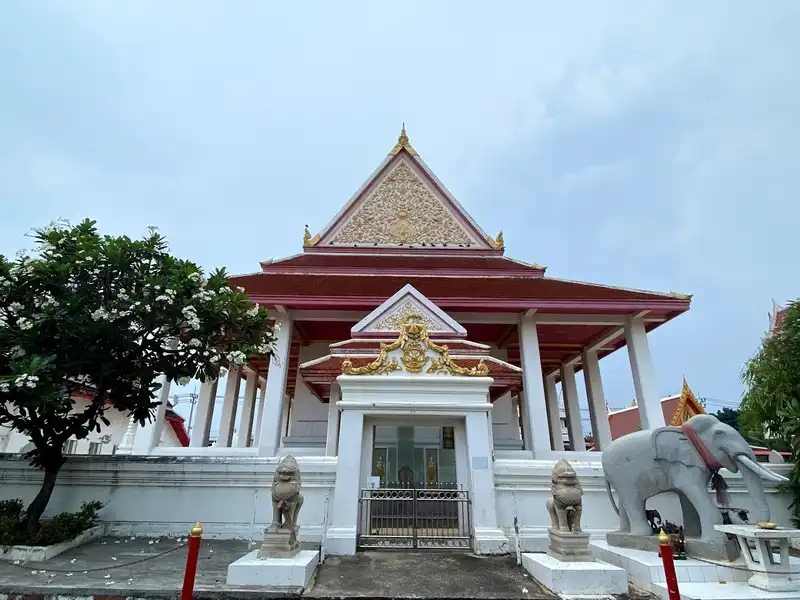
Wat Kanchana Singhasan Worawihan (Wat Thong Bang Phrom) is an old canalside temple on the Thonburi side of Bangkok with a very clear “riverside community temple” charm. It doesn’t need to try to be a tourist attraction to feel meaningful—it already carries stories that visitors can genuinely read and sense. The temple sits in the Khlong Chak Phra–Khlong Bang Phrom area of Taling Chan, a part of Bangkok where traces of canal life still show up in the waterways, the narrow lanes running alongside them, and the community rhythm that has long used the temple as a real center of shared activities.
What gives this temple its character is how locals often describe it as the “pair” across the water. In the neighborhood, people commonly speak of a “silver–gold temple” duo: Wat Ratchathitthan (the “silver temple”) and Wat Kanchana Singhasan (the “gold temple”), positioned on opposite sides near the mouth of the Bang Phrom canal junction. It feels like a twin set of spiritual landmarks for a waterside community—back from the era when canals functioned as the main roads of everyday life.
According to local historical accounts, Wat Thong dates to the late Ayutthaya period. Two Chinese brothers of the Tan clan—remembered as Chao Khrua Ngern and Chao Khrua Thong—settled here, prospered through trade, and established temples to serve as shared centers of faith for the canal communities on both banks. The name “Thong” (gold) has therefore never been just a pleasant label. It is tied to the local memory of commerce, abundance, and a riverside network that grew through travel and trade.
In the Rattanakosin era, the temple went through multiple phases of establishment and restoration. A major milestone came under King Rama IV, when the temple was granted the new name “Wat Kanchana Singhasan” in 1854 (B.E. 2397). In 1863 (B.E. 2406), the principal Buddha image and its pedestal (base) were also restored. Step by step, the temple’s overall layout became more orderly and structurally secure, paralleling how Thonburi evolved from a “water city” into a “road city” over time.
If you come for architecture, the spot worth slowing down for is the “old ubosot” (ordination hall). Its form reflects Ayutthaya-era style, with a high plastered wall rising toward the roof line, giving the building a grounded, weighty old-temple feel. Some upper structural details are believed to have been repaired in the early Rattanakosin period. Notably, the gable is not crowned with the typical chofa and bai raka ornaments. Instead, it stands out with stucco motifs of vines and trees, a restrained craftsmanship that feels quietly confident rather than showy.
Many visitors pause longest at the door panels, decorated with gold-on-black “lai rot nam” motifs depicting trees and various animals. These details are part of the charm of an old temple that can tell its story without needing curated exhibits. Another distinctive feature is the boundary stones around the ubosot, known as “sema nang than” (sema stones set on pedestals), without the common side-flame-like decorative pattern seen elsewhere. The result is a cleaner, unusual silhouette that makes the ubosot perimeter feel unmistakably its own.
The spiritual heart of the temple is “Luang Pho Thong,” long revered by local worshippers, especially among community members whose lives are closely tied to trade and livelihood blessings. Local belief often speaks of praying for work, business success, and good fortune. Even if you come simply to pay respect, it’s easy to do so in a calm, respectful way: keep your voice low, avoid disrupting the space, and if you plan to make offerings or donate, follow the temple’s guidance and the instructions of staff or monks on that day.
Another question visitors commonly have is why there is a “new ubosot.” The simplest explanation is that the original ubosot became deteriorated and, during certain periods, could not be restored under relevant procedures. The temple therefore built a new ubosot for monastic ceremonies. The old ubosot has since been used as a viharn (assembly hall) instead, allowing today’s visitors to see both the historical layer and the living, practical layer of how the temple is used.
Getting There The temple is located at No. 686 Kaew Ngern Thong Road (Chim Phli–Wat Ratchathitthan Road), Khlong Chak Phra Subdistrict, Taling Chan District, Bangkok. Driving or taking a taxi is the easiest option—simply pin the temple name on your map and follow navigation. As this is a residential community area, drive slowly and be mindful of narrow lanes in some stretches. If you come by public transport, it’s usually most convenient to get to the Charan Sanitwong/Taling Chan area first, then take a taxi or local hired vehicle for the final leg. If you want to enter specific inner areas, it’s best to call ahead to avoid ceremony times.
| Name | Wat Kanchana Singhasan Worawihan (Wat Thong Bang Phrom) |
| Location | No. 686 Kaew Ngern Thong Road (Chim Phli–Wat Ratchathitthan Road), Khlong Chak Phra, Taling Chan, Bangkok |
| Highlights | A historic “paired” temple with Wat Ratchathitthan (Wat Ngern). Notable for the old Ayutthaya-style ubosot, stucco vine motifs, gold-on-black lai rot nam door art, and distinctive “sema nang than” boundary stones |
| Period | Late Ayutthaya origin; renamed “Wat Kanchana Singhasan” under King Rama IV (B.E. 2397 / 1854) and restoration of the principal Buddha image and base noted in B.E. 2406 / 1863 |
| Name Origin | Originally known as “Wat Thong”; later granted the name “Wat Kanchana Singhasan” under King Rama IV |
| Current Status | An active community temple and a respected place to pay homage to “Luang Pho Thong” |
| Contact Number | 02-418-5061 |
| Nearby Attractions with Distance | Royal Barge National Museum — approx. 8 km — 02-424-0004 Taling Chan Floating Market — approx. 6 km — (for a phone number, check the latest official page/announcement) Khlong Lat Mayom Floating Market — approx. 10 km — (for a phone number, check the latest official page/announcement) ChangChui Creative Park — approx. 11 km — 064-145-9595 Artist’s House (Baan Silapin), Khlong Bang Luang — approx. 11 km — 095-662-7910 |
| Popular Restaurants Nearby with Distance | Samsen Villa (Ratchaphruek branch) — approx. 10 km — 089-040-1805 Maguro Sushi (The Circle Ratchapruk) — approx. 10 km — 085-456-5556 Food zone at Taling Chan Floating Market — approx. 6 km — (check the latest market contact info) Food zone at Khlong Lat Mayom Floating Market — approx. 10 km — (check the latest market contact info) Restaurants around Bang Khun Non–Charan Sanitwong — approx. 8 km — (choose based on reviews and convenience) |
| Popular Accommodations Nearby with Distance | Royal City Hotel (Pinklao) — approx. 9 km — 02-435-8888 Theatre Residence — approx. 9 km — 02-848-9488 Charlie House Pinklao — approx. 10 km — 02-883-2222 Praya Palazzo — approx. 11 km — 02-883-2998 The Siam Hotel — approx. 13 km — 02-206-6999 |
Frequently Asked Questions (FAQ)
Q: Which part of Bangkok is Wat Kanchana Singhasan Worawihan located in?
A: The temple is in Khlong Chak Phra, Taling Chan District on the Thonburi side of Bangkok, near the Bang Phrom canal area—a long-established canalside community where traces of traditional canal life can still be felt.
Q: Is Wat Thong Bang Phrom truly connected to the “silver temple” (Wat Ngern)?
A: In local community narratives, this temple is often mentioned together with Wat Ratchathitthan (Wat Ngern) across the canal, forming the well-known “gold–silver” temple pair at the same canal junction.
Q: What architectural highlights should I not miss?
A: Don’t rush past the old Ayutthaya-style ubosot, the stucco vine motifs on the gable, the gold-on-black lai rot nam door paintings, and the distinctive “sema nang than” boundary stones around the ubosot.
Q: What do people usually pray for at “Luang Pho Thong”?
A: Many locals come to pay respect for auspiciousness, especially regarding work, business, and good fortune. Visitors are encouraged to keep the atmosphere calm and respectful and to follow temple guidance during ceremony times.
Q: Why does the temple have a new ubosot, while the old one is used as a viharn?
A: In general, the old ubosot became deteriorated and had limitations around restoration during certain periods, so a new ubosot was built for monastic ceremonies. The old ubosot is therefore used as a viharn instead.
 Category: ●Places of Worship
 Group: ●Temple
Last Update : 9 MonthAgo
 Last Update : 9 MonthAgo
 Click to Access the Navigation Map GPS
Wat Kanchana Singhasns Worawihan Map
Recommend

 Art, Culture and Heritage
 Historical Sites and Monuments(3)
 Landmarks and Memorials(23)
 Royal Palace(13)
 Art, Craft Centres, Tradition(35)
 Museums(59)
 Historic Homes and Cities(3)
 Art Gallery(16)
 Educational Places
 Museum for Study(6)
 Library(4)
Temple(72)
Library(4)
Temple(72)
 Church(2)
 Mosque(67)
 Other Sacred Sites(8)
 Research and Development
 Royal Project(1)
 Suburban Living
 Village, Community(5)
 Local Market(9)
 Floating Market(2)
 Nature and Wildlife
 River, Canal(3)
 Bays and Beaches(1)
 Other natural attractions(1)
 Entertainment and Agricultural
 Zoos and Aquariums(5)
 Animal camps and shows(5)
 Stadium(9)
 Farms, Parks and Ecotourism(20)
 Amusement Park(1)
 Waterpark(4)
 Theater(7)
 Cinema(1)
 Shopping
 Shopping and Night Market(20)
 Department Store(7)
 Spas and Wellness
 Spas and Wellness(1)
 Restaurant
 Michelin Star(5)
 Accommodation
 Hotel(3)
 Call Customer Service in Tourism
 Call Customer Service in Tourism(1)
 Travel Articles, Recipes
 Travel Review, Food Review(41)
 Royal Thai Desserts and Recipes(56)


