
 Home
Home North(
 Chiang Mai(


Wat Phitchaya Yatikaram Worawihan
Rating: 4/5 (6 votes)
 Search By
  Map
Map 
 Have Map
  No Map
Bangkok attractions
Attractions in Thailand
Open Days: Generally open daily (recommended to call and confirm before visiting, especially during merit-making events/ceremonies)
Opening Hours: Generally 08:00 – 17:00
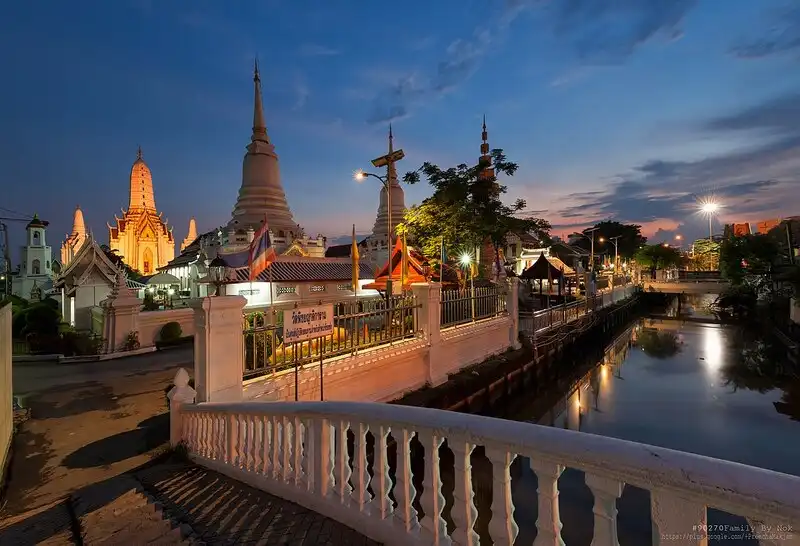
Wat Phitchaya Yatikaram Worawihan (Wat Pichaiyat) is a royal temple on the Thonburi side with a very distinct character from the moment you first see its buildings. Its charm is not only the calm, grounded atmosphere you expect from an urban temple, but also the way it reflects early Rattanakosin Bangkok as a city growing through river trade and deep connections with China. The temple is located near the Memorial Bridge (Saphan Phut), in an area older generations know as “Wongwian Yai/Lek” (Wongwian area) in Somdet Chao Phraya Subdistrict, Khlong San District, and it sits along Khlong Ban Somdet Chao Phraya. That setting gives the temple both a riverside-community feel and the role of a ceremonial heart for people in Thonburi.
The appeal of Wat Phitchaya Yatikaram is not about being the “grandest” temple in Bangkok. It is the density of stories and architectural details you can actually see and feel as you walk. The site was originally abandoned, before Somdet Chao Phraya Borom Maha Phichaiyat (That Bunnag) — who at the time held the title Phraya Si Phiphat Ratchakosa — restored it around 1832 – 1835 (B.E. 2372 – 2375), during the reign of King Rama III. That period was when Bangkok was propelled by river commerce and bustling Chinese junk trade. Materials such as colored roof tiles, stone, and decorative elements from China were not unusual; they became the “language of the era,” carried from the world of trade into religious architecture in a way that feels remarkably coherent.
After the restoration was completed, the temple was presented to King Rama III, who bestowed the name “Wat Phra Ya Yatikaram.” Later, in the reign of King Rama IV, the temple was renamed “Wat Phitchaya Yatikaram.” The name most people still use today is simply “Wat Pichaiyat.” In other words, the temple’s name is more than a signboard; it reflects its ties to its patron and its status as a royal monastery rooted in Bangkok’s political, economic, and spiritual history.
The temple’s overall style is Thai blended with Chinese influences, in line with the royal tastes of King Rama III’s era. One feature many visitors linger on is the ordination hall (ubosot), designed in a Chinese style and notably “without chofa and bai raka” — roof finials commonly seen on Thai temples. Familiar Thai roof elements were intentionally omitted. A local explanation often shared is that the temple once sat within garden grounds with many trees; reducing such roof ornaments helped minimize the risk of branches or fruit falling and damaging the roof or its upper structures. This makes Wat Phitchaya Yatikaram not just “beautiful in an unusual way,” but also a practical example of design responding to its real environment.
Inside the ubosot, the principal Buddha image is a sculpted figure in the Maravijaya posture (subduing Mara), described as an ancient image of the same “generation” as Phra Phuttha Chinnarat/Chinnasi. It was brought from Wat Phra Wihan Luang in Phitsanulok and is named “Phra Siddhartha.” Locally, it is widely known by a warmer, easy-to-remember name: “Luang Pho Sompratthana” (“the Venerable Buddha Who Grants Wishes”). Many devotees connect their prayers with the hope that their intentions will “be fulfilled,” echoing the popular name. As a result, the atmosphere in the ubosot often feels especially focused and serene — people tend to stand quietly before the principal image a little longer than usual, as if placing their hopes down gently and mindfully.
In front of the principal image, there is another Buddha image in the Maravijaya posture. It is recorded that Prince Nakhon Sawan Woraphinit had it cast in 1922 (B.E. 2465) and named it “Phra Worawinayok.” Details like this create layers of time within the same space: the Rama III foundation with its strong Chinese character, followed by later additions that blend in naturally. Rather than feeling like separate worlds, these layers make the temple feel lived-in and continuously meaningful across eras.
Another strong visual identity of the temple is its prominent prang (Khmer-style tower), remarkable for both its scale and the way it shapes the surrounding space. The main prang is recorded as measuring 33 wa and 2 sok in circumference, and 21 wa, 1 sok, and 10 inches in height to the top finial. The structure is associated with four sculpted Buddha images facing the four directions. There are also two smaller prangs, each recorded as 15 wa in circumference and 11 wa, 1 sok, 1 kube, and 2 krabiet in height. The eastern prang enshrines the Bodhisattva Phra Si Ariya (Maitreya). The western prang enshrines a set of four replica Buddha footprints carved on stone slabs, believed to be old, though their original provenance is unknown. This combination makes a visit feel less like “take a photo and leave” and more like walking through symbols, beliefs, and craftsmanship at the same time.
Seen through an urban lens, Wat Phitchaya Yatikaram functions as a true community center on the Thonburi side — not merely a landmark for quick check-ins. Merit-making days, kathina robe offerings, traditional observances, and various ceremonies still bring local people back together. The temple becomes a place where “faith” and “community” are inseparable. There is also a story commonly mentioned that Mae Chi Thotsaphon (or Thanaphon) once resided at this temple. It is usually shared in the context of practice and simple living within temple grounds rather than as sensational talk, reinforcing the image of the temple as a calm place that supports contemplation and a quiet kind of “rest for the heart.”
Getting There The easiest way is to use a train line and then take a taxi or local ride into the temple area, as the temple is in Khlong San near the Memorial Bridge and Prajadhipok Road. Another option that suits the neighborhood’s atmosphere is traveling by boat and then walking or taking a short ride, turning the trip into a riverside day out — for example connecting to Kudichin, Wat Prayurawongsawat, Wat Kalayanamitr, or crossing to the Phra Nakhon side to continue to Museum Siam and the Old Town in the same day. If you drive, it’s wise to allow extra time for parking and traffic around the bridge approach, especially in the morning and after work hours.
If you want to visit without rushing, it’s best to allow at least 45 – 90 minutes. There is a lot of detail, and the atmosphere is better suited to slow walking than to trying to beat the clock. A simple flow is to begin by paying respects to Luang Pho Sompratthana in the ubosot, then observe the Thai–Chinese architectural features and tilework details, and finally continue to the prang complex, including the locations of Phra Si Ariya and the four replica Buddha footprints. This kind of visit gives people something to take home beyond photos — it gives them a story.
| Name | Wat Phitchaya Yatikaram Worawihan (Wat Pichaiyat) |
| Zone/Area | Khlong San – Near Memorial Bridge (Wongwian area), Bangkok |
| Location | Somdet Chao Phraya Subdistrict, Khlong San District, Bangkok (along Khlong Ban Somdet Chao Phraya) |
| Key Characteristics | Royal temple with Thai–Chinese architecture, Chinese-style ubosot without chofa/bai raka, prominent prang complex |
| Period | Major restoration during King Rama III (approx. 1832 – 1835 / B.E. 2372 – 2375) |
| Key Highlights | Principal Buddha image “Phra Siddhartha” (Luang Pho Sompratthana), Phra Worawinayok (cast in 1922 / B.E. 2465), main and smaller prangs, four replica Buddha footprints |
| Name Origin | Named “Wat Phra Ya Yatikaram” in Rama III; renamed “Wat Phitchaya Yatikaram” in Rama IV |
| Travel Summary | Use rail transit then taxi/local ride; suitable for a connected Thonburi–Old Town route; driving requires time for parking/traffic |
| Current Status | Open for worship/visiting as usual (recommended to call and confirm before visiting) |
| Contact Number | 02-438-1738 |
| Nearby Attractions With Distance | Wat Prayurawongsawat Worawihan (approx. 1.6 km) Tel. 02-465-5592 Wat Kalayanamitr Woramahawihan (approx. 2.2 km) Tel. 02-466-4594 Santa Cruz Church (Kudichin) (approx. 2.8 km) Tel. 02-472-0153 Museum Siam (approx. 5.0 km) Tel. 02-225-2777 ICONSIAM (approx. 4.2 km) Tel. 02-495-7000 |
| Popular Restaurants Nearby With Distance | The Never Ending Summer (approx. 4.0 km) Tel. 02-861-0953 The Jam Factory (approx. 4.1 km) Tel. 02-861-0950 Blue by Alain Ducasse (ICONSIAM) (approx. 4.4 km) Tel. 06-5731-2346 Sirimahannop (Asiatique) (approx. 6.5 km) Tel. 02-059-5999 Kuay Kai Wongwian Yai (approx. 3.8 km) Tel. 086-052-5221 |
| Popular Accommodations Nearby With Distance | Avani+ Riverside Bangkok Hotel (approx. 7.0 km) Tel. 02-431-9100 Anantara Riverside Bangkok Resort (approx. 8.0 km) Tel. 02-476-0022 ibis Bangkok Riverside (approx. 5.2 km) Tel. 02-659-2888 The Peninsula Bangkok (approx. 5.5 km) Tel. 02-861-2888 Shangri-La Bangkok (approx. 6.5 km) Tel. 02-236-7777 |
Frequently Asked Questions (FAQ)
Q: Which part of Bangkok is Wat Phitchaya Yatikaram Worawihan located in?
A: It is in Khlong San District, near the Memorial Bridge, in the area many locals know as Wongwian, along Khlong Ban Somdet Chao Phraya.
Q: What architectural features should I look for?
A: The Chinese-style ubosot without chofa and bai raka, and the overall Thai–Chinese blend that reflects the royal taste of King Rama III’s era.
Q: Which image is Luang Pho Sompratthana (Phra Siddhartha), and how should I pay respects?
A: It is the principal Buddha image inside the ubosot in the Maravijaya posture. Pay respects quietly and mindfully, and follow the temple’s etiquette inside the ordination hall.
Q: How much time should I plan for a visit?
A: If you want to see the details properly, allow around 45 – 90 minutes, especially if you want to explore both the ubosot and the prang complex without rushing.
Q: What nearby places can I combine in a one-day route?
A: You can continue to Wat Prayurawongsawat, Wat Kalayanamitr, the Kudichin area and Santa Cruz Church, or cross to the Old Town side for Museum Siam.
Q: What number should I call to confirm information with the temple?
A: 02-438-1738
 Wat Phitchaya Yatikaram Worawihan Map
 Category:
  Group:
  Tag: ●Wat Phitchaya Yatikaram Worawihan●wat phitchaya yatikaram ●wat pichaiyat ●khlong san temple ●temple near memorial bridge ●thai chinese temple bangkok ●luang pho sompratthana ●thonburi temple tour ●bangkok riverside temples ●kudichin nearby attractions ●travel klong san bangkok Last Update: 2 MonthAgo
Comment
 Nearby Attractions
| Keyword (Advance) |
 Region
|
 Phra Nakhon(
 Copyright 2012,