

 Home
Home Chiang Mai(




Bang Sai Arts and Crafts Center
Rating: 2.9/5 (8 votes)
 Search By
  Map
Map 
 Have Map
  No Map
Phranakhon Si Ayutthaya attractions
Attractions in Thailand
Open Days: Wednesday–Sunday and Public Holidays
Opening Hours: 08.30–16.30
Bang Sai Arts and Crafts Center is one of Ayutthaya’s most distinctive attractions, offering a very different perspective from the province’s famous ancient ruins and temples. Set along the Chao Phraya River, this expansive site brings together the history of livelihood development, tangible artistic craftsmanship, and a living learning atmosphere in one place. The first impression upon entering is the sense of openness and the well-organized landscape. The center was shaped by an approach that puts people at the heart of development, treats local skills as valuable capital, and regards dignified, sustainable livelihoods as a central goal. As a result, visiting here is not simply about walking around buildings or buying souvenirs; it is about understanding that Thai handicrafts are not defined by beauty alone, but by long-standing systems of knowledge transfer, disciplined training, and sustained opportunity.
The story traces back to one of the major royal duties associated with Her Majesty Queen Sirikit, The Queen Mother, namely accompanying His Majesty the King on royal visits to meet people across every region of Thailand. Carried out continuously over many decades, these visits enabled Her Majesty to witness the realities of daily life—people’s hardships, their moments of happiness, and the fragile nature of household income. A key concern was poverty, which left many families struggling with uncertainty. Her Majesty therefore wished to help provide occupations that could increase earnings sufficiently for everyday living in contemporary conditions. The significance of this approach lies in its long-term thinking: rather than short-term relief, it aims to build an enduring foundation of livelihoods so people can stand on their own.
With a royal vision that recognized the value of local skills, Her Majesty Queen Sirikit, The Queen Mother, took a strong interest in traditional village handicrafts and folk arts produced largely from locally available materials. Such work reflects community wisdom, delicacy, and regional identity. Support was provided by sending instructors to train villagers and improve product quality. Once artisans became skilled, their products would be purchased using Her Majesty’s personal funds. This became a powerful driver that elevated what had once been spare-time household work into income-generating occupations with market demand and production standards. The initiative later expanded into the SUPPORT Foundation (The Foundation for the Promotion of Supplementary Occupations and Related Techniques), established on July 21, 1976. The first arts-and-crafts training school was subsequently founded at Suan Chitralada Palace on Coronation Day in 1980, marking an important milestone in the development of a structured vocational training system.
As the training model began to show results, expanding to a larger site capable of serving more people became the next step. Her Majesty Queen Sirikit, The Queen Mother, graciously entrusted Mr. Thanin Kraivichien, Vice Chairman of the Foundation’s Board, to locate land near Bang Pa-In Royal Palace for the establishment of another arts-and-crafts center. Two plots were identified, both belonging to the Crown Property Bureau and granted by His Majesty the King for land reform so disadvantaged citizens could have places to live and work. One plot was in Ban Na District, Nakhon Nayok Province, and the other in Bang Sai District, Phra Nakhon Si Ayutthaya Province.
Their Majesties personally visited the Bang Sai plot. The land covered approximately 750 rai, and it was judged suitable for establishing an arts-and-crafts center. On June 3, 1980, the government formally presented this land to Her Majesty Queen Sirikit, The Queen Mother, on the occasion of her 4th cycle birthday celebration, and resolved that various government agencies would support the Bang Sai project to ensure stable and continuous vocational training. In terms of administration, the Ministry of Agriculture and Cooperatives, through the Agricultural Land Reform Office (ALRO), was assigned responsibility for site management and training, while the 21st Infantry Regiment, King’s Guard, assisted with security and coordination. Later, an additional approximately 200 rai was acquired, bringing the total area to nearly 1,000 rai. Her Majesty Queen Sirikit, The Queen Mother, officially opened the Bang Sai Arts and Crafts Center on December 7, 1984.
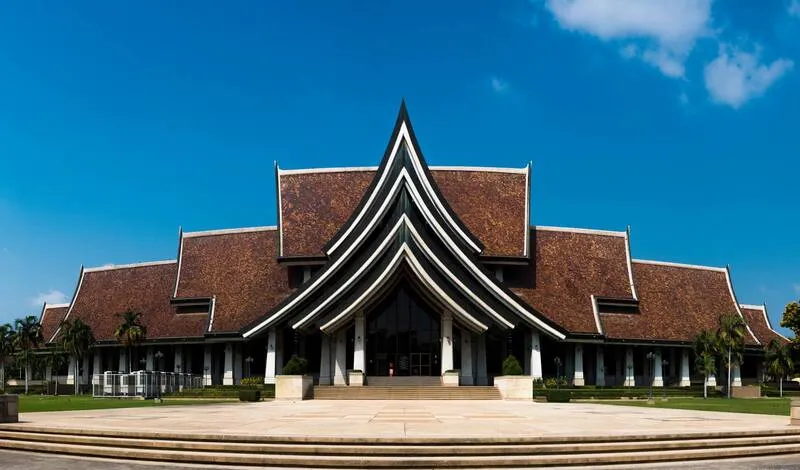
Understanding this background gives deeper meaning to a visit, because each building and activity reflects the principle of “providing knowledge, building skills, raising standards, and creating income” in practical, real-world terms. One of the first landmarks that draws attention is the Phra Ming Khwan Pavilion, a prominent Thai-applied architectural building in a four-gabled style with four floors. The ground floor serves as a demonstration and retail area for arts-and-crafts products from the Bang Sai center and other centers nationwide. Floors 2 and 3 exhibit outstanding arts-and-crafts works, allowing visitors to appreciate quality in detail—pattern precision, fine stitching, refined weaving, and meticulous finishing that require both time and mastery. The 4th floor is commonly used for meetings and seminars, underscoring that this building is not only a shop but also a platform for knowledge management, standard-setting, and broader arts-and-crafts networking.
Another area that many visitors enjoy is the Arts and Crafts Village, which was supported as a place to showcase Thai regional house architecture and to recreate lifestyles and cultural expressions from across the country. Walking through the village can feel like traveling between regions in a single visit, because each house style reflects climate, local materials, and distinct ways of life. Beyond viewing the houses, visitors may also see demonstrations of regional living practices and arts-and-crafts work, turning “knowledge” into a real, visible experience rather than just text on signs. At certain times, traditional performances and folk games may also take place, adding rhythm, sound, and emotional texture to the visit.
A defining charm of the Bang Sai Arts and Crafts Center is that it contains a dedicated vocational training complex within the same site, making the term “center” genuinely accurate. This is not merely a tourist venue but an active training facility. Today, the center provides arts-and-crafts and supplementary vocational training for farmers from all regions of Thailand across a total of 29 departments. Visitors can often observe training processes in several stages—from material preparation and basic skills to production, quality checks, and finishing to meet standards. Many arts-and-crafts products are exquisitely detailed and require long hours to complete. Seeing the real process helps explain why certain pieces are so valuable, and why effective vocational training must be systematic and step-by-step rather than informal repetition of old habits.
In another part of the center, visitors can encounter a space connected to faith and contemporary cultural ties: the Thousand-Armed Guan Yin Bodhisattva. This 6-meter-tall sculpture carved from yellow sandalwood was presented in tribute to His Majesty the King on the occasion of his 6th cycle birthday celebrations. By royal permission, it was installed at Sala Rong Chang (the Elephant House Pavilion) within the Bang Sai Arts and Crafts Center so that those with devotion may pay respects. The presence of this worship site adds another dimension to the center, showing that it is not only about craftsmanship and training, but also about the cultural diversity that intertwines with Thai society today.
Another building that often makes visitors pause is the royal residence pavilion (Phra Tamnak), a traditional Central Thai stilt house built with easily sourced local materials and crafted in classic Thai style. It was constructed as a place of rest for His Majesty the King, Her Majesty Queen Sirikit, The Queen Mother, and the royal family. The surrounding area features ornamental gardens and a man-made waterfall, creating a calm, shaded atmosphere. Seeing a Thai house in its physical setting feels different from viewing photographs, because visitors can understand proportions, airflow design, natural light, and the relationship between the house and garden—all reflecting practical wisdom suited to the Central Thai climate.
For families or those seeking additional variety in a day trip, the Fish Palace (Wang Pla) zone is another highlight. Created and operated by the Department of Fisheries, it is an exhibition of freshwater aquatic species. The main building features two very large glass tanks: a bean-shaped tank with a capacity of 1,400 tons and a spherical tank with a capacity of 600 tons. The exhibits illustrate how different native Thai freshwater fish coexist within a shared environment. Walking through this zone can feel like reading an ecosystem through real visuals, especially when observing fish behavior and the carefully constructed habitat settings.
Nearby is the Bird Park, operated by the Foundation for Wildlife and Plant Conservation of Thailand under royal patronage. The park includes two large aviaries housing more than 30 rare bird species. The interior is arranged to resemble natural conditions, including waterfalls, streams, and a shaded forest-like setting. A suspension bridge allows visitors to walk above and photograph birds from a higher vantage point, so the experience is not just a loop around cages but a change of perspective and viewing distance. After exploring these zones, it becomes clear that the Bang Sai Arts and Crafts Center is not defined by a single theme; it is a carefully balanced blend of craftsmanship, culture, nature, and learning.
Getting There The Bang Sai Arts and Crafts Center can be reached in several ways. If driving from Bangkok, once you reach Bang Pa-In District, you can turn left onto the Bang Sai–Sam Khok route; based on the commonly referenced route description, it is about 24 kilometers to the center. Another option is to use the Nonthaburi–Pathum Thani route (Highway 306), pass the Rangsit intersection, and look for the right turn toward Bang Sai District. This route can suit travelers who prefer to avoid certain stretches of the main roads.
To get the most from a visit, it helps to “pay attention to the intention behind the work,” because some people initially assume the site is purely an exhibition-style attraction. However, walking through the training areas and demonstrations reveals a disciplined system of skill transfer. Familiar Thai crafts—basketry, embroidery, weaving, fine arts craftsmanship, and local-material adaptations—are developed to meet production standards accepted by the market. In a broader view, this is cultural capital transformed into economic opportunity with dignity, while also preserving skills that might otherwise disappear without serious training. A walk through the center can feel like reading a contemporary chapter of Thai history through artisans’ hands, through the detail of each piece, and through the training processes that require sustained practice.
For photography lovers, the Phra Ming Khwan Pavilion offers strong Thai-applied architectural compositions, especially when framed against the wide open grounds. The Arts and Crafts Village provides narrative-rich angles that communicate regional identity in a single frame, as house forms and visual elements function like living cultural sets. The Fish Palace and Bird Park add variety by shifting from craftsmanship to nature, combining stillness and movement within the same trip. A half-day visit suits travelers focused on relaxed walking and photography, while a full-day plan is better for those who want to explore in detail, read contextual information, cover all zones, take breaks, and select arts-and-crafts products as meaningful souvenirs with stories behind them.
Ultimately, what sets the Bang Sai Arts and Crafts Center apart from typical attractions is its “meaning.” Knowing the center’s origins reveals a long-term commitment to creating opportunity through livelihoods, upgrading craftsmanship quality through training, building systems that support output, and sustaining an institution that operates continuously. Many visitors leave not only remembering purchases or photos, but remembering that they witnessed a process that keeps Thai craftsmanship alive and moving forward in the modern world. This is why Bang Sai remains an Ayutthaya attraction worth returning to—whether to share learning with family, or to see familiar crafts again with a deeper understanding.
| Place Name | Bang Sai Arts and Crafts Center |
| Address | Bang Sai District, Phra Nakhon Si Ayutthaya Province (along the Chao Phraya River) |
| Place Summary | A large cultural-learning destination and vocational training center focused on Thai arts and crafts, featuring training observation areas, a four-region village recreation, a worship site, and nature-oriented zones. |
| Key Highlights | Phra Ming Khwan Pavilion, Arts and Crafts Village, Vocational Training Buildings, Fish Palace (Wang Pla), Bird Park, Thousand-Armed Guan Yin Bodhisattva, Royal Residence Pavilion (Phra Tamnak) |
| Current Management | Agricultural Land Reform Office (ALRO) |
| Open Days | Wednesday–Sunday and Public Holidays |
| Opening Hours | 08.30–16.30 |
| Fees | Free admission (Note: some zones may charge separate fees, such as the Bird Park.) |
| Contact Number | 035-207-041 |
| Travel | By car: via Bang Pa-In, then enter Bang Sai–Sam Khok route / or use Nonthaburi–Pathum Thani (Highway 306) toward Bang Sai District |
| Current Status | Open to visitors according to the days and hours listed |
| Nearby Tourist Attractions with Distance | 1) Bang Pa-In Royal Palace (approx. 6.7 km) Tel. 035-261-044 2) Japanese Village Ayutthaya (approx. 18 km) Tel. 035-259-867 3) Ayothaya Floating Market (approx. 22 km) Tel. 035-881-733 4) Ayutthaya Historical Park (approx. 24 km) Tel. 035-242-525 5) Wat Chaiwatthanaram (approx. 27 km) Tel. 035-242-286 |
| Popular Restaurants Nearby with Distance | 1) Rim Nam Bang Sai (approx. 2 km) Tel. 035-367-733 2) Ruay Kung Phao (approx. 10 km) Tel. 086-007-1451 3) Krua Pa Lan Restaurant (approx. 10 km) Tel. 035-366-142 4) Kung Phao Ratchakhram (approx. 12 km) Tel. 085-169-4770 5) Ruen Thai Kung Phao (Wat Choeng Len) (approx. 13 km) Tel. 035-333-410 |
| Popular Accommodations Nearby with Distance | 1) SALA Bang Pa-In (approx. 9 km) Tel. 035-246-388 2) Ayutthaya Garden River Home (approx. 15 km) Tel. 035-704-582 3) Panna Homestay Bang Sai (approx. 8 km) Tel. 081-494-1550 4) Kieng Kiri Resort (approx. 14 km) Tel. 066-124-6236 5) Land Saen Rak Resort Bang Sai (approx. 12 km) Tel. 091-939-5659 |
Frequently Asked Questions (FAQ)
Q: How many hours should I plan for visiting the Bang Sai Arts and Crafts Center?
A: If you focus on the main pavilion and the Arts and Crafts Village at a relaxed pace, 3–4 hours is usually enough. If you also want to observe the training zones and include the Fish Palace and Bird Park, plan for half a day to a full day.
Q: Is there an admission fee?
A: Overall, admission is free, but some zones may charge separate fees (such as the Bird Park). It is best to check the latest notice before your trip.
Q: What are the must-see highlights inside the center?
A: Many visitors start at the Phra Ming Khwan Pavilion for exhibitions and crafts products, then continue to the Arts and Crafts Village and the training areas, and finally choose to visit the Fish Palace or Bird Park depending on interest.
Q: Where should I go if I want to buy arts-and-crafts products?
A: The Phra Ming Khwan Pavilion is generally the main place to browse and purchase arts-and-crafts products.
Q: Is it convenient to travel from Bangkok?
A: Driving is the most convenient. Many travelers go via Bang Pa-In and connect to the Bang Sai–Sam Khok route, or use the Nonthaburi–Pathum Thani (Highway 306) route toward Bang Sai District.
Q: What nearby places can I visit afterward?
A: You can combine your trip with Bang Pa-In Royal Palace, the Japanese Village, Ayothaya Floating Market, or the Ayutthaya Historical Park area. Consider travel time to plan a half-day or full-day itinerary.
 Tel: 035366252-4, 035283246-9
 Bang Sai Arts and Crafts Center Map
 Category:
  Group:
  Tag: ●Bang Sai Arts and Crafts Center●bang sai arts and crafts center ●bang sai arts and crafts ●ayutthaya attractions ●things to do in ayutthaya ●bang sai ayutthaya ●thai handicrafts ●SUPPORT foundation ●arts and crafts village ayutthaya ●phra ming khwan pavilion ●fish palace ayutthaya Last Update: 2 MonthAgo
Comment
 Nearby Attractions
| Keyword (Advance) |
 Region
|
 Phranakhon Si Ayutthaya(
 Copyright 2012,