
 Home
Home North(
 Chiang Mai(


Wat Mahanam
Rating: 4.5/5 (4 votes)
 Search By
  Map
Map 
 Have Map
  No Map
Ang Thong attractions
Attractions in Thailand
Open Days: Daily
Opening Hours: 07:00 – 17:00
Wat Mahanam (formerly Wat Inthararam) is located in Moo 4, Chaiyaphum Subdistrict, Chaiyo District, Ang Thong Province, on the eastern bank of the Chao Phraya River, in an area where the river once functioned as the “main road” for Central Thailand’s river-basin communities. The temple is shaded by large trees, giving it the calm, cooling atmosphere typical of riverside temples. Its location not far from Wat Chaiyo Worawihan also makes it convenient for merit-makers to plan a seamless temple-hopping day trip within the same area. One of the first things visitors tend to notice is the old riverside community ambience nearby—homes and everyday life that remain closely tied to the river can still be felt through local travel patterns, merit-making routines, and community activities that naturally revolve around the temple.
From the perspective of Chao Phraya River Basin history, many riverside temples were not established solely as places of worship; they also served as anchors for the economic, social, and administrative life of earlier times. The Chao Phraya has long been a vital artery sustaining the agricultural abundance of Central Thailand, especially across the upper stretches around Ayutthaya before flowing through Sing Buri, Ang Thong, and Suphan Buri and then connecting to Bangkok. Riverbanks accumulated fresh alluvial sediments, supporting rice fields, orchards, and water-based trade. As communities expanded, temples became centers of faith, community learning, local communication, and ceremonial life that shaped the “rhythm” of the year. As a temple on the eastern bank of the Chao Phraya, Wat Mahanam belongs to the same relationship network as other important temples in Ang Thong that grew alongside water transportation and the prosperity of riverside markets.
The temple’s former name was “Wat Inthararam” before it became known as Wat Mahanam. Renaming temples is not uncommon in Central Thailand; changes sometimes reflect shifts in local leadership, adjustments in community boundaries, or the construction and restoration of major sacred objects that become a new collective “memory” of the place. Over time, the name used in everyday speech often becomes more enduring than formal records. In this sense, Wat Mahanam is a clear example of a temple whose modern name is closely tied to community sentiment and easy recognition for travelers.
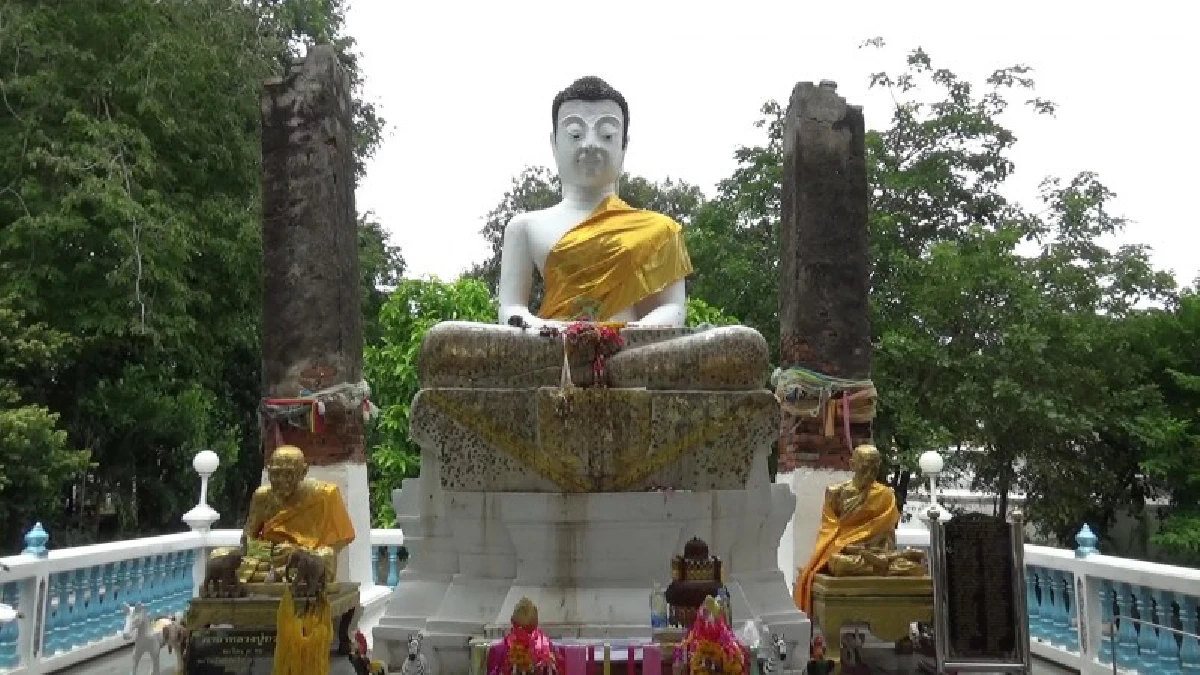
The heart of a visit to Wat Mahanam is paying respect to the large statue of “Phra Sangkajjai,” widely associated with abundance, good fortune, and the uplifting joy that faith can bring. In contemporary Thai belief, Phra Sangkajjai is often linked to commerce, prosperity, and peace of mind, so devotees commonly pray for work, finances, business ventures, or even emotional ease during difficult periods. Within the temple grounds, the statue is positioned as a natural focal point; whether you arrive from the parking area or along shaded walkways, the figure gradually comes into view like an opening scene that invites you to slow down before making offerings and paying respects with intention.
What adds a deeper dimension to Wat Mahanam’s Phra Sangkajjai is the “chedi enshrining the Buddha’s relics (Phra Borom Sareerikathat) and disciples’ relics,” located above the head area at the top of the umbrella-like spire. This means worship does not stop at worldly wishes alone; it connects clearly to the core of Buddhism. The Buddha’s relics are among the highest symbols of reverence, while disciples’ relics represent the continuation of the Dhamma and Vinaya. As a result, visitors often arrange their homage to include both the sacred image and the relics, seeking a complete sense of spiritual fullness and steadiness.
Another major highlight that strengthens Wat Mahanam’s historical character is “Luang Pho Khao,” an old Buddha image that local narratives place at around 400 years of age and associate with the era of King Naresuan the Great. This allows visitors to experience both living devotion and a sense of layered history. Luang Pho Khao feels especially “close” to local residents because the image is linked to prayers for safety, success, and protection from harm. Thai sacredness here is not only about size or grandeur; it is also the accumulated devotion entrusted by generations to the same revered image over time.
The tradition of “fulfilling vows with long-drum dancing” connected to Luang Pho Khao vividly reflects riverside community life in the Chao Phraya Basin. Long-drum music and dance become a language of gratitude offered to the sacred through movement, sound, and the cheerful spirit of local culture—distinct from the more formal rituals often seen in major city temples. When prayers are answered, returning to perform the long-drum dance is not merely keeping a promise; it becomes a shared announcement that faith still works and that the temple remains a tangible space of hope for the community.
On a deeper level, vow-fulfillment through long-drum performance aligns with the social structure of agricultural communities in Central Thailand, where festivals and folk performances help maintain relationships. When people gather to fulfill vows, relatives, neighbors, and visitors often meet and make merit together. The temple becomes a place that builds “social capital,” supporting community warmth and cohesion. Even as modern life leads more people to move away, traditions like this still bring a sense of “coming home,” at least emotionally.
Current temple stewardship further clarifies Wat Mahanam’s identity. The abbot is Phra Khru Wisutthichaikhun (Luang Pho Sa-at), who is also mentioned as Chaiyo District’s ecclesiastical head (Chao Khana Amphoe). Online communications related to the temple have described an inspiration behind the creation of the Phra Sangkajjai statue, including a narrative that Luang Pho Sa-at once had a dream vision of Phra Sangkajjai. Such stories are often interpreted by devotees as auspicious signs, reinforcing both religious meaning and morale for those who travel to pay respects.
Wat Mahanam also clearly embodies the character of a “community temple” through annual activities familiar to local residents, such as Songkran in the form of paying respect to elders and Loy Krathong, which naturally links people to the Chao Phraya River. The temple functions as a shared communal space where everyone can participate—devotees, youth, volunteers, and elders alike. The continuity of these activities helps visitors feel that the temple is not merely a check-in point but a place that is genuinely alive.
Beyond nationwide festivals where the temple and community co-host activities, Wat Mahanam also holds traditional merit-making events typical of Central Thai temples, such as the “Kathin Samakkhi” (community Kathin offering) after the end of Buddhist Lent. This reflects collective effort and shared faith from participants near and far. Kathin at a riverside temple often feels especially warm because it involves extended family ties and long-standing community networks. Joining the Kathin is therefore both a religious act and a reunion for those connected to the area.
Another ceremony that people often remember is “gold-leaf sealing and boundary-marker consecration (Luk Nimit / Phatthasima consecration).” In some years, this becomes a major merit festival with celebratory activities and multiple days of merit-making. Such events are a recognizable feature of Central Thai temple culture, blending social life with religious devotion in a natural way: people come to make merit sincerely while also spending time with family, enjoying local food, and participating in communal joy. This kind of celebration does not diminish sacredness; it helps the temple remain a welcoming, livable space for all ages.
For visitors who want to worship mindfully, a practical sequence is to begin with the main Buddha image in the ubosot or viharn (as arranged by the temple), then proceed to Phra Sangkajjai and the relic chedi, and finally pay respects to Luang Pho Khao for a complete devotional experience. Along the way, notice the temple’s greenery and shade—an important charm that makes many people feel rested simply by walking slowly. As always, dress modestly, keep voices low, and avoid taking photos in ways that disturb devotees or practitioners to preserve the serenity of the place.
Getting There Wat Mahanam is easy to reach by private car or public transport. A common route from Bangkok is to take Highway 32 (Asia Road) toward Ang Thong, then use Highway 309 (Ang Thong – Chaiyo) to enter Chaiyaphum Subdistrict and turn into the access road to Wat Mahanam near the riverside community zone. If you wish to continue sightseeing, Wat Chaiyo Worawihan is nearby, making it convenient to plan a one-day itinerary that combines the quiet charm of a community temple with a major provincial landmark.
As a cultural travel destination, Wat Mahanam suits visitors who enjoy a “slow rhythm” and want to see devotion connected to real everyday life—not only scenic photo spots. The temple’s key highlights are the large Phra Sangkajjai statue as a spiritual focal point, Luang Pho Khao as a revered old Buddha image, and the relic chedi that deepens the worship experience. Combined with the shaded atmosphere along the Chao Phraya River, Wat Mahanam offers both merit and peace of mind without the need to rush.
| Name | Wat Mahanam (Moo 4, Chaiyaphum Subdistrict, Chaiyo District, Ang Thong Province) |
| Address | Ban Mahanam, Moo 4, Chaiyaphum Subdistrict, Chaiyo District, Ang Thong 14140 |
| Place Summary | A community temple on the eastern bank of the Chao Phraya River, shaded and tranquil, suitable for merit-making and cultural travel along the Chaiyo – Ang Thong route. |
| Highlights | Large Phra Sangkajjai statue, relic chedi enshrining Buddha’s and disciples’ relics above the head area, Luang Pho Khao (about 400 years old in local accounts), long-drum vow-fulfillment tradition. |
| Former Name | Wat Inthararam |
| Abbot (Latest) | Phra Khru Wisutthichaikhun (Luang Pho Sa-at) |
| Travel | From Bangkok: Highway 32 (Asia Road) → enter Ang Thong → Highway 309 (Ang Thong – Chaiyo) → Chaiyaphum Subdistrict → turn into Wat Mahanam (approximate driving route). |
| Current Status | Open for worship and merit-making. |
| Contact Number | 089-774-1118 |
| Nearby Attractions (Approx. Distance) | 1) Wat Chaiyo Worawihan – approx. 2 km – Tel. 089-987-2500 2) Wat Ton Son (Mueang Ang Thong) – approx. 15 km – Tel. 035-611-198 3) Wat Chan Ruesi (Mueang Ang Thong) – approx. 18 km – Tel. 035-612-386 4) Wat Khun Inthapramun (Pho Thong) – approx. 25 km – Tel. 035-691-406 5) Wat Muang (Wiset Chai Chan) – approx. 28 km – Tel. 035-631-556 |
| Popular Restaurants Nearby (Approx. Distance) | 1) Naphat Cafe – approx. 6 km – Tel. 081-853-3269 2) Monstera Cafe & Restaurants – approx. 7 km – Tel. 062-451-2551 3) Fanting House – approx. 9 km – Tel. 098-536-0838 4) Kitchen Chaiyo (KM 59, PTT Station) – approx. 10 km – Tel. 081-451-4397 5) The Duck (Chaiyo Branch) – approx. 11 km – Tel. 084-994-9551 |
| Popular Accommodations Nearby (Approx. Distance) | 1) Baan Chaiyo Resort – approx. 3 km – Tel. 098-108-7807 2) H. Nokhook Resort (Chaiyo) – approx. 5 km – Tel. 084-941-2502 3) Bualuang Hotel Ang Thong (Mueang) – approx. 18 km – Tel. 035-611-116 4) Bualuang Boutique Resort Ang Thong (Mueang) – approx. 19 km – Tel. 035-949-850 5) Bualuang Hotel Ang Thong (Reservation/Inquiry) – approx. 18 km – Tel. 080-922-4040 |
Frequently Asked Questions (FAQ)
Q: Where is Wat Mahanam located?
A: Wat Mahanam is in Moo 4, Chaiyaphum Subdistrict, Chaiyo District, Ang Thong Province, on the eastern bank of the Chao Phraya River.
Q: What is the main highlight of Wat Mahanam?
A: The most well-known highlight is the large Phra Sangkajjai statue, along with the relic chedi above the head area and the revered old Buddha image Luang Pho Khao.
Q: Why is Luang Pho Khao important?
A: Luang Pho Khao is regarded as an old Buddha image linked by local tradition to a long history. Devotees often pray for success, well-being, and safety, and the temple is known for a long-drum vow-fulfillment tradition connected to answered prayers.
Q: If I want to worship in a meaningful sequence, where should I start?
A: A practical sequence is to begin with the main Buddha image in the ubosot or viharn, then pay respects to Phra Sangkajjai and the relic chedi, and end at Luang Pho Khao.
Q: Can I visit nearby temples in the same day?
A: Yes. Wat Mahanam is close to Wat Chaiyo Worawihan, and you can extend the route to other nearby temples such as Wat Ton Son, Wat Chan Ruesi, or Wat Khun Inthapramun depending on your time.
Q: What annual merit events are commonly associated with the temple community?
A: In general, community merit events may include Kathin ceremonies and, in some periods, Luk Nimit consecration events, as well as community activities around Songkran and Loy Krathong.
 Wat Mahanam Map
 Category:
  Group:
  Tag: ●Wat Mahanam●wat mahanam ●wat mahanam ang thong ●wat mahanam chaiyo ●phra sangkajjai statue ●luang pho khao ●chaiyo district temple ●ang thong temple ●chao phraya riverside temple ●merit making thailand ●day trip ang thong Last Update: 2 WeekAgo
Comment
 Nearby Attractions
| Keyword (Advance) |
 Facebook Fanpage
 Region
 Art, Culture and Heritage
 Landmarks and Memorials(
 Royal Palace(
 Art, Craft Centres, Tradition(
 Museums(
 Historical Houses and The Ancient City(
 Educational Places
 Educational Gardens, Farm(
 Other religious and spiritural sites(
 Research and Development
 Royal Project(
 Suburban Living
 Village, Community(
 Local Market(
 Floating Market(
 Nature and Wildlife
 River, Canal(
 Other natural attractions(
 Entertainment and Agricultural
 Farm, Parks, Gardens and Ecotourism(
 Outdoor and Adventure Activities(
 Shopping
 Shopping and Night Market(
 Travel Articles, Recipes
 Travel Review, Food Review(
 Central Thai Cuisine, Central Thai food recipes(
 Copyright 2012,