

 Home
Home Chiang Mai(




Wat Ratchapaksi (Wat Nok)
Rating: 3.8/5 (4 votes)
 Search By
  Map
Map 
 Have Map
  No Map
Ang Thong attractions
Attractions in Thailand
Open Days: Daily
Opening Hours: 08:00 – 17:00
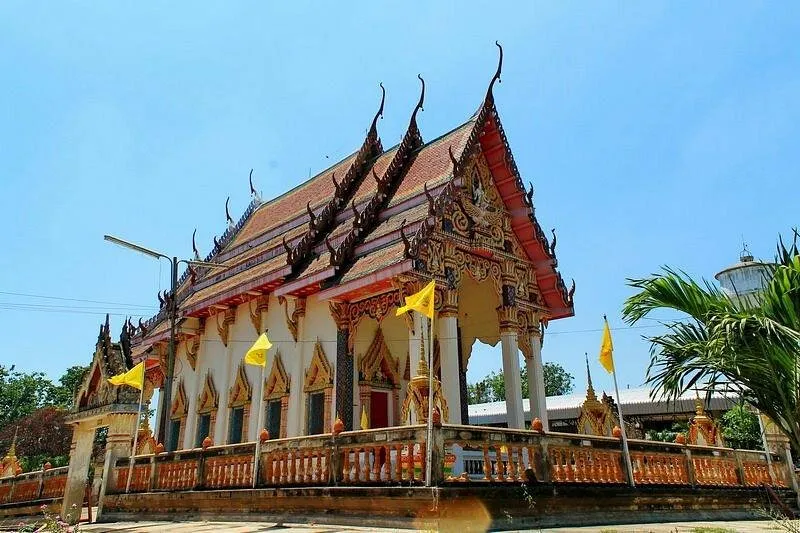
Wat Ratchapaksi (Wat Nok), Ang Thong Province is a riverside temple on the Chao Phraya River that offers both devotion and atmosphere in the same visit. The moment you turn in from the Ang Thong–Ayutthaya road, you can feel the contrast between the liveliness of the main route and the quiet calm that gently slows your breathing. The temple sits on the eastern bank of the Chao Phraya River in Pho Sa Subdistrict, Mueang Ang Thong District, and locals know it well as a living community temple — with resident monks, merit-making events, and a long-standing role in Buddhist education that continues to connect people in the area. For temple-hopping travelers and those who enjoy following important Buddha images, Wat Ratchapaksi is especially known for its large reclining Buddha. Its overall appearance is reminiscent of the famous reclining Buddha at Wat Pamok, but on a smaller scale, making it an easy and worthwhile stop on a one-day Ang Thong merit-making route.
The charm of Wat Ratchapaksi is not only about having a large reclining Buddha to pay respect to. It also lies in the “riverside temple context,” which naturally gives greater weight to stories of art, history, and community. Temples located beside major waterways like the Chao Phraya have long been interwoven with local life — transportation, trade, and seasonal merit-making. And because a river can be both an opportunity and a challenge, riverside temples often carry stories of restoration, erosion prevention, and sometimes important events such as relocating revered Buddha images from vulnerable areas to safer, more stable ground. This is why visiting Wat Ratchapaksi feels like more than a quick stop to pray. It becomes an opportunity to see how faith and real geography have shaped one another through time, and how the community has cared for both the sacred and the landscape for generations.
As you walk into the temple grounds, the first sight that draws your attention is the large reclining Buddha that stands as the focal point of devotion. The reclining Buddha at Wat Ratchapaksi is commonly described as being believed to date back to the Ayutthaya period. Although the original statue once deteriorated over time, it has been restored and returned to a complete, dignified form that the community continues to revere. Seeing the reclining Buddha up close can feel like looking up at a still, quiet compassion. The reclining posture carries Buddhist meaning related to the cessation of suffering, inner peace, and the ability to place the mind above impermanence — a feeling that pairs naturally with the steady breeze from the Chao Phraya that moves through the temple precinct throughout the day. If you come with a wish to pause from daily urgency, simply sitting quietly nearby for a moment often makes restless thoughts soften on their own.
Another key element that deepens the temple’s historical dimension is a Buddha image said to date to the reign of King Songtham, around 2163 BE. This image was once located on the bank of the Chao Phraya River, and because riverside ground can be unstable and prone to collapse, the monks and local community worked together to move the statue inward to a safer, more secure position in 2490 BE. This story makes one point unmistakably clear: the community’s faith is not only expressed through worship, but also through real effort in preserving what they hold sacred. Relocating a large Buddha image in a local context is never a small task. It requires readiness, cooperation, and a shared belief that the work is necessary to protect the statue so future generations can continue to pay respect.
After the Buddha image was relocated and properly placed, the community continued their efforts by building a viharn, which was completed and celebrated in 2502 BE. This became a clear story of collective achievement, because constructing a viharn in a community temple reflects gradual accumulation of support, strength, and shared intention. When the viharn was finished, villagers came together to bestow the sacred name “Phra Rot Watchiramoli,” expressing the idea of having overcome obstacles smoothly and establishing the image as an object of reverence for both celestial beings and humans for ages to come, according to local belief. If you enjoy understanding the meanings behind sacred names, taking time to read the story and reflect on the word “rot” (to be saved / to make it through) within the community’s real experience can make worship feel deeper than a quick, passing wish.
Wat Ratchapaksi also stands out for its educational role in the community through the opening of a Buddhist scripture school (Dhamma Division of the Phra Pariyatti School) since 2489 BE. This reflects that the riverside area here has not only had a temple for merit-making, but also a systematic space for learning Buddhist teachings in earnest. In a broader view, temples with Phra Pariyatti education help develop monks with strong knowledge of Buddhist doctrine and discipline, while also serving as a moral anchor for the wider community. Together with ongoing Dhamma activities on Buddhist holy days, when local people come to listen to sermons, Wat Ratchapaksi functions like the “heart of the community,” helping people practice mindfulness and review their way of life through the teachings on a continuing basis.
In terms of formal religious status, Wat Ratchapaksi received its Wisungkhamsima (official consecrated boundary for the ubosot) on 13 February 2491 BE. This is an important milestone because Wisungkhamsima relates directly to the ubosot boundary and major monastic ceremonies, especially ordination. Having this status officially recognized reflects the temple’s stability within the Thai Sangha system and its long-term role in the community. If you are interested in religious-site history, this detail helps show that Wat Ratchapaksi is not merely a tourist stop, but a temple with clearly established standing and enduring local significance.
When people talk about Wat Ratchapaksi, many are curious about its nickname, “Wat Nok” (the Bird Temple). Nicknames like this often arise from local usage or a distinctive association that people remember collectively. In real travel planning, an easy nickname makes a place more shareable and easier to follow on a route, especially for those doing a multi-temple itinerary in Ang Thong and wanting to remember each stop without confusion. In that sense, “Wat Nok” becomes a kind of traveler’s shorthand that gives the temple a clear identity on the mental map of visitors.
If you want to appreciate the reclining Buddha properly, it helps to view the image from multiple distances. Start farther back to understand the overall proportion, then move closer to observe restoration details and the surrounding atmosphere. The beauty of a Buddha image is not only in its form, but also in how it relates to space — the way morning or late-afternoon light falls, the shadows that create depth, and the river breeze that adds calm without effort. If you enjoy respectful photography, choosing a soft-light time of day can make images feel gentle and devotional without staging or disturbing ritual areas.
In the dimension of spiritual practice, Wat Ratchapaksi is a place where locals value Buddhist holy-day activities. The temple holds Dhamma sermons and encourages Buddhists to study and practice on an ongoing basis. Visiting on a holy day therefore feels different from an ordinary day, because you can see how the space is actively used by the community — listening to teachings, making merit, and gathering quietly and respectfully. If you want a temple visit to feel more meaningful than a simple check-in, going on a holy day and listening to a sermon for even a short time often turns the visit into a memory that lasts longer than photographs.
Getting There is straightforward because the temple is located on Highway 309 (Ang Thong–Ayutthaya), around kilometer markers 52–53, about 3–4 kilometers south of Ang Thong town. If you drive, follow the Ang Thong–Ayutthaya road and watch for signage or the kilometer markers, then turn into the temple entrance, which is easy to spot because this is a main route with steady traffic all day. If you use public transport, it is practical to reach Ang Thong town first, then take a local taxi or hired vehicle to the temple, since the distance is short and the route is direct — ideal for adding as a stop on a one-day itinerary.
Once you arrive, the best way to keep the visit smooth is to dress modestly, keep your voice low, and respect ritual areas, especially where people may be praying or practicing. For photography, it is recommended to avoid using flash close to sacred images or disturbing others, and to walk carefully so you do not block pathways, especially for elderly visitors and worshippers. Planning at least 45–90 minutes allows enough time to pay respect to the reclining Buddha, visit Phra Rot Watchiramoli, enjoy the riverside breeze, and absorb the calm without rushing — which often makes the feeling of “visiting a temple and finding peace” more real than a brief stop of just a few minutes.
If you are planning a serious Ang Thong trip, Wat Ratchapaksi works well as either a starting point or a mid-route pause because it is close to town and connects easily to other major temples in the province. You can continue the route to temples known for large Buddha images or historic importance within the same day, such as Wat Pamok, Wat Chaiyo, or Wat Muang. This kind of itinerary helps you experience devotion through the distinctive “reclining Buddha” theme while also seeing the wider variety of central Thai temple art in a single province, without exhausting long-distance driving across multiple provinces.
| Place Name | Wat Ratchapaksi (Wat Nok) |
| Address | Pho Sa Subdistrict, Mueang Ang Thong District, Ang Thong 14000, Thailand |
| Location (Overview) | On the eastern bank of the Chao Phraya River, near Highway 309 (Ang Thong–Ayutthaya), around km 52–53 |
| Place Summary | A community temple on the Chao Phraya River, best known for its large reclining Buddha and Phra Rot Watchiramoli, with a local story of relocating a revered Buddha image from the vulnerable riverbank and an ongoing role in Buddhist education and practice. |
| Key Highlights | Large reclining Buddha (similar in style to Wat Pamok but smaller); Phra Rot Watchiramoli; calm riverside atmosphere; holy-day sermon activities |
| Period / History | The reclining Buddha is believed to be from the Ayutthaya era (restored). A Buddha image associated with King Songtham’s period is dated around 2163 BE; it was moved inward to a safer location in 2490 BE. The viharn was completed and celebrated in 2502 BE and the sacred name “Phra Rot Watchiramoli” was bestowed. Wisungkhamsima was granted on 13 February 2491 BE. The Dhamma Division of the Phra Pariyatti School has been open since 2489 BE. |
| Key Features / Sacred Objects | Reclining Buddha; Phra Rot Watchiramoli; viharn; riverside temple setting |
| Name Origin | “Wat Ratchapaksi” and the nickname “Wat Nok” are used locally and by travelers as an easy-to-remember name for the temple. |
| Travel | Highway 309 (Ang Thong–Ayutthaya), around km 52–53; about 4 km south of Ang Thong town, then turn into the temple entrance |
| Facilities | Parking area; worship areas and walkable temple grounds; participation in holy-day activities (details may vary by day-to-day management) |
| Admission Fee | No admission fee stated (temple visits are typically free) |
| Current Status | Active community temple serving as a center for merit-making, practice, and education |
| Abbot / Current Caretaker | Phra Khru Sathit Woratham Ajala Dhammo (tel. 089-801-5935) |
| Nearby Tourist Attractions (Approx. Distance) | 1) Wat Pamok Worawihan – approx. 12 km 2) Wat Chaiyo Worawihan – approx. 18 km 3) Wat Muang (Luang Pho Yai) – approx. 26 km 4) Wat Khun Inthapramun – approx. 22 km 5) Talat San Chao Rong Thong (Wisetchai Chan) – approx. 35 km |
| Popular Restaurants Nearby (Approx. Distance + Phone) | 1) Krua Mae Manee (Si Yaek Pho Sa) – approx. 3 km – tel. 082-689-4796 2) Krua Pa Aed – approx. 6 km – tel. 096-112-2000 3) Bohk Toh Restaurant – approx. 9 km – tel. 065-275-1898 4) Lek Ban Ro – approx. 7 km – tel. 035-612-070 5) 10/6 Restaurant – approx. 7 km – tel. 035-611-654 |
| Popular Accommodations Nearby (Approx. Distance + Phone) | 1) Suphorn Grand Hotel Ang Thong – approx. 8 km – tel. 081-551-2828 2) Bualuang Hotel Ang Thong – approx. 6 km – tel. 035-611-116 3) Bualuang Boutique Resort Ang Thong – approx. 6 km – tel. 081-495-8884 4) IKKYU2 Angthong – approx. 7 km – tel. 086-559-6642 5) Rachaphruek DC Resort Ang Thong – approx. 12 km – tel. 035-610-800 |
Frequently Asked Questions (FAQ)
Q: Where is Wat Ratchapaksi (Wat Nok), and what is the easiest way to get there?
A: The temple is in Pho Sa Subdistrict, Mueang Ang Thong District, along Highway 309 (Ang Thong–Ayutthaya), around km 52–53. From Ang Thong town, drive about 4 km south and turn into the temple entrance.
Q: What are the must-see highlights at Wat Ratchapaksi?
A: The key highlights are the large reclining Buddha (the devotional centerpiece) and Phra Rot Watchiramoli, which has a local story of being relocated from the vulnerable riverbank to a safer position inside the temple grounds.
Q: What is the origin of the name “Phra Rot Watchiramoli”?
A: After the community completed the viharn and held a celebration in 2502 BE, they collectively bestowed the sacred name “Phra Rot Watchiramoli” to express the idea of having overcome obstacles smoothly, and to honor the image as an object of reverence according to local tradition.
Q: If I want to join spiritual activities, which day should I visit?
A: Buddhist holy days are recommended, because the temple serves as a community practice center and hosts Dhamma sermons for ongoing participation.
Q: How much time should I plan for visiting Wat Ratchapaksi?
A: Plan about 45–90 minutes to pay respect to the reclining Buddha, visit Phra Rot Watchiramoli, enjoy the riverside atmosphere, and make merit without rushing.
Q: Are there any special etiquette guidelines for visiting?
A: Dress modestly, keep your voice low, respect ritual areas, avoid using flash in a way that disturbs others, and walk carefully — especially around elderly visitors and worshippers.
 Wat Ratchapaksi (Wat Nok) Map
 Category:
  Group:
  Tag: ●Wat Ratchapaksi (Wat Nok)●wat ratchapaksee ●wat nok ang thong ●ratchapaksee temple ●reclining buddha ang thong ●reclining buddha ratchapaksee ●phra rot watchiramoli ●temples in ang thong ●chai praya riverside temple ●one day trip ang thong ●buddhist temple thailand Last Update: 1 DayAgo
Comment
 Nearby Attractions
| Keyword (Advance) |
 Region
|
 Muang Ang Thong(
 Copyright 2012,