
lovethailand home >Central Travel Attractions >Phetchaburi Travel Attractions >Muang Phetchaburi >Na Wung > Phetchaburi Rajabhat University
TL;DR: Phetchaburi Rajabhat University is located at 38 Moo 8, Hat Chao Samran Road, Na Wung Subdistrict, Mueang Phetchaburi District, Phetchaburi 76000, Thailand, open Monday – Friday (Except Public Holidays), hours 8:30 AM – 4:30 PM (Administrative Office Hours).

Phetchaburi Rajabhat University
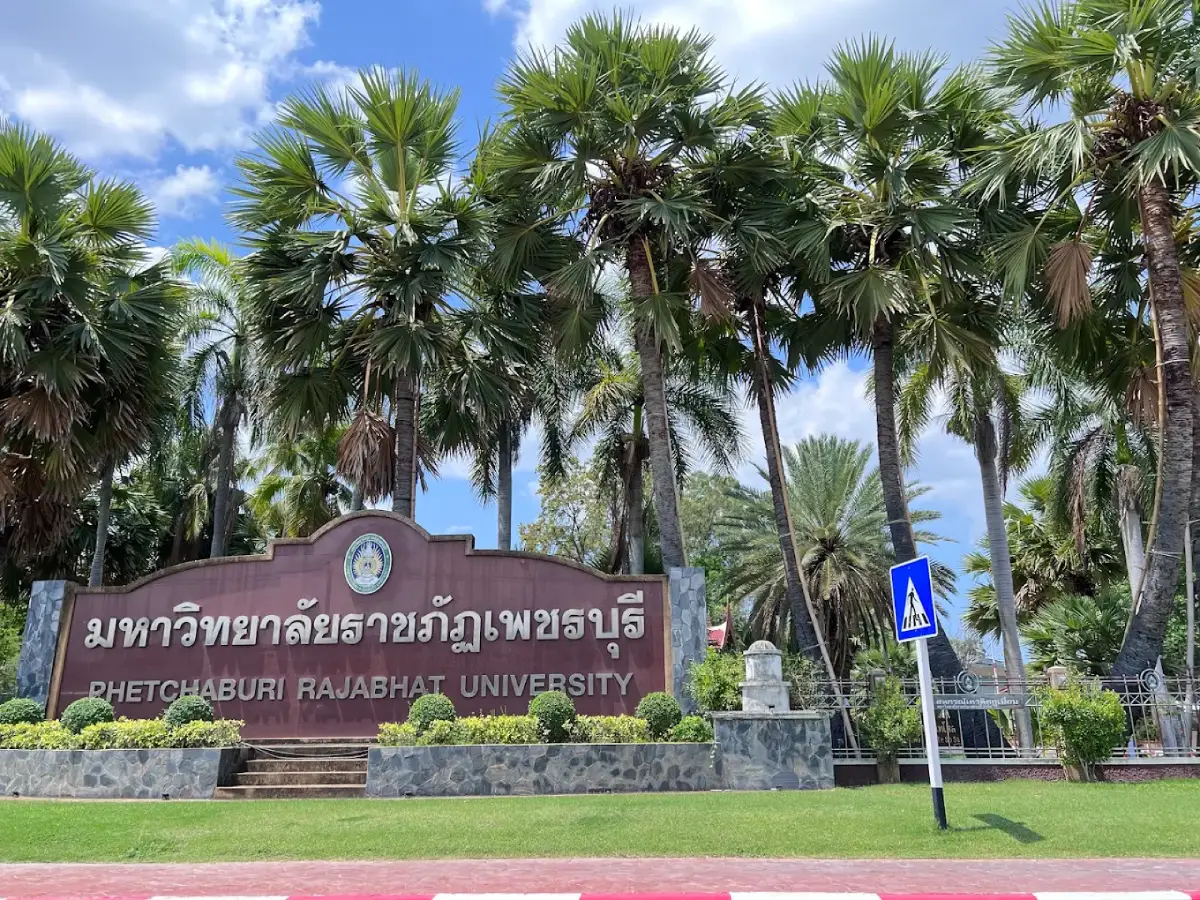
Open Days: Monday – Friday (Except Public Holidays)
Opening Hours: 8:30 AM – 4:30 PM (Administrative Office Hours)
Phetchaburi Rajabhat University (PBRU) is a public university in Phetchaburi Province, Thailand, with an educational history spanning more than 100 years. Located at 38 Moo 8, Hat Chao Samran Road, Na Wung Subdistrict, Mueang Phetchaburi District, the university traces its origins to an agricultural teacher-training school established in Ratchaburi Province on March 27, 1925. The institution relocated to Phetchaburi in 1927 and was eventually elevated to university status under the Rajabhat University Act of 2004. Today, PBRU plays an important role in teacher education, science, technology, engineering, agriculture, business, tourism, food innovation, health sciences, and local development. In 2026, the university is led by Rector Associate Professor Dr. Patcharasak Alai.
Phetchaburi Rajabhat University is significant both as an institution rooted in Thailand's historic teacher-training system and as a modern center of higher education closely connected to the economic, social, and cultural development of Phetchaburi and western Thailand. Over the decades, the university has evolved from a specialized teacher-training school into a multidisciplinary institution offering academic and professional education, research, innovation, community services, and cultural development initiatives.
The university's main campus stands in Na Wung Subdistrict along Hat Chao Samran Road, a route connecting Phetchaburi town with the coastal area. Its grounds include academic buildings, administrative offices, laboratories, a university library, learning centers, sports facilities, a demonstration school, and student activity areas. The campus reflects the character of a regional university whose educational mission extends into the surrounding communities and their economic and cultural life.
The history of Phetchaburi Rajabhat University begins in U Ruea Subdistrict, Ratchaburi Province, near the Mae Klong River. The original institution was an agricultural teacher-training school established to develop educators with knowledge relevant to the needs of an agricultural society. University historical records recognize March 27, 1925, as the founding date, while the commencement and development of early teacher-training activities are also associated with 1926.
The establishment of an agricultural teacher-training school reflected Thailand's efforts to strengthen education and practical knowledge in rural communities. Teachers were expected to contribute not only to literacy and classroom learning but also to agricultural understanding, self-reliance, and the improvement of community life. This early educational philosophy provides a historical foundation for the university's modern commitment to using knowledge and professional expertise for local development.
In 1927, the institution relocated from Ratchaburi to Phetchaburi Province, occupying an area within Phra Ram Ratchaniwet Palace, commonly known as Wang Ban Puen, in Ban Mo Subdistrict, Mueang Phetchaburi District. Teacher training began at the new location on April 1. This relocation established a lasting relationship between the institution and Phetchaburi Province, ultimately shaping its identity as one of the region's most important educational establishments.
Phra Ram Ratchaniwet is historically important as a royal palace commissioned during the reign of King Chulalongkorn, Rama V. Its distinctive architecture makes it one of Phetchaburi's notable heritage landmarks. The university's early connection with this palace creates an unusual link between the history of Thai teacher education and the architectural and royal heritage of Phetchaburi. Visitors interested in the university's origins can therefore explore the former school location as part of a wider historical itinerary.
In 1933, the school was upgraded to an elementary teacher-training institution. It was renamed the Phetchaburi Provincial Certificate Teacher Training School the following year. These changes reflected the development of Thailand's teacher-training system, including the establishment of educational qualifications and institutional structures designed to support the growing national demand for qualified teachers.
The institution moved again in 1938, this time to the Wat Ketu area in Tha Rap Subdistrict, Mueang Phetchaburi District. In 1942, it began offering training for community-school teachers and adopted the name Phetchaburi Basic Teacher Training School. In 1948, the community-teacher curriculum was discontinued, and the institution became Phetchaburi Teacher Training School. These adjustments illustrate how teacher education changed in response to national educational policies and administrative reforms.
Another major milestone occurred in 1963, when the school relocated to its present site in Na Wung Subdistrict on more than 200 rai of land. Establishing a permanent and larger campus allowed the institution to develop its academic buildings, student facilities, curriculum, and institutional infrastructure. The move created the physical foundation for the expansion that eventually transformed the school into a comprehensive university.
On May 1, 1969, the institution was upgraded to Phetchaburi Teachers College and began offering higher certificates in education. The transition from a teacher-training school to a teachers college represented an important advancement in academic status, enabling the institution to strengthen professional teacher education and expand its educational programs.
Following the Teachers College Act of 1975, Phetchaburi Teachers College was recognized as a higher education institution in 1976. The change broadened its academic and professional responsibilities beyond the earlier teacher-training model. It also provided a foundation for the development of additional academic disciplines and educational services in later years.
On February 14, 1992, King Bhumibol Adulyadej, Rama IX, graciously bestowed the name "Rajabhat" upon institutions in the teachers college system. The name is closely associated with serving the monarchy and the nation, symbolizing the responsibility of these institutions to contribute to education, local communities, and society. Rajabhat subsequently became a defining element of the institutional identity of Thailand's regional universities.
In 1995, Phetchaburi Teachers College became Phetchaburi Rajabhat Institute under the Rajabhat Institutes Act of 1995. The new status enabled the institution to develop a broader range of disciplines, including humanities, social sciences, science, technology, management, and other professional fields, reflecting the changing needs of the country.
The institution reached another defining milestone in 2004, when the Rajabhat University Act was enacted. The legislation took effect on June 15, 2004, formally elevating Phetchaburi Rajabhat Institute to Phetchaburi Rajabhat University. University status established its responsibilities in higher education, research, academic services, technology development, cultural preservation, and the preparation and professional advancement of teachers.
Following its elevation to university status, PBRU expanded its graduate education programs. In 2005, graduate study began in areas including curriculum and instruction, science education, business administration, and information technology. Undergraduate law education was also introduced. Over subsequent years, the university increased the range of its bachelor's, master's, and doctoral programs and developed relationships with international educational institutions.
International cooperation, particularly with educational institutions in China, contributed to the university's expansion into language learning, cultural exchange, and international academic collaboration. Such partnerships created opportunities for students to encounter different educational environments while strengthening the university's connections with institutions beyond Thailand.
A further development came with the establishment of Phetchaburi Rajabhat University Demonstration School in 2010. The school extended the university's educational role into basic education and created an environment for studying teaching methods, curriculum development, and professional teacher preparation. Its presence remains closely connected to the university's origins as a teacher-training institution.
The university also expanded into health sciences. A Faculty of Nursing was established in 2013 and subsequently developed into the Faculty of Nursing and Allied Health Sciences. Its academic fields include nursing, public health, Thai traditional medicine, and alternative medicine. These programs contribute to preparing healthcare personnel and supporting community health, disease prevention, and the well-being of people across different age groups.
In 2026, Phetchaburi Rajabhat University extended its activities in animal health education through the Faculty of Veterinary Science. The faculty began recruiting students for its Animal Nursing program, emphasizing animal care, clinical assistance, practical skills, and the management of veterinary healthcare environments. This educational direction is aligned with the One Health concept, which recognizes the relationship between human health, animal health, and environmental conditions.
In the same year, the University Council approved a project to establish the PBRU Institute of Bioscience, Life Science and Innovation on August 17, 2026. The proposed institute is intended to support graduate education, scientific research, innovation, and academic services. Its development plans include central laboratory facilities, pilot-scale production infrastructure, and research facilities relevant to agriculture, food, medicinal plants, and the life sciences.
The university's identity is strongly connected to local development, particularly the distinctive natural resources and cultural heritage of Phetchaburi Province. The region is known for historic architecture, traditional craftsmanship, agriculture, palm sugar, local cuisine, and coastal tourism. These resources provide opportunities for interdisciplinary education and research that connect academic knowledge with community products, businesses, and cultural experiences.
The university's official colors are green and yellow. Its university tree is the sugar palm, known locally as Tan Tanot, a plant deeply associated with the agricultural economy and cultural identity of Phetchaburi. The sugar palm symbolizes perseverance, stability, resilience, and the institution's long-standing relationship with the local community. It is an especially meaningful university symbol because of the plant's importance in regional food traditions and livelihoods.
Phetchaburi Rajabhat University's educational philosophy is expressed through the Thai statement "Khunatham Nam Khwamru Khamchu Sangkhom," meaning that morality should guide knowledge in supporting society. Its commitment is described as the "Intellectual Power of the Local Community," while its traditional motto conveys the Buddhist teaching that no light is equal to the light of wisdom. Together, these statements emphasize ethical responsibility, intellectual development, and the practical contribution of education to society.
The university emblem is derived from the royal seal of King Bhumibol Adulyadej, Rama IX. Its symbolic elements include the royal throne, a chakra, and a seven-tiered white umbrella. The Rajabhat emblem also incorporates five significant colors: blue, green, gold, orange, and white. These represent the monarchy, the natural environment, intellectual prosperity, local arts and culture, and the purity of scholarly thought.
The university's Royal Emblem Ceremony and university pin presentation are important elements of student identity. These ceremonies introduce new students to the institution's history and the meaning of the royal emblem, while encouraging pride, belonging, and a sense of responsibility. During the 2026 academic year, PBRU organized a traditional Bai Sri Su Khwan welcoming ceremony together with the presentation of university emblem pins to first-year students.
February 14 is celebrated as Rajabhat Day, commemorating the granting of the Rajabhat name in 1992. It is a significant date for Rajabhat universities across Thailand and is associated with institutional heritage, academic activities, cultural traditions, and public-service responsibilities. The details of commemorative activities vary according to each university's annual program.
The university also participates in religious and cultural activities connected with Thai traditions, including Buddhist Lent candle offerings, merit-making events, cultural preservation programs, and student welcoming activities. These occasions provide opportunities for students to experience local customs, strengthen relationships, and develop a broader understanding of Thai social and cultural life beyond classroom education.
Today, Phetchaburi Rajabhat University offers academic education across teacher training, humanities, social sciences, science, technology, management, engineering, agriculture, nursing, allied health sciences, and animal health. Its College of Food and Hospitality Innovation also specializes in food, agriculture, tourism, hospitality, and language-based professional education, reflecting the needs of contemporary regional industries.
The Faculty of Education maintains a particularly important connection with the university's origins. Its programs emphasize teaching methodology, educational psychology, curriculum development, evaluation, educational innovation, and professional teaching experience. Undergraduate programs listed for the 2026 academic year include Physical Education, Early Childhood Education, Primary Education, Educational Technology and Innovation, and Sports Science and Exercise. Graduate education is available in areas including Educational Administration, Curriculum and Instruction, and Educational Technology and Innovation.
The Faculty of Humanities and Social Sciences develops knowledge in language, culture, the arts, law, public administration, and social development. Its academic areas include teacher education in Thai, English, Chinese, Social Studies, Music, Art, and Dance, alongside Business English, Art and Design, Social Development Administration, Law, Public Administration, and Tourism and Hotel Innovation. These programs prepare graduates to understand cultural traditions and the changing requirements of contemporary communities and organizations.
The Faculty of Science and Technology supports education in scientific principles, experimentation, analytical skills, and science teaching. Undergraduate fields listed in the 2026 admission plan include Chemistry, Biology, Mathematics, and Science and Technology within teacher education programs. These areas contribute to the development of scientifically trained educators and professionals capable of supporting education and applied scientific knowledge.
The Faculty of Management Science focuses on business administration, accounting, marketing, human resources, logistics and supply chains, digital business computing, and digital communication. Students develop knowledge relevant to organizational management, business planning, digital operations, and professional practice. The faculty's programs support both employment in established organizations and the development of entrepreneurial skills.
The Faculty of Engineering and Industrial Technology offers education in Mechanical Engineering, Information and Communication Engineering, Industrial Engineering, Electrical Engineering, Energy Engineering, and Interior Architecture. These disciplines connect technical knowledge with design, production, system development, and industrial problem-solving. Practical training and applied engineering knowledge are central to preparing graduates for technological and industrial careers.
The Faculty of Information Technology focuses on computer science and digital technologies. Its undergraduate fields include Computer Science, with specializations in Software Science and Data and Information Science, and Information Technology, with specializations in Digital Content and Games and Digital Office Technology. These areas prepare students for careers involving computer systems, software development, information management, digital media, and technology-supported organizational operations.
The Faculty of Agricultural Technology preserves an important aspect of the university's original educational identity. Its undergraduate programs cover Animal Science, Modern Crop Production Technology, Aquaculture, and Food Science and Technology. These disciplines are relevant to improving agricultural productivity, applying scientific research to production systems, developing food quality, and supporting sustainable community-based agricultural businesses.
The Faculty of Nursing and Allied Health Sciences prepares students for professional careers in healthcare. Its academic offerings include Nursing Science, an International Nursing Program, Thai Traditional and Alternative Medicine, and Public Health and Occupational Health. These programs contribute to patient care, health promotion, disease prevention, community healthcare, and professional health services.
The Faculty of Veterinary Science represents a newer area of academic development. The introduction of Animal Nursing admissions in 2026 marks an important step toward professional animal healthcare education. Its educational focus includes animal care, veterinary assistance, clinical procedures, and practical activities associated with veterinary facilities. A Doctor of Veterinary Medicine program is part of the university's longer-term development plan rather than an established undergraduate intake in the 2026 academic year.
The College of Food and Hospitality Innovation integrates agriculture, culinary arts, hospitality, tourism, and foreign-language communication. Its four major undergraduate programs are Organic Agriculture and Smart Farm Management, Creative Gastronomy and Food Service Management, Chinese for Business and Services, and International Tourism, Hospitality, Events and Restaurant Management. The college emphasizes practical learning alongside academic study, giving students opportunities to connect theoretical knowledge with professional environments.
A distinctive feature of the College of Food and Hospitality Innovation is its integrated approach to the food and service value chain. Students may study the production of agricultural ingredients, the development of creative food products, restaurant and hotel operations, tourism services, and events. This approach is particularly relevant to Phetchaburi, which has been recognized by UNESCO as a Creative City of Gastronomy and is known for local ingredients such as palm sugar and traditional food products.
Research is another important part of PBRU's mission. The university's Research and Arts and Culture Promotion Institute supports academic research, innovation, community development, academic services, and cultural preservation. Its activities demonstrate the university's commitment to applying knowledge beyond the campus and working with local communities, businesses, and regional partners.
Examples of research connected to regional development include the improvement of sugar palm products, food processing, agricultural innovation, and support for small and medium-sized enterprises. The university also works with other Rajabhat universities in western Thailand through the Western SMEs Foodinnopolis initiative, which aims to strengthen local food and agricultural processing businesses through research, technology, and innovation.
The sugar palm provides a particularly clear example of how local culture and scientific research can intersect. The tree has long been part of Phetchaburi's agricultural landscape and culinary traditions. Its sap and fruit are used in various local products, while other parts of the tree have traditional applications. Research into sugar palm production and processing connects indigenous knowledge with food science, engineering, product development, and opportunities for increased community income.
The university's research and public-service activities also extend to teacher development, digital technologies, community welfare, healthcare, and environmental management. Interdisciplinary approaches allow university faculties to contribute different types of expertise to local challenges, supporting solutions that reflect the economic and social realities of the communities involved.
As a university located in a province famous for its artistic heritage, PBRU also contributes to the preservation and promotion of local culture. Phetchaburi is known for intricate stucco craftsmanship, woodcarving, traditional murals, historic temples, and distinctive culinary traditions. Research and cultural education can help preserve these traditions while encouraging younger generations to understand their historical and creative significance.
Several important buildings and facilities form part of the university's educational environment. Witthayaphirom Building is associated with the central administration and serves as a location for important university meetings and administrative functions. It is one of the principal buildings involved in coordinating institutional operations.
The Academic Resources and Information Technology Center is another important university facility. The Bannaratnakharin Building and associated library spaces provide academic resources and information services for students and staff. The development of automated library systems and digital information management has strengthened the university's ability to support academic research, independent study, and access to learning materials.
Phetchaburi Rajabhat University Demonstration School is closely associated with the institution's long-standing commitment to teacher education. The school provides an educational setting connected to basic education, curriculum development, teaching practice, and professional preparation. Its role reflects the continuation of the university's historical responsibility for developing educators.
The PBRU Heritage is a tourism and hotel training facility associated with the College of Food and Hospitality Innovation. It provides an environment for practical learning in hospitality services, event operations, and hotel management. The facility demonstrates how students can connect academic knowledge with professional training in real service-industry environments.
Other learning and activity areas across the university support sports, student development, training, and educational events. These facilities contribute to a broader university experience in which students can develop professional, social, and personal skills alongside their academic qualifications.
Student welfare services are coordinated through university student-development units. Their responsibilities include scholarships, student loan support, accommodation, healthcare, student activities, and the development of career and life skills. These services help students manage the academic and practical demands of university life while encouraging personal development and social responsibility.
For prospective students, Phetchaburi Rajabhat University provides educational opportunities at different academic levels, including bachelor's degrees, relevant graduate diplomas, master's degrees, and doctoral degrees. Admission requirements, available programs, intake numbers, and study arrangements depend on official announcements for the relevant academic year. Applicants should carefully review each program's qualification requirements and current admissions information.
PBRU is also relevant to visitors interested in educational tourism. Its long institutional history and facilities related to science, food, agriculture, and hospitality provide a variety of possible educational visit themes. School groups, academic visitors, and prospective students should contact the relevant university departments to arrange visits. Access to classrooms, laboratories, demonstration-school facilities, and restricted areas is subject to the policies of the responsible units.
The surrounding Mueang Phetchaburi area offers numerous cultural and historical attractions. Phra Ram Ratchaniwet Palace is especially relevant to the university's history because it housed the early teacher-training institution. Other major sites include Phra Nakhon Khiri Historical Park, Wat Mahathat Worawihan, Wat Yai Suwannaram Worawihan, and Wat Kamphaeng Laeng. Together, these destinations provide insights into the royal history, religion, architecture, and traditional craftsmanship of Phetchaburi.
Getting There Travelers driving from Bangkok can use Rama II Road through Samut Songkhram toward Phetchaburi or take Phetkasem Road through Nakhon Pathom and Ratchaburi. From Phetchaburi town, follow Hat Chao Samran Road toward Na Wung Subdistrict to reach the university at 38 Moo 8. Visitors using public transportation can travel to Phetchaburi by train or intercity bus and arrange local transportation to the campus. Transport schedules and local connections should be checked before departure.
University administrative offices operate Monday to Friday from 8:30 AM to 4:30 PM, excluding public holidays. Individual facilities, including the library, sports center, training hotel, health services, and specialized educational units, may have different operating schedules. Visitors arranging academic meetings, educational tours, or access to specific facilities should contact the relevant department in advance.
Over more than a century, Phetchaburi Rajabhat University has developed from an agricultural teacher-training school in Ratchaburi into a multidisciplinary public university serving Phetchaburi and western Thailand. Its transformation through the stages of a teacher-training school, teachers college, Rajabhat institute, and university reflects the changing requirements of Thai education. At the same time, its commitment to teacher preparation, local wisdom, agriculture, food innovation, tourism, healthcare, and community development remains central to its identity and public mission.
| University Name | Phetchaburi Rajabhat University (PBRU) |
| Thai Name | มหาวิทยาลัยราชภัฏเพชรบุรี |
| Institution Type | Public University, Rajabhat University System |
| Address | 38 Moo 8, Hat Chao Samran Road, Na Wung Subdistrict, Mueang Phetchaburi District, Phetchaburi 76000, Thailand |
| Original Founding Date | March 27, 1925 |
| Relocation to Phetchaburi | 1927 |
| Relocation to Present Campus | 1963 |
| Teachers College Status | May 1, 1969 |
| Rajabhat Institute Status | 1995 |
| University Status | June 15, 2004 |
| Institutional Age in 2026 | 101 Years Since the Original Foundation |
| Rector | Associate Professor Dr. Patcharasak Alai |
| University Colors | Green and Yellow |
| University Tree | Sugar Palm Tree |
| Educational Philosophy | Morality Guides Knowledge in Supporting Society |
| Institutional Commitment | Intellectual Power of the Local Community |
| Motto | There Is No Light Equal to the Light of Wisdom |
| Faculties and College | 1. Faculty of Education 2. Faculty of Humanities and Social Sciences 3. Faculty of Science and Technology 4. Faculty of Management Science 5. Faculty of Engineering and Industrial Technology 6. Faculty of Information Technology 7. Faculty of Agricultural Technology 8. Faculty of Nursing and Allied Health Sciences 9. Faculty of Veterinary Science 10. College of Food and Hospitality Innovation |
| Important Buildings and Facilities | Witthayaphirom Building, Academic Resources and Information Technology Center, Bannaratnakharin Building, PBRU Demonstration School, Research and Arts and Culture Promotion Institute, and The PBRU Heritage |
| Academic Strengths | Teacher Education, Food Innovation, Agriculture, Sugar Palm Research, Tourism, Hospitality, Technology, Engineering, Health Sciences, and Local Development |
| Administrative Office Days | Monday – Friday, Except Public Holidays |
| Administrative Office Hours | 8:30 AM – 4:30 PM |
| Educational Visits | Advance arrangements with the relevant department are required for academic visits to classrooms, laboratories, and restricted facilities |
| Getting There | Follow Hat Chao Samran Road from central Phetchaburi toward Na Wung, or arrange local transport from Phetchaburi Railway Station or the intercity bus area |
| Attractions in Mueang Phetchaburi | 1. Phra Ram Ratchaniwet Palace (Wang Ban Puen) 2. Phra Nakhon Khiri Historical Park (Khao Wang) 3. Wat Mahathat Worawihan 4. Wat Yai Suwannaram Worawihan 5. Wat Kamphaeng Laeng |
| Restaurants in Mueang Phetchaburi | 1. Krua Kun Lek 2. Phuang Phet Restaurant 3. Rabieng Rimnam 4. Krua Phet Nam Fa 5. Ban Pad Thai Tha Yang 2 |
| Accommodation in Mueang Phetchaburi | 1. The PBRU Heritage 2. The Cozy Hotel Phetchaburi 3. 611 Hotel 4. A+ Hometel 5. 2N Guesthouse |
| Administrative Office Telephone | +66 32 708 605, +66 32 708 625 |
| Admissions Office Telephone | +66 32 708 640 |
| Official Website | https://www.pbru.ac.th/ |
| Admissions Website | https://reg.pbru.ac.th/ |
| Current Status | Operating as a Public University in 2026 |
Academic Programs at Phetchaburi Rajabhat University, Academic Year 2026
| Faculty / College | Degree Programs and Fields of Study |
| Faculty of Education | Bachelor's Degrees Bachelor of Education 1. Physical Education 2. Early Childhood Education 3. Primary Education 4. Educational Technology and Innovation Bachelor of Science 5. Sports Science and Exercise Master's Degrees 1. Master of Education in Educational Administration 2. Master of Education in Curriculum and Instruction 3. Master of Education in Educational Technology and Innovation Doctoral Degree 1. Doctor of Philosophy in Educational Administration |
| Faculty of Science and Technology | Bachelor's Degrees Bachelor of Education 1. Chemistry 2. Science and Technology 3. Biology 4. Mathematics |
| Faculty of Agricultural Technology | Bachelor's Degrees Bachelor of Science 1. Animal Science 2. Modern Crop Production Technology 3. Aquaculture 4. Food Science and Technology |
| Faculty of Humanities and Social Sciences | Bachelor's Degrees Bachelor of Education 1. Thai Language Education 2. English Language Education 3. Social Studies Education 4. Chinese Language Education 5. Music Education 6. Art Education 7. Dance Education Bachelor of Arts 8. Tourism and Hotel Innovation 9. Business English 10. Art and Design 11. Social Development Administration Bachelor of Public Administration 12. Public Administration (Public and Private Sector Administration; Local Administration and Governance) Bachelor of Laws 13. Law |
| Faculty of Management Science | Bachelor's Degrees Bachelor of Business Administration 1. Business Administration (Management and Human Resources; Digital Marketing; Logistics and Supply Chain Management; Digital Business Computing) Bachelor of Accountancy 2. Accounting Bachelor of Communication Arts 3. Digital Communication Arts |
| Faculty of Engineering and Industrial Technology | Bachelor's Degrees Bachelor of Engineering 1. Mechanical Engineering 2. Information and Communication Engineering 3. Industrial Engineering 4. Electrical Engineering 5. Energy Engineering Bachelor of Architecture 6. Interior Architecture |
| Faculty of Information Technology | Bachelor's Degrees Bachelor of Science 1. Computer Science (Software Science; Data and Information Science) 2. Information Technology (Digital Content and Games; Digital Office Technology) |
| Faculty of Nursing and Allied Health Sciences | Bachelor's Degrees 1. Nursing Science 2. Nursing Science (International Program) 3. Thai Traditional and Alternative Medicine 4. Public Health and Occupational Health |
| College of Food and Hospitality Innovation | Bachelor's Degrees 1. Organic Agriculture and Smart Farm Management 2. Creative Gastronomy and Food Service Management 3. International Tourism, Hospitality, Events and Restaurant Management 4. Chinese for Business and Services |
| Faculty of Veterinary Science | Undergraduate Program 1. Animal Nursing (First Admissions in Academic Year 2026) |
| Additional Graduate Programs with Confirmed 2026 Admissions Announcements | Master's Degree 1. Master of Public Administration in Public Administration and Local Development Strategy Doctoral Degree 1. Doctor of Philosophy in Public Administration and Local Development Strategy |
Frequently Asked Questions (FAQ)
Q: Where is Phetchaburi Rajabhat University located?
A: Phetchaburi Rajabhat University is located at 38 Moo 8, Hat Chao Samran Road, Na Wung Subdistrict, Mueang Phetchaburi District, Phetchaburi 76000, Thailand.
Q: What are the opening days and hours of Phetchaburi Rajabhat University?
A: Administrative offices operate Monday to Friday, from 8:30 AM to 4:30 PM, excluding public holidays. Individual campus facilities may have different operating hours.
Q: When was Phetchaburi Rajabhat University founded?
A: The institution was originally founded on March 27, 1925, as an agricultural teacher-training school in Ratchaburi Province. It relocated to Phetchaburi in 1927 and became a university in 2004.
Q: How old is Phetchaburi Rajabhat University in 2026?
A: The university is 101 years old in 2026, counting from the original institution's establishment on March 27, 1925.
Q: What faculties are available at Phetchaburi Rajabhat University?
A: Its academic units include Education, Humanities and Social Sciences, Science and Technology, Management Science, Engineering and Industrial Technology, Information Technology, Agricultural Technology, Nursing and Allied Health Sciences, Veterinary Science, and the College of Food and Hospitality Innovation.
Q: What is Phetchaburi Rajabhat University known for?
A: PBRU is known for teacher education, agricultural and food innovation, tourism and hospitality, health sciences, technology, and community development, with a strong emphasis on applying academic knowledge to local needs.
Q: Does Phetchaburi Rajabhat University offer Animal Nursing?
A: Yes. The Faculty of Veterinary Science began recruiting students for its Animal Nursing program in the 2026 academic year. The Doctor of Veterinary Medicine program is part of a later development plan.
Q: How can I contact Phetchaburi Rajabhat University?
A: Contact the administrative office at +66 32 708 605 or +66 32 708 625 during office hours. Further information is available from the official website at https://www.pbru.ac.th/.
 Category: ●University
 Group: ●Rajabhat University
Last Update : 4 DayAgo
 Last Update : 4 DayAgo
 Click to Access the Navigation Map GPS
Phetchaburi Rajabhat University Map
Recommend

 Art, Culture and Heritage
 Historical Sites and Monuments(1)
 Landmarks and Memorials(1)
 Royal Palace(2)
 Art, Craft Centres, Tradition(8)
 Museums(1)
 Educational Places
 Educational Gardens, Farm(4)
 Public university(1)
Rajabhat University(1)
 Private University(1)
 Places of Worship
 Temple(72)
 Other Sacred Sites(7)
 Research and Development
 Royal Project(6)
 Suburban Living
 Village, Community(10)
 Floating Market(1)
 Nature and Wildlife
 National Parks and Marine Reserves(4)
 Mountain (Doi)(3)
 Dam, Reservoir, Lake(3)
 Waterfalls(5)
 Hot Springs(1)
 Caves(13)
 River, Canal(1)
 Bays and Beaches(11)
 Islands(1)
 Other natural attractions(10)
 Entertainment and Agricultural
 Farms, Parks and Ecotourism(3)
 Waterpark(1)
 Theater(1)
 Outdoor and Adventure Activities(1)
 Travel Articles, Recipes
 Travel Review, Food Review(3)


