
lovethailand home >Central Travel Attractions >Phetchaburi Travel Attractions >Ban Lat >Samo Plue > Sala Tha Nam Wat Tha Chaisi
TL;DR: Sala Tha Nam Wat Tha Chaisi is located at Moo 1, Ban Samo Phlue, Samo Phlue Subdistrict, Ban Lat District, Phetchaburi, open Daily, hours 06:00 – 18:00.
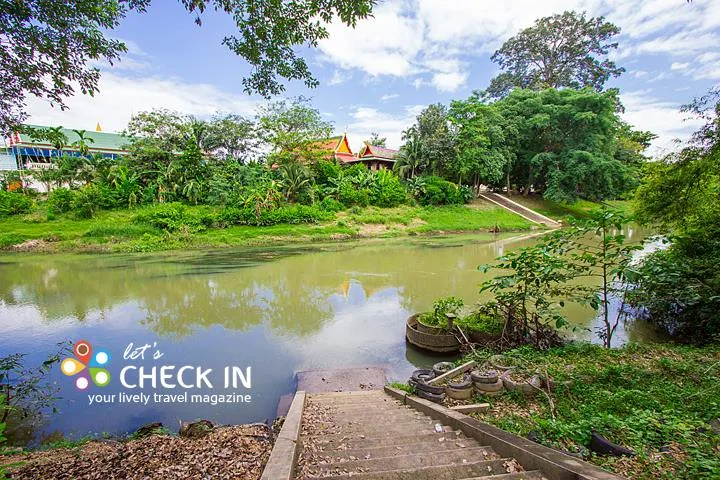
Sala Tha Nam Wat Tha Chaisi
Open Days: Daily
Opening Hours: 06:00 – 18:00
The Sacred Pier Pavilion at Wat Tha Chai Siri, Phetchaburi is a standout destination for faith-based travel and local history along the Phetchaburi River basin. This place is remembered not only as a riverside community temple, but also as a “sacred water pier” closely tied to Thai royal traditions of drawing water from significant sources for state-level ceremonies. It is also a space where local narratives and collective memory remain deeply interwoven, making a visit feel more meaningful than a quick stop for merit-making. The temple is located in Moo 1, Ban Samo Phlue, Samo Phlue Subdistrict, Ban Lat District, Phetchaburi, right along the Phetchaburi River, where you can clearly sense the rhythm of the current, riverside life, and a living temple that continues to serve the community every day.
The charm of the “pier pavilion” at Wat Tha Chai Siri lies in the feeling that you are standing in a place where the past still shapes the present. In the context of Thai temples, a pier is not merely a path down to the water or a place to dock a boat. It is a connector between faith and daily life: people used it for travel, for drawing water, for welcoming visitors, and for rituals involving water at multiple levels – from everyday temple use to water drawn for important ceremonies. When these layers come together at Wat Tha Chai Siri, the pier becomes a tangible symbol of sanctity: visible, reachable on foot, and experienced through the atmosphere itself – not just a story confined to books.
Local accounts commonly explain that this temple was originally called “Wat Tai” (the “Lower/Southern Temple”) because it sits on the southern side of the Phetchaburi River. Upstream, there were historically Wat Klang (the “Middle Temple”) and Wat Nuea (the “Upper/Northern Temple”), located very close by in geographic terms. This tradition helps illustrate how riverside communities often used the river’s direction to name places and religious sites. For travelers, the appeal is that once you understand the logic behind the old name, you begin to see the temple not simply as a destination, but as part of a cultural landscape shaped by long-term coexistence with the Phetchaburi River. The visit gains context immediately: you are not only seeing a temple, you are seeing a river-based system of relationships that has sustained local life for generations.
Another layer that caused “Wat Tai” to be remembered and retold under a new name is a local legend connected to conflict in the past, which became a well-known community tale. In brief, it tells of Thai troops clashing with Burmese forces near Dan Singkhon in present-day Prachuap Khiri Khan, then retreating while being pursued. When the Thai troops reached Wat Tai, they went down to the temple pier to bathe and drink water to recover and regroup. The Burmese caught up, leading to a fierce fight within the temple grounds, even to the point of close-quarters combat, until the Burmese were ultimately driven back. Some versions of the story mention traces once seen in the ordination hall and later restoration work. While certain details are naturally difficult to verify through documents, the value of this narrative is that it frames the pier as more than a physical structure. It becomes a place of shared memory that gives the community a sense of meaning, story, and historical dignity rooted in their own homeland.
As this story was repeated across generations, the temple’s name gradually shifted in local understanding from “Wat Tai” to “Wat Tha Chai,” before developing into the name used today, “Wat Tha Chai Siri.” The progression reflects an elevation of meaning – from an ordinary pier to a pier associated with victory and auspiciousness. This evolution reveals a clear mechanism in Thai local culture: when a place is anchored by an “event” or a “collective memory,” the name becomes more than a locator. It turns into language that carries value and significance in itself. That is why a visit to Wat Tha Chai Siri appeals to travelers who want more than a photo stop, because even the name hints at the deeper narrative that has long nourished this place.
For many people in Phetchaburi, however, the temple’s stature is not defined by legend alone, but also by its ceremonial role related to “Phetchaburi River water,” which is another central reason to visit. In Thai tradition, sacred water is often connected to significant water sources and rigorous ceremonial processes, especially in rites associated with the state and royal traditions. In this context, the “pier at Wat Tha Chai Siri” is spoken of as a point where water from the Phetchaburi River was drawn as part of processes involving sacred water, before proceeding to further rituals at important provincial sites and then onward into national-level ceremonies. This significance positions the temple not only as a community site of faith, but also as a point that helps explain the broader relationship between Phetchaburi Province and state ritual traditions.
At its core, Thai water-related ceremonial tradition emphasizes purity and auspiciousness through the choice of trusted sources and a structured ritual process. Across many periods, water from major sources – representing regions or the land’s ecology – was preferred, including sacred ponds and key rivers. In Phetchaburi’s case, the Phetchaburi River is a particularly clear emblem of the province because it has been the city’s main lifeline from the past to the present. When the pier at Wat Tha Chai Siri is identified as a drawing point, it reflects recognition that the location is suitable in geography, belief, and practicality for ceremonial use. For cultural travelers, standing at the pavilion is like standing at the “starting point” of a ritual with strong symbolic weight, because water drawn here is not viewed as ordinary water. It is regarded as water that has entered a realm of sanctity and official ceremonial meaning.
Many visitors begin by walking through the temple atmosphere before slowing their pace at the pier, because it clearly reveals the relationship between “temple and river.” You can see why riverside temples mattered so deeply to communities: historically, when boats were the main mode of travel, and today, even when cars are more common, the pier remains both a sacred space and a shared memory space. In the morning, the light is soft and the air is cooler, ideal for observing details and taking photos without rushing. In the evening, the ambiance is calmer and more private, making it well-suited for prayer, merit-making, and a quiet riverside walk.
In terms of worship and conduct, Wat Tha Chai Siri’s strength lies in being a living community temple. Visitors should therefore prioritize appropriate etiquette: dress modestly, keep voices low in worship areas, and avoid activities that disturb monks’ routines or locals who come to make merit. If you want to experience the place’s essence, a good flow is to begin with worship inside the temple, make merit according to your means, and then walk to the pier pavilion to understand the pier’s meaning in both ceremonial and historical dimensions. This creates a more continuous visit with a clear emotional rhythm: starting with faith, moving into understanding, and ending in calm.
Another aspect worth noticing is the overall architectural setting and restoration traces, because many temples in Phetchaburi reflect broader developments in Thai art and temple-building concepts from the late Ayutthaya period into the Rattanakosin era. This makes temple-hopping in Phetchaburi more rewarding if you “look slowly” and collect details: building components, internal layout, and how the temple’s placement relates to the river. Content like this elevates the visit beyond a typical review, because it gives readers a framework for seeing temples with meaning rather than relying only on descriptions like “beautiful” or “sacred.”
If you are planning a one-day itinerary, visiting Wat Tha Chai Siri can be conveniently paired with attractions in Phetchaburi town, since the route from Ban Lat into the city is not far. This allows you to structure a “half-day of faith” followed by a “half-day of old-town history” with a smooth flow – for example, Phra Nakhon Khiri (Khao Wang) for panoramic city views, Wat Yai Suwannaram for key artistic heritage, or Phra Ram Ratchaniwet (Ban Puen Palace) to complete the Rattanakosin-era dimension. This kind of route helps readers visualize the journey and decide the visiting order without complicated planning.
Getting There If you start from Phetchaburi town, drive toward Ban Lat District and enter Samo Phlue Subdistrict via local roads. It is recommended to use online maps and search for “Wat Tha Chai Siri” or “Wat Tha Chai, Ban Samo Phlue” to get the most up-to-date route based on current road conditions. Once you enter the community area, drive at a moderate speed and be mindful of narrower sections, especially near the river where pedestrians and local activities may appear. If traveling from Bangkok, take Phetkasem Road into Phetchaburi Province, then turn toward Ban Lat and Samo Phlue before heading to the temple. The overall route is suitable for private cars. Plan at least 45–90 minutes for an unhurried visit so you can worship, make merit, walk along the riverside, and fully absorb the atmosphere.
For a smoother visit, bring drinking water, a hat, or an umbrella on very sunny days, because some areas near the river and within the temple grounds are open. If you are traveling with elderly visitors or small children, keep a slow pace, choose stable walking shoes, and avoid standing too close to the pier edge. A detailed temple visit feels most rewarding when you respect both the site and the community, because Wat Tha Chai Siri is not merely a photo backdrop – it is a living space of faith used by people every day.
| Topic | Details |
| Summary | A riverside community temple on the Phetchaburi River featuring a “Sacred Pier Pavilion,” linking local narratives with the province’s water-related ceremonial tradition. |
| Place Name | Wat Tha Chai Siri (Wat Tha Chai) – Sacred Pier Pavilion |
| Address | Moo 1, Ban Samo Phlue, Samo Phlue Subdistrict, Ban Lat District, Phetchaburi |
| Key Highlights | A pier pavilion on the Phetchaburi River often discussed as a provincial “sacred water” drawing point, alongside the temple’s well-known local name-history from “Wat Tai” to “Wat Tha Chai Siri.” |
| Name Origin | Originally called “Wat Tai” (on the southern side of the river). Later, local war-related narratives contributed to the name “Tha Chai,” which developed into “Tha Chai Siri” over time. |
| Current Status | Open for merit-making, worship, and visits in the style of a living community temple. |
| Contact (Verified) | Samo Phlue Subdistrict Administrative Organization: 0-3249-3529 |
| Travel | From Phetchaburi town → drive toward Ban Lat District → enter Samo Phlue Subdistrict → Ban Samo Phlue (Moo 1) → Wat Tha Chai Siri (recommended: search “Wat Tha Chai Siri” on online maps for the latest route) |
| Nearby Attractions (Approx. Distance) | 1) Wat Mahathat Worawihan (approx. 17 km) 2) Phra Nakhon Khiri (Khao Wang) (approx. 18 km) 3) Wat Yai Suwannaram (approx. 16 km) 4) Phra Ram Ratchaniwet (Ban Puen Palace) (approx. 15 km) 5) Tham Khao Luang (approx. 20 km) |
| Popular Restaurants Nearby (Approx. Distance / Phone) | 1) Krua Kamnan Chob (approx. 15 km) – 065-942-6496 2) Krua Tanotod (Tanote Restaurant) (approx. 16 km) – 082-252-4990 3) Ploy Wan Restaurant, Phetchaburi (approx. 18 km) – 089-081-2559 4) PENN Palmyra & Chill (approx. 18 km) – 087-487-8464 5) Rodtai Restaurant, Phetchaburi (approx. 18 km) – 081-869-1648 |
| Popular Accommodations Nearby (Approx. Distance / Phone) | 1) Royal Diamond Hotel (approx. 18 km) – 032-411-061 2) Banthai Guesthouse (approx. 18 km) – 086-608-6957 3) Fisherman’s Resort (Hat Chao Samran) (approx. 35 km) – 032-478-020 4) Kaengkrachan River Resort (approx. 55 km) – 081-255-2006 5) Boathouse Paradise Resort (Kaeng Krachan) (approx. 55 km) – 081-908-5665 |
Frequently Asked Questions (FAQ)
Q: Where is the Sacred Pier Pavilion at Wat Tha Chai Siri located?
A: It is in Moo 1, Ban Samo Phlue, Samo Phlue Subdistrict, Ban Lat District, Phetchaburi, within Wat Tha Chai Siri (Wat Tha Chai) along the Phetchaburi River.
Q: What makes Wat Tha Chai Siri worth visiting?
A: The highlight is the riverside pier pavilion often discussed in the context of provincial “sacred water,” and the way local narratives and community memory remain closely tied to the real place and atmosphere.
Q: How is Wat Tha Chai Siri connected to Phetchaburi’s sacred water tradition?
A: The pier at Wat Tha Chai Siri is spoken of as a drawing point for water from the Phetchaburi River in processes involving provincial sacred water, which then proceeds to ceremonies at key sites in Phetchaburi and onward into national-level rites.
Q: What time of day is best for a comfortable visit and the best atmosphere?
A: Morning is ideal for comfortable walking and photos due to cooler air, while evening is calmer and more private for worship and a quiet riverside walk.
Q: How should visitors behave around the pier area?
A: Dress modestly, keep your voice low, do not litter, and be careful near the pier edge. If traveling with children or elderly visitors, walk slowly and choose stable footing.
Q: Who should I contact for local area information?
A: Contact the Samo Phlue Subdistrict Administrative Organization at 0-3249-3529.
 Category: ●Places of Worship
 Group: ●Other Sacred Sites
Last Update : 6 MonthAgo
 Last Update : 6 MonthAgo
 Click to Access the Navigation Map GPS
Sala Tha Nam Wat Tha Chaisi Map
Recommend

 Art, Culture and Heritage
 Historical Sites and Monuments(1)
 Landmarks and Memorials(1)
 Royal Palace(2)
 Art, Craft Centres, Tradition(8)
 Museums(1)
 Educational Places
 Educational Gardens, Farm(4)
 Temple(72)
Other Sacred Sites(6)
Temple(72)
Other Sacred Sites(6)
 Research and Development
 Royal Project(6)
 Suburban Living
 Village, Community(10)
 Floating Market(1)
 Nature and Wildlife
 National Parks and Marine Reserves(4)
 Mountain (Doi)(3)
 Dam, Reservoir, Lake(3)
 Waterfalls(5)
 Hot Springs(1)
 Caves(13)
 River, Canal(1)
 Bays and Beaches(11)
 Islands(1)
 Other natural attractions(10)
 Entertainment and Agricultural
 Farms, Parks and Ecotourism(3)
 Theater(1)
 Outdoor and Adventure Activities(1)
 Travel Articles, Recipes
 Travel Review, Food Review(2)


