
lovethailand home >Central Travel Attractions >Phetchaburi Travel Attractions >Muang Phetchaburi >Khlong Kra Saeng > Wat Mahathat Worawihan
TL;DR: Wat Mahathat Worawihan, open Daily, hours 08.00 – 17.00. Highlights include Five-Spired Prang, Cloistered Gallery, Ayutthaya-Era Sema Stones, Masterful Stucco And Mural Art.
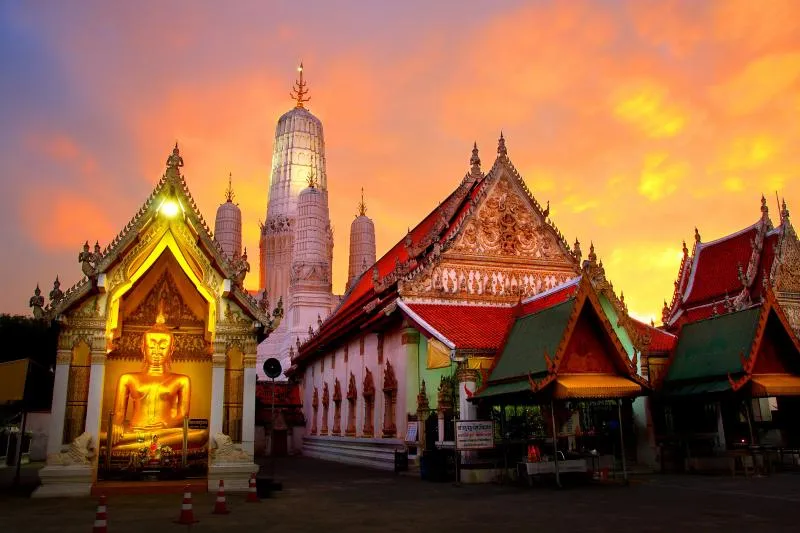
Wat Mahathat Worawihan
Open Days: Daily
Opening Hours: 08.00 – 17.00
Wat Mahathat Worawihan is located in Nong Krachaeng Subdistrict, Mueang Phetchaburi District, Phetchaburi Province. As a royal monastery and one of Phetchaburi’s most important temples since the Ayutthaya period, it has long been regarded as the city’s spiritual and cultural anchor. This temple is not only a place for Buddhist rites and merit-making, but also a living repository of local history, fine arts, and collective memory passed down through generations. The image of its five-spired prang (Khmer-style tower) rising prominently in the heart of the city has become an enduring symbol of Phetchaburi’s continuity and past prosperity.
The setting of Wat Mahathat Worawihan within the old-town area reflects a classic Ayutthaya-era pattern of urban planning, where the principal temple of a city was placed close to the civic center. Such placement reinforced the temple’s role as both a spiritual refuge and a venue for major communal ceremonies. In Phetchaburi, the temple did not develop apart from local life; instead, it has grown alongside the city, remaining closely intertwined with the rhythms of the community and the evolving landscape of the historic district.
Although no definitive founding record is known, archaeological observations and local historical sources commonly suggest that the temple site may be more than 1,000 years old. A key reference appears in the so-called “Phetchaburi Notebook” tradition, noting the discovery of Dvaravati-period bricks in the temple cemetery area adjoining Wat Kaen Lek. One brick, described as roughly a forearm in length, was found covering a burial pit with a skeleton, and bore an inscription conveying a vow to complete the construction of the prang. Such evidence is often cited to illustrate the long sacred continuity of the site and the extended timeline of prang-related construction and patronage in this area.
The temple’s defining landmark is its five-spired prang, standing prominently at the center of the compound. The structure rises to approximately 55 meters to the finial and measures roughly 120 meters around the base. Beyond architecture, the form communicates Buddhist cosmology: the central prang is commonly interpreted as a symbolic Mount Meru, with surrounding elements suggesting sacred continents and cosmic geography. In this sense, the prang is not merely a monumental tower but also a powerful visual statement of belief and worldview.
In the Rattanakosin period, the prang underwent continuous restoration, with historical accounts commonly describing five major restoration phases. The first is recorded in 1814 (B.E. 2357) during the reign of King Rama II, focusing on structural stability so the monument could continue serving religious functions. The second, in 1863 (B.E. 2406) during the reign of King Rama IV, was carried out under high officials appointed to oversee the restoration, underscoring the temple’s importance in both local and royal spheres.
The third restoration took place in the reign of King Rama V, who granted royal funds and assigned a senior noble to proceed with construction. However, the work was left incomplete due to collapse during construction and the passing of the responsible patron before completion. This episode is often remembered as a historical lesson in the complexity and risks of conserving large-scale monuments.
The fourth restoration, spanning 1928–1936 (B.E. 2471–2479), marked a major turning point. Under the abbot Phra Suwan Muni (Chit), an appointed designer led the restoration work, resulting in the five-spired prang form recognizable today. Although the earliest stage lacked exterior ornamentation due to limited funds, this period is also associated with the discovery of important relics and sacred items, including small votive tablets and relic deposits. Later, in 1932 (B.E. 2475), King Rama VII and Queen Rambhai Barni visited and donated personal funds toward the restoration, and broader public donations helped the project reach completion.
The fifth major restoration is commonly dated to 1992 (B.E. 2535), undertaken under the leadership of Phra Thep Suwan Muni, using donations from devotees amounting to over 11 million baht. This phase emphasized reinforcing stability and preserving decorative details, reflecting the continued role of community faith and public support in protecting Phetchaburi’s cultural heritage.
Encircling the prang is a cloistered gallery (phra rabiang khot), where late-Ayutthaya sandstone sema stones are found. These red sandstone sema are intricately carved and function as both sacred boundary markers and significant artworks that reveal the skill level of Ayutthaya-period craftsmen. Their presence is frequently referenced as further evidence of Wat Mahathat’s status as a principal temple of the city.
The main viharn (Phra Wihan Luang) is another high-value artistic component. Its pediment features exquisite stucco work attributed to Phetchaburi artisans in the early Rattanakosin era, depicting Vishnu riding Garuda and Hanuman bearing Garuda, framed by swirling floral motifs. The lower pediment includes figures in devotional posture, and even the chofa and hang hong roof finials are rendered as praying figures, highlighting a distinctive local craftsmanship known for refined detail and elegant proportions.
Inside the main viharn, mural paintings of considerable value appear on beams, ceilings, and wall fields. The front wall area depicts episodes of the Buddha’s life, while the north and south walls present multi-tiered assemblies of celestial beings arranged in ordered registers, separated by fine linear borders and ceremonial fans. Between window bays, panels depict the Ten Jataka tales. These murals have been discussed in historical travel notes attributed to Prince Naris, with observations comparing certain stylistic choices to other major temples in Phetchaburi.
Getting There Wat Mahathat Worawihan is in central Phetchaburi City and can be reached easily from Phetkasem Road by entering the city center. The location also makes it convenient to connect with other important heritage sites nearby, making it well-suited for a one-day itinerary focused on history and the arts.
| Place Summary | A royal monastery and Phetchaburi’s landmark temple, famed for its five-spired prang believed to be over 1,000 years old |
| Highlights | Five-Spired Prang, Cloistered Gallery, Ayutthaya-Era Sema Stones, Masterful Stucco And Mural Art |
| Abbot / Caretaker (Latest) | Phra Thep Suwan Muni |
| Nearby Attractions | 1) Wat Yai Suwannaram – 1.2 km 2) Wat Ko – 1.5 km 3) Phra Nakhon Khiri (Khao Wang) – 2.5 km 4) Phra Ram Ratchaniwet (Ban Puen Palace) – 3.0 km 5) Phetchaburi Old Town Area – 1.0 km |
| Nearby Restaurants | 1) Oaw Thueng Nai Kee – 1.3 km Tel. 081-852-3350 2) Je Ja Fish Porridge – 1.1 km Tel. 065-828-9379 3) Krua Boonthang – 1.4 km Tel. 092-459-5263 4) Khao Chae Mae Orn – 1.6 km Tel. 032-456-789 5) Jek Meng Restaurant – 1.7 km Tel. 032-123-456 |
| Nearby Accommodations | 1) Royal Diamond Hotel – 1.8 km Tel. 032-411-061 2) Save Zone Hotel – 2.0 km Tel. 084-106-3397 3) Chedi View Hostel – 2.4 km Tel. 090-950-6529 4) Sweet Dreams Guest House – 3.2 km Tel. 085-121-9666 5) Alinda Resort – 4.2 km Tel. 086-318-4220 |
Frequently Asked Questions (FAQ)
Q: How old is Wat Mahathat Worawihan?
A: It is commonly believed to be more than 1,000 years old, based on archaeological references and local historical sources.
Q: What does the five-spired prang represent?
A: It reflects Buddhist cosmology, often interpreted with the central prang symbolizing Mount Meru.
Q: What makes this temple different from other temples in Phetchaburi?
A: It is the city’s principal landmark temple and features one of the province’s most prominent five-spired prang monuments.
Q: How much time should I plan for a visit?
A: Plan at least 1–2 hours to see the prang, the main viharn, and the cloistered gallery at a comfortable pace.
Q: Can I combine this visit with nearby temples and sites?
A: Yes. Many travelers pair it with Wat Yai Suwannaram and Wat Ko in the same day, along with other old-town heritage spots.
 Category: ●Places of Worship
 Group: ●Temple
Last Update : 8 MonthAgo
 Last Update : 8 MonthAgo
 Click to Access the Navigation Map GPS
Wat Mahathat Worawihan Map
Recommend

 Art, Culture and Heritage
 Historical Sites and Monuments(1)
 Landmarks and Memorials(1)
 Royal Palace(2)
 Art, Craft Centres, Tradition(8)
 Museums(1)
 Educational Places
 Educational Gardens, Farm(4)
Temple(72)
Educational Gardens, Farm(4)
Temple(72)
 Other Sacred Sites(7)
 Research and Development
 Royal Project(6)
 Suburban Living
 Village, Community(10)
 Floating Market(1)
 Nature and Wildlife
 National Parks and Marine Reserves(4)
 Mountain (Doi)(3)
 Dam, Reservoir, Lake(3)
 Waterfalls(5)
 Hot Springs(1)
 Caves(13)
 River, Canal(1)
 Bays and Beaches(11)
 Islands(1)
 Other natural attractions(10)
 Entertainment and Agricultural
 Farms, Parks and Ecotourism(3)
 Waterpark(1)
 Theater(1)
 Outdoor and Adventure Activities(1)
 Travel Articles, Recipes
 Travel Review, Food Review(3)


