

 Home
Home Chiang Mai(










Wat Luk Kae
Rating: 2.7/5 (7 votes)
 Search By
  Map
Map 
 Have Map
  No Map
Kanchanaburi attractions
Attractions in Thailand
Open Days: Daily
Opening Hours: 06:00 – 18:00
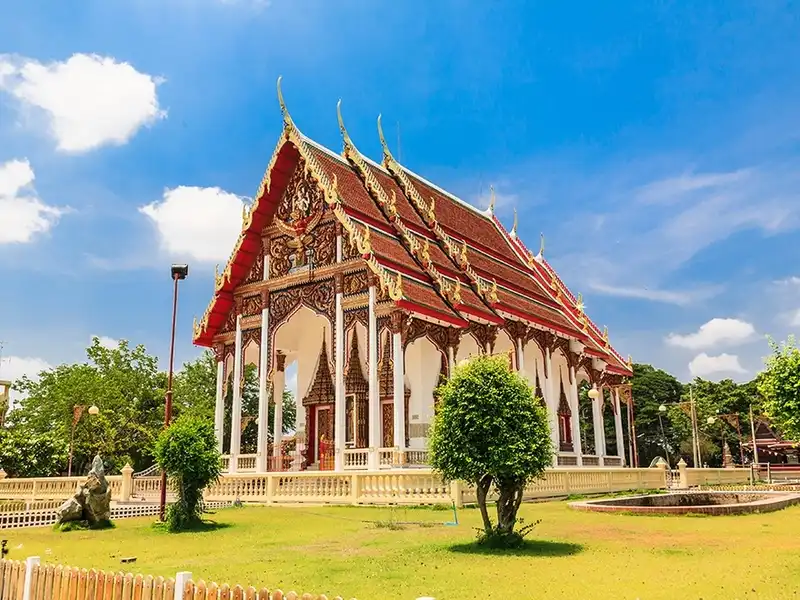
Wat Luk Kae is located in Moo 7, Don Khamin Subdistrict, Tha Maka District, Kanchanaburi 71120. It is a community (rat) temple under the Mahanikaya order and has long been familiar to local residents. For people in Tha Maka, this temple is not only a place for religious rites, but also a “community anchor” that closely connects faith, everyday life, and shared memories across generations. The temple grounds cover about 41 rai, giving the layout an open, airy feel and allowing it to host a wide range of community activities, including annual merit-making festivals, ordinations, Kathina ceremonies, forest robe offerings, and local rites tied to community beliefs and the continuation of Thai traditions.
When it comes to the identity of Wat Luk Kae, what many people think of first is the opportunity to “pay homage to the replica Buddha footprint,” a devotional highlight for visitors seeking auspicious blessings. In Buddhist belief, venerating the Buddha footprint is a way of recalling the Buddha through a symbolic representation of his presence. The footprint, in particular, is regarded as a sign of the Buddha’s coming and an emblem of the path of Dhamma that he laid out for people to follow. For this reason, visiting Wat Luk Kae is not merely a quick stop to “pray at a temple”; it is a chance to gather the mind into calm focus and to begin anew with renewed meaning in one’s life.
Wat Luk Kae is associated with a local legend about three wandering forest monks who traveled from Northern Thailand: Luang Pho Paen, Luang Pho Di, and Luang Pho Suea. At the time, the area was known as “Ban Pak Tho” before later becoming widely known as “Ban Luk Kae.” The surroundings were considered suitable for meditation practice because they were quiet and rural, with people who had strong faith. Villagers invited the three monks to stay for the rains retreat and appointed Luang Pho Paen as the first abbot, using the name “Wat Pak Tho” after the village name of that period. In its earliest stage, the temple reflected a monastic community that grew out of devotion and collective effort rather than abundant resources.
As time passed, the tradition of dhutanga (wandering ascetic practice) continued. Luang Pho Paen and Luang Pho Di went on further journeys, while Luang Pho Suea was appointed to succeed as abbot. After Luang Pho Suea passed away, the community appointed Luang Pho Kham as the next abbot and began developing the temple area more concretely. At one point, a devoted benefactor donated more than 10 rai of land to the temple, enabling more systematic expansion and supporting a wider range of community activities. This period highlights the continuity of local faith that was not tied to any single person, but sustained by the community as a whole, with both monastics and laypeople working together to care for their sacred place.
As the temple gradually developed, procedures were undertaken to comply with laws and formal regulations for establishing a temple. There is information indicating that permission was requested through the proper steps, followed by the construction of key monastic structures such as the ordination hall (ubosot), a chanting hall, and monks’ residences (kuti) to support monastic life and provide an appropriate venue for community religious activities. Local accounts also mention early-stage construction of an ordination hall and thatched roofing, used so villagers could study and so youth activities could take place. This reflects a well-known pattern in rural Thailand, where a “temple” often serves simultaneously as a school, a cultural center, and a public gathering space for the community.
Another figure mentioned in the temple’s history is Phrakhru Chariyaphonrat (original name “Poh,” monastic name Dhammarato), a former district ecclesiastical head of Tha Maka, who played a notable role in developing Wat Luk Kae. His period is often seen as a turning point when the temple expanded its land and constructed many permanent buildings and facilities, becoming clearly established in the form seen today. This overall picture helps explain that Wat Luk Kae did not grow overnight; instead, it steadily accumulated stability through continuous work by the Sangha and the long-term devotion of the local community.
In terms of administration and present-day stewardship, multiple sources state that “Phra Athikan Rangsan Chanthavamso” is the abbot of Wat Luk Kae. This provides clear reference information for visitors and organizers of religious activities. When a temple’s administrative information is clear, it increases trust among devotees for making merit, organizing Kathina or forest robe offerings, and coordinating community activities more systematically, especially for visitors coming from outside the area who need verifiable information.
For many visitors, the charm of Wat Luk Kae lies in the experience of a rural temple atmosphere that feels “real” and “unhurried.” The spacious grounds make a temple walk comfortable, with corners to pause, regain composure, and observe the community’s everyday life, whether it is morning chanting, villagers preparing offerings, or elders gathering to rest their hearts within the temple grounds. These elements make visiting Wat Luk Kae more meaningful than simply stopping to pray and leaving; it becomes an opportunity to see the living relationship between a religious site and its community.
One of the liveliest and most colorful times at Wat Luk Kae is during “Chinese New Year” each year, when the temple hosts an annual festival that locals look forward to. This period often reflects cultural coexistence in Tha Maka, an area shaped by diverse communities, including Thai-Chinese residents who continue traditions of merit-making and gratitude during the Chinese New Year season. As a result, the annual event is not only Buddhist merit-making; it also becomes a shared space for appropriate celebration, featuring local food, vendors, and activities that help the temple function as a “public space for everyone” in the community. Visiting during the festival reveals the temple as a social and cultural center, not only a religious site in a narrow sense.
For those paying homage to the replica Buddha footprint at Wat Luk Kae, if you want the act of worship to feel meaningful and orderly, it helps to calm the mind first, then offer flowers, incense, and candles as appropriate. Some visitors make aspirations related to gratitude toward family, honest livelihood, or setting new life goals and seeking stability. In general, venerating the Buddha footprint symbolically expresses a wish to walk one’s life in the right direction with mindfulness, because the “footprint” can be understood as the trace of the Dhamma path the Buddha pointed out. When visitors emphasize doing good deeds alongside making aspirations, the visit becomes deeper and more lasting.
For visitors interested in cultural travel, taking time to walk around and notice details helps reveal how temples evolve with time, combining newer buildings with structures reflecting local forms. Many temples in Western Thailand show a blend of styles according to different restoration periods, such as roof structures adapted to climate and practical use, open courtyards for community festivals, and shaded areas suitable for sitting and resting. Observing these details helps visitors understand that a temple is not static; it is a “living place” that changes along with the community that cares for it.
From a meditation perspective, Wat Luk Kae is suitable for those who want a simple “mental reset,” even without undertaking multiple days of precepts. A quiet walk around the grounds, deep breathing, and bringing attention to the present moment can be enough to slow down one’s inner rhythm, especially for people whose lives are busy and fast-paced. Visiting early in the morning, when the weather is cooler and the temple is less crowded, is ideal for chanting, praying, and sitting quietly for 10–20 minutes to return the mind to oneself.
If you come as a tourist, it is important to observe appropriate etiquette and dress respectfully, such as wearing a top with sleeves and long pants or a long skirt, keeping your voice low within sacred areas, and avoiding inappropriate photography, especially where people are performing rituals or chanting. If you wish to take photos as a keepsake, choose spots that do not disrupt others’ merit-making and be mindful of steps or uneven ground for safety. Respectful behavior helps ensure a positive experience both for visitors and the local community.
Another reason a trip to Wat Luk Kae can feel worthwhile is that it connects well with a day route linking “Tha Maka – Tha Muang – Kanchanaburi City.” Tha Maka functions as an important passage between Bangkok and Kanchanaburi, making it convenient for a short temple trip. For example, you can visit Wat Luk Kae in the morning, then explore a market or find food in the district, and continue to major attractions in Kanchanaburi City in the afternoon. This kind of route helps save time and provides both devotional and travel experiences within the same day.
Getting There by private car is quite convenient because Tha Maka District connects to multiple main roads. Travelers from Bangkok can enter Kanchanaburi Province, head toward Tha Maka District, then continue to Don Khamin Subdistrict and Moo 7 by following local signposts. The temple is within the village and is genuinely accessible, making it suitable for family trips or small groups who want a relaxed temple visit. When you reach the area, drive carefully because village roads may have motorcycles and pedestrians, especially in the morning or during temple festivals.
If you plan to visit during Chinese New Year festivities or major merit-making events, it is wise to allow extra time for parking and local traffic, as the number of visitors will be higher than usual. Arriving early in the morning generally makes parking easier and the weather more comfortable. From late morning to afternoon it can become hotter and more crowded. If you prefer a quiet, focused worship experience, weekdays or early hours on holidays before crowds arrive are better choices.
Wat Luk Kae is also suitable for bringing elderly family members because the overall atmosphere is unhurried and the spacious grounds make walking easier. However, if someone has difficulty walking, it helps to prepare comfortable footwear and plan rest stops along the way. Bringing drinking water and a hat is also useful, especially around midday.
In terms of “cultural value,” Wat Luk Kae is an example of a local temple that grew from dhutanga practice, villagers inviting monks to stay, and a community-established monastic site, before expanding into a temple with a clear social role. The stories of Luang Pho Paen, Luang Pho Di, and Luang Pho Suea reflect the spirit of wandering monks seeking peaceful places for practice, while the temple’s later development reflects the power of the community not only to preserve a religious site, but also to make it a learning space and a gathering place for people of all ages.
Putting all these elements together, Wat Luk Kae suits devoted visitors who come to venerate the replica Buddha footprint, those looking for a quiet place to reflect, and travelers who want to experience Kanchanaburi through the lens of local community life. If you visit without rushing, take time to walk and observe details, calm the mind, and respect the shared space with local residents, Wat Luk Kae can offer an experience that feels “simple yet meaningful,” a feeling many people seek when life becomes filled with urgency.
| Place Name | Wat Luk Kae |
| Address | Moo 7, Don Khamin Subdistrict, Tha Maka District, Kanchanaburi 71120 |
| Summary | A Mahanikaya community temple in Tha Maka, known for its replica Buddha footprint and its role as a community activity hub |
| Highlights | Replica Buddha footprint for veneration and a spacious, peaceful community-temple atmosphere ideal for merit-making and quiet reflection |
| Period / Brief History | Local tradition traces the temple’s establishment to around 1857 (B.E. 2400), beginning with wandering monks and community devotion, later developed with additional structures and land expansion |
| Key Evidence | Local historical accounts and publicly available temple/registry information from official or widely referenced sources |
| Name Origin | Derived from the community name “Ban Luk Kae” and local usage, later adopted as the official temple name |
| Abbot (Latest) | Phra Athikan Rangsan Chanthavamso |
| Open Days | Daily |
| Opening Hours | 06:00 – 18:00 |
| Travel | Best reached by private car: enter Tha Maka District, then head to Don Khamin Subdistrict and Moo 7 by following local signposts |
| Current Status | Open for merit-making and worship; annual festival held during Chinese New Year |
| Contact Number | 034-566-064 |
| Nearby Attractions (Approx. Distance) | 1) Wat Phra Thaen Dong Rang Worawihan – 18 km 2) Tha Ruea Market (Tha Maka) – 14 km 3) Wat Tham Suea (Tha Muang) – 28 km 4) Bridge over the River Kwai (Kanchanaburi City) – 40 km 5) Mallika R.S. 124 – 42 km |
| Popular Restaurants Nearby (Approx. Distance + Phone) | 1) Kob Thot (Tha Maka) – 12 km Tel. 087-174-5569 2) Ko Khio (Tha Maka) – 13 km Tel. 034-694-188 3) Na’s Southern Kitchen (Tha Maka) – 15 km Tel. 080-091-5291 4) Pad Thai Je Tum (Tha Maka) – 14 km Tel. 089-837-3085 5) The Connection 78 (Tha Maka) – 16 km Tel. 096-965-1442 |
| Popular Accommodations Nearby (Approx. Distance + Phone) | 1) Ban Khung Nam Resort (Tha Maka) – 16 km Tel. 087-106-0918 2) Wana Kaew Resort (Tha Maka) – 18 km Tel. 085-323-3999 3) Chaba Kaew Resort (Tha Maka) – 19 km Tel. 089-254-3885 4) Ing Kanch Villa Resort (Tha Maka) – 20 km Tel. 091-441-4562 5) The Gallery Resort Kanchanaburi (Tha Maka) – 23 km Tel. 098-938-6502 |
Frequently Asked Questions (FAQ)
Q: Where is Wat Luk Kae located?
A: It is located in Moo 7, Don Khamin Subdistrict, Tha Maka District, Kanchanaburi.
Q: What is the main highlight of Wat Luk Kae?
A: The main highlight is the replica Buddha footprint for veneration, along with a spacious, peaceful community-temple atmosphere.
Q: When is the annual festival at Wat Luk Kae held?
A: The temple holds its annual festival during Chinese New Year each year, when the grounds become especially lively.
Q: What should I wear when visiting the temple?
A: Dress respectfully: a top with sleeves and long pants or a long skirt, and observe quiet etiquette within sacred areas.
Q: How can I contact Wat Luk Kae?
A: You can call 034-566-064 to confirm activities, events, or merit-making arrangements.
 Wat Luk Kae Map
 Category:
  Group:
  Tag: ●Wat Luk Kae●wat luk kae ●wat luk kae kanchanaburi ●tha maka temple ●don khamin temple ●buddhist footprint replica ●kanchanaburi temple tour ●merit making kanchanaburi ●chinese new year temple fair ●thailand rural temple ●wat in tha maka Last Update: 1 MonthAgo
Comment
 Nearby Attractions
| Keyword (Advance) |
 Region
|
 Muang Kanchanaburi(
 Copyright 2012,