
 Home
Home North(
 Chiang Mai(


Tham Dao Dueng Cave
Rating: 3.6/5 (5 votes)
 Search By
  Map
Map 
 Have Map
  No Map
Kanchanaburi attractions
Attractions in Thailand
Open Days: Daily
Opening Hours: 08.00 – 16.00
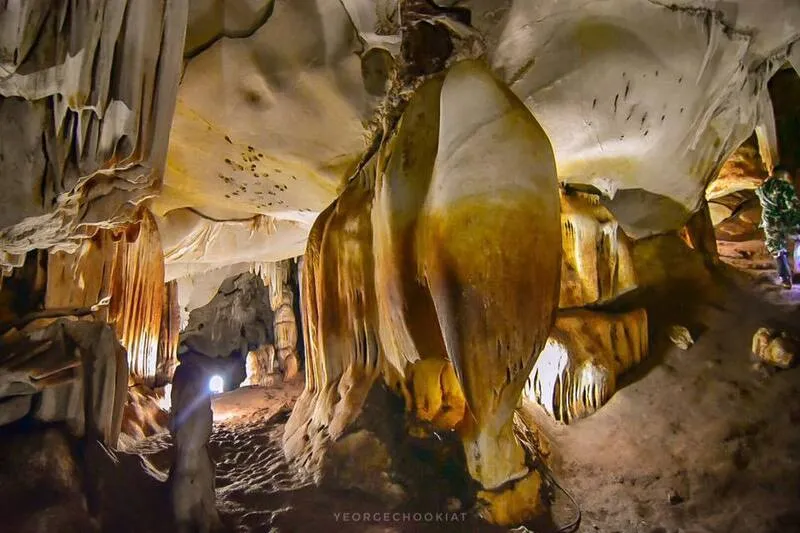
Tham Dao Dueng Cave is located in Sai Yok District, Kanchanaburi Province. It is a limestone cave praised as one of Thailand’s most beautiful caves, known for the creamy-white tone of its stalactites and stalagmites, the airy feel of its chambers, and the way the interior is naturally divided into distinct rooms with clear identities. One of its key highlights is that this is a nature attraction you have to “truly mean to visit.” Even though it sits within the broader Sai Yok tourism area, you still need to hike about 1 kilometer uphill from the parking/starting point. That makes it ideal for travelers who want a real exploration-style experience rather than a quick stop where you step off the car and walk straight in.
The charm of Tham Dao Dueng Cave is not only about grand, dramatic scenery. It is also about how your senses gradually change as you enter: from daylight and wind outside to complete darkness inside, where you must rely on a flashlight and stay attentive. Step by step, you begin to understand that cave beauty is beauty created by time. Rainwater seeps through limestone, slowly dissolving calcium carbonate. The mineral solution drips downward, and as carbon dioxide gradually escapes, calcite crystallizes little by little. Over an incredibly long period, this forms stalactites from the ceiling and stalagmites from the ground. The process is so slow it is almost impossible to measure within a human lifetime, which is why cave formations are fragile natural artworks that should be viewed with respect rather than touched.
Historically, Tham Dao Dueng Cave is reported to have been discovered in 1972 by Mr. Samlee Kooha-ng (some sources shorten the name to “Samlee Kooha”). The story is often told as him following animal tracks into the cave before discovering the beauty inside, and the cave later became an important attraction in the area. Having a clearly named discoverer and a specific year gives Tham Dao Dueng a concrete time anchor, unlike many caves that are described only through broad legends without dates. When we recognize that the cave became known as a tourist cave relatively recently in Thailand’s modern history, it reinforces the importance of careful tourism management so that rising popularity does not damage a natural resource that took an unimaginably long time to form.
Another point that makes Tham Dao Dueng “different from typical caves” is its scale and structure. It is often described as approximately 80–100 meters deep and divided into 8 chambers. Each chamber is named after the shapes or impressions suggested by the formations—for example, the Chandelier Chamber, the Pagoda Chamber, the Crystal Parasol Chamber, and the Blue Curtain Chamber. Many Top 1–10 articles simply say “8 chambers” and stop there, leaving readers unable to imagine what each chamber feels like or how to explore them well. This longer version describes the “8 chambers” as a step-by-step experience, helping readers picture the real journey before they go and plan a safer, more memorable route through the cave.
It often begins with what many visitors call the “Chandelier Chamber.” The first impression is a ceiling layered with numerous stalactites. Some are slender and elongated; others look like ice droplets suspended in the air. If you use a flashlight without holding it too close, you will see overlapping shadows that resemble multiple tiers of chandeliers. The beauty of this chamber is not only about photo-taking. It is about allowing your eyes to adapt to the darkness and using gentle light to study the rock surfaces. You may notice subtle color differences in calcite layers that formed at different times, and in some angles, small glints where crystals reflect the light.
As you walk deeper, you begin to encounter stalagmites that stand more distinctly. A chamber frequently mentioned is the “Pagoda Chamber.” Here, some stalagmites naturally resemble bases and spires, which is why people intuitively compare them to pagodas. Watching these formations closely reveals differences in calcite density. Some areas are smooth and compact, while others form small ripples. If you move slowly and shine light at an angle, you can sometimes see traces of past water flow that gradually shaped the stone.
Another chamber that often makes visitors linger is the “Crystal Parasol Chamber.” The name reflects formations that fan out in layers, like tiered parasols. Its beauty lies in delicacy. In places, calcite may form thin sheets that resemble curtains or fabric-like streaks. When a flashlight passes through, you may notice translucency and a soft sheen. The key caution is that many people instinctively reach out because the formations look close—but touching even once can leave oils that interfere with crystallization, causing formations to stop growing or change color over time. This chamber is best enjoyed by learning to observe rather than trying to feel by touch.
Deeper in complete darkness, many people describe the “Blue Curtain Chamber” as walking into natural artwork. Its highlight is sheet-like stalactites that hang down like flowing curtains from the ceiling. If you shine the light broadly, you can see lines resembling pleated fabric. The beauty here is about light control: if the beam is too strong, you may only see whiteness. If it is softer and you slowly change the angle, subtle shadows appear and the stone curtain gains depth, almost like it is moving—even though it has been still for an extremely long time.
Another chamber that tends to stay in people’s memory is one some sources call the “Prang Chamber” or a chamber with tall, slender stalagmites resembling prang-like architecture. The feeling is “height” and “verticality,” naturally drawing your eyes upward. For photography, it is better to keep some distance and shoot from a slightly low angle so you can capture the height without stepping too close and risking a bump.
After that, there are chambers whose names vary across sources and visitor stories—some compare shapes to animals or specific figures (some lists mention “lion” or “white elephant”). The important point is that the on-site chamber names usually follow local signage and the guide/park staff’s terminology. The best way to enjoy the cave is to listen to the guide and interpret the natural shapes together. In a cave like this, part of the fun is reading stone forms the way you read clouds—except these “clouds” have been sculpted and fixed by dripping water over time.
One section often slows people down because the floor becomes less even and may be more damp. Foot placement becomes critical. This is exactly where the advice “a guide is recommended” truly matters. Someone familiar with the route knows where it is slippery, where to use railings, where to duck under low ceilings, and where to stop safely for the best viewpoints. Although Tham Dao Dueng is known for being relatively open, some parts may have low ceilings or protruding formations. Learning to control your flashlight so it illuminates the ground before each step is one of the most important skills for safe cave walking.
For many visitors, the later chambers create a feeling that makes you “want to look back.” At first, you may feel excited and tense from darkness and slippery ground. After a while, you begin to understand the cave’s rhythm, and you realize how many details are hidden in the dark. The calmer you become, the more beauty you notice. The last chambers often feel quieter and more peaceful than the first ones. They make you want to pause, listen to dripping water, breathe slowly, and watch how nature creates endless unique forms within the space of a single cave.
In terms of location, Tham Dao Dueng Cave lies in the northern part of Sai Yok National Park and is often described as being near Ranger Unit SY.2 (Tham Dao Dueng). The main approach uses Highway 323. From there, you turn onto a smaller road toward Wat Tham Dao Dueng Sukharam (some sources cite a turn-in distance around 2–2.5 kilometers), and then continue on foot uphill for about 1 kilometer. This is what makes the cave different from easy-access caves: the hike is part of the experience, and it makes arriving at the cave entrance feel more rewarding.
Getting There If you start from Kanchanaburi town, the overall distance to the Sai Yok area is about 110 kilometers. Take Highway 323 toward Sai Yok. Near the entrance/zone of Sai Yok National Park, look for signage directing you to Wat Tham Dao Dueng Sukharam. Drive along the smaller road for about 2–2.5 kilometers, park where appropriate, and then hike uphill for about 1 kilometer. Allow extra time for the hike up and down, and avoid starting the cave walk late in the afternoon. Inside the cave it is completely dark and you need a flashlight throughout, and returning when daylight is fading increases the risk of slipping or missteps.
The baseline equipment for Tham Dao Dueng Cave includes a headlamp (hands-free balance), shoes with good traction, sufficient drinking water, a small towel, and comfortable, flexible clothing. In the rainy season, add a light rain jacket and expect wetter, more slippery trail conditions. Avoid carrying bulky items such as large umbrellas or long-hanging bags, because they can accidentally hit cave walls or stalactites. A good cave visit should feel “light” in terms of gear, making your steps steadier and safer.
For families with children or older visitors, it is necessary to assess physical readiness before the uphill hike. One kilometer on flat ground may not feel hard, but uphill sections combined with damp, slippery surfaces require more energy. A practical approach is to walk in stages, take short breaks, and avoid rushing. Extra time makes the cave visit safer and more enjoyable—especially because once inside, you need even more concentration for darkness and uneven ground.
Another important topic is cave etiquette and conservation. Tham Dao Dueng is famous for delicate white formations. Touching or scraping can leave marks easily, and oils from hands can discolor surfaces or disrupt crystal growth. The best practice is to observe with your eyes, take photos with a safe distance, avoid frequent flash use, and never touch stalactites or stalagmites. If you see signs or rope barriers, respect them strictly, because certain areas may be especially fragile or under recovery.
For travelers who want to plan an efficient day trip, Tham Dao Dueng Cave can fit well into a “one-day Sai Yok” itinerary, paired with Sai Yok Noi Waterfall/Sai Yok Yai Waterfall, Hin Dad Hot Springs, or viewpoints along the Kwai Noi River near resorts and cafés on Highway 323. The key is to treat the cave as a main activity rather than a quick stop. The 8-chamber experience is most rewarding when you move slowly, use light thoughtfully, and listen to a local guide describing what each formation resembles, what each chamber is called, and how it forms.
In the end, Tham Dao Dueng Cave offers both wonder and humility. You feel wonder at stone shapes that resemble architecture, and humility when you realize they were created by tiny water droplets working over time scales beyond human counting. Visiting the cave is not only about “seeing something beautiful,” but about learning time, nature’s patience, and the responsibility of visitors to help keep the cave beautiful for future generations.
| Name | Tham Dao Dueng Cave |
| Address / Coordinates | Sai Yok National Park area, Sai Yok District, Kanchanaburi Province Coordinates (approx.): N 14.47207, E 98.83458 |
| Overview | A well-known limestone cave in Sai Yok, divided into 8 chambers. Highlights include beautiful white stalactites and stalagmites in varied forms. Requires an uphill hike of about 1 km, ideal for nature and serious exploration travelers. |
| Key Highlights | Beautiful stalactites/stalagmites in many shapes, spacious chambers but completely dark inside, 8-chamber structure (e.g., Chandelier / Pagoda / Crystal Parasol / Blue Curtain), discovery story dated to 1972. |
| Open Days | Daily |
| Opening Hours | 08.00 – 16.00 |
| Fees | Sai Yok National Park entry fee: Thai — Adult 60 THB / Child 30 THB; Foreigners — Adult 300 THB / Child 150 THB |
| Facilities | Bring a flashlight/headlamp and good-grip shoes (the cave is completely dark). The route includes an uphill hike. |
| Getting There (Summary) | Use Highway 323 (Sai Yok area), turn toward Wat Tham Dao Dueng Sukharam for about 2–2.5 km, then hike uphill about 1 km. A flashlight and a guide are recommended. |
| Current Status | A cave attraction in the Sai Yok area that is open to visitors within the stated hours. Visiting in the morning to early afternoon is recommended for safety. |
| Contact Numbers (Verified) | Sai Yok National Park: 0-3468-6024, 034-516-163 Tham Dao Dueng cave info (local tourism source): 090-404-4811 TAT Kanchanaburi Office: 0-3451-1200, 0-3451-2800 |
| Nearby Attractions (Approx. Distance) | 1) Sai Yok Noi Waterfall – 15 km 2) Sai Yok Yai Waterfall (National Park zone) – 25 km 3) Lawa Cave – 20 km 4) Hin Dad Hot Springs – 35 km 5) Nam Tok Station (end of the Kanchanaburi–Nam Tok railway line) – 30 km |
| Popular Restaurants Nearby (Approx. Distance + Phone) | 1) Baan Tang Rim Kwae (Sai Yok) – 25 km – 081-839-3689 2) Krua Phak Wan Baan Rai (Lum Sum) – 20 km – 083-241-6561 3) Nueng Wang Pho Restaurant – 12 km – 081-007-1449 4) Je Taew I Din Klin Ya – 28 km – 063-786-8502 5) The FloatHouse River Kwai (restaurant/café in the resort) – 35 km – 084-725-8686 |
| Popular Accommodations Nearby (Approx. Distance + Phone) | 1) River Kwai Resotel – 30 km – 02-642-5497, 081-734-5238 2) The FloatHouse River Kwai – 35 km – 02-642-5497, 084-725-8686 3) Home Phutoey River Kwai – 28 km – 02-642-5497 4) Saiyok River House – 25 km – 034-696-999 (publicly listed group/main number) 5) NexStation Kanchanaburi – 100 km – 092-268-1899 |
Frequently Asked Questions (FAQ)
Q: Where is Tham Dao Dueng Cave located?
A: It is in Sai Yok District, Kanchanaburi Province, within the Sai Yok National Park area. You turn off Highway 323 toward Wat Tham Dao Dueng Sukharam, then hike uphill for about 1 kilometer to reach the cave.
Q: What time does Tham Dao Dueng Cave open, and is it open every day?
A: Local published information states that it is open daily from 08.00 – 16.00. Visiting in the morning or early afternoon is recommended so you have enough time for the uphill hike and cave exploration without rushing.
Q: Why do I need a flashlight, and why is a guide recommended?
A: The cave is spacious but completely dark, so you need a flashlight or headlamp throughout. Some sections can be damp or slippery, and ceilings may be low in places. A guide helps reduce risk and can also explain each chamber’s highlights more completely.
Q: Does the cave really have 8 chambers, and what are the standout ones?
A: It is often described as being divided into 8 chambers named after the shapes of formations—such as the Chandelier Chamber, Pagoda Chamber, Crystal Parasol Chamber, and Blue Curtain Chamber. Some chamber names may follow on-site signage and the terminology used by staff/guides.
Q: What should I wear and bring to Tham Dao Dueng Cave?
A: Wear shoes with good traction and comfortable clothing. Bring a headlamp/flashlight and a reasonable amount of water. Avoid bulky items because you need to hike uphill about 1 km and walk carefully inside on uneven surfaces.
Q: What is the most important safety and conservation advice for visiting the cave?
A: Prioritize safety in darkness and on slippery ground: walk slowly, shine your light on the floor before each step, and never touch stalactites or stalagmites because they are fragile and can be permanently damaged. Always respect ropes, barriers, and warning signs.
 Tham Dao Dueng Cave Map
 Category:
  Group:
  Tag: ●Tham Dao Dueng Cave●tham dao dueng cave ●sai yok cave ●cave in kanchanaburi ●limestone cave thailand ●sai yok national park cave ●cave hiking thailand ●natural cave attraction thailand ●kanchanaburi nature travel ●thailand cave exploration ●hidden cave in thailand
Last Update: 1 MonthAgo
Tag: ●Tham Dao Dueng Cave●tham dao dueng cave ●sai yok cave ●cave in kanchanaburi ●limestone cave thailand ●sai yok national park cave ●cave hiking thailand ●natural cave attraction thailand ●kanchanaburi nature travel ●thailand cave exploration ●hidden cave in thailand
Last Update: 1 MonthAgo
Comment
 Nearby Attractions
| Keyword (Advance) |
 Facebook Fanpage
 Region
 Art, Culture and Heritage
 Historical Sites and Monuments(
 Landmarks and Memorials(
 Art, Craft Centres, Tradition(
 Museums(
 Art Gallery(
 University
 Places of Worship
 Temple(
 Church(
 Other religious and spiritural sites(
 Research and Development
 Royal Project(
 Suburban Living
 Village, Community(
 Local Market(
 National Parks and Marine Reserves(
 Mountain (Doi)(
 Dam, Reservoir, Lake(
 Waterfalls(
 Hot Springs(
 River, Canal(
 Other natural attractions(
 Entertainment and Agricultural
 Zoos and Aquariums(
 Animal camps and shows(
 Farm, Parks, Gardens and Ecotourism(
 Cinema(
 Outdoor and Adventure Activities(
 Travel Articles, Recipes
 Travel Review, Food Review(
 Copyright 2012,