
lovethailand home >North Travel Attractions >Chiang Mai Travel Attractions >Mae Rim >Khi Lek > Wat Si Chonlathan
TL;DR: Wat Si Chonlathan is located at Village No. 3, Ban Huai Nam Rin, Chotana Road, Chiang Mai–Fang Route, Khi Lek Subdistrict, Mae Rim District, Chiang Mai Province, open Daily, hours 08.00 – 17.00.
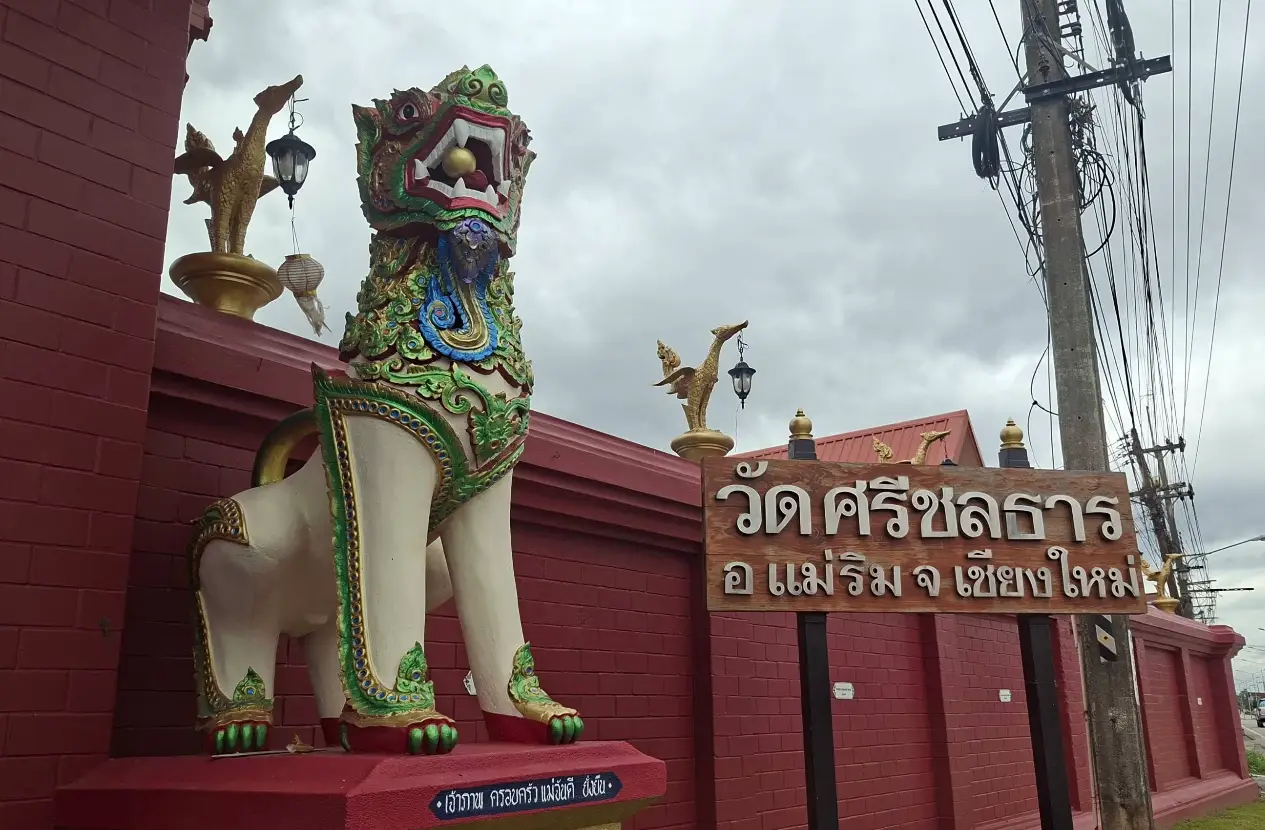
Wat Si Chonlathan
Open Days: Daily
Opening Hours: 08.00 – 17.00
Wat Si Chonlathan, formerly known as Wat Huai Nam Rin, is located at 114 Moo 3, Ban Huai Nam Rin, Chotana Road, the Chiang Mai–Fang route, Khi Lek Subdistrict, Mae Rim District, Chiang Mai Province. It is a private Buddhist temple under the Mahanikaya order and an important community temple of Ban Huai Nam Rin. The temple was officially established in 1937, received its royal consecrated boundary on 24 February 1955, and held its boundary consecration ceremony in 1957, when Phra Maha Duang Thitawiro was recorded as abbot.
The temple covers 4 rai and 43 square wa, according to title deed no. 21728, volume 218, page 28, Mae Rim District, Chiang Mai Province. Its location is closely tied to the village: the north side borders Ban Huai Nam Rin Market, the south side borders Ban Huai Nam Rin School, the east side borders Chotana Road, and the west side borders the Mae Taeng irrigation canal. This position places the temple at the heart of village life, between a market, a school, a main road, and a water-management system.
The former name Wat Huai Nam Rin came from the village’s original water source. According to stories passed down by village elders, before the irrigation department dug a canal through the village, the area was a high plain sloping eastward. South of the village was a small water hollow that local people called Huai Rin because water continuously trickled from a hole about the size of a bamboo cylinder.
Huai Rin was important because water flowed there throughout the year. During the dry season, when wells in other parts of the village sometimes dried up, Huai Rin still provided water for drinking and daily use. This made the water source a vital part of community life and became the origin of the village name Ban Huai Nam Rin. The old temple name preserved this relationship between the temple, the village, and water.
Later, when the irrigation department dug the canal through the area, soil from the excavation was used to fill the old Huai Rin site. As a result, the original stream-like hollow no longer remains in its old form. The area later became a community garden associated with Somdet Ya, with trees planted for the village. Even though the landscape changed, the memory of Huai Rin remains preserved in the names of the village and the temple.
Phra Khru Udomwutthikhun, the Mae Rim district ecclesiastical chief at the time, renamed the temple Wat Si Chonlathan. The name retains the meaning of Huai Nam Rin. “Chonlathan” refers to a stream or flowing water, while “Si” suggests beauty, auspiciousness, and prosperity. The new name therefore gives the temple a more formal and auspicious identity while still preserving the original water-based meaning of the village.
The history of Wat Si Chonlathan began when a small number of Buddhist families settled in Ban Huai Nam Rin. The villagers established a temple in the middle of rice fields because the land was public and vacant. The temple remained there for some time and later received a royal consecrated boundary and an ordination hall. This early stage shows the community’s desire to create a shared religious center for worship, merit-making, and Buddhist ceremonies.
As the original location became inconvenient, the villagers agreed to move the temple into the village, opposite its present site. At that time, there was no public school, so the temple served as a place where local children studied. This role shows that Wat Si Chonlathan was not only a religious place but also an early educational center for the village before the public school system became established in the area.
When Chotana Road, the Chiang Mai–Fang route, was later cut through behind the temple, the community agreed that the temple should move again to a more suitable place. Villagers selected land to the west, which became the present temple site. Over time, monastic buildings were constructed, including monks’ residences, a viharn, and other temple facilities. As the population of the village grew, the temple developed along with the community.
The abbot at that time submitted a request to the Department of Religious Affairs to have the temple legally recognized. Wat Si Chonlathan was officially established as a temple in 1937. It received its royal consecrated boundary on 24 February 1955 and held its boundary consecration ceremony in 1957. This recognition allowed the temple to perform formal monastic acts within a proper consecrated boundary and confirmed its status within the Thai Sangha system.
Important temple structures mentioned in the temple history include the ordination hall, viharn, monks’ residences, and other monastic facilities. The ordination hall became significant after the temple received its royal consecrated boundary. The viharn serves as a place for worship, Dhamma listening, and community religious activities, while monks’ residences and other facilities support monastic life and regular temple functions.
Wat Si Chonlathan has served Ban Huai Nam Rin in more ways than one. It was founded by villagers, moved along with the development of the settlement, served as an early learning place before the public school existed, and continues to support Buddhist ceremonies. Its location beside the market, school, road, and irrigation canal makes it a clear example of how a local temple can stand at the center of community life.
The context of Khi Lek Subdistrict helps explain the temple’s importance. Khi Lek lies in the Ping River lowland, with soil suitable for agriculture. The area has long been associated with rice cultivation and post-harvest crops. Ban Huai Nam Rin is Village No. 3 of the subdistrict, alongside other communities such as Ban Khi Lek Noi, Ban San Khayom, Ban Sang, Ban Ton Kham, Ban Khi Lek Luang, Ban Pak Thang Saluang, and Ban Phana Wan.
The temple is also closely connected with local education. In the period before the public school existed, the temple was used as a place for teaching. Today, Ban Huai Nam Rin School borders the south side of the temple. This proximity reinforces the temple’s long-standing role as both a religious and social center for the village.
The main appeal of Wat Si Chonlathan lies in its layered local history. It preserves the story of a natural water source, the naming of a village, the movement of a temple as a community expanded, its role as an early place of learning, and its continued use for merit-making. Visitors who appreciate community temples will find this temple meaningful because it tells the story of Ban Huai Nam Rin through place, memory, and Buddhist practice.
Religious activities at Wat Si Chonlathan follow the rhythm of northern Thai community temples. These include Buddhist observance days, major Buddhist holy days, Kathin, robe-offering ceremonies, food offerings, Dhamma listening, and village merit-making events. The temple is also associated with the Poi Luang tradition. In March 2026, a Poi Luang event at Wat Si Chonlathan included a khrua than procession, merit-making, offerings, community food, local shops, and cultural activities.
Poi Luang is an important Lanna Buddhist tradition. It is a large celebration often held to mark the completion or restoration of temple property, such as a viharn, sala, chedi, or other religious structure. The event is not only a religious ceremony but also a communal expression of faith. Villagers prepare khrua than offerings, form processions, perform cultural activities, and support the temple together. This tradition shows that Wat Si Chonlathan remains a living cultural space, not merely an old temple site.
Wat Si Chonlathan is suitable for visitors interested in community temples, local history, and the relationship between Buddhism and water in village life. Visitors should pay respect in the main temple area, walk quietly around the temple grounds, and observe the surrounding context of the school, market, Chotana Road, and irrigation canal. These elements are part of the temple’s story and help explain why it matters to Ban Huai Nam Rin.
Visitors should dress modestly, speak quietly, and avoid entering monks’ private areas without permission. If visiting during Poi Luang or other major ceremonies, extra time should be allowed because the temple is close to a main road, a market, and the school area. Respectful behavior helps preserve the calm atmosphere of this living community temple.
A meaningful local route can connect Wat Si Chonlathan with other temples in Khi Lek Subdistrict and northern Mae Rim. Nearby temple stops include Wat Kuna Nusorn, Wat Mongkhon Prasit, Wat Intharam, Wat Nong Pan Chiang, and Wat Surin Tharat. A wider Mae Rim route can continue to Wat Pa Dara Phirom, Daraphirom Palace Museum, Mae Sa Elephant Camp, Mae Sa Waterfall, or Queen Sirikit Botanic Garden.
Wat Kuna Nusorn and Wat Mongkhon Prasit help complete the picture of community temples in Khi Lek Subdistrict. Wat Kuna Nusorn is connected with Ban San Khayom, while Wat Mongkhon Prasit is connected with Ban Ton Kham. Together with Wat Si Chonlathan, these temples show how each village in the subdistrict maintains its own Buddhist center with distinct local memories and traditions.
Getting There from Chiang Mai city is convenient by following Highway 107 / Chotana Road, the Chiang Mai–Fang route, toward Mae Rim District. Continue into Khi Lek Subdistrict and Ban Huai Nam Rin. Wat Si Chonlathan is located at 114 Moo 3 beside Chotana Road. A private car, rental car, hired vehicle, or public transport on the Chiang Mai–Mae Rim–Mae Taeng route with local connection can be used.
A short visit to Wat Si Chonlathan usually takes about 30–60 minutes. Travelers who want to combine it with other local temples or Mae Rim attractions should plan a half-day route. Morning is suitable for worship and walking through the temple grounds, while the afternoon can be used for nearby cultural or nature attractions in Mae Rim.
Wat Si Chonlathan is valuable not because of grand architecture but because of its community history. The temple preserves the memory of Huai Rin, the movement of the temple over time, its former role as a place of learning, its consecrated boundary, and its continuing role in Poi Luang and village merit-making. For travelers who want to understand Mae Rim through water, education, community, and faith, this temple offers a quiet and meaningful stop.
| Name | Wat Si Chonlathan |
| Former / Local Name | Wat Huai Nam Rin / Wat Si Chonlathan (Huai Nam Rin) |
| Location | Village No. 3, Ban Huai Nam Rin, Chotana Road, Chiang Mai–Fang Route, Khi Lek Subdistrict, Mae Rim District, Chiang Mai Province |
| Address | 114 Moo 3, Chotana Road, Chiang Mai–Fang Route, Khi Lek Subdistrict, Mae Rim District, Chiang Mai Province 50180, Thailand |
| Temple Land | 4 rai and 43 square wa, according to title deed no. 21728, volume 218, page 28, Mae Rim District, Chiang Mai Province |
| Boundary | North: Ban Huai Nam Rin Market; South: Ban Huai Nam Rin School; East: Chotana Road; West: Mae Taeng irrigation canal |
| Highlights | A Mahanikaya community temple of Ban Huai Nam Rin, with history linked to the old Huai Rin water source, temple relocation, early village education, and the Poi Luang tradition |
| History | Officially established as a temple in 1937, granted a royal consecrated boundary on 24 February 1955, and formally bound by consecration ceremony in 1957 |
| Name Origin | The former name Wat Huai Nam Rin came from Huai Rin, a year-round village water source. The later name Wat Si Chonlathan preserves the same water-related meaning in a more formal temple name. |
| Distinctive Features | A local Lanna community temple located beside Chotana Road, Ban Huai Nam Rin Market, Ban Huai Nam Rin School, and the Mae Taeng irrigation canal |
| Important Structures | Ordination hall, viharn, monks’ residences, monastic facilities, merit-making area, and community activity spaces within the temple grounds |
| Historical Abbot | Phra Maha Duang Thitawiro was recorded as abbot during the 1957 boundary consecration period |
| Travel Information | From Chiang Mai city, follow Highway 107 / Chotana Road on the Chiang Mai–Fang route toward Mae Rim District and continue to Ban Huai Nam Rin in Khi Lek Subdistrict. The temple is located beside Chotana Road. |
| Current Status | An active private Buddhist temple and community religious site of Ban Huai Nam Rin, Khi Lek Subdistrict, Mae Rim District, Chiang Mai Province |
| Open Days | Daily |
| Opening Hours | 08.00 – 17.00 |
| Traditions / Merit-Making Events | Poi Luang at Wat Si Chonlathan, Buddhist observance days, major Buddhist holy days, Kathin, robe-offering ceremonies, food offerings, Dhamma listening, and Ban Huai Nam Rin community merit-making events |
| Nearby Tourist Attractions | 1. Wat Kuna Nusorn, Ban San Khayom, about 3 km 2. Wat Mongkhon Prasit, Ban Ton Kham, about 3 km 3. Wat Intharam, Khi Lek Subdistrict, about 4 km 4. Wat Nong Pan Chiang, about 5 km 5. Wat Surin Tharat (Pa Ngae), about 5 km 6. Wat Pa Dara Phirom, about 12 km |
| Nearby Restaurants | 1. Aun Ai Rak Noodle, San Khayom Mae Rim Branch, about 2 km, Tel. 095-674-0915 2. Maerim Villa & Pool, about 3 km, Tel. 089-433-9534, 053-465-564 3. Hainanese Chicken Rice Mae Rim, about 5 km 4. Khloem Garden Folk & Restaurant Maerim, about 6 km, Tel. 095-676-9942 5. Petchburirama, about 7 km, Tel. 090-840-0030 |
| Nearby Accommodations | 1. Maerim Villa & Pool, about 3 km, Tel. 089-433-9534, 053-465-564 2. In Suan Sin, about 4 km, Tel. 064-572-1082 3. Dang One Boutique, about 4 km, Tel. 089-851-6876 4. Happy Resort, about 5 km, Tel. 064-451-5791 5. Baan Phak Kosol Hotel, about 6 km, Tel. 094-962-8881 |
Frequently Asked Questions (FAQ)
Q: Where is Wat Si Chonlathan located?
A: Wat Si Chonlathan is located at 114 Moo 3, Ban Huai Nam Rin, Chotana Road, Khi Lek Subdistrict, Mae Rim District, Chiang Mai Province.
Q: What are the opening hours of Wat Si Chonlathan?
A: Wat Si Chonlathan is open daily from 08.00 to 17.00.
Q: What was the former name of Wat Si Chonlathan?
A: The temple was formerly known as Wat Huai Nam Rin, named after the local water source Huai Rin.
Q: When was Wat Si Chonlathan officially established?
A: Wat Si Chonlathan was officially established as a temple in 1937, received its royal consecrated boundary on 24 February 1955, and held its boundary consecration ceremony in 1957.
Q: What is the origin of the name Ban Huai Nam Rin?
A: The name came from Huai Rin, a small water source where water flowed throughout the year and was used by villagers for drinking and daily life.
Q: What is the main highlight of Wat Si Chonlathan?
A: The main highlight is its community history linked to Huai Rin, temple relocation, early village education, and its continuing role in the Poi Luang tradition.
Q: What important tradition is associated with Wat Si Chonlathan?
A: The temple is associated with the Poi Luang tradition, a major Lanna merit-making celebration involving khrua than processions, offerings, community food, and cultural activities.
Q: What nearby places can be visited with Wat Si Chonlathan?
A: Nearby places include Wat Kuna Nusorn, Wat Mongkhon Prasit, Wat Intharam, Wat Nong Pan Chiang, Wat Surin Tharat, and Wat Pa Dara Phirom.
 Category: ●Places of Worship
 Group: ●Temple
Last Update : 2 WeekAgo
 Last Update : 2 WeekAgo
 Click to Access the Navigation Map GPS
 Muang Chiang Mai(121)Chom Thong(47)Mae Chaem(25)Chiang Dao(33)Doi Saket(68)Mae Taeng(85)Mae Rim(69)Samoeng(29)Fang(71)Mae Ai(59)Phrao(70)San Pa Tong(103)San Kamphaeng(66)San Sai(73)Hang Dong(73)Hot(32)Doi Tao(22)Omkoi(11)Saraphi(74)Wiang Haeng(15)Chai Prakan(28)Mae Wang(32)Mae On(22)Doi Lo(33)Galyani Vadhana(1)


