

 Home
Home Chiang Mai(










Huai Som Poi Royal Project Development Center
Rating: 3.8/5 (4 votes)
 Search By
  Map
Map 
 Have Map
  No Map
Chiang Mai attractions
Attractions in Thailand
Open Days: Daily (recommended to call/check the latest notice before traveling, especially in the rainy season)
Opening Hours: Generally 08.00–17.00 (may change depending on on-site operations)
Huai Som Poi Royal Project Development Center is a solid pick for travelers who want Chiang Mai in a quieter, more meaningful way—where nature, community, and the practical spirit of royal-initiative development meet in one place. Established in 2000, the center sits within a national reserved forest area, with boundaries that connect to (and in places overlap with) both Doi Inthanon National Park and Op Luang National Park. That setting explains the core mission here: development is not separated from conservation. The work focuses on protecting natural resources while improving livelihoods and living conditions for Karen hill-tribe communities in the area—communities that historically relied on rotational farming, lacked permanent agriculture, and faced significant gaps in basic infrastructure.
The center’s responsibility area is extensive, covering 15 villages and 545 households. The landscape is a complex mix of rolling hills and narrow valleys, with pockets of lowland suitable for rice fields and scattered cultivation along the folds of the terrain. This geography forces farming to be practical—grounded in slope, soil, water access, and what can realistically thrive in the valleys and uplands. Visiting therefore feels different from a typical tourist stop: you are walking through a living working landscape, where the goal is to help communities stand on stable, long-term livelihoods without pushing the burden back onto the forest and upstream ecosystems.
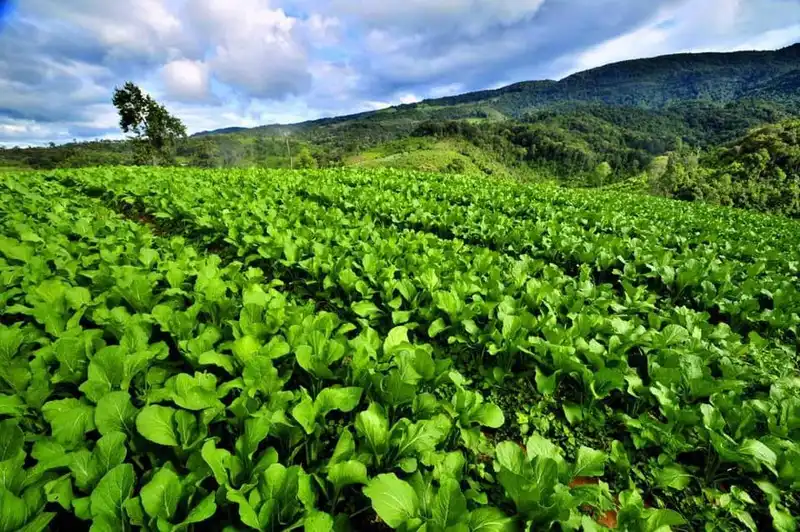
If you come in “agricultural learning” mode, you can explore demonstration plots featuring seasonal vegetables, Arabica coffee, and Hass avocado, alongside integrated farming examples and medicinal plants. Coffee often becomes the highlight for visitors because it shows a clear path to higher-value crops that fit upland conditions and support forest-friendly livelihoods—one of the practical alternatives to land-use patterns that can degrade watershed forests.
Huai Som Poi also connects naturally to nearby learning areas such as the Ban Khun Tae Royal-initiative model farm, where integrated demonstration plots make it easier to understand the “food system” and “income system” logic in a hands-on way. In the right season, you may also encounter persimmon orchards operated by local farmers, with harvest activities typically around July–August (timing varies by year depending on weather and yields).
For travelers drawn to culture, Karen community life in this zone offers a deep, respectful kind of learning: the traditional “Teh-Na” musical instrument, rice pounding using a foot-operated mortar (krok kradueang), rituals and beliefs tied to forest protection, and Karen New Year celebrations. This is often what gives visitors a “different Inthanon perspective”—not just chasing cool temperatures, but understanding how people and forest ecology are woven together.
On the nature side, the wider area includes notable routes and sites such as Mae Tia Waterfall (within Op Luang National Park), Mae Sakhue Waterfall, and the Doi Song Mia nature trail (around 1,500 meters above sea level), which is part of a Karen community conservation forest. The trade-off is travel time and road conditions: the landscape is genuinely green and rural, but the rainy season can make access slower and more demanding.
Local souvenirs tend to be seasonal cool-climate produce and community handicrafts such as backstrap-loom weaving, embroidered textiles, and basketry. Buying locally is one of the most direct ways to send support back into the community economy.
Food and accommodation are the “know-before-you-go” items here. Based on the available information, the center itself does not operate a tourist restaurant, so bringing your own food and drinking water is recommended. For staying overnight, there is one on-site guesthouse (about 10-person capacity) plus a camping area and 2-person tent rental service. If you want a homestay-style experience, community options such as Ban Khun Tae are often used (contact ahead to confirm availability and conditions).
Getting There From Chiang Mai city, take Highway 108 (Chiang Mai–Hot) toward Chom Thong District (around Km 58). Then turn right onto the Chom Thong–Mae Tia Waterfall road (near the Chom Thong District Office) for about 7 km. You will reach a junction to the national park/Mae Tia Waterfall; from there, the route continues on laterite/dirt road toward the entrance of Ban Huai Som Poi. In general, many vehicle types can pass in normal conditions, but during the rainy season a 4WD is recommended. Plan extra time for slippery sections, and note that the available information indicates there is no local hired-car service on this route.
| Name | Huai Som Poi Royal Project Development Center |
| Location | Doi Kaeo Subdistrict, Chom Thong District, Chiang Mai (route zone: Chom Thong – Mae Tia – Huai Som Poi) |
| Characteristics | A Royal Project development center in reserved-forest / national-park-adjacent areas, combining natural resource conservation with livelihood development for Karen communities through permanent agriculture and learning-based tourism. |
| Period | Established in 2000 |
| Key Evidence | Responsible area: 494,823 rai; coverage: 15 villages; 545 households; rainfall: ~1,300 mm/year; temperature range: 6°C (min) to 32°C (max). |
| Name Origin | Named after the local stream/area “Huai Som Poi” within the center’s responsibility zone. |
| Travel | Chiang Mai → Highway 108 (Chiang Mai–Hot) → Chom Thong (~Km 58) → turn right to Chom Thong–Mae Tia road (~7 km) → junction to national park/Mae Tia → laterite/dirt road to Ban Huai Som Poi (rainy season: recommend 4WD). |
| Current Status | Active development and learning-tourism area; recommended to contact the center in advance to confirm visit conditions and road status, especially during the rainy season. |
| Contact Number | If you want “verified-for-publishing” contacts, it’s best to confirm directly with the Royal Project network/official listings before final posting (the numbers circulating online are inconsistent across sources). |
| Nearby Tourist Attractions with Distance | Mae Tia Waterfall (Op Luang NP) ~10–25 km; Op Luang National Park viewpoint/gorge zone ~25–45 km; Mae Sakhue Waterfall ~20–40 km; Doi Song Mia nature trail ~25–45 km; Phra That Si Chom Thong Temple ~25–40 km; Chom Thong town ~25–40 km; Doi Inthanon NP main-route zone ~45–80 km. |
| Popular Restaurants Nearby | Chom Thong town restaurants & cafés are the closest reliable cluster (~25–40 km). If you want, I can compile a verified list (5+ places) with correct phone numbers based on official pages/Google listings only. |
| Popular Accommodations Nearby | Nearest practical bases are in Chom Thong town and the lower Inthanon route (~25–70 km). If you want, I can compile a verified list (5+ stays) with confirmed phone numbers from official sources only. |
| Facilities | Demonstration plots/learning points; coordination/contact point; limited on-site guesthouse; camping area (confirm latest conditions and rules before visiting). |
| Fees | No fixed confirmed fee information; check with the center and any national-park routes you plan to connect before traveling. |
Frequently Asked Questions (FAQ)
Q: Who is Huai Som Poi Royal Project Development Center best for?
A: Travelers who want learning-based trips in Chiang Mai, are interested in royal-initiative development, highland agriculture, Karen community life, and conservation that truly connects to everyday livelihoods.
Q: What will I mainly see there?
A: Demonstration agriculture (vegetables, Arabica coffee, Hass avocado, integrated plots, medicinal plants), plus the wider community-and-forest relationship that underpins conservation and stable livelihoods.
Q: Is there food service inside the center?
A: The available information indicates there is no tourist restaurant on-site, so bringing your own food and water is recommended, or plan meals in Chom Thong town.
Q: Can I stay overnight there, and how do I book?
A: There is limited accommodation (one guesthouse) and a camping area with tent rental options. Contact the center in advance to confirm availability, rules, and pricing for your dates.
Q: Is the route difficult, especially in the rainy season?
A: The last stretch can be laterite/dirt road and may become slippery. In the rainy season, a 4WD is recommended, and you should allow extra travel time.
Q: How do I plan a one-day trip efficiently?
A: Leave Chiang Mai early, stop in Chom Thong to eat and stock supplies, visit the center for learning and community context, then connect to Mae Tia Waterfall or Op Luang if weather and roads allow—returning before dark.
 Tel: 053228240, 053318327
 Huai Som Poi Royal Project Development Center Map
 Category:
  Group:
  Tag: ●Huai Som Poi Royal Project Development Center●huai som poi royal project development center ●huai som poi royal project ●royal project chom thong ●royal project chiang mai ●chiang mai agro tourism ●karen community tourism ●doi inthanon nearby attractions ●op luang national park route ●mae tia waterfall route ●highland agriculture thailand Last Update: 3 MonthAgo
Comment
 Nearby Attractions
| Keyword (Advance) |
 Region
|
 Muang Chiang Mai(
 Copyright 2012,