
lovethailand home >North Travel Attractions >Chiang Mai Travel Attractions >Mae Rim >Pong Yaeng > Tung Rua Royal Project Development Center
TL;DR: Tung Rua Royal Project Development Center is located at Mae Rim–Samoeng area, Chiang Mai (from Mae Rim–Samoeng junction, approx. 2 km in), open Daily (recommended to call ahead before traveling), hours 08.00–16.30 (may vary depending on on-site operations).
Tung Rua Royal Project Development Center
Open Days: Daily (recommended to call ahead before traveling)
Opening Hours: 08.00–16.30 (may vary depending on on-site operations)
Tung Rua Royal Project Development Center is a Chiang Mai getaway for people who want to “reach the mountains” and still come home with something meaningful. This isn’t just a photo spot or a pretty demonstration garden. It’s an active working area under the Royal Project and royal initiative development, originally focused on pioneering land allocation for farmers, securing water sources, and building irrigation systems—so local livelihoods could shift away from shifting cultivation and opium planting toward stable, sustainable crops that fit highland conditions.
Background information notes that in 1977 (B.E. 2520), the Royal Project Foundation, together with the Land Development Department and the Royal Irrigation Department, began developing the Tung Rua area. The key objectives were to reduce opium cultivation, increase incomes, and improve the quality of life for highland farmers, while also easing pressure on upstream forests caused by shifting cultivation. In this context, “development” isn’t an abstract idea—it’s about household water, irrigation, practical farming knowledge, and market access that makes it possible to sell produce for real income.
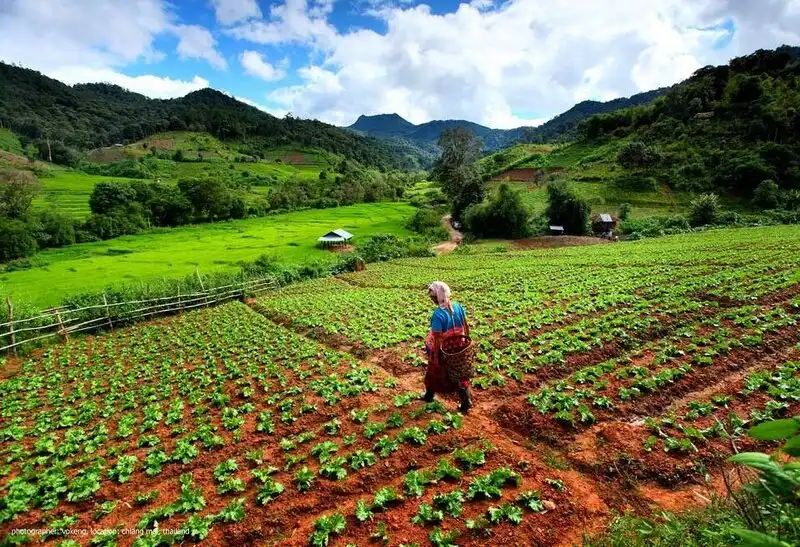
Tung Rua Royal Project Development Center oversees roughly 7,985 rai across 3 villages and 303 households. Most residents are Hmong and local Northern Thai communities. The landscape includes both flatter areas and steep slopes, at around 800–1,300 meters above sea level. The climate shifts clearly with the seasons, with average lows around 10°C and highs around 37°C, and average rainfall of about 1,400 mm per year. This combination supports a wide range of vegetables, fruits, and flowers—as long as water and land are managed properly.
If you’re coming for agro-tourism, the core activity is walking through the center’s demonstration plots for vegetables and flowers, plus visiting notable farmer plots in the surrounding communities. Highlights mentioned include a gerbera field on the hillside tended by Hmong farmers in Ban Buak Chan, strawberry plots, and pesticide-safe vegetables such as chayote shoots, chayote fruit, colorful sweet peppers, and tomatoes. There are also herb plots featuring U.S. mint and Japanese mint, and rose plots in Ban Buak Toei. Seeing these areas in person makes it clear that “highland farming” depends on choosing suitable crops, caring for soil and water, and managing plots in a systematic way.
What people who love learning often enjoy most is noticing how the landscape changes with the seasons. The standout crops and flowers rotate with production cycles—some periods are best for leafy greens and cool, comfortable walks, while other times the flowers make the entire area feel especially lively. And if you like talking with the growers themselves, asking about plant care or local water management can turn a simple walk into a much more meaningful visit.
On the cultural side, Tung Rua remains closely connected to Hmong life, including livelihoods, handicrafts, and major traditions such as Hmong New Year, typically held from December through January each year. Some communities continue to share traditional activities like top spinning and cultural music such as Hmong reed-pipe performances. If you visit with respect for the place, you’ll experience a living community atmosphere—not a staged “culture for photos.”
For nature, the Samoeng viewpoint area near the boundary of Mae Rim and Samoeng is a common stop, especially in winter when sea-of-mist views are possible. The Ban Buak Chan viewpoint offers sweeping mountain scenery with real working agricultural plots—“a livelihood landscape,” not just a pretty backdrop. If you want to extend the trip along the same route, the Mae Sa area and nearby waterfalls are often chosen as add-on options for people who want both learning and nature in a single day.
Souvenirs here tend to be seasonal agricultural produce such as cabbage, Chinese cabbage, Doi Kham tomatoes, chayote, U.S. mint, Japanese mint, avocados, strawberries, and seasonal flowers. You may also find Hmong handicrafts such as hemp textiles, batik-style wax-resist fabrics, Hmong embroidery, and silverwork. It’s a good place for people who want gifts that come with a real “story of the area,” rather than generic souvenirs you can find anywhere.
About accommodation and food, it’s best to be straightforward: there are no lodgings or restaurants inside the center. The main option is camping, and visitors can bring their own cooking gear and cook for themselves, or buy food from roadside shops before heading up. Planning ahead makes the trip much easier—bring enough drinking water, simple-to-cook food, warm layers in the cool season, and a flashlight or camp light, because darkness comes faster in the mountains and the temperature drops noticeably at night.
Getting There From Chiang Mai city, take Route 107 (Chiang Mai–Mae Rim) past the Mae Rim District Office. Turn left at the Mae Rim–Samoeng junction and continue for about 26 kilometers. Watch for signs on the left; you’ll find a turn-off leading uphill. From there, continue for about 2 kilometers to reach the center office. The access road is laterite/dirt, so a pickup truck or a vehicle suitable for rough roads is recommended. Drive at a moderate speed, especially in the rainy season when the road can be slippery and potholes may be more severe.
If you want a “worth-it in one day” visit, a practical flow is to start with the demonstration plots to get the overall picture, then stop at a viewpoint or a standout community plot, and finish by buying seasonal produce or local goods before heading back. If you truly enjoy slow travel, camping overnight lets you experience highland air and atmosphere more fully—just prepare food supplies and safety essentials properly, and the trip will feel much smoother and more enjoyable.
| Name | Tung Rua Royal Project Development Center |
| Location | Mae Rim–Samoeng area, Chiang Mai (from Mae Rim–Samoeng junction, approx. 2 km in) |
| Characteristics | Agro-tourism + culture + nature; pesticide-safe vegetables, strawberries, gerbera, mint herbs, rose plots; learning about Royal Project highland development and water/irrigation systems |
| Period | Development began in 1977 (B.E. 2520) |
| Key Evidence | Royal Project Foundation with land and irrigation agencies to allocate farmland, secure water sources, and build irrigation systems; reduce opium and shifting cultivation; increase community income |
| Name Origin | Named after the local area/community known as “Tung Rua,” which is the center’s responsibility zone |
| Elevation | Approx. 800–1,300 m above sea level |
| Open Days & Hours | Daily 08.00–16.30 (recommended to confirm before traveling) |
| Fees | Not specified (recommended to ask before traveling) |
| Contact Number | 081-952-7650 |
| Travel | Route 107 → Mae Rim–Samoeng junction → about 26 km → left turn uphill → about 2 km in (laterite/dirt road) |
| Current Status | Open to visitors (recommended to call to confirm road conditions and the most suitable visit time) |
| Nearby Tourist Attractions with Distance | Samoeng Viewpoint — approx. 10–25 km Ban Buak Chan Viewpoint — approx. 5–15 km Nang Hong Waterfall — approx. 10–25 km Mae Sa Waterfall — approx. 20–35 km Queen Sirikit Botanic Garden — approx. 25–40 km |
| popular restaurants nearby | rabieng na maerim — approx. 25–40 km — 053-861-511 the ironwood (mae rim) — approx. 25–45 km — 081-831-1000 pongyang angdoi — approx. 20–35 km — 085-618-8885 river rock cafe hill — approx. 25–45 km — 081-472-2732 baan landai mae rim — approx. 25–45 km — 064-469-2929 |
| popular accommodations nearby | onsen @ moncham — approx. 25–45 km — 053-111-606 panviman chiang mai spa resort — approx. 25–45 km — 053-879-540 maesa valley garden resort & craft village — approx. 25–45 km — 053-290-051 mae rim grace — approx. 30–50 km — 066-095-7267 four seasons resort chiang mai — approx. 35–55 km — 053-298-181 |
| Facilities | Demonstration plots and community farm areas, viewpoints along the route, camping area (no lodgings/restaurants inside the center) |
Frequently Asked Questions (FAQ)
Q: Which days and hours is Tung Rua Royal Project Development Center open?
A: General information often cites 08.00–16.30, and visiting is possible in many seasons. It’s recommended to confirm before traveling by calling 081-952-7650, as hours and access conditions may change depending on operations and road conditions.
Q: What are the highlight activities at Tung Rua?
A: The highlights are agro-tourism and learning—pesticide-safe vegetable plots, strawberries, gerbera, herb/mint plots, and rose fields—along with seeing real Royal Project highland development work in action.
Q: Are there accommodations and restaurants at Tung Rua?
A: There are no lodgings or restaurants inside the center. Camping is the main option, so bring your own gear and food, or buy supplies from roadside shops before going up.
Q: What kind of vehicle is recommended to reach Tung Rua?
A: A pickup truck or a vehicle suitable for rough roads is recommended because the access road is laterite/dirt. In the rainy season, be extra careful about slippery sections and potholes, and drive at a moderate speed.
Q: When is the best time to experience Hmong cultural atmosphere?
A: December–January is often when Hmong New Year activities take place in many communities. If you want to plan well, ask locally in advance about dates and visit with respect for community space and customs.
Tel : 053518302
 Tel : 053518302
Mobile : 0819527650
 Mobile : 0819527650
 Category: ●Research and Development
 Group: ●Royal Project
Last Update : 9 MonthAgo
 Last Update : 9 MonthAgo
 Click to Access the Navigation Map GPS
Tung Rua Royal Project Development Center Map
Recommend

 Art, Culture and Heritage
 Historical Sites and Monuments(8)
 Landmarks and Memorials(5)
 Royal Palace(2)
 Art, Craft Centres, Tradition(43)
 Museums(24)
 Educational Places
 Museum for Study(2)
 Educational Gardens, Farm(5)
 Training Center(1)
 Places of Worship
 Temple(79)
 Mosque(2)
 Other Sacred Sites(17)
Royal Project(44)
Other Sacred Sites(17)
Royal Project(44)
 Suburban Living
 Village, Community(41)
 Local Market(14)
 Nature and Wildlife
 National Parks and Marine Reserves(16)
 Mountain (Doi)(21)
 Dam, Reservoir, Lake(26)
 Waterfalls(43)
 Hot Springs(12)
 Caves(11)
 River, Canal(6)
 Other natural attractions(14)
 Entertainment and Agricultural
 Zoos and Aquariums(2)
 Animal camps and shows(3)
 Stadium(1)
 Farms, Parks and Ecotourism(19)
 Waterpark(2)
 Theater(1)
 Outdoor and Adventure Activities(10)
 Shopping
 Shopping and Night Market(6)
 Restaurant
 Michelin Star(1)
 Michelin Guide(23)
 Call Customer Service in Tourism
 Call Customer Service in Tourism(1)
 Travel Articles, Recipes
 Travel Review, Food Review(15)
 Food Menu, North Recipes(30)
 Thai Desserts, North Recipes(17)


