
 Home
Home North(
 Chiang Mai(


Wat Phra Non Nong Phueng
Rating: 2.4/5 (25 votes)
 Search By
  Map
Map 
 Have Map
  No Map
Chiang Mai attractions
Attractions in Thailand
Open Days: Daily
Opening Hours: Recommended 08.00–17.00
Wat Phra Non Nong Phueng is an ancient temple located in Saraphi District, Chiang Mai Province. For generations, local residents have regarded it as one of the most important temples in the Nong Phueng area because it preserves both layers of legend and tangible archaeological evidence within the same sacred space. The temple stands at kilometer 6 on the Chiang Mai–Lamphun Road, House No. 205, Moo 4, Ban Nong Phueng, Nong Phueng Subdistrict, Saraphi District, Chiang Mai. The temple grounds cover approximately 9 rai, 3 ngan, and 56 square wah, surrounded by village homes and rice fields, creating the atmosphere of a traditional rural community temple despite its proximity to the city.
According to local legend, this area was once inhabited by the Lua (Lawa) people. When Buddhism spread into the region, five Buddhist monks traveled through the Lua village. A villager, moved by faith, climbed a tree to collect a honeycomb and offered it to the monks. The community then built a stupa to enshrine relics, and the temple was named “Wat Nong Phueng.” This story gives the temple’s name a deeper meaning, serving as a collective memory of how devotion began from a simple act and was passed down through generations.
As time passed, the original community relocated and the temple was abandoned for a period. It was later rediscovered and restored. One significant phase of revival involved the construction of a large reclining Buddha statue measuring approximately 19 meters in length. This led to the temple being known as “Wat Phra Phuttha Ban Ping Phra Non Nong Phueng.” The reclining Buddha became the defining feature of the temple and stands as rare evidence of large-scale Buddhist sculpture associated with the Wiang Kum Kam area and the Ping River basin.
The reclining Buddha is locally called “Phra Non Pan Ping.” The word “pan” suggests blocking or resisting, reflecting the belief that the statue was positioned symbolically to obstruct the Ping River in ancient times, protecting nearby communities from flooding. As a result, worship at this temple is not only an act of seeking spiritual blessings but also a way to connect with the historical relationship between people and water, which once shaped life in Wiang Kum Kam and surrounding settlements.
Architecturally, Wat Phra Non Nong Phueng contains elements that reveal multiple historical layers. The main stupa is situated between the reclining Buddha hall and the ordination hall. It is a small bell-shaped stupa with tiered bases, lotus moldings, and a finial influenced by Burmese design, indicating restoration during later periods. Such stylistic blending is common among ancient temples in Chiang Mai that have undergone continuous renovation, especially during the late Rattanakosin era.
The ordination hall is a brick-and-mortar structure facing west, guarded by a pair of stucco lions at the front. The entrance arch features Burmese-style stucco ornamentation, reflecting architectural influences introduced during the reign of King Rama V. The assembly hall, located to the northwest and facing east, displays Central Thai stylistic elements, including gilded and painted naga staircases (makara-naga), a familiar visual language seen in many temples throughout Chiang Mai.
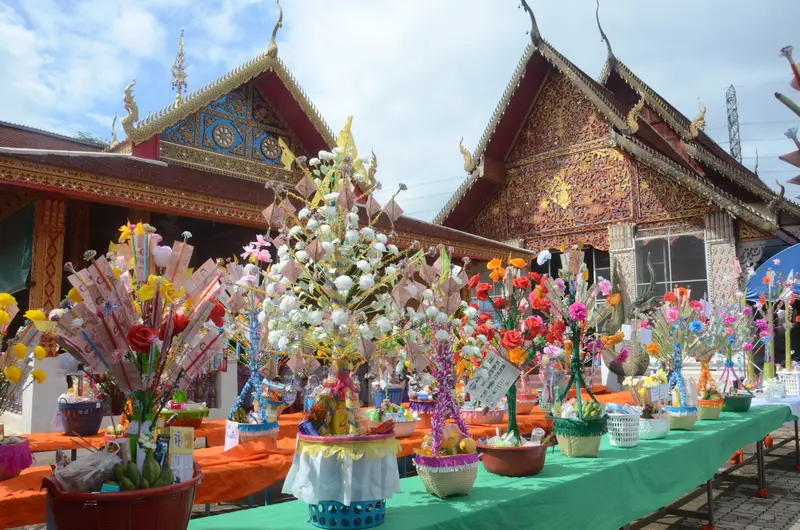
Beyond its architectural value, the temple remains spiritually alive through local traditions. A notable ritual involves the worship, water pouring, and gold leaf application on the reclining Buddha during the full moon of the eighth lunar month. During this time, community members gather to reaffirm their shared faith, transforming the temple into a living space of collective identity rather than merely a historical monument.
Getting There From Chiang Mai city, take the Chiang Mai–Lamphun Road (Highway 106) toward Saraphi District. At approximately kilometer 6, look for signage leading into Ban Nong Phueng (Moo 4). The temple is located close to the main road and can be reached easily by private car, motorcycle, or ride-hailing services by searching for “Wat Phra Non Nong Phueng.” Visitors can conveniently combine this visit with other Wiang Kum Kam historical sites nearby.
| Name | Wat Phra Non Nong Phueng (Phra Non Pan Ping) |
| Location | 205 Moo 4, Chiang Mai–Lamphun Road (Km.6), Nong Phueng Subdistrict, Saraphi District, Chiang Mai 50140, Thailand |
| Key Features | Ancient temple associated with Wiang Kum Kam, featuring a large 19-meter reclining Buddha, a small bell-shaped stupa, and Burmese-influenced stucco decoration |
| Historical Context | Linked to Wiang Kum Kam and possibly earlier Hariphunchai-era settlements associated with Lua communities |
| Important Structures | Phra Non Pan Ping reclining Buddha, relic stupa believed to enshrine sacred relics, ordination hall with Burmese-style stucco, assembly hall with naga staircases |
| Name Origin | Named after the offering of a honeycomb by a Lua villager to Buddhist monks, symbolizing the origin of faith at the site |
| Important Tradition | Annual worship, water-pouring, and gold-leaf application on the reclining Buddha during the full moon of the eighth lunar month |
| Current Status | Active community temple with ongoing maintenance and religious activities |
| Contact | +66 53 424 893 |
Frequently Asked Questions (FAQ)
Q: Where is Wat Phra Non Nong Phueng located?
A: It is located at kilometer 6 on the Chiang Mai–Lamphun Road in Nong Phueng Subdistrict, Saraphi District, Chiang Mai Province.
Q: What is the main highlight of Wat Phra Non Nong Phueng?
A: The main highlight is the large reclining Buddha known as Phra Non Pan Ping, measuring approximately 19 meters in length.
Q: Why is the reclining Buddha called “Phra Non Pan Ping”?
A: The name reflects local belief that the statue symbolically blocks the Ping River, protecting the community from flooding in ancient times.
Q: Does the temple have any important annual ceremonies?
A: Yes, the temple holds a traditional ceremony involving worship, water pouring, and gold-leaf application on the reclining Buddha during the full moon of the eighth lunar month.
Q: What is the best time to visit the temple?
A: The best time to visit is in the morning or early afternoon, between 08.00 and 17.00, to explore the site comfortably.
Q: How can I contact the temple for more information?
A: You can contact the temple at +66 53 424 893.
 Wat Phra Non Nong Phueng Map
 Category:
  Group:
  Tag: ●Wat Phra Non Nong Phueng●wat phra non nong phueng ●reclining buddha chiang mai ●ancient temple chiang mai ●wiang kum kam temple ●saraphi temple ●buddhist temple northern thailand ●wat nong phueng
Last Update: 3 MonthAgo
Tag: ●Wat Phra Non Nong Phueng●wat phra non nong phueng ●reclining buddha chiang mai ●ancient temple chiang mai ●wiang kum kam temple ●saraphi temple ●buddhist temple northern thailand ●wat nong phueng
Last Update: 3 MonthAgo
Comment
 Nearby Attractions
| Keyword (Advance) |
 Region
|
 Muang Chiang Mai(
 Copyright 2012,