
lovethailand home >South Travel Attractions >Surat Thani Travel Attractions >Phun Phin >Tha Kham > Nice City Museum
TL;DR: Nice City Museum is located at Near the foot of Chulachomklao Bridge, Tha Kham Subdistrict, Phunphin District, Surat Thani Province, open Tuesday – Sunday, hours 10.00 – 16.00.
Nice City Museum
Open Days: Tuesday – Sunday
Opening Hours: 10.00 – 16.00
Nice City Museum in Surat Thani is located near the foot of Chulachomklao Bridge in Tha Kham Subdistrict, Phunphin District. It is a local historical learning center that presents the story of Surat Thani Province through royal visits, ancient towns, river communities, transportation history, Buddhist heritage, local identity, and important figures such as Buddhadasa Bhikkhu. For visitors who want to understand why Surat Thani is known as the “City of Good People,” this museum is one of the best places to begin.
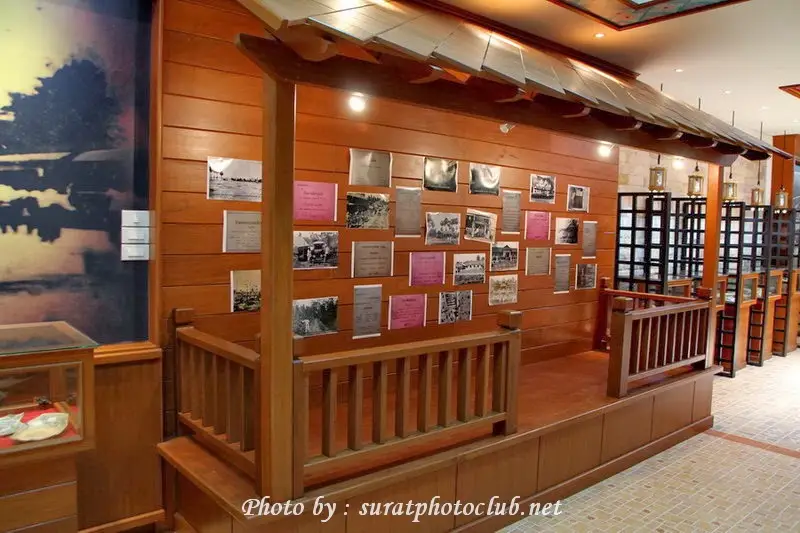
The museum is designed as an accessible learning space rather than a conventional object-based museum. Its exhibitions use wall images, multimedia screens, videos, electronic books, and organized storytelling to help visitors understand the province as a connected historical landscape. A visit here introduces not only facts about the past, but also the relationship between ancient settlements, the Tapi River, Chulachomklao Bridge, royal history, Buddhism, and the cultural memory of local communities.
The phrase “City of Good People” is closely associated with Surat Thani. Nice City Museum explains that this identity is not just a slogan, but a reflection of history, people, places, and values preserved in the province. Surat Thani has ancient towns, sacred Buddhist sites, river communities, local wisdom, and figures whose work influenced Thai society. By presenting these stories together, the museum gives visitors a deeper image of Surat Thani beyond islands, beaches, dams, and ferry routes.
The first exhibition zone presents the royal visits of King Bhumibol Adulyadej and Queen Sirikit to Surat Thani. This section is important because it records the close connection between the monarchy and the people of the province. Their Majesties visited Surat Thani many times, and these visits remain part of the shared memory of local residents. The exhibition helps visitors understand how royal activities were connected with communities, livelihoods, and the emotional history of the province.
This zone is both historical and emotional. It shows how national events can become local memories. Surat Thani is a province of many landscapes, including coastlines, islands, rivers, agricultural land, and urban communities. Royal visits to different areas helped connect the monarchy with local life in a direct and meaningful way.
The second zone presents the history of Surat Thani. It begins with evidence of ancient towns in the region, including Wiang Sa, Tha Thong, Tha Khanon, Phunphin, and Chaiya. These towns show that Surat Thani has been historically important for a long time. It was not only a modern province, but a region of settlements, river routes, coastal exchange, sacred sites, and political development.
Chaiya is one of the most important historical areas in the province. Wat Phra Borommathat Chaiya is a major sacred site and an important trace of Srivijaya-related culture in Southern Thailand. Other archaeological sites such as Wat Kaeo, Wat Long, and Wat Wiang also show the depth of Chaiya’s history. By presenting Chaiya within the broader story of Surat Thani, the museum helps visitors see the province as an ancient cultural landscape.
Tha Thong, Tha Khanon, Phunphin, and Wiang Sa also help explain the historical network of Surat Thani. Each settlement had a role shaped by geography and transportation. River towns connected people, goods, and military movements. Coastal towns linked the region with maritime trade. Inland towns connected forest resources, mountain routes, and communities deeper in the peninsula. Together, these places show that Surat Thani was part of a complex historical system.
The museum also explains the relationship between the Surat Thani area and the Siamese kingdom from the Ayutthaya period through Thonburi and into the Rattanakosin period. This helps visitors understand how older towns developed into modern administrative units. Changes in governance affected town names, transport, trade, security, and the growth of communities such as Tha Kham, Phunphin, and Ban Don.
Important royal journeys are also highlighted. These include King Chulalongkorn’s visits to Koh Samui and Koh Phangan and King Vajiravudh’s overnight stay in the Tha Kham area. These events are central to the province’s identity because King Vajiravudh later bestowed the name “Surat Thani” and renamed the former Mae Nam Luang as the “Tapi River.” The museum helps visitors understand that the name Surat Thani is connected with real places, royal history, and local memory.
The third zone focuses on the community life of Tha Kham, the Tapi River, and Chulachomklao Bridge. This section is especially meaningful because the museum itself stands near the bridge. Tha Kham was historically a crossing point, a river community, and a transport junction. The name Tha Kham directly reflects its function as a place where people crossed the river and connected with important routes.
Chulachomklao Bridge is important in the history of transportation in Southern Thailand. It is connected with the Southern railway route and the crossing of the Tapi River. The bridge area also became strategically important during World War II and was affected by bombing. Learning about the bridge helps visitors understand that Tha Kham was not only a riverside settlement, but also a site linked with transport, wartime history, the railway, and regional development.
The Tapi River and the meeting point of the Tapi and Phum Duang rivers are central to the story of Phunphin and Tha Kham. Rivers were once the main routes of travel, trade, settlement, fishing, and communication. When the museum presents Tha Kham together with the bridge and the river, visitors can see both the older water-based way of life and the modern transport infrastructure that changed the area.
The fourth zone presents temples, Suan Mokkhaphalaram, and Buddhadasa Bhikkhu. Buddhadasa Bhikkhu was one of the most influential Buddhist thinkers from Surat Thani. He dedicated his life to studying and explaining the Buddha’s teachings in language that ordinary people could understand. His work made Buddhist principles accessible to people from many backgrounds and remains important in Thai religious and intellectual history.
Suan Mokkhaphalaram, commonly known as Suan Mokkh, is deeply connected with Buddhadasa Bhikkhu and with Chaiya District. Including Suan Mokkh in Nice City Museum shows that Surat Thani is not only important for archaeology and ancient towns, but also for Buddhist thought. Visitors who learn about Buddhadasa Bhikkhu at the museum can continue their journey to Suan Mokkh in Chaiya for a deeper understanding of his life and teachings.
Nice City Museum is suitable for visitors who want a broad but meaningful introduction to Surat Thani. Its content connects the monarchy, ancient towns, river communities, transportation, Buddhism, local wisdom, and important people. A single visit gives travelers a foundation before exploring related sites such as Chulachomklao Bridge, Wat Phra Borommathat Chaiya, Suan Mokkh, the Tapi River, and other historical places in the province.
For families and students, the museum works well as an outdoor classroom. Its multimedia displays, wall images, and organized zones make local history easier to understand. Children can begin with images and videos, then connect those stories with real places outside the museum, such as the bridge, river, temples, and town. This makes local history more concrete than learning from textbooks alone.
For general travelers, the museum changes the way Phunphin and Tha Kham are viewed. Many people pass through Phunphin because of the railway station, airport access, road connections, and transfers to other parts of Surat Thani. Nice City Museum shows that Phunphin is not only a transit area. It is a historical junction where river routes, railway routes, roads, royal history, and community life meet.
Getting There from Surat Thani City Pillar Shrine, follow Si Wichai Road toward Tha Kup intersection and continue toward Phunphin District. Pass Saranrom Hospital, then turn right at Phunphin junction onto Chulachomklao Road. Continue for about 1 km before crossing the bridge over the Tapi River. Nice City Museum is on the left-hand side near the foot of Chulachomklao Bridge. The route is convenient by private car, local transport, or hired vehicle from Surat Thani Railway Station.
Travelers arriving by train can get off at Surat Thani Railway Station in Phunphin and continue by local transport to the bridge area. Those arriving from Surat Thani Airport can also include the museum in a short route before continuing to Surat Thani city, Chaiya, or other destinations. With half a day, visitors can combine the museum with Chulachomklao Bridge, Wat Tha Kham, the two-colored river area, and other sites in Tha Kham.
Visitors should know that the museum is open from Tuesday to Sunday, 10.00 to 16.00, and admission is free. Parking is available. Groups should submit a request in advance before visiting so the responsible office can prepare appropriate support and guidance. This is especially useful for schools, universities, agencies, and study groups.
Visitors should behave respectfully inside the museum. The displays include content related to the monarchy, religion, local heritage, and important historical figures. Guests should avoid loud noise, avoid damaging exhibition media, and supervise children carefully. Respectful behavior helps preserve the learning atmosphere for everyone.
Overall, Nice City Museum is one of the most meaningful historical learning sites in Surat Thani. It brings together the province’s ancient towns, royal history, the naming of Surat Thani, the Tapi River, Chulachomklao Bridge, Wat Phra Borommathat Chaiya, Buddhadasa Bhikkhu, and Suan Mokkhaphalaram. For anyone who wants to understand the deeper identity of Surat Thani, this museum is an excellent starting point.
| Name | Nice City Museum |
| Type | Local learning museum for history, lifestyle, culture, traditions, local wisdom, and religion |
| Location | Near the foot of Chulachomklao Bridge, Tha Kham Subdistrict, Phunphin District, Surat Thani Province |
| Address | Education Division, Tha Kham Municipality, Tha Kham Subdistrict, Phunphin District, Surat Thani 84130, Thailand |
| Highlights | Learning center about Surat Thani history, King Rama 9’s royal visits, ancient towns, Tha Kham community, Chulachomklao Bridge, Buddhadasa Bhikkhu, and Suan Mokkhaphalaram |
| Main Areas / Zones | 1. King Rama 9’s visits to Surat Thani 2. History of Surat Thani 3. Tha Kham community, the Tapi River, and Chulachomklao Bridge 4. Temples, Suan Mokkh, and Buddhadasa Bhikkhu |
| Exhibition Style | Exhibitions, wall images, multimedia videos, electronic books, and local history storytelling media |
| Travel Information | From Surat Thani City Pillar Shrine, follow Si Wichai Road toward Phunphin, pass Saranrom Hospital, turn right onto Chulachomklao Road, continue about 1 km, and the museum is on the left before crossing the Tapi River bridge |
| Current Status | Open as a local learning museum |
| Open Days | Tuesday – Sunday |
| Closed Day | Monday |
| Opening Hours | 10.00 – 16.00 |
| Admission Fee | Free admission |
| Responsible Agency | Education Division, Tha Kham Municipality |
| Main Contact Number | 077-311-833, 081-891-8599 |
| Group Visits | Groups should submit a request in advance before visiting |
| Facilities | Parking available |
| Nearby Tourist Attractions | 1. Chulachomklao Bridge, about 0 km 2. Two-Colored River, meeting point of the Tapi and Phum Duang rivers, about 1 km 3. Wat Tha Kham, about 1 km 4. Phra Ya Tha Kham Shrine, about 1 km 5. Saranrom Park, about 3 km |
| Nearby Restaurants | 1. Mee Sen Ancient Pork Leg Noodles, about 1 km, Tel. 062-228-4642, 093-629-5622 2. Saep Suang Boat Noodles Phunphin Branch, about 1 km, Tel. 094-542-8298 3. Sapha Kafae, about 1 km, Tel. 081-607-6441 4. Phi Ya Chicken Biryani, Tha Kham Evening Market, about 1 km, Tel. 099-304-9263, 099-362-0198 5. Pa Ang Khanom Chin Pad Thai Dessert, Scala Market, about 1 km, Tel. 086-945-4671 |
| Nearby Accommodations | 1. Nadpob Mansion Hotel, about 2 km, Tel. 065-536-6697 2. Phunphin Station, about 2 km, Tel. 065-536-6697 3. Kasira Green, about 4 km, Tel. 098-262-2242 4. Baan Khun Inn, about 7 km, Tel. 091-820-6760 5. You In House, about 7 km, Tel. 096-658-3364 |
Frequently Asked Questions (FAQ)
Q: Where is Nice City Museum located?
A: Nice City Museum is located near the foot of Chulachomklao Bridge in Tha Kham Subdistrict, Phunphin District, Surat Thani Province, under the supervision of the Education Division of Tha Kham Municipality.
Q: When is Nice City Museum open?
A: The museum is open from Tuesday to Sunday, 10.00 to 16.00, and is closed on Monday.
Q: Is there an admission fee?
A: No. Admission is free for general visitors.
Q: What can visitors see inside Nice City Museum?
A: The museum has 4 main zones: King Rama 9’s visits to Surat Thani, the history of Surat Thani, the Tha Kham community and Chulachomklao Bridge, and the story of temples, Suan Mokkh, and Buddhadasa Bhikkhu.
Q: Why is Nice City Museum important to Surat Thani?
A: It brings together key stories of the province, including ancient towns, the royal naming of Surat Thani, the Tapi River, Chulachomklao Bridge, Wat Phra Borommathat Chaiya, Buddhadasa Bhikkhu, and Suan Mokkhaphalaram.
Q: Do groups need to contact the museum before visiting?
A: Yes. Groups should submit a request in advance so the responsible office can prepare appropriate support and guidance.
Q: What nearby places can be visited with Nice City Museum?
A: Nearby places include Chulachomklao Bridge, the Two-Colored River area, Wat Tha Kham, Phra Ya Tha Kham Shrine, and Saranrom Park.
Mobile : 0816066208
 Mobile : 0816066208
 Category: ●Art, Culture and Heritage
 Group: ●Museums
Last Update : 2 MonthAgo
 Last Update : 2 MonthAgo
 Click to Access the Navigation Map GPS
 Landmarks and Memorials(1)
 Art, Craft Centres, Tradition(8)
Museums(5)
Art, Craft Centres, Tradition(8)
Museums(5)
 Educational Places
 Educational Gardens, Farm(1)
 Places of Worship
 Temple(32)
 Other Sacred Sites(8)
 Research and Development
 Royal Project(1)
 Suburban Living
 Village, Community(6)
 Local Market(1)
 Nature and Wildlife
 National Parks and Marine Reserves(8)
 Mountain (Doi)(2)
 Dam, Reservoir, Lake(8)
 Waterfalls(34)
 Hot Springs(7)
 Caves(18)
 River, Canal(11)
 Bays and Beaches(30)
 Islands(16)
 Other natural attractions(10)
 Entertainment and Agricultural
 Animal camps and shows(6)
 Farms, Parks and Ecotourism(7)
 Outdoor and Adventure Activities(2)
 Shopping
 Shopping and Night Market(1)
 Travel Articles, Recipes
 Travel Review, Food Review(1)
 Southern Food Menu, Southern Food Recipes(1)


