
lovethailand home >South Travel Attractions >Phang Nga Travel Attractions >Takua Thung >Ka Lai > Wat Si Rattanaram (Wat Chiang Mai)
TL;DR: Wat Si Rattanaram (Wat Chiang Mai) is located at Ban Chiang Mai, Moo 7, Kalai Subdistrict, Takua Thung District, Phang Nga Province, open Daily, hours 08.00 – 17.00.

Wat Si Rattanaram (Wat Chiang Mai)
Open Days: Daily
Opening Hours: 08.00 – 17.00
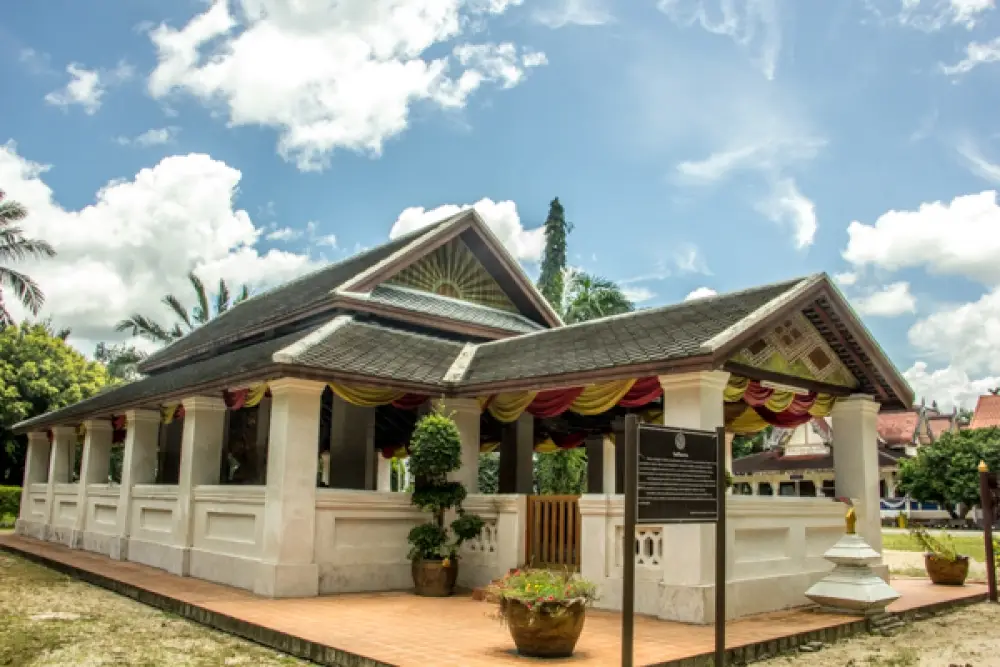
Wat Chiang Mai in Phang Nga Province, officially known as Wat Si Rattanaram, is a historic Buddhist temple in Ban Chiang Mai, Kalai Subdistrict, Takua Thung District. It is a long-standing community temple that preserves local Buddhist faith, village memory, and cultural evidence connected with earlier trade. The temple is best known for its more-than-200-year-old sermon hall, old Holland ceramics connected with historical trade contacts, the life-size statue of Luang Pho Chan, and the annual Songkran water-pouring tradition dedicated to Luang Pho Chan, whom the people of Kalai deeply respect.
Wat Chiang Mai is located in Kalai Subdistrict, an area positioned between Phang Nga town, Khok Kloi, and the Phang Nga Bay side of Takua Thung District. Kalai has long been connected with local agriculture, fishing communities, coastal routes, and old villages. The presence of an old temple in Ban Chiang Mai reflects the settlement history and religious life of this community. Although the name may remind some visitors of Chiang Mai Province in Northern Thailand, in this context Chiang Mai refers to the local village name in Phang Nga.
The official temple name is Wat Si Rattanaram. It is a Mahā Nikāya local Buddhist temple and remains active today with resident monks. The temple’s history extends back more than 200 years, making it one of the older community temples in the Kalai area. Its importance does not come from monumental scale, but from continuity: the temple has served local people for generations as a place for worship, merit-making, Buddhist ceremonies, and community gathering.
The most distinctive feature of Wat Chiang Mai is its old sermon hall, which is more than two centuries old. In a Thai village temple, a sermon hall is more than a building. It is where laypeople gather to listen to Buddhist teachings, make merit, join ceremonies, and take part in community activities. The age of this hall gives Wat Chiang Mai strong historical value because it preserves the memory of how the temple functioned as the heart of Ban Chiang Mai and Kalai Subdistrict.
The old sermon hall also reflects the social role of the temple. In traditional communities, the temple often functions as a shared public space. People come not only for religious rites but also for local meetings, festival preparations, funerary activities, and family ceremonies. Preserving an old hall therefore means preserving the social history of the community. Visitors who see this structure should understand it as a living record of village life, not simply as an old building.
Another important feature is the collection of old Holland ceramics preserved at the temple. These ceramics are linked with earlier trade contact between foreign merchants and Thailand. In Southern Thailand, especially along the Andaman coast, trade routes shaped the movement of goods, people, and cultural objects. The presence of foreign ceramics in a local temple suggests that the community was connected to wider maritime networks and that valuable objects were brought into temple culture through donation, trade, or local preservation.
The old ceramics should be viewed as cultural evidence rather than decoration. Ceramics can tell stories about taste, exchange, economy, and offerings. Their survival at Wat Chiang Mai helps visitors understand that Kalai was not an isolated rural area. It stood within a wider historical environment shaped by travel, trade, and contact with people from outside the region. For this reason, the temple is meaningful not only to worshippers but also to travelers interested in local history.
The most revered sacred figure associated with the temple is Luang Pho Chan. Inside the temple is a life-size statue of Luang Pho Chan, respected by the people of Kalai and nearby communities. For local devotees, the statue is a point of remembrance and faith. Luang Pho Chan represents the spiritual identity of the temple and the close relationship between a respected monk and the community that continues to honor him.
Every year during Songkran, the temple holds the water-pouring tradition for Luang Pho Chan. This annual ceremony is an important expression of gratitude, respect, and community continuity. For the people of Kalai, the ritual is not simply a seasonal festival. It is a way to remember a revered monk, strengthen local bonds, and pass religious values from one generation to the next.
The Songkran tradition at Wat Chiang Mai also shows how a village temple remains central to community life. During the festival, people come together to make merit, pour water as an act of respect, meet relatives, and participate in a shared ritual. The ceremony connects Buddhist faith with local identity. Travelers who visit during Songkran can see a living community tradition rather than a staged tourist performance.
Main buildings and areas inside the temple include the ordination hall, sermon hall, monks’ residences, kitchen, crematorium, and community ceremonial areas. The ordination hall is used for important monastic rites. The sermon hall serves lay gatherings and religious instruction. The monks’ residences support the daily life of resident monks. The kitchen and crematorium show that the temple serves the full range of community needs, from merit-making events to family ceremonies.
The principal Buddha image in the ordination hall is an important sacred object of the temple. It measures about 4 sok across the lap and more than 3 sok in height. Together with the life-size statue of Luang Pho Chan, the old sermon hall, and the Holland ceramics, the temple contains a meaningful combination of Buddhist devotion, revered monk tradition, historic architecture, and cultural objects connected with earlier trade.
The temple stands on flat land, making it easy to access. Its character is quiet and local rather than grand or commercial. A good visit should begin with paying respect to the principal Buddha image, followed by the statue of Luang Pho Chan, the old sermon hall, and the old ceramics. Visitors should walk slowly and see the temple as a community heritage site, not only as a quick stop on the way to larger attractions.
Wat Chiang Mai works well as part of a cultural route through Kalai, Takua Thung, Khok Kloi, and Phang Nga Bay. Nearby places include Ban Bangnu’s local market, Ban Sam Chong Nuea, Ban Sam Chong Tai, Wat Suwan Khuha, Ao Phang Nga National Park, and Samet Nangshe Viewpoint. This route gives travelers a broader picture of Phang Nga by combining old temples, local food, coastal communities, mangrove landscapes, limestone scenery, and bay viewpoints.
Getting There is convenient by private car or rental car. Travel to Kalai Subdistrict in Takua Thung District, Phang Nga Province, then search for Wat Si Rattanaram or Wat Chiang Mai in Ban Chiang Mai. Travelers from Phang Nga town can follow routes toward Takua Thung, while those coming from Phuket or Khok Kloi can include the temple in a Kalai and Phang Nga Bay itinerary.
The best time to visit is in the morning or late afternoon when the weather is more comfortable. Those who want to experience local tradition should consider visiting during Songkran, when the water-pouring ceremony for Luang Pho Chan takes place. Visitors who prefer a quiet atmosphere should come on a weekday or early in the day. Modest clothing and respectful behavior are expected because the temple is an active Buddhist place.
Wat Chiang Mai shows that Phang Nga is not only a province of islands, beaches, and limestone cliffs. It also has old communities and temples that preserve religious memory, trade evidence, and local traditions. This temple is valuable because it brings together an old sermon hall, foreign ceramics, the revered Luang Pho Chan, and an annual Songkran ritual that continues to bind the Kalai community together.
Although Wat Chiang Mai is not as widely known as Wat Suwan Khuha or Samet Nangshe Viewpoint, its strength lies in its authenticity as a community temple. Visitors who come here can understand a quieter and more local side of Phang Nga. The temple is suitable for those interested in old temples, community Buddhism, local ceremonies, and cultural history connected with Southern Thailand’s trade routes.
| Name | Wat Chiang Mai, Officially Wat Si Rattanaram |
| Location | Ban Chiang Mai, Moo 7, Kalai Subdistrict, Takua Thung District, Phang Nga Province |
| Address | Kalai Subdistrict, Takua Thung District, Phang Nga 82130, Thailand |
| Map Search | Wat Si Rattanaram, Kalai Subdistrict, Takua Thung District, Phang Nga |
| Highlights | More-Than-200-Year-Old Sermon Hall, Old Holland Ceramics, Life-Size Statue Of Luang Pho Chan, And Songkran Water-Pouring Tradition For Luang Pho Chan |
| History | A historic Mahā Nikāya local Buddhist temple in Ban Chiang Mai, Kalai Subdistrict, with more than 200 years of community history |
| Name Origin | Wat Chiang Mai follows the name of Ban Chiang Mai, while Wat Si Rattanaram is the official temple name |
| Distinctive Features | A long-standing community temple on flat land, preserving local faith, old architecture, trade-related ceramics, and village traditions |
| Main Sacred Objects | Principal Buddha Image In The Ordination Hall Life-Size Statue Of Luang Pho Chan |
| Main Buildings / Areas | Ordination Hall Sermon Hall Monks’ Residences Kitchen Crematorium Community Ceremonial Areas |
| Important Cultural Evidence | Old Holland Ceramics Connected With Historical Trade And The Old Sermon Hall Preserved In The Temple |
| Main Tradition | Annual Songkran Water-Pouring Ceremony For Luang Pho Chan, A Revered Figure Of The Kalai Community |
| Travel Information | Travel to Kalai Subdistrict, Takua Thung District, then search for Wat Si Rattanaram or Wat Chiang Mai in Ban Chiang Mai. Private car or rental car is the most convenient option |
| Current Status | Active Mahā Nikāya local Buddhist temple and community worship site in Kalai Subdistrict |
| Open Days | Daily |
| Opening Hours | 08.00 – 17.00 |
| Abbot / Caretaker | Phra Khru Bowon Thammaphinit |
| Published Contact Numbers | 086-024-8343 085-784-0512 |
| Nearby Tourist Attractions | 1. Lard Long Lae @ Ban Bangnu, About 5 Km 2. Ban Sam Chong Nuea, About 9 Km 3. Ban Sam Chong Tai, About 10 Km 4. Wat Suwan Khuha, About 11 Km 5. Ao Phang Nga National Park, About 16 Km 6. Samet Nangshe Viewpoint, About 23 Km |
| Nearby Restaurants | 1. J’Nong Local Phang Nga Restaurant, About 5 Km, Tel. 081-893-6479 2. Sam Chong Seafood, About 9 Km, Tel. 081-719-4880 3. The Adventure Mountain Club, About 17 Km, Tel. 098-671-1744, 081-635-4736, 081-375-9516 4. Nai Hui Congee Khok Kloi By Ko-Jade, About 20 Km 5. Tha Nun Seafood, About 26 Km |
| Nearby Accommodations | 1. Bangnu Greenery Resort, About 5 Km, Tel. 061-490-4545 2. Sametnangshe Boutique, About 23 Km, Tel. 065-508-8655 3. Siriwan Boutique Hotel, About 24 Km, Tel. 093-651-0111 4. Beyond Skywalk Nangshi, About 24 Km, Tel. 076-429-965 5. Rnana Grand, About 25 Km, Tel. 076-670-355 |
Frequently Asked Questions (FAQ)
Q: Where is Wat Chiang Mai located?
A: Wat Chiang Mai is located in Ban Chiang Mai, Moo 7, Kalai Subdistrict, Takua Thung District, Phang Nga Province. Its official name is Wat Si Rattanaram.
Q: Are Wat Chiang Mai and Wat Si Rattanaram the same temple?
A: Yes. Wat Chiang Mai is the local name connected with Ban Chiang Mai, while Wat Si Rattanaram is the official temple name.
Q: Why is Wat Chiang Mai important?
A: The temple is important because it preserves a more-than-200-year-old sermon hall, old Holland ceramics, the statue of Luang Pho Chan, and the annual Songkran water-pouring ceremony for Luang Pho Chan.
Q: Who is Luang Pho Chan?
A: Luang Pho Chan is a revered monk respected by the people of Kalai. The temple houses a life-size statue of him, and local people honor him every year during Songkran.
Q: What buildings can visitors see inside Wat Chiang Mai?
A: The temple includes an ordination hall, sermon hall, monks’ residences, kitchen, crematorium, and community ceremonial areas.
Q: What are the opening hours of Wat Chiang Mai?
A: The temple is open daily from 08.00 to 17.00.
Q: What nearby places can travelers visit after Wat Chiang Mai?
A: Nearby places include Lard Long Lae @ Ban Bangnu, Ban Sam Chong Nuea, Ban Sam Chong Tai, Wat Suwan Khuha, Ao Phang Nga National Park, and Samet Nangshe Viewpoint.
 Category: ●Places of Worship
 Group: ●Temple
Last Update : 3 WeekAgo
 Last Update : 3 WeekAgo
 Click to Access the Navigation Map GPS
Wat Si Rattanaram (Wat Chiang Mai) Map
Recommend

 Art, Culture and Heritage
 Historical Sites and Monuments(2)
 Landmarks and Memorials(6)
 Art, Craft Centres, Tradition(3)
Temple(18)
Art, Craft Centres, Tradition(3)
Temple(18)
 Other Sacred Sites(8)
 Suburban Living
 Village, Community(3)
 Nature and Wildlife
 National Parks and Marine Reserves(12)
 Mountain (Doi)(8)
 Waterfalls(21)
 Hot Springs(2)
 Caves(12)
 River, Canal(4)
 Bays and Beaches(28)
 Islands(11)
 Other natural attractions(7)
 Entertainment and Agricultural
 Animal camps and shows(2)
 Farms, Parks and Ecotourism(2)
 Outdoor and Adventure Activities(3)
 Travel Articles, Recipes
 Southern Food Menu, Southern Food Recipes(1)


