
lovethailand home >South Travel Attractions >Narathiwat Travel Attractions >Su Ngai Ko Lok >Pu Yo > Sirindhorn Peat Swamp Forest Nature Research and S..
TL;DR: Sirindhorn Peat Swamp Forest Nature Research and Study Centre is located at Ban To Daeng, Village No. 5, Puyo Subdistrict, Su-ngai Kolok District, Narathiwat Province, open Daily, hours 08.00 – 16.00.

Sirindhorn Peat Swamp Forest Nature Research and Study Centre
Open Days: Daily
Opening Hours: 08.00 – 16.00
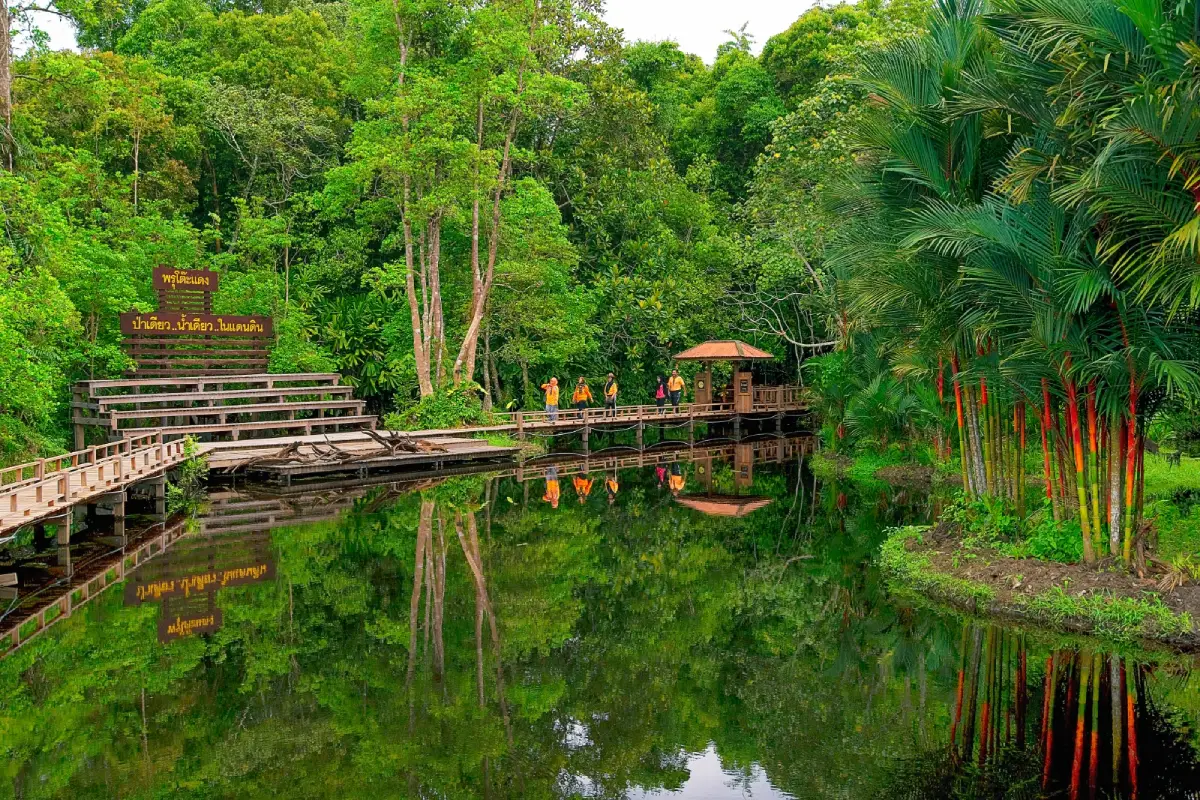
Sirindhorn Peat Swamp Forest Nature Research and Study Centre, also known as To Daeng Peat Swamp Forest, is one of Thailand’s most important peat swamp forest learning sites. It is located at Ban To Daeng, Village No. 5, Puyo Subdistrict, Su-ngai Kolok District, Narathiwat Province. The wider To Daeng peat swamp forest covers parts of Tak Bai, Su-ngai Kolok, and Su-ngai Padi districts, with a total area of about 120,000 rai and around 50,000 rai of relatively intact forest remaining. The site is known for its wetland forest, ancient peat soil, rare plants, wildlife, birdlife, exhibition room, and a 1,200-meter wooden nature trail that allows visitors to enter the peat swamp environment safely and respectfully.
To Daeng is not an ordinary forest. It is a peat swamp forest formed by long-term freshwater flooding and the slow accumulation of plant remains, wood, leaves, and other organic matter. In waterlogged and low-oxygen conditions, this organic material decomposes very slowly and becomes peat soil. Peat works like a natural sponge, holding large amounts of water and supporting a special ecosystem that cannot be recreated easily once damaged. In this forest, the lower peat layers are about 6,000–7,000 years old, while the upper peat layers are about 700–1,000 years old. This makes the site important not only for tourism, but also for ecology, botany, wildlife studies, soil science, hydrology, and climate-related learning.
The name To Daeng comes from Khlong To Daeng, one of the key waterways that pass through the swamp, together with Khlong Su-ngai Padi and the Bang Nara River. These waterways help maintain the water balance that keeps the peat swamp alive. A peat swamp forest needs waterlogged conditions to remain healthy. When the water level drops too much, peat can dry out, vegetation becomes stressed, and the risk of underground peat fire increases. A visit to To Daeng therefore helps travelers understand that wetlands are not empty or useless spaces. They are living systems that store water, carbon, biodiversity, and ecological memory.
The research and nature study centre was established to support research and public learning about peat swamp resources, including plants, wildlife, aquatic animals, soil, water, ecological processes, and environmental conservation. Visitors should begin at the centre building and exhibition room to understand the forest before walking into the nature trail. The wooden walkway starts behind the centre building, crossing a water body before entering the peat swamp. Along the route, visitors can find plant labels, interpretation points, observation areas, and a tower-like viewpoint that offers a broader look at the forest structure.
The 1,200-meter nature trail is the main highlight of the visit. It is a raised wooden boardwalk that leads visitors above waterlogged peat soil and through a shaded swamp forest. Some parts are wooden planks, some are supported by cable structures, and some sections pass through very dense vegetation. The trail allows people to experience the forest closely without trampling the fragile peat surface. Visitors who walk slowly will notice changes in water color, root shapes, plant communities, insects, bird calls, and the distinctive quietness of the swamp environment.
One of the first things visitors notice is the tea-colored water beneath the boardwalk. The dark color comes from organic material and peat conditions, not from dirt or pollution. The water supports fish, aquatic insects, small organisms, and wetland plants. The trees around the walkway also show special adaptations. Many have buttress roots, aerial roots, stilt-like support roots, or branching root systems that help them stand in soft, waterlogged soil. These root structures make the forest look almost architectural and show how plants adapt to an environment where ordinary deep roots may not work well.
The root systems of peat swamp trees are one of the most important features to observe. Because the ground is soft and saturated, trees often rely on networks of roots that spread outward and interlock with other trees. This creates a natural support system. In some parts of the forest, trees appear to stand together like a community, holding one another in place. If one tree falls, nearby trees may be affected. This is why visitors should stay on the boardwalk and avoid stepping directly onto peat soil or roots.
More than 400 plant species are associated with the To Daeng peat swamp forest. Notable plants include lumphi, red sealing wax palm, panan chang, sago, wetland palms, ferns, orchids, climbers, and many small forest plants that require careful observation. Lumphi is a palm-like plant with thorny stems and sour fruit that resembles small salak. Local communities use the fruit for pickling, and the harvest season usually falls between November and March. Red sealing wax palm is valued for its striking red leaf sheaths and its visual connection with the Malay Peninsula’s wetland flora.
Panan chang, a large-flowered plant in the custard apple family, is another interesting species found in the peat swamp ecosystem. Many plants in this forest do not immediately stand out to casual visitors, but they reveal their uniqueness when observed closely. Leaf texture, root form, flower shape, fruit structure, and the relationship between plants and water are all part of the learning experience. The forest rewards slow walking and careful looking.
The wildlife of To Daeng is also highly significant. More than 200 wildlife species have been reported in the peat swamp, including langurs, civets, wild boars, binturongs, flat-headed cats, Singapore rats, birds, reptiles, amphibians, insects, and many aquatic species. The flat-headed cat is a rare protected wetland-associated animal. The Singapore rat is another species closely linked with this habitat. Protecting the peat swamp therefore means protecting animals that cannot easily move to ordinary dry forest or urban landscapes.
Aquatic life is another important part of the forest. Fish species such as the protruding-mouth fish, Ramphan walking catfish, and unusual broad-headed freshwater fish have been associated with this ecosystem. These fish can live in acidic or unusual wetland water conditions. They use the peat swamp as shelter, breeding habitat, and nursery ground before dispersing into other waterways that local communities may also depend on. This shows how forest conservation and community livelihood are connected through water.
To Daeng is especially interesting for birdwatchers. Notable bird species include the rufous-tailed shama and the Malaysian blue flycatcher, both of which make the site important for bird observation in Thailand. The forest also supports wetland birds, small forest birds, and species that depend on dense swamp vegetation. Birdwatchers should move quietly, use binoculars, and avoid playing bird calls or making loud noises, as many forest birds are sensitive to disturbance.
The centre is highly suitable for students, families, researchers, birdwatchers, photographers, and anyone interested in ecology. Children can learn directly from real nature by seeing dark peat water, strange roots, plant labels, insects, birds, and wetland plants along the boardwalk. Adults can see how a wetland once misunderstood as useless land is actually a vital ecological system. This makes the site valuable not only as a tourist attraction, but also as a natural classroom.
The best period to visit is from February to April because rainfall is lower and walking conditions are generally more comfortable. However, the area has a peninsular climate and receives rain throughout much of the year. Visitors should be prepared for wet conditions at any time. Morning visits are often more pleasant because the air is cooler and wildlife sounds may be clearer. Late afternoon visits should be timed carefully so that visitors finish the trail before the centre closes at 16.00.
Black mosquitoes are an important practical concern in the peat swamp, especially around dusk. Visitors should wear long sleeves and long trousers, apply insect repellent, and avoid staying too late in the forest. Useful items include drinking water, a hat, binoculars, a notebook, a camera, and mosquito repellent. Children should be supervised closely and should not run, climb railings, or drop objects into the water.
Fire prevention is critical in peat swamp forest. When peat dries and catches fire, the fire can spread below the ground and burn for a long time. Peat fires are difficult to extinguish because the fuel is not only aboveground vegetation, but also accumulated organic material beneath the surface. Visitors must not smoke, light fires, burn incense, or discard anything hot in the area. A small careless action can damage an ecosystem that took thousands of years to form.
Getting to the centre is easiest from Su-ngai Kolok town, which is about 7 km away. Travelers arriving by train can get off at Su-ngai Kolok Railway Station and continue by local transport. By car from Tak Bai District, follow Highway 4057 on the Tak Bai-Su-ngai Kolok route for about 5 km, turn into Chawanan Road for about 3 km, and then turn left for another 2 km. Direction signs lead toward the centre at intervals.
Travelers staying in Su-ngai Kolok can comfortably plan To Daeng as a half-day trip. A practical itinerary is to arrive in the morning, visit the exhibition room, walk the boardwalk nature trail, and return to town for lunch. Nearby town attractions such as Toh Moh Goddess Shrine, Su-ngai Kolok Railway Station, the border checkpoint area, and local markets can be added afterward. Travelers with a full day can continue toward Tak Bai or other nature and cultural attractions in Narathiwat.
To experience the forest properly, visitors should move slowly. The goal is not simply to finish the boardwalk, but to understand what each part of the forest is showing. The tea-colored water, interlocking roots, red palms, plant signs, bird calls, insects, and quiet atmosphere are all parts of the peat swamp story. Walking quietly may increase the chance of seeing wildlife feeding or moving through the forest.
For photography, the strongest subjects include the wooden boardwalk, reflections in dark peat water, red palm stems, roots, wetland plants, and dense green forest. Morning or softly overcast light usually works well because it reduces harsh shadows and reveals leaf details. Photographers should not step off the walkway, move plants, or break branches to create a cleaner composition. The forest should remain untouched.
Facilities at the centre focus on environmental learning rather than commercial tourism. Visitors will find the exhibition building, wooden nature trail, observation points, plant labels, and interpretation shelters. Food and accommodation are easier to find in Su-ngai Kolok town, which is close enough for a comfortable day trip. Visitors should prepare drinking water, insect repellent, and personal items before entering the trail.
In summary, Sirindhorn Peat Swamp Forest Nature Research and Study Centre deserves at least half a day. It offers a 1,200-meter nature trail, exhibition room, peat swamp forest, more than 400 plant species, more than 200 wildlife species, rare birds, wetland fish, ancient peat soil, and important lessons about fire prevention and wetland conservation. This is one of the best places in Narathiwat to understand how water, soil, forest, animals, people, and time are connected within a single living ecosystem.
Getting There is easiest from Su-ngai Kolok District, about 7 km from the centre. Train travelers can arrive at Su-ngai Kolok Railway Station and continue by local transport. By car from Tak Bai District, use Highway 4057 on the Tak Bai-Su-ngai Kolok route for about 5 km, turn into Chawanan Road for about 3 km, and then turn left for another 2 km. Travel during the daytime, bring mosquito repellent, and allow enough time to complete the nature trail before closing time.
| Name | Sirindhorn Peat Swamp Forest Nature Research And Study Centre / To Daeng Peat Swamp Forest |
| Location | Ban To Daeng, Village No. 5, Puyo Subdistrict, Su-ngai Kolok District, Narathiwat Province |
| Address | Sirindhorn Peat Swamp Forest Nature Research And Study Centre, Ban To Daeng, Village No. 5, Puyo Subdistrict, Su-ngai Kolok District, Narathiwat Province 96120, Thailand |
| Coordinates | 6.0667, 101.9667 |
| Highlights | Thailand’s major remaining peat swamp forest, 1,200-meter wooden nature trail, exhibition room, tea-colored peat water, wetland plants, rare wildlife, birds, fish, and observation points |
| History | To Daeng peat swamp was declared Thailand’s Ramsar wetland site No. 1102 on 5 July 2001, and the research centre was established to study, conserve, and share knowledge about peat swamp ecosystems |
| Name Origin | The name To Daeng comes from Khlong To Daeng, one of the important waterways passing through the peat swamp, together with Khlong Su-ngai Padi and the Bang Nara River |
| Distinctive Features | A peat swamp forest with year-round waterlogging, sponge-like peat soil, wetland-adapted roots, acidic water, and high biodiversity |
| Travel Information | About 7 km from Su-ngai Kolok town; from Tak Bai, follow Highway 4057 for about 5 km, turn into Chawanan Road for about 3 km, then turn left for another 2 km toward the centre |
| Current Status | Open as a nature study centre and eco-tourism site with an exhibition room and peat swamp forest nature trail |
| Open Days | Daily |
| Opening Hours | 08.00 – 16.00 |
| Fees | Free admission |
| Facilities | Exhibition room, wooden nature trail, observation tower, plant labels, interpretation shelters, wetland learning points, and visitor preparation area |
| Main Areas / Zones | Research and exhibition building, rear water body, 1,200-meter boardwalk, cable-supported wooden sections, observation tower, plant study points, and surrounding peat swamp forest |
| Caretaker / Coordinator | Sirindhorn Peat Swamp Forest Nature Research And Study Centre, Department Of National Parks, Wildlife And Plant Conservation |
| Main Contact Number | 073-538-789 |
| Nearby Tourist Attractions | 1. Ban To Daeng And Puyo Community, about 1 km 2. Su-ngai Kolok Railway Station, about 7 km 3. Toh Moh Goddess Shrine, Su-ngai Kolok, about 8 km, Tel. 073-611-521 4. Su-ngai Kolok Border Checkpoint, about 9 km 5. Wat Chon Thara Singhe, Tak Bai District, about 22 km 6. Narathat Beach, Mueang Narathiwat District, about 70 km |
| Nearby Restaurants | 1. D2Hi Restaurant, Su-ngai Kolok, about 8 km, Tel. 093-660-8199, 081-542-4117 2. JayChon Korean Chicken & Thai Restaurant, about 8 km, Tel. 088-038-6888 3. Follow Me Su-ngai Kolok, about 8 km, Tel. 081-599-8383, 083-190-6911 4. Krua Ladda Halal Food, Su-ngai Kolok, about 8 km, Tel. 063-845-3347 5. Kalah Im-Im Inter Fried Chicken, about 9 km, Tel. 087-474-7402, 080-533-3336 6. Kab Khao Mae, Su-ngai Kolok, about 9 km, Tel. 095-429-9978, 089-466-5517 |
| Nearby Accommodations | 1. Green View Boutique Hotel, Su-ngai Kolok, about 8 km, Tel. 073-530-666 2. Grand Garden Hotel, Su-ngai Kolok, about 8 km, Tel. 073-613-600 3. The Bed Kolok Resort, about 9 km, Tel. 073-700-878 4. The Sekret Hotel, Su-ngai Kolok, about 9 km, Tel. 073-700-181 5. Genting Hotel, Su-ngai Kolok, about 9 km 6. Krung Tong Hotel Kolok, about 10 km, Tel. 064-042-0362 |
Frequently Asked Questions (FAQ)
Q: Where is Sirindhorn Peat Swamp Forest Nature Research And Study Centre located?
A: It is located at Ban To Daeng, Village No. 5, Puyo Subdistrict, Su-ngai Kolok District, Narathiwat Province.
Q: What is special about To Daeng Peat Swamp Forest?
A: It is a major remaining peat swamp forest in Thailand, with ancient peat soil, year-round waterlogging, more than 400 plant species, more than 200 wildlife species, rare birds, wetland fish, and a 1,200-meter boardwalk nature trail.
Q: What are the opening hours?
A: The centre is open daily from 08.00 to 16.00. Visitors should arrive in the morning or early afternoon to complete the nature trail before closing time.
Q: Is there an admission fee?
A: No. Admission is free for visitors who want to see the exhibition room and walk the nature trail.
Q: How long is the nature trail?
A: The nature trail is about 1,200 meters long. It is a raised wooden boardwalk that leads from the water body behind the centre building into the peat swamp forest.
Q: When is the best time to visit?
A: February to April is the most convenient period because rainfall is lower, although the peat swamp remains humid and green throughout the year.
Q: What should visitors prepare before walking the trail?
A: Wear comfortable walking shoes, bring drinking water, mosquito repellent, a hat, binoculars, and stay on the boardwalk at all times. Smoking and open flames must be avoided.
Q: How can travelers get there?
A: The centre is about 7 km from Su-ngai Kolok town. Train travelers can get off at Su-ngai Kolok Railway Station and continue by local transport. Drivers from Tak Bai can use Highway 4057 and follow Chawanan Road toward the centre.
 Category: ●Nature and Wildlife
 Group: ●National Parks and Marine Reserves
Last Update : 3 MonthAgo
 Last Update : 3 MonthAgo

 Click to Access the Navigation Map GPS
Sirindhorn Peat Swamp Forest Nature Research and Study Centre Map

 Art, Culture and Heritage
 Landmarks and Memorials(8)
 Royal Palace(1)
 Art, Craft Centres, Tradition(7)
 Museums(4)
 Art Gallery(1)
 University
 Public university(1)
 Places of Worship
 Temple(16)
 Mosque(23)
 Other Sacred Sites(5)
 Research and Development
 Royal Project(1)
 Suburban Living
 Village, Community(9)
 Local Market(1)
National Parks and Marine Reserves(5)
 Mountain (Doi)(2)
 Dam, Reservoir, Lake(2)
 Waterfalls(16)
 River, Canal(3)
 Bays and Beaches(5)
 Islands(1)
 Other natural attractions(4)
 Entertainment and Agricultural
 Stadium(1)
 Farms, Parks and Ecotourism(7)
 Shopping
 Shopping and Night Market(1)
 Travel Articles, Recipes
 Travel Review, Food Review(1)


