
lovethailand home >South Travel Attractions >Krabi Travel Attractions >Khlong Thom >Khlong Thom Tai > Wat Khlong Thom Museum
TL;DR: Wat Khlong Thom Museum is located at Inside Wat Khlong Thom, Khlong Thom Tai Subdistrict, Khlong Thom District, Krabi Province, open Thursday – Tuesday, closed every Wednesday, hours 10.00 – 16.00.

Wat Khlong Thom Museum
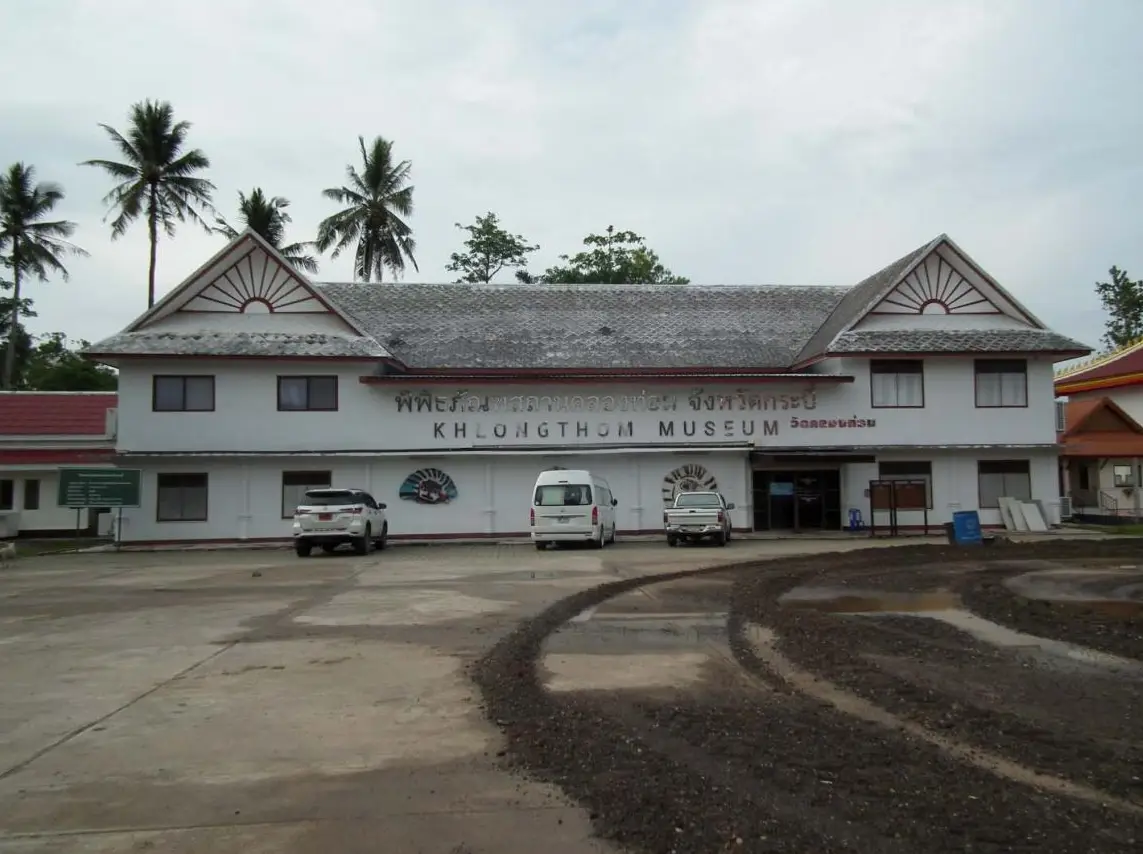
Open Days: Thursday – Tuesday, closed every Wednesday
Opening Hours: 10.00 – 16.00
Wat Khlong Thom Museum in Krabi Province, also known as Khlong Thom Museum or Phra Khru Athonsangworakit Museum, is one of the most important historical and archaeological learning sites in Khlong Thom District. Located inside Wat Khlong Thom in Khlong Thom Tai Subdistrict, along Phetkasem Road around kilometer markers 71–72, the museum preserves ancient beads, stone tools, stone and clay ornaments, animal-shaped objects, glass objects, pottery fragments, household items, and archaeological artifacts discovered around Khuan Luk Pat, the bead mound behind Wat Khlong Thom. These finds make Khlong Thom one of southern Thailand’s significant archaeological areas and reveal its past role as an ancient port community and bead-production center.
In brief, Wat Khlong Thom Museum is a key destination for understanding Khlong Thom beads, Khuan Luk Pat, and the ancient maritime trade networks of southern Thailand. Visitors can see the famous Suriya Thep bead, mosaic glass beads, colored stone beads, stone tools, bracelets, rings, seals, and many other artifacts that point to cultural exchange across the Malay Peninsula and the Andaman Sea. The museum is suitable for history lovers, archaeology enthusiasts, cultural travelers, families, students, and anyone who wants to see a deeper side of Krabi beyond beaches and islands.
What makes Wat Khlong Thom Museum especially meaningful is that many of its artifacts are directly connected to the archaeological landscape behind the temple. The area is known as Khuan Luk Pat. In southern Thai usage, “khuan” means a mound or small hill, while “luk pat” means beads. Together, the name refers to a mound where large numbers of beads were found. Local residents had known of beads in this area for generations, but systematic preservation began later, when the archaeological value of the site became clearer.
The origin of the museum is closely tied to Phra Khru Athonsangworakit, also known as Phra Sawat Kantasangwaro, a former abbot of Wat Khlong Thom. Seeing the importance of the beads and artifacts discovered around Khuan Luk Pat, he began collecting and preserving them at the temple around 1966. His purpose was to prevent these local treasures from being lost, scattered, or taken away from the community. In 1982, the collection became the foundation of Wat Khlong Thom Museum, created as a place for later generations to study the history of Khlong Thom and appreciate the value of their local heritage.
The museum was later improved with support from local and cultural agencies, including Khlong Thom Tai Municipality, Krabi Provincial Cultural Office, Krabi Provincial Administrative Organization, scholars, and archaeological institutions. Over time, the museum developed from a temple-based collection into a public learning center with a more systematic exhibition. Its displays explain the history of Wat Khlong Thom, the founder of the museum, the Khuan Luk Pat archaeological site, maritime trade, bead types, bead-making techniques, and objects linked to the daily life of past communities.
The museum building has 2 floors and is easily recognized by a large replica of the Suriya Thep bead on the exterior. Inside, visitors first encounter the reception area and a space for group briefings. The lower floor introduces the history of Wat Khlong Thom and Phra Khru Athonsangworakit, whose role in collecting and preserving local archaeological objects is central to the museum’s story.
Wat Khlong Thom itself has a noteworthy history. It began as a small temple founded in 1908 by Phra Chan together with local residents. When Phra Sawat Kantasangwaro, later known as Phra Khru Athonsangworakit, came to reside at the temple in 1955, Wat Khlong Thom gradually developed through the construction of monastic buildings, a sermon hall, monks’ residences, and other religious facilities. Because the temple was already a spiritual and community center, it became a natural place to safeguard the beads and artifacts discovered at Khuan Luk Pat.
Another important exhibition zone presents southern beads along the ancient trans-peninsular routes. Southern Thailand’s geography, stretching between the Andaman Sea and the Gulf of Thailand, made it a natural corridor for travel and trade across the Malay Peninsula. Many ancient port communities in the region were connected to maritime trade, glass objects, ornaments, and beads. Khlong Thom stands out because of the quantity and variety of beads found there, pointing to use, exchange, and production within an early historic community.
Khlong Thom beads are important because they vary widely in form, material, and size. Some are made of glass, while others are made of colored stone, agate, carnelian, quartz, amethyst, metal, clay, or other natural materials. This variety reflects craft knowledge, cultural preferences, and exchange networks among past communities. The large number of beads found in Khlong Thom is therefore not only evidence of decoration; it is evidence for the study of ancient economy, society, craftsmanship, and cultural contact.
One of the museum’s most famous objects is the Suriya Thep bead. This mosaic glass bead shows a human-like face with a radiating pattern often compared to the sun, which is why it became known as the Suriya Thep or Sun God bead. Its design is visually distinct from ordinary beads and requires a highly skilled mosaic-glass technique. Colored glass pieces were arranged into facial patterns, softened with heat, drawn into rods, and cut into small sections so that the face appeared repeatedly in cross-section. The bead is therefore both an archaeological object and a remarkable example of early glass craftsmanship.
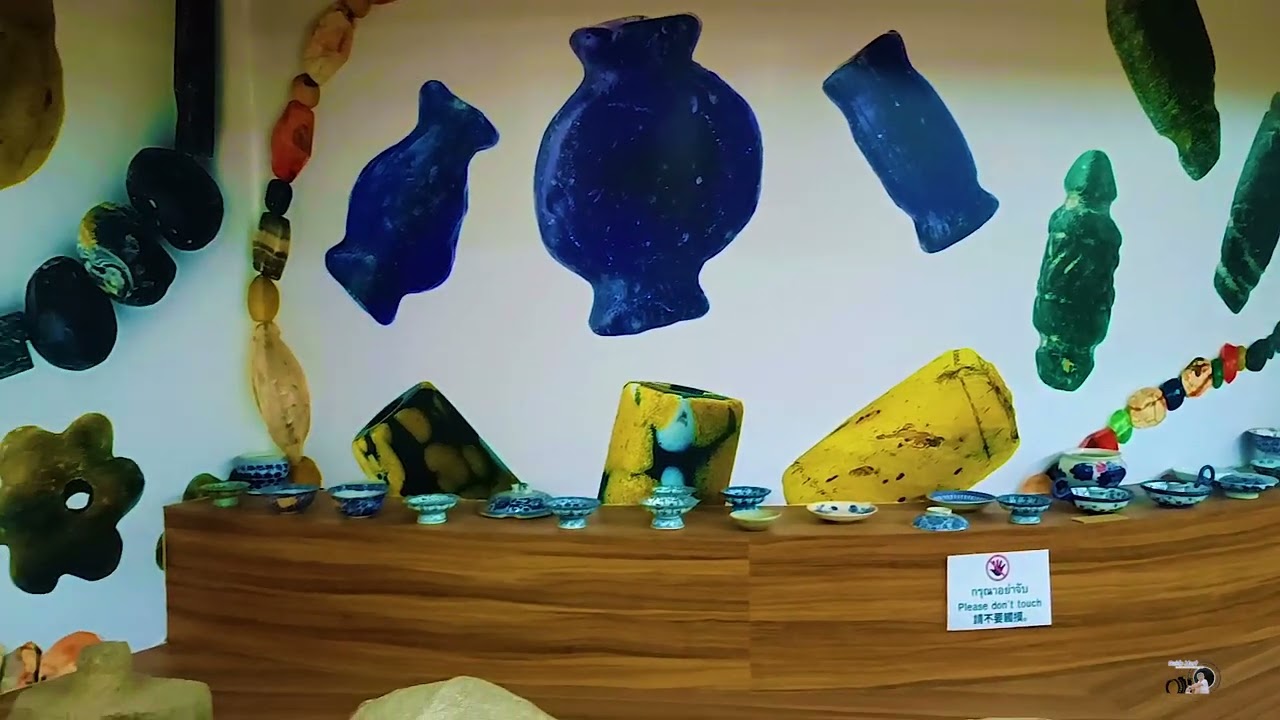
Beyond the Suriya Thep bead, the museum displays auspicious beads, mosaic glass beads, sunbird beads, animal-shaped beads, colored stone beads, clay beads, metal beads, amber-colored beads, stone bracelets, glass bracelets, bronze bracelets, rings, stone tools, stone axes, pottery fragments, clay seals with ancient inscriptions, and many other historical objects. These objects help visitors imagine Khlong Thom as a community involved in production, trade, belief, and contact with the wider world.
The museum also explains bead-making techniques. Glass beads, for example, required melting, stretching, cutting, and piercing to create the desired form. This section helps visitors understand that even a very small bead was the result of material knowledge and specialized craftsmanship. When viewed together with the number of beads found at Khuan Luk Pat, the evidence supports the idea that Khlong Thom was an important ancient bead-production area.
The second floor adds another layer of historical significance. It displays photographs and items related to the visits of Her Royal Highness Princess Maha Chakri Sirindhorn to Khlong Thom Museum in 1992 and 1993. This section shows that the museum is not only a local collection but a site of national interest because of the historical, artistic, archaeological, and educational value of Khlong Thom’s artifacts.
Other displays on the second floor include old tools and household objects such as oil lamps, typewriters, bows, plough parts, carrying poles, teapots, traditional manuscripts, pottery, and everyday objects from the past. These items broaden the museum’s story beyond beads and trade. They connect visitors with the daily life, labor, learning, ritual practice, and material culture of communities in Khlong Thom District.
From an archaeological perspective, Wat Khlong Thom Museum is significant because it helps explain Khlong Thom as an early historic community in southern Thailand. The evidence suggests that Khlong Thom was not isolated. It was connected to trade and cultural networks across the peninsula and maritime world. Small objects such as beads become crucial keys to understanding the movement of people, technologies, ornaments, beliefs, and ideas between the Andaman coast and other regions.
For general visitors, a visit to Wat Khlong Thom Museum should take at least 45 minutes to 1 hour. Those who want to read the labels carefully and observe the beads in detail should allow more time. Recommended highlights include the Suriya Thep bead, the bead-making section, the Khuan Luk Pat section, the trans-peninsular trade section, and the second-floor displays of historical photographs and everyday objects.
The museum is also suitable for a one-day cultural and nature route in Khlong Thom District. Visitors can combine the museum with Khlong Thom Hot Waterfall, Emerald Pool, Khlong Thom Salt Hot Spring, and other local attractions. Starting at the museum gives travelers a deeper historical context before continuing to the natural attractions that have made Khlong Thom widely known.
Getting There is most convenient by private car, rental car, or hired vehicle. From Krabi Town, follow Phetkasem Road toward Khlong Thom District for about 40 km. The museum is inside Wat Khlong Thom near kilometer markers 71–72 and about 1 km from the Khlong Thom District Office. The route works well for travelers who plan to continue to Hot Waterfall or Emerald Pool on the same day.
Travelers using public transport can take a vehicle from Krabi Town to Khlong Thom District and continue by local transport, motorcycle taxi, or hired vehicle to Wat Khlong Thom. This is possible, but visitors should plan the timing carefully because local transport may not run as frequently as in central Krabi. For those visiting several places in Khlong Thom in one day, renting a car or hiring a vehicle is usually more practical.
Before visiting, it is advisable to confirm the latest opening schedule with Khlong Thom Tai Municipality or the museum. Current local information states that the museum opens from 10.00 to 16.00 and closes every Wednesday. Some travel listings show slightly different hours, so group visitors should contact the museum or municipality in advance, especially if a guided explanation or educational visit is needed.
Visitors should follow basic museum etiquette: do not touch the artifacts, do not tap display cases, do not use flash photography close to fragile objects, do not bring food or drinks into the exhibition area, and speak quietly. Many objects in the collection are small, delicate, and archaeologically valuable. Respectful behavior helps protect Khlong Thom’s cultural heritage for future visitors.
Wat Khlong Thom Museum is worth visiting because it brings together local history, archaeology, craftsmanship, community memory, and the pride of Khlong Thom people in one place. The small beads displayed inside the museum work like windows into southern Thailand’s ancient past. They reveal maritime trade, cultural exchange, craft technology, and the effort of earlier generations to protect their local heritage.
For travelers interested in Thai culture and southern history, Wat Khlong Thom Museum should not be treated as only a short stop on the way to Emerald Pool or Hot Waterfall. It deserves to be a main cultural stop in Khlong Thom. Seeing the Suriya Thep bead and the artifacts from Khuan Luk Pat in person makes the story of ancient Khlong Thom clearer, more tangible, and far more memorable.
| Name | Wat Khlong Thom Museum / Khlong Thom Museum |
| Location | Inside Wat Khlong Thom, Khlong Thom Tai Subdistrict, Khlong Thom District, Krabi Province |
| Address | Wat Khlong Thom, Moo 2, Khlong Thom Tai Subdistrict, Khlong Thom District, Krabi 81120, Thailand |
| Coordinates | Approximately 7.9286, 99.1480 |
| Highlights | Suriya Thep bead, mosaic glass beads, colored stone beads, stone tools, bracelets, rings, clay seals, and artifacts from Khuan Luk Pat |
| History | The collection began with Phra Khru Athonsangworakit’s preservation of local artifacts around 1966. Wat Khlong Thom Museum was founded in 1982 and later improved as Khlong Thom Museum, a local learning center for archaeology and bead heritage. |
| Name Origin | The museum name comes from its location inside Wat Khlong Thom. Khuan Luk Pat means the bead mound behind the temple where many beads and artifacts were found. |
| Distinctive Features | A local museum focused on ancient beads and Khlong Thom archaeology, showing the area’s role as an ancient port community and bead-production center in southern Thailand. |
| Travel Information | From Krabi Town, follow Phetkasem Road toward Khlong Thom District for about 40 km. The museum is inside Wat Khlong Thom around kilometer markers 71–72 and about 1 km from Khlong Thom District Office. |
| Current Status | Open as a learning center for local history, archaeology, and Khlong Thom beads under the care of Khlong Thom Tai Municipality. |
| Open Days | Thursday – Tuesday, closed every Wednesday |
| Opening Hours | 10.00 – 16.00 |
| Fees | No admission fee |
| Facilities | Parking area, reception point, briefing area for group visits, and indoor exhibitions in a 2-storey museum building. |
| Main Areas / Zones | History of Wat Khlong Thom and the museum founder Khuan Luk Pat section Southern beads on trans-peninsular routes Beads from southern archaeological sites Archaeological work at Khuan Luk Pat Types of beads Bead-making techniques Second-floor displays related to royal visits and historical household objects |
| Abbot / Caretaker | The museum is under the care of Khlong Thom Tai Municipality. Its founder was Phra Khru Athonsangworakit, former abbot of Wat Khlong Thom. The current abbot named in public sources is Phra Khru Sathit Narathikan. |
| Main Contact Number | Museum Tel. 075-640-308 / Khlong Thom Tai Municipality Tel. 075-699-223 |
| Official Website / Official Page | Khlong Thom Tai Municipality Website |
| Nearby Tourist Attractions | 1. Wat Khlong Thom, about 0 km 2. Khuan Luk Pat, about 1 km 3. Khlong Thom Salt Hot Spring, about 12 km 4. Khlong Thom Hot Waterfall, about 13 km 5. Emerald Pool, about 18 km 6. Hin Phoeng Waterfall, about 31 km |
| Nearby Restaurants | 1. Krua Kin Dee Aroi Tang Amphoe, about 1 km, Tel. 095-258-4826 2. Zaab Bangkok Restaurant, about 1 km, Tel. 087-889-2779 3. Krua Muslim Restaurant, about 2 km, Tel. 081-083-7095 4. Krua Yok Phet, about 2 km, Tel. 090-870-3755 5. Papilio, about 2 km, Tel. 081-085-6725 6. Ko Hab Chicken Rice, about 2 km, Tel. 087-270-9812 |
| Nearby Accommodations | 1. Baan Nai Suan Resort Khlong Thom, about 1 km, Tel. 087-075-8288 2. Jidapa Rooms, about 2 km, Tel. 086-950-6411 3. In My Place Cafotel, about 2 km, Tel. 098-096-0942 4. Pinthong Resort, about 3 km, Tel. 087-890-9962 5. Khlong Thom Resort, about 7 km 6. VP Resort Emerald Pool Khlong Thom, about 14 km, Tel. 075-699-045, 081-439-2656 |
Frequently Asked Questions (FAQ)
Q: Where is Wat Khlong Thom Museum located?
A: Wat Khlong Thom Museum is located inside Wat Khlong Thom, Moo 2, Khlong Thom Tai Subdistrict, Khlong Thom District, Krabi Province, along Phetkasem Road around kilometer markers 71–72.
Q: What are the opening days and hours of Wat Khlong Thom Museum?
A: The museum opens Thursday to Tuesday from 10.00 to 16.00 and closes every Wednesday.
Q: Is there an admission fee?
A: There is no admission fee according to current tourism information that lists the museum as free to enter.
Q: What is the main highlight of Wat Khlong Thom Museum?
A: The main highlight is the collection of ancient beads from Khuan Luk Pat, especially the Suriya Thep bead, mosaic glass beads, colored stone beads, stone tools, seals, and other artifacts showing Khlong Thom’s role as an ancient port community.
Q: What is Khuan Luk Pat?
A: Khuan Luk Pat is the bead mound behind Wat Khlong Thom where many beads and archaeological objects were found. It is one of the key archaeological sites that made Khlong Thom famous for ancient beads.
Q: How long should visitors spend at the museum?
A: Visitors should allow at least 45 minutes to 1 hour. Those who want to read the labels and study the bead collection in detail should allow more time.
Q: How do visitors get to Wat Khlong Thom Museum from Krabi Town?
A: Take Phetkasem Road from Krabi Town toward Khlong Thom District for about 40 km. The museum is inside Wat Khlong Thom, near the district office area.
Q: What nearby attractions can be visited after the museum?
A: Nearby places include Wat Khlong Thom, Khuan Luk Pat, Khlong Thom Salt Hot Spring, Khlong Thom Hot Waterfall, Emerald Pool, and Hin Phoeng Waterfall.
 Category: ●Art, Culture and Heritage
 Group: ●Museums
Last Update : 2 MonthAgo
 Last Update : 2 MonthAgo
 Click to Access the Navigation Map GPS
Wat Khlong Thom Museum Map
Recommend

 Historical Sites and Monuments(1)
 Landmarks and Memorials(7)
 Art, Craft Centres, Tradition(2)
Museums(2)
 Educational Places
 Educational Gardens, Farm(1)
 Places of Worship
 Temple(3)
 Mosque(2)
 Other Sacred Sites(2)
 Research and Development
 Royal Project(1)
 Suburban Living
 Village, Community(6)
 Nature and Wildlife
 National Parks and Marine Reserves(5)
 Mountain (Doi)(2)
 Dam, Reservoir, Lake(3)
 Waterfalls(12)
 Hot Springs(3)
 Caves(20)
 River, Canal(2)
 Bays and Beaches(36)
 Islands(23)
 Other natural attractions(7)
 Entertainment and Agricultural
 Farms, Parks and Ecotourism(1)
 Outdoor and Adventure Activities(1)
 Travel Articles, Recipes
 Travel Review, Food Review(2)
 Southern Food Menu, Southern Food Recipes(1)


