
lovethailand home >Eastern Travel Attractions >Trat Travel Attractions >Muang Trat >Huang Nam Khao > Ban Pred Nai Mangrove Forest
TL;DR: Ban Pred Nai Mangrove Forest is located at Moo 2, Huai Nam Khao Subdistrict, Mueang Trat District, Trat Province, open Advance Booking Recommended, hours Advance Booking Recommended.
Ban Pred Nai Mangrove Forest
Open Days: Advance Booking Recommended
Opening Hours: Advance Booking Recommended
Ban Pred Nai Mangrove Forest in Trat Province is an important eco-tourism destination, nature study site, and community-based conservation learning area on Thailand’s eastern coast. Located in Moo 2, Huai Nam Khao Subdistrict, Mueang Trat District, Trat Province, the learning center and nature trail cover about 140 rai. The area is known as a destination for travelers interested in mangrove ecology, students, university groups, government agencies, private organizations, and visitors who want to understand how a coastal community can restore and manage natural resources. It is also a place connected to aquatic animal cultivation and coastal nursery habitats, showing the deep relationship between people, forest, canals, sea, and traditional fishing livelihoods.
The most memorable feature of Ban Pred Nai Mangrove Forest is its nature study trail, which allows visitors to enter the mangrove ecosystem at a close and comfortable distance. Along the trail, travelers can observe mangrove roots spreading into the mud, trees adapted to brackish water, fiddler crabs, sesarmid crabs, mudskippers, shellfish, birds, and many small coastal organisms. The forest is not only a scenic place for a short walk. It is an outdoor classroom that explains how mangroves work as nursery grounds for marine life, food sources for local communities, natural coastal barriers, and living systems that support the balance of the eastern Gulf coast.
Ban Pred Nai is a coastal community with a long relationship with mangrove forests. Local people have traditionally relied on fishing, orchards, agriculture, and coastal resources. In the past, the area faced serious mangrove degradation caused by timber concessions, land encroachment, and the expansion of shrimp farming. As the forest declined, aquatic resources decreased, food sources became weaker, and the community was affected both economically and environmentally. In response, villagers worked together to restore the mangrove forest, establish rules for resource use, create the Ban Pred Nai Mangrove Conservation and Development Group, and gradually develop the area into a respected community learning destination.
What makes Ban Pred Nai Mangrove Forest different from many ordinary nature attractions is that it was shaped by real restoration work. The forest is not a separate display created only for tourism. It is part of local life. The community protects the forest because the forest supports their livelihoods. Mangroves provide habitat for aquatic animals, protect the coast from waves and wind, supply food, support youth education, and form a natural foundation for the village economy. A visit here therefore means more than enjoying greenery. It offers a direct look at how conservation, community rules, and local knowledge can help bring a degraded coastal landscape back to life.
The mangrove nature trail is suitable for visitors who want to understand coastal ecology step by step. The route helps explain the difference between freshwater, seawater, and brackish water, the role of muddy soil, the adaptation of mangrove trees, and the importance of small animals that help loosen the soil and break down organic matter. As visitors walk through the area, they begin to see that a mangrove forest is not an empty or muddy wasteland. It is a living system with rhythm, structure, and relationships among plants, animals, soil, water, and human communities.
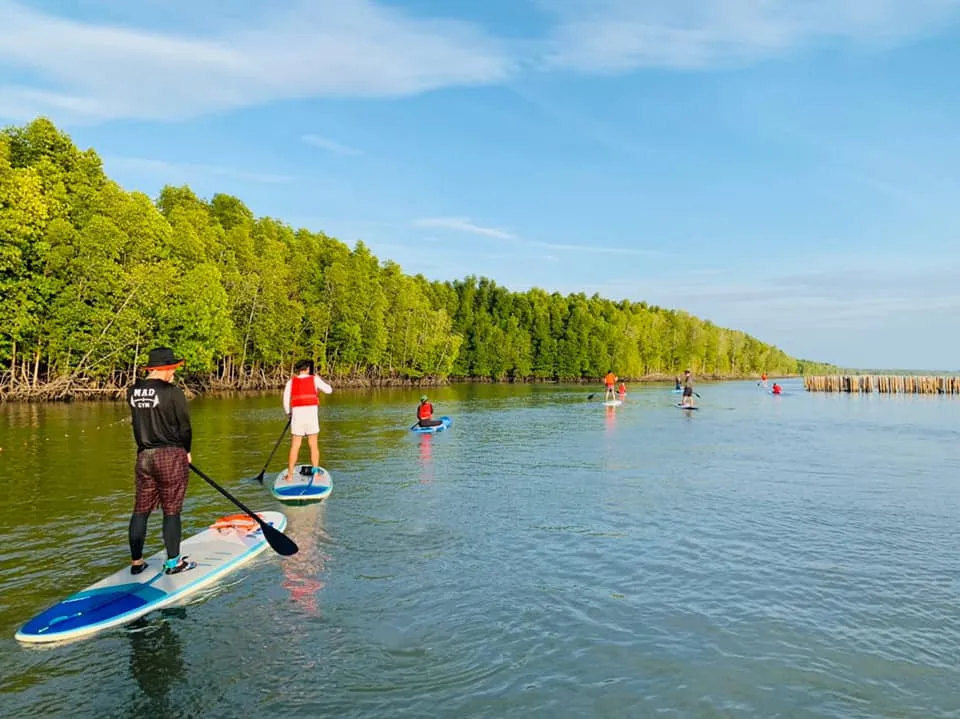
Activities at Ban Pred Nai Mangrove Forest include walking along the nature trail and taking a boat ride to enjoy the scenery of the mangrove forest. The boat ride gives visitors a different perspective from the walking trail. From the canal, travelers can see mangrove edges, root systems, small boats, community fishing areas, and the wider coastal landscape. This experience is suitable for general travelers, families, students, and study groups who want to understand the broader setting of the forest and the surrounding waterways.
The area also serves as a place connected to aquatic animal cultivation and coastal nursery habitats. A healthy mangrove forest gives young shrimp, crabs, fish, shellfish, and other small marine life a place to hide, feed, and grow before moving into canals and the sea. This role makes Ban Pred Nai more than a tourist destination. It is part of the natural system that supports local fisheries, food security, and the coastal economy of Trat Province.
For students and educational groups, Ban Pred Nai Mangrove Forest offers learning opportunities across many fields, including environmental science, biology, geography, community sociology, local economics, natural resource management, and community-based tourism. Visitors can see a real example of how local people solve environmental problems, establish shared rules, restore ecosystems, and pass knowledge to younger generations. This makes the site especially suitable for field trips, university study programs, and professional study visits.
The Ban Pred Nai Mangrove Conservation and Development Group plays a key role in protecting the area. Its work includes forest monitoring, resource zoning, coastal resource management, community education, youth learning activities, and receiving visitors who want to study the restoration process. The group’s role shows that successful conservation is not based only on planting trees. It requires local leadership, community participation, long-term rules, and continuous care.
The name “Pred Nai” also reflects the history and memory of the community. One explanation says that the word “Pred” comes from a Khmer term meaning a passage or shortcut, which fits the area’s former role as a route of contact along the Gulf coast. Another local story links the name to the word “duck” and a village legend about Nong Ped. These stories add cultural depth to the destination, showing that Ban Pred Nai is valuable not only for its ecosystem but also for its history, identity, and local memory.
The community’s cultural life is also connected to temples, family traditions, and local beliefs. Many villagers have Thai-Chinese roots, and important traditions include Chinese New Year, Chinese Sart, ancestor worship, and local merit-making. Wat Huai Nam Khao serves as an important spiritual center for people in the area. This cultural background helps visitors see that the mangrove forest is part of a wider community landscape that includes families, beliefs, food, work, and shared memory.
For groups that want to stay overnight, the community offers homestay accommodation. Staying in the village allows visitors to experience Ban Pred Nai at a slower pace, enjoy local food, talk with residents, and understand that mangrove conservation is connected not only to the forest trail but also to households, livelihoods, income, food, and community cooperation. Advance booking is recommended for homestay stays and organized group visits.
The atmosphere of Ban Pred Nai Mangrove Forest is best experienced slowly. Morning is a good time to walk the nature trail because the temperature is more comfortable and details of plants and small animals are easier to observe. During low tide, visitors may see more mudflat life, including crab holes, mudskippers, and animal traces. Boat activities should be coordinated in advance so that the timing matches tide levels, weather, and community availability.
Visitors should dress appropriately for outdoor and coastal conditions. Comfortable walking shoes, clothes suitable for warm weather, a hat, drinking water, mosquito repellent, and waterproof protection for phones or cameras are recommended. While walking through the mangrove area, visitors should keep noise low, avoid littering, avoid disturbing animals, and follow local guidance. The forest is both a learning site and a living habitat for many species.
For photography, Ban Pred Nai offers many strong visual elements, including wooden walkways, layered mangrove roots, canal reflections, muddy tidal flats, small boats, and the quiet atmosphere of the forest. These scenes are especially meaningful for travelers who want to tell stories about responsible travel, nature education, and community conservation in Thailand.
Ban Pred Nai Mangrove Forest can also be combined with nearby attractions in Mueang Trat District and surrounding areas. Travelers may visit Wat Huai Nam Khao, Ban Nam Chiao Community, Trat City Museum, Wat Buppharam, Trat City Pillar Shrine, Laem Sok Pier, or Ban Tha Ranae Community. With more time, the trip can be extended toward Trat’s island destinations, including Koh Kood and Koh Mak.
Community products and local food also add value to the trip. Visitors can ask in advance about local demonstrations, community-made products, or meals prepared by the community. Supporting local products helps distribute income directly to households and strengthens the link between tourism and local livelihoods.
Getting There is most convenient by private car or rental car from Trat town. Travelers should head toward Huai Nam Khao Subdistrict in Mueang Trat District and use Ban Pred Nai as the main destination. The site can be visited as a half-day or full-day trip. For boat rides, study visits, or homestay stays, visitors should contact the community in advance at 089-542-8925 to arrange activities, group size, meals, accommodation, and suitable timing according to tide and weather conditions.
Ban Pred Nai Mangrove Forest is therefore much more than a nature attraction. It is a place where visitors can clearly understand the idea that a community protects the forest and the forest protects the community. Every step along the trail, every view from the boat, and every local story reflects the value of long-term conservation led by people who live with the land and sea every day.
| Name | Ban Pred Nai Mangrove Forest |
| Location | Moo 2, Huai Nam Khao Subdistrict, Mueang Trat District, Trat Province |
| Address | Ban Pred Nai, Moo 2, Huai Nam Khao Subdistrict, Mueang Trat District, Trat Province 23000, Thailand |
| Coordinates | 12.1497239, 102.5519811 |
| Highlights | Mangrove nature trail, boat ride through mangrove scenery, coastal aquatic nursery area, community learning center, and study visit destination for students, government agencies, private organizations, and conservation groups. |
| History | Ban Pred Nai is a coastal community with a long relationship with mangroves and traditional fisheries. After past degradation from timber concessions and shrimp farming, the community restored the forest and developed it into a learning site for coastal resource conservation. |
| Name Origin | The word “Pred” is locally explained as coming from a Khmer term meaning a passage or shortcut, while another story connects it to the word “duck” and the village legend of Nong Ped. |
| Distinctive Features | A community-managed mangrove forest with nature trails, ecological learning areas, aquatic animal nursery functions, and community-based conservation management. |
| Area Size | The learning center and nature trail cover about 140 rai. |
| Travel Information | Travel by private car or rental car from Trat town to Huai Nam Khao Subdistrict, Mueang Trat District. Suitable for half-day trips, full-day trips, and organized study visits. |
| Current Status | Eco-tourism destination, nature study site, and community study visit area. Advance coordination is recommended before traveling. |
| Open Days | Advance Booking Recommended |
| Opening Hours | Advance Booking Recommended |
| Facilities | Nature trail, ecological learning points, community boat activities, study visit area, and community homestay for overnight groups. |
| Main Areas / Zones | 1. Mangrove Nature Trail 2. Mangrove Ecosystem Learning Area 3. Aquatic Animal Cultivation And Nursery Area 4. Boat Ride Area 5. Ban Pred Nai Community Learning Center 6. Community Homestay Area 7. Coastal Resource Conservation Study Area |
| Caretaker | Ban Pred Nai Mangrove Conservation And Development Group, Ban Pred Nai Community, and Huai Nam Khao Subdistrict Administrative Organization. |
| Main Contact Number | Community Service / Homestay Tel. 089-542-8925 Huai Nam Khao Subdistrict Administrative Organization Tel. 039-510-903 |
| Nearby Tourist Attractions | 1. Wat Huai Nam Khao, about 5 km 2. Ban Nam Chiao Community, about 16 km 3. Trat City Museum, about 14 km 4. Wat Buppharam Trat, about 15 km 5. Trat City Pillar Shrine, about 14 km 6. Laem Sok Pier, about 24 km 7. Ban Tha Ranae Community, about 23 km |
| Nearby Restaurants | 1. Cherry Ann Seafood, Huai Nam Khao Subdistrict, about 8 km, Tel. 089-886-3630 2. Chompoo Farm And Cafe, Nong Khan Song Subdistrict, about 9 km, Tel. 092-450-7566 3. Khiang Khlong Eatery, Noen Sai Subdistrict, about 16 km, Tel. 082-391-6166 4. Tid Nua Trat, Nong Samet Subdistrict, about 16 km, Tel. 080-501-6772 5. Krua Ban Mae, Wang Krachae Subdistrict, about 17 km, Tel. 097-826-6655 6. Lung Boon Rim Lay Seafood & Homestay, Ao Yai Subdistrict, about 26 km, Tel. 089-831-9397 |
| Nearby Accommodations | 1. Ban Pred Nai Community Homestay, about 0 km, Tel. 089-542-8925 2. Baan Poo Resort, about 5 km 3. Wat Bang Kung Homestay, about 8 km 4. Baan Hotelier Resort, about 9 km 5. Toscana Trat Hotel, about 10 km 6. Trat 101 Hotel, about 11 km 7. Trattara Boutique Hotel, about 12 km 8. Trat City Hotel, about 13 km |
Frequently Asked Questions (FAQ)
Q: Where is Ban Pred Nai Mangrove Forest located?
A: Ban Pred Nai Mangrove Forest is located in Moo 2, Huai Nam Khao Subdistrict, Mueang Trat District, Trat Province.
Q: How large is the Ban Pred Nai Mangrove Forest learning area?
A: The learning center and nature trail area cover about 140 rai.
Q: What are the main activities at Ban Pred Nai Mangrove Forest?
A: Main activities include walking the mangrove nature trail, learning about the mangrove ecosystem, observing aquatic nursery areas, and taking a boat ride through the mangrove scenery.
Q: Is Ban Pred Nai Mangrove Forest suitable for study visits?
A: Yes. It is highly suitable for students, universities, government agencies, private organizations, and community groups interested in mangrove restoration, aquatic resources, and community-based conservation.
Q: Is homestay accommodation available?
A: Yes. Community homestay accommodation is available for groups that want to stay overnight. Advance booking is recommended at 089-542-8925.
Q: Should visitors contact the community before traveling?
A: Yes. Advance contact is recommended, especially for boat rides, study visits, and homestay stays, because activities depend on group size, tide conditions, and community arrangements.
Q: How can travelers get from Trat town to Ban Pred Nai Mangrove Forest?
A: Travelers can drive or rent a car from Trat town to Huai Nam Khao Subdistrict in Mueang Trat District, using Ban Pred Nai as the main destination.
Q: What should visitors prepare before walking the mangrove trail?
A: Visitors should wear suitable outdoor clothing, bring comfortable walking shoes, a hat, drinking water, mosquito repellent, and follow community guidelines to help protect the mangrove ecosystem.
 Category: ●Nature and Wildlife
 Group: ●Other natural attractions
Last Update : 2 MonthAgo
 Last Update : 2 MonthAgo
 Click to Access the Navigation Map GPS
Ban Pred Nai Mangrove Forest Map
Recommend

 Art, Culture and Heritage
 Historical Sites and Monuments(1)
 Landmarks and Memorials(1)
 Art, Craft Centres, Tradition(3)
 Museums(2)
 Educational Places
 Museum for Study(1)
 Educational Gardens, Farm(2)
 Places of Worship
 Temple(11)
 Mosque(2)
 Other Sacred Sites(2)
 Suburban Living
 Village, Community(6)
 Local Market(2)
 National Parks and Marine Reserves(2)
 Mountain (Doi)(1)
 Dam, Reservoir, Lake(3)
 Waterfalls(15)
 River, Canal(1)
 Bays and Beaches(21)
 Islands(19)
Other natural attractions(12)
Islands(19)
Other natural attractions(12)
 Entertainment and Agricultural
 Outdoor and Adventure Activities(1)
 Shopping
 Shopping and Night Market(1)


