
lovethailand home >Eastern Travel Attractions
>Chon Buri Travel Attractions >Phan Thong
>Na Pradu
> Wat Laem Khae
TL;DR: Wat Laem Khae. is an ancient temple located at 13, Moo 1, Na Pradu Subdistrict, Phan Thong District, Chonburi Province. It is affiliated with the.

Wat Laem Khae
Operating day: Daily
Operating time: 08.00 - 17.00
Wat Laem Khae is an ancient temple located at 13, Moo 1, Na Pradu Subdistrict, Phan Thong District, Chonburi Province. It is affiliated with the Mahanikaya sect of Thai Buddhism. The temple grounds cover a total area of 15 rai, 2 ngan, and 60 square wah, with land title deeds numbered 4089, 2480, and 4090. The temple’s boundaries are defined as follows: the north borders a public road, while the south, east, and west border private land. Additionally, the temple owns five plots of consecrated land, covering a total of 46 rai, 3 ngan, and 67 square wah, with land title deeds numbered 2445, 2455, 3042, 3051, and 2751. This extensive area makes Wat Laem Khae a significant center for religious activities, merit-making events, and community gatherings.
The temple features several important structures. The ordination hall, or ubosot, was built in 1957 (B.E. 2500). It is a reinforced concrete building measuring 12 meters in width and 27.50 meters in length, showcasing traditional Thai architectural elements such as chofa, bai raka, and hang hong, which reflect the elegance of Thai artistry. The sermon hall, constructed in 1991 (B.E. 2534), is a two-story reinforced concrete building in Thai style, measuring 14 meters wide and 40 meters long. Its front gable is especially notable as it bears the royal cypher “S.T.,” representing Her Royal Highness Princess Maha Chakri Sirindhorn, symbolizing the community’s pride and devotion to both religion and the monarchy.
Within the temple grounds are five monk residences, or kutis, consisting of one wooden structure, one mixed wooden and concrete building, and three entirely concrete buildings. The temple also houses a wooden merit-making pavilion built in 1997 (B.E. 2540), featuring wooden floors and glass-paneled walls. This pavilion serves as a venue for various ceremonies and community events such as merit-making and funerals. There is also a crematorium hall built in 1989 (B.E. 2532), measuring 14 by 18.25 meters, and a bell tower with a base width of 4.25 meters and a height of 3 meters, constructed in 1971 (B.E. 2514).
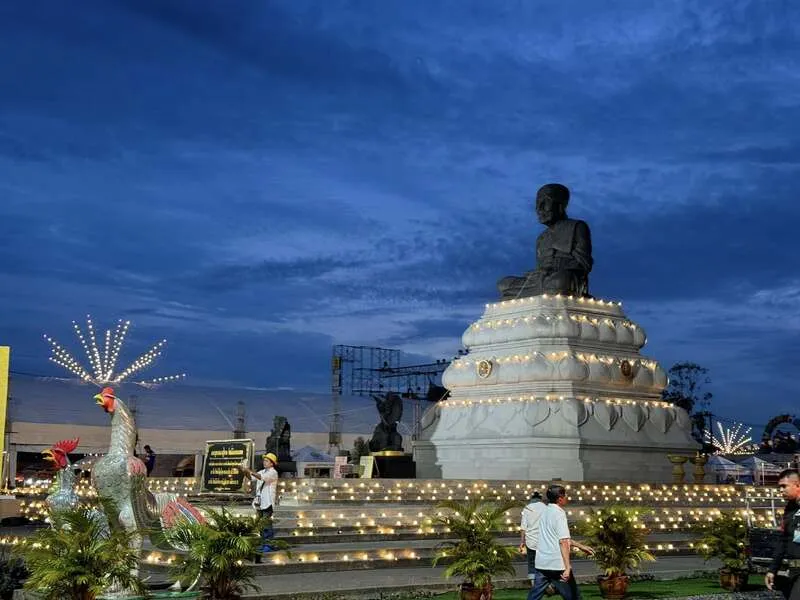
Among its sacred treasures, Wat Laem Khae is home to an ancient metal Buddha image with a lap width of three sok (approximately 1.5 meters). This revered Buddha image was created in 1915 (B.E. 2458) and has long been a spiritual focal point for the local community. In addition to this, Wat Laem Khae is renowned for its large statue of Luang Pu Thuat, which is enshrined at the Lan Tham Luang Pu Thuat, or Luang Pu Thuat Dharma Courtyard. Luang Pu Thuat is one of Thailand’s most highly revered monks, believed to possess miraculous powers and boundless compassion. Worshippers from near and far visit the temple to pay their respects, seek blessings, and pray for good fortune. The presence of this monumental statue has significantly elevated the temple’s reputation, making it a prominent destination for religious tourism in Phan Thong District and throughout Chonburi Province.
Wat Laem Khae has a rich and meaningful history. It was founded in 1871 (B.E. 2414), during a time when the surrounding area was filled with khae trees (Sesbania grandiflora), inspiring the temple’s name. The land for the temple was generously donated by Mrs. Yuk Sonsiri, who encouraged local villagers to contribute funds and resources to build religious structures for communal worship and merit-making. The Sonsiri family has since maintained a deep and continuous relationship with the temple, especially Mr. Sin and Mrs. Sen Sonsiri, descendants of Mrs. Yuk, who played a vital role in supporting and sustaining the temple through the years.
The temple was officially granted wisungkhamsima, a consecrated boundary for performing ordination ceremonies, on January 30, 1962 (B.E. 2505). The designated area measures 40 meters wide and 80 meters long. This milestone marked a turning point in the temple’s growth, leading to the construction of more sacred buildings and the expansion of religious activities. The sermon hall, with its royal cypher, stands as a symbol of the local community’s faith and reverence for both Buddhism and the monarchy.
Wat Laem Khae has been guided by many dedicated abbots over the years, each playing a crucial role in its development and spiritual guidance for the community. Known abbots include Phra Ya, Phra Tui in 1891, Phra Plang from 1891 to 1900, Phra Ta from 1900 to 1937, Phra Thongkham from 1937 to 1939, Phra Prayoon Prongukaro from 1939 to 1954, Phra Palad Samran Uppakara from 1954 to 1970, Phra Khru Warakitpisan (Phra Khru Hom Jattabhayo) from 1971 to 1998, and Phra Khru Soraphatpilai (Phra Khru Suphon Chandasilo) who has been abbot since 2000 (as of 2001). Each abbot has contributed to the temple’s growth, both in physical development and in nurturing the spiritual life of its devotees.
The temple has also served as an educational hub. In 1917 (B.E. 2460), it established a Pariyatti Dhamma School, offering monks and novices the opportunity to study Buddhist scriptures and discipline. Later, in 1986 (B.E. 2529), a preschool education center was opened to nurture young children in the community, focusing on moral development and foundational learning.
Today, Wat Laem Khae continues to thrive as a spiritual, cultural, and social center for the community of Phan Thong District. It remains a gathering place for villagers to engage in religious rituals, cultural celebrations, and educational programs. The presence of the grand Luang Pu Thuat statue has enhanced the temple’s significance, drawing countless visitors who come to seek blessings and experience its sacred atmosphere. This has not only reinforced the temple’s role as a site of deep religious devotion but also as a vital cultural landmark, preserving the values, traditions, and unity of the community for generations to come.
 Category: ●Places of Worship
 Group: ●Temple
Last Update : 8 MonthAgo
 Last Update : 8 MonthAgo
 Click to Access the Navigation Map GPS
Wat Laem Khae Map
Recommend
 Art, Culture and Heritage
 Historical Sites and Monuments(4)
 Landmarks and Memorials(4)
 Royal Palace(1)
 Art, Craft Centres, Tradition(5)
 Museums(11)
 Art Gallery(1)
 Educational Places
 Educational Gardens, Farm(2)
 Training Center(2)
 University Temple(42)
 Church(1)
 Mosque(2)
 Other religious and spiritural sites(14)
 Suburban Living
 Village, Community(5)
 Local Market(4)
 Floating Market(1)
 Nature and Wildlife
 National Parks and Marine Reserves(2)
 Mountain (Doi)(2)
 Dam, Reservoir, Lake(4)
 Waterfalls(3)
 Caves(3)
 Bays and Beaches(20)
 Islands(7)
 Other natural attractions(1)
 Entertainment and Agricultural
 Zoos and Aquariums(6)
 Animal camps and shows(2)
 Stadium(9)
 Farm, Parks, Gardens and Ecotourism(9)
 Amusement Park(3)
 Waterpark(3)
 Theater(5)
 Cinema(1)
 Outdoor and Adventure Activities(4)
 Shopping
 Shopping and Night Market(1)


