

 Home
Home Chiang Mai(




Buddha Cremation Offering Tradition
Rating: 3.8/5 (5 votes)
 Search By
  Map
Map 
 Have Map
  No Map
Chachoengsao attractions
Attractions in Thailand
Open Days: Held annually (from the 8th waning day to the 15th waning day of the 6th lunar month, with the 1st waxing day of the 6th lunar month as the cremation day)
Opening Hours: Abhidhamma chanting begins at 20.00 onwards / Cremation ceremony in the morning (please check the annual schedule)
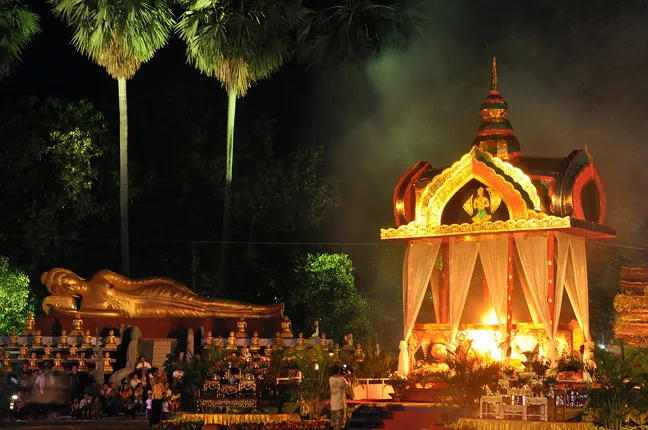
Buddha Cremation Offering Tradition at Wat Hua Samrong, Hua Samrong Subdistrict, Plaeng Yao District, Chachoengsao Province, is one of the most significant traditions reflecting the cultural roots of the Thai-Khmer community in Eastern Thailand. The ritual is held annually from the 8th waning day to the 15th waning day of the 6th lunar month for eight consecutive nights, during which monks chant the Abhidhamma. The 1st waxing day of the 6th lunar month is the main cremation day and marks the most important moment of the event.
Although the ceremony is called “Offering the Cremation of the Buddha,” it does not refer to a literal historical event. Rather, it is a symbolic reenactment of the Parinibbana (final passing) of the Lord Buddha. The purpose is to allow Buddhists to recollect the Buddha’s virtues and contemplate the truth of life through tangible ritual expression. The Hua Samrong community has preserved this tradition for over a century, maintaining its ceremonial structure in full detail.
The Hua Samrong area has long been home to a Thai-Khmer community. Historical accounts suggest migration from eastern and southeastern border regions during the early Rattanakosin period. The villagers continue to use elements of the Khmer dialect in daily life, and their ritual practices reflect a blend of Theravada Buddhism and traditional Khmer cultural beliefs. Wat Hua Samrong therefore functions as both a religious and cultural center that unites the collective memory of the community.
Before the event begins, villagers work together to construct a coffin and a symbolic image of the Buddha. These are placed before the principal Buddha image in the ordination hall. This act carries profound meaning, as it transforms the abstract remembrance of Parinibbana into something visible and participatory. It converts doctrinal teachings into lived communal ritual.
From the 8th to the 15th waning day of the 6th lunar month, monks chant the Abhidhamma every night beginning at 20.00. Villagers attend faithfully to listen to the Dhamma. The chanting emphasizes reflection on conditioned phenomena and serves as a reminder of impermanence, suffering, and non-self. Listening to the teachings over eight nights is akin to preparing the mind before the final cremation ceremony.
Each night, villagers offer the four requisites to the monks as acts of merit-making. Participation across all eight nights reflects sustained devotion, showing that the tradition is not confined to a single ceremonial day but represents an ongoing spiritual process.
On the 1st waxing day of the 6th lunar month, the coffin and the symbolic image of the Buddha are carried in procession around a temporary crematorium structure within the temple grounds. Circumambulating the crematorium symbolizes the cyclical nature of samsara. The coffin is then placed upon the funeral pyre platform. Monks chant the Matika and Bangsukun, and villagers offer sandalwood flowers before the cremation ritual is performed in a solemn and composed atmosphere.
The core of this tradition lies in contemplation of the principle of “Anicca,” or impermanence. The cremation ritual symbolizes the dissolution of physical form and serves as a reminder that all conditioned things decay. Participation in the ceremony deepens awareness of this truth—not merely at an intellectual level, but through a powerful communal and emotional experience.
Philosophically, “Anicca” is one of the Three Marks of Existence in Buddhism, alongside “Dukkha” (suffering) and “Anatta” (non-self). The reenactment of the Buddha’s cremation thus functions as a practice of marananussati—mindfulness of death. By reflecting on mortality, participants cultivate awareness, reduce attachment to material and social status, and recognize the value of the present moment.
The Thai-Khmer community of Hua Samrong continues to uphold strong family and kinship bonds. The eight-day ceremony often becomes a time for relatives working elsewhere to return home. The tradition thus acts as a “social calendar,” strengthening communal relationships and reinforcing shared identity.
Wat Hua Samrong, located in Hua Samrong Subdistrict, Plaeng Yao District, Chachoengsao Province, serves as the ritual center. It remains a focal point of faith and community life. The current abbot is Phra Khru Wisutthammaphon, who plays an essential role in sustaining the tradition.
Getting There From Bangkok, take Highway 304 toward Plaeng Yao District, then continue into Hua Samrong Subdistrict. The temple is situated within the community and provides parking facilities. Visitors are advised to allow extra travel time on ceremony days due to increased attendance.
| Place Summary | Buddha Cremation Offering Tradition at Wat Hua Samrong, Hua Samrong Subdistrict, Plaeng Yao District, Chachoengsao Province |
| Highlights | Symbolic Buddha cremation ceremony, eight nights of Abhidhamma chanting, crematorium procession, and contemplation of impermanence (Anicca) |
| Abbot | Phra Khru Wisutthammaphon |
| Temple Phone | 038-575-148 |
| Nearby Attractions | 1) Wat Pho Bang Khla – 32 km 2) Wat Sothon Wararam Worawihan – 38 km 3) Ban Mai 100-Year Market – 40 km 4) Palm Farm Nok – 25 km 5) Khlong Suan 100-Year Market – 35 km |
| Nearby Restaurants | 1) Krua Lung Nuad – 3 km – 081-234-5678 2) Plaeng Yao Seafood – 5 km – 086-345-7890 3) Ban Suan Noodle Shop – 2 km – 089-112-3344 4) Pa Samran Restaurant – 4 km – 085-223-4455 5) Rim Thung Kitchen – 6 km – 081-778-8899 |
| Nearby Accommodations | 1) The Garden View Resort – 6 km – 038-580-123 2) Plaeng Yao Hotel – 4 km – 081-998-7766 3) Green Field Resort – 8 km – 089-556-7788 4) KP Place – 5 km – 086-223-1122 5) Punya Garden Home – 7 km – 095-665-4433 |
Frequently Asked Questions (FAQ)
Q: When is the Buddha Cremation Offering Tradition held?
A: It is held from the 8th waning day to the 15th waning day of the 6th lunar month, with the 1st waxing day of the 6th lunar month as the cremation day.
Q: Why are there eight nights of Abhidhamma chanting?
A: The chanting allows participants to reflect on Dhamma teachings and prepare their minds before the cremation ceremony.
Q: What is the meaning of “Anicca” in this ceremony?
A: Anicca means impermanence. The cremation ritual symbolizes the inevitable decay of all conditioned things and encourages mindfulness of life’s transient nature.
Q: Can tourists attend the ceremony?
A: Yes, visitors are welcome. Modest attire and respectful conduct are expected.
Q: Is there an admission fee?
A: There is no admission fee. Visitors may make voluntary donations according to their faith.
 Buddha Cremation Offering Tradition Map
 Category:
  Group:
  Tag: ●Buddha Cremation Offering Tradition●buddha cremation offering tradition thailand ●wat hua samrong plang yao ●thai khmer tradition chachoengsao ●buddhist cremation ceremony festival ●waning moon month 6 ritual ●abhidhamma chanting eight nights ●eastern thailand cultural festival ●buddhist impermanence ceremony ●thai khmer heritage festival ●plang yao temple festival Last Update: 1 WeekAgo
Comment
 Nearby Attractions
| Keyword (Advance) |
 Facebook Fanpage
 Region
 Historical Sites and Monuments(
 Landmarks and Memorials(
 Royal Palace(
 Museums(
 Historical Houses and The Ancient City(
 Educational Places
 Museum for Study(
 Library(
 Educational Gardens, Farm(
 University
 Places of Worship
 Temple(
 Mosque(
 Other religious and spiritural sites(
 Research and Development
 Royal Project(
 Suburban Living
 Village, Community(
 Local Market(
 Floating Market(
 Nature and Wildlife
 National Parks and Marine Reserves(
 Mountain (Doi)(
 Dam, Reservoir, Lake(
 Waterfalls(
 Caves(
 River, Canal(
 Bays and Beaches(
 Islands(
 Other natural attractions(
 Entertainment and Agricultural
 Zoos and Aquariums(
 Animal camps and shows(
 Farm, Parks, Gardens and Ecotourism(
 Spas and Wellness
 Spas and Wellness(
 Travel Articles, Recipes
 Travel Review, Food Review(
 Copyright 2012,