

 Home
Home Chiang Mai(




Ta Khab Flag Parade Tradition
Rating: 4/5 (7 votes)
 Search By
  Map
Map 
 Have Map
  No Map
Chachoengsao attractions
Attractions in Thailand
Open Days: Daily
Opening Hours: 08.00 – 17.00
Ta Khab Flag Parade Tradition at Wat Pimphawas (Tai), Chachoengsao Province, is a distinctive Songkran tradition of the Thai-Raman (Mon) community that has been preserved with remarkable strength in Pimpha Subdistrict, Bang Pakong District, Chachoengsao. The heart of this tradition is not only the modern image of Songkran as “water splashing” for fun, but a deeply meaningful act of making merit and dedicating it to ancestors and the deceased through the “offering of the Ta Khab flag” and the procession that carries the flag into the temple. The ritual follows long-held Mon community practices in which Buddhism serves as the central pillar connecting belief, gratitude, and collective unity.
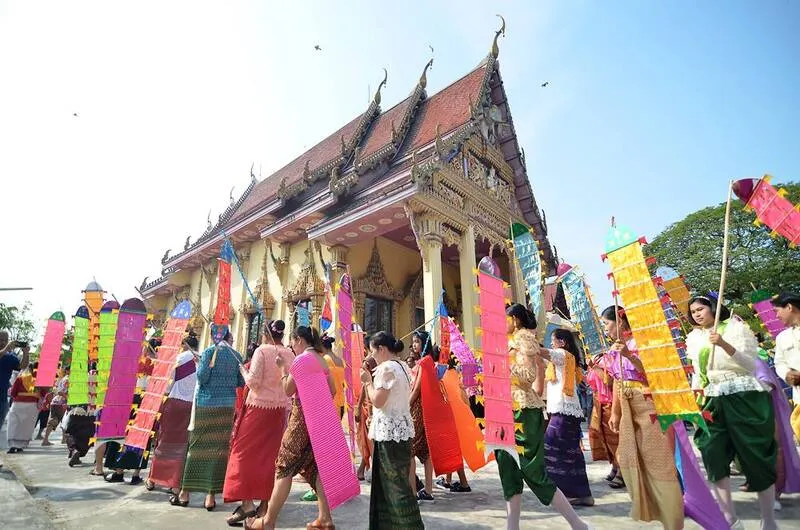
For visitors from outside the community, the most striking sight is the extraordinarily long “Ta Khab flag” that requires many people to support it along its entire length as it moves through local streets and lanes in a coordinated procession. With numerous “legs” arranged in segments, the flag clearly resembles a centipede, becoming the unforgettable image of the event. Yet its meaning goes far beyond visual beauty: the Ta Khab flag symbolizes the dedication of merit to the deceased, and it reflects the belief that once the flag is hoisted on the Hong Pole, the fluttering motion in the wind signifies that ancestors have “received the merit” and are supported toward a better realm.
The core period of the event takes place during Songkran each year. Community recognition and many public activity listings commonly cite April 13–15, while some sources mention April 12–14 depending on how the parade route and yearly sub-activities are arranged. Therefore, the key to planning a trip to witness this tradition is to use the Songkran period as the main timeframe and check the annual schedule again before traveling, so you do not miss the parade day and the temple offering ceremony, when all essential elements are most complete: the procession, the ritual in the pavilion, the bathing of Buddha images and monks, and the hoisting of the flag onto the Hong Pole.
What makes the Ta Khab flag parade especially distinctive is the community craftsmanship that draws on shared knowledge across generations. It involves everything from preparing the frame, building a long and durable body, arranging bamboo slats in consistent intervals, to decorating the head, tail, and the “legs” of the centipede in orderly alignment. This is both a ritual act and a living transmission of local craft traditions, because the flag is not created merely for display—it is made as a genuine offering, a real act of merit, and must be appropriate for the ceremony.
Traditionally, the Ta Khab flag was made of paper, later developing into fabric for durability. Today, materials are adapted to practical community needs. Rope is used to form the outer frame, with cross-ties and bamboo slats placed in segments along the length. A long woven mat is laid over the structure to create a continuous “body.” At the ends of each slat that extend outward on both sides, spoons are tied and hung to represent the legs, alternating with paper tassels for visual richness. When the entire flag is lifted and moved in unison, it creates a rhythmic, dimensional effect—like a living creature gliding through the community.
The head and tail are typically formed with a wooden framework and covered with colored paper to create a clear shape and strong visual presence in the procession. The number of flags made each year depends on community capacity and participation. Some years see more, some fewer, but the key is always to make the flags “complete for the ritual” and to ensure the procession is safe and graceful. Because the flag is very long and richly decorated, it requires both careful handling and coordinated teamwork.
Once the Ta Khab flag is completed, the most lively stage is the “parade.” Villagers hold the flag along its full length and process through the community toward Wat Pimphawas (Tai). Music and Songkran festivities bring energy to the procession, yet the atmosphere remains clearly that of a “merit-making event” because the destination is the sacred ritual space inside the temple, not simply a parade for entertainment.
Upon arrival at the temple, the flag is stretched and secured to a pole or within the pavilion area in preparation for the ceremony. Monks then encircle the flag with sacred thread, symbolically linking the “crafted object” to the “sacred space” within Buddhist belief and local tradition. When the offering ceremony begins, participants pay homage to the Triple Gem, followed by a key Songkran rite: bathing Buddha images and monks, which expresses reverence and marks a traditional new-year renewal.
After the pavilion ceremony, the community works together to hoist the flag onto the “Hong Pole,” a significant symbol in many Mon communities. The Hong Pole is not merely an architectural element in the temple; it represents identity, community, and shared memory that connects the living with the deceased through merit. Once the flag is raised high, the sight of the long flag fluttering in the wind becomes a powerful visual expression of prayers and the transfer of merit to ancestors according to local belief.
From a sociological perspective, this tradition functions as a clear “cultural mechanism” that makes beliefs about the afterlife and gratitude toward ancestors tangible. Instead of remaining as abstract stories, these beliefs become visible through ritual objects (the Ta Khab flag), shared labor (making and parading), religious rites (sacred thread and the offering), and community symbols (the Hong Pole). As a result, every age group has a role: elders as knowledge keepers, adults as the main workforce, children and youth as learners of community responsibility, and visitors as witnesses to a community that can still truly “gather together” in the modern world.
Wat Pimphawas (Tai), as the ritual venue, is therefore not merely an “event site” but a religious and cultural center of Pimpha Subdistrict, and a place that sustains the shared memory of the Mon community in Bang Pakong. The temple is located at 24/2 Moo 2, Bang Na-Trat Road (Km 35 reference), Pimpha Subdistrict, Bang Pakong District, Chachoengsao. It is described as a local temple under the Dhammayut order, established in 1887 (B.E. 2430), with temple land of approximately 9 rai 3 ngan 87 square wah. These details highlight the temple as a long-standing community institution, not something created solely to accommodate a seasonal festival.
The temple’s location in Bang Pakong—connected to key economic and travel routes of Eastern Thailand, including the Bang Na–Trat corridor and links to motorways—also makes the tradition more accessible today, when cultural tourism depends on convenient travel. Visitors can plan a short trip from Bangkok or nearby eastern provinces, while still respecting the ritual space and ensuring the merit-making atmosphere is not overwhelmed by the feel of a modern “event.”
Visitors should begin by understanding that “this is a community ritual and merit-making tradition,” rather than a festival designed purely for entertainment. Dressing modestly, respecting the pavilion space, not blocking the parade route, and not distracting participants are essential courtesies that allow cultural tourism to coexist with the dignity of the community. During the flag-offering and bathing rites, avoid flash photography or standing in ways that obstruct the ceremony. If you wish to take photos, choose angles that do not interfere with the procession or participants’ movement.
Another especially intriguing aspect is the belief in the “wind” as a sign that the flag is being acknowledged by ancestors. This belief weaves nature directly into the ritual: the wind is not just weather, but a symbolic language through which the community understands that merit has reached the deceased. This symbolism is powerful because it makes the invisible concept of merit and dedication visible through the motion of the flag on the Hong Pole.
Seen within the broader meaning of Songkran, the Ta Khab flag parade helps restore Songkran to its foundation as “a new beginning through gratitude” rather than a new beginning defined only by fun. While many places emphasize water play, concerts, or modern activities, the Pimpha community maintains a ritual form centered on ancestors and kinship, giving Songkran clear ethical and communal meaning, with the temple as the anchor that connects long-held beliefs to Buddhist practice.
The flag itself is also a canvas for local creativity. While the core structure follows tradition, decorative details reflect the makers’ taste, craftsmanship, and the materials available in each era. The spoons used as legs, alternating paper tassels, colored-paper head and tail, and carefully spaced bamboo segments all require patience and skill. If the community were to stop making the flag each year, this hands-on knowledge could fade quickly—one reason the tradition is so valuable as living intangible heritage.
For those who enjoy deeper observation, looking closely at the “sub-elements” of Ta Khab flags in different contexts may reveal variations—flag length, body materials, rope framing methods, head and tail design, or choices of decorative items as legs. These differences are not distortions, but adaptations that keep the tradition workable within real community conditions. What remains constant is the ritual core: creating the flag as an offering, parading it to the temple, conducting the sacred-thread and offering rites along with Songkran bathing, and hoisting the flag on the Hong Pole with the belief in dedicating merit to ancestors.
In terms of cultural tourism, the Ta Khab flag parade can be meaningfully paired with other notable attractions in Chachoengsao. Bang Pakong sits along routes that connect both the city area of Chachoengsao and the Bang Khla riverside zone along the Bang Pakong River. Many travelers plan a one-day route of “temple visit – old market – local food,” and with thoughtful pacing, visitors can experience devotion, community life, and local cuisine without rushing.
At the community level, the tradition also functions as a “social calendar.” It sets a time when locals and family members who work elsewhere return home. Making the flag, joining the procession, and participating in the rites become a reunion of relatives and neighbors who may not meet throughout the year. In this way, the tradition is not just an “activity,” but a mechanism that maintains real social bonds, not merely proximity on paper.
From the wider perspective of Central Thai culture, the Ta Khab flag parade is a strong example of how ethnic communities in Thailand can preserve their identity within contemporary Thai society. The Mon community shares Buddhism as a common foundation with broader Thai society, while maintaining distinctive symbols and rites such as the Hong Pole and the Ta Khab flag offering. This creates a cultural diversity that truly coexists in one place, and it is precisely why the tradition should be recognized as a shared cultural heritage of Chachoengsao Province, not simply a small local event.
Getting There If traveling by private car, you can take Bang Na–Trat Road (Highway 34) toward Bang Pakong, follow signs into Pimpha Subdistrict, and continue on local roads to Wat Pimphawas (Tai), commonly referenced near the Km 35 point on Bang Na-Trat. Parking is typically available within the temple grounds and nearby areas depending on annual event management. During Songkran, allow extra time, as traffic and temporary road closures for the procession may slow access compared to normal days.
If traveling by public transport, a practical approach is to reach Chachoengsao town or the Bang Pakong area first, then use local transport (such as hired vehicles) into Pimpha Subdistrict. Public transport formats and schedules may vary by season and event arrangements, so it is advisable to confirm routes and drop-off points with local operators or relevant local offices before traveling during the festival period.
Ultimately, the Ta Khab flag parade is not merely “an event to see once,” but an experience that shows how ritual, belief, craftsmanship, and community energy can be tightly interwoven to create a living culture with real meaning today. Visiting with respect and understanding is therefore more than tourism—it is bearing witness to a community heritage that continues to stand firmly along the Bang Pakong River in Chachoengsao.
| Place Summary | The Ta Khab Flag Parade tradition takes place at Wat Pimphawas (Tai), Pimpha Subdistrict, Bang Pakong District, Chachoengsao. It is a Songkran tradition of the Thai-Mon community centered on dedicating merit to ancestors and the deceased through making, parading, and offering the Ta Khab (centipede) flag, and hoisting it on the Hong Pole. |
| Main Venue | Wat Pimphawas (Tai) |
| Address | 24/2 Moo 2, Pimpha Subdistrict, Bang Pakong District, Chachoengsao 24180 |
| Festival Period | Songkran period (most commonly April 13–15 each year) |
| Key Highlights | Ta Khab flag offering to dedicate merit to the deceased; large-scale community craftsmanship; coordinated procession; sacred-thread and Songkran bathing rites; hoisting the flag on the Hong Pole as a major Mon community symbol. |
| Abbot (Latest) | Phra Khru Wichan Somanakhun |
| Temple Contact Number | 038-570-180 |
| Nearby Tourist Attractions (By Car) | 1) Wat Sothon Wararam Worawihan (Luang Phor Sothon) – approx. 25 km 2) Wat Saman Rattanaram – approx. 35 km 3) Ban Mai 100-Year Market – approx. 24 km 4) Bang Khla Floating Market – approx. 30 km 5) Khlong Suan 100-Year Market – approx. 18 km |
| Nearby Restaurants (By Car + Phone) | 1) PIMPA food&drink – approx. 4 km – 061-545-3889 2) Krua Phot – approx. 6 km – 089-096-2826 3) Sathan Hom Pla Phao (Talat Wat Phim) – approx. 3 km – 093-446-6662 4) Pluem Coffee (Dim Sum, Krapao, Burgers) – approx. 5 km – 084-141-9017 5) Jai Sang Ma – approx. 6 km – 080-249-0290 |
| Nearby Accommodations (By Car + Phone) | 1) Wellgrow Hotel – approx. 8 km – 033-050-739 2) Goodnine Hotel – approx. 10 km – 097-373-6363 3) PJ Place Service Apartment – approx. 9 km – 099-004-6365 4) Bangpakong Boat Club – approx. 12 km – 063-535-2521 5) Ratathara Resort – approx. 15 km – 038-574-318 |
Frequently Asked Questions (FAQ)
Q: Where is the Ta Khab Flag Parade held?
A: It is held in Pimpha Subdistrict, Bang Pakong District, with Wat Pimphawas (Tai) as the main ceremonial venue and the destination of the procession.
Q: When does the event take place each year?
A: It takes place during Songkran every year. The most commonly cited dates are April 13–15, though specific sub-schedules may vary slightly year to year.
Q: What does the Ta Khab flag symbolize?
A: The flag is an offering used to dedicate merit to ancestors and the deceased, reflecting Thai-Mon beliefs in transferring merit. When the flag is hoisted on the Hong Pole, its fluttering in the wind is interpreted as a sign that ancestors have received the merit.
Q: What are the most important rituals during the event?
A: Key rituals include parading the Ta Khab flag into the temple, stretching the flag in the pavilion, monks encircling it with sacred thread, the flag-offering ceremony, bathing Buddha images and monks for Songkran, and hoisting the flag onto the Hong Pole.
Q: How should visitors behave to join respectfully?
A: Dress modestly, respect ceremonial spaces, avoid blocking the procession route or participants, avoid using flash or obstructing the ceremony in the pavilion, and allow extra travel time due to Songkran traffic and possible road closures.
Q: Is there an admission fee?
A: Typically there is no admission fee to join a temple tradition. Visitors may donate or make merit according to their preference.
 Ta Khab Flag Parade Tradition Map
 Category:
  Group:
  Tag: ●Ta Khab Flag Parade Tradition●ta khab flag parade ●ta khab flag festival ●mon songkran tradition ●mon culture chachoengsao ●pimphawas temple bang pakong ●hong pole tradition ●songkran festival bang pakong ●merit offering tradition ●cultural festival chachoengsao ●thai mon tradition Last Update: 1 WeekAgo
Comment
 Nearby Attractions
| Keyword (Advance) |
 Region
|
 Muang Chachoengsao(
 Copyright 2012,