
 Home
Home North(
 Chiang Mai(


Wat Bang Samae
Rating: 3.9/5 (8 votes)
 Search By
  Map
Map
 Have Map
  No Map
Chachoengsao attractions
Attractions in Thailand
Open Days: Open Daily
Opening Hours: 08:00 – 17:00
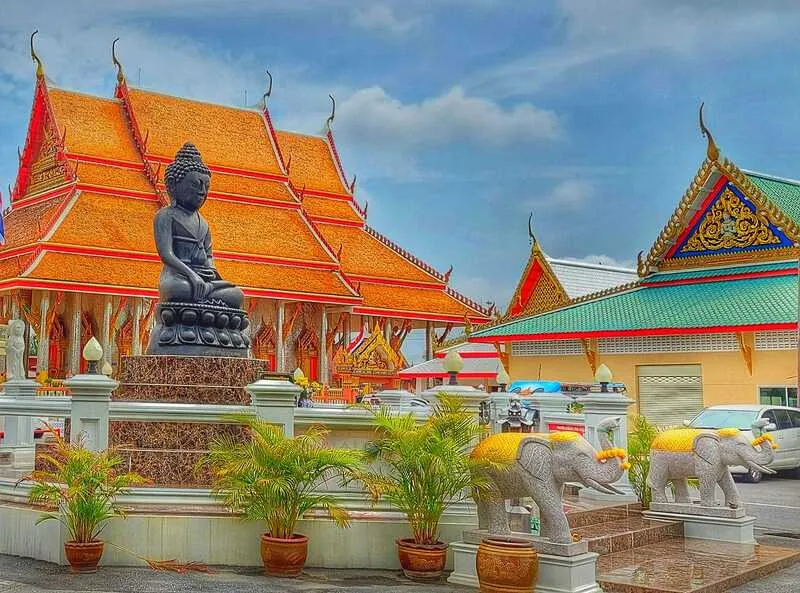
Wat Bang Saem (Wat Thong Nopakhun) in Moo 6, Tha Kham Subdistrict, Bang Pakong District, Chachoengsao Province, is a long-established community temple that locals commonly call “Wat Bang Saem.” The temple features a newly built, beautifully designed ubosot, making it an ideal place for an unhurried visit to pay respects and make merit. The temple was established in 1936, received its Wisungkhamsima (official ubosot boundary) on 13 February 1979, and has played a role in Buddhist education through Dhamma studies since 1977.
Another cultural highlight is the bell tower built in 1957. It is a brick-and-mortar structure with a two-tiered busabok-style roof, raised with an open base, and decorated with dragons coiling around all 4 pillars, with 4 bells in total. A 1–2 hour visit is enough to make merit, pay respects, walk around the key buildings, and continue on to riverside dining along the Bang Pakong River or head into Paet Riu (Chachoengsao town) with ease.
Wat Bang Saem (Wat Thong Nopakhun) in Moo 6, Tha Kham Subdistrict, Bang Pakong District, Chachoengsao Province, is a local temple under the Mahanikaya order that the community has been closely connected with for generations. Although the temple’s official name is “Wat Thong Nopakhun,” most residents refer to it as “Wat Bang Saem,” a name tied directly to local place memory. The appeal of this temple lies in its accessibility and its genuine role as a community anchor—whether for merit-making on Buddhist holy days, paying respects and making wishes, participating in temple activities, or practicing meditation to slow down and regain clarity amid a fast-paced life.
The overall atmosphere feels simple, clean, and orderly—very much a temple that is “used in real life.” It is not arranged merely as a photo spot, but as a space where people come and go regularly. Worship here feels unpressured, and there is room to walk and observe the temple buildings at a comfortable pace. One feature that stands out immediately is the newly built ubosot, which looks elegant and prominent, giving the temple a more contemporary visual presence while still retaining the warm, approachable character of a local community temple. For this reason, Wat Bang Saem suits both locals who visit regularly and travelers who want a calm “pause point” on the Bang Pakong–Paet Riu route or routes connecting to Thailand’s eastern provinces.
Historically, Wat Bang Saem has clear milestones that show the temple’s development. It was established in 1936, and the land for the temple was donated by Mr. Chuen and Mrs. Kham Thong Nopakhun, which is the origin of the official name “Wat Thong Nopakhun.” The temple’s land area is approximately 38 rai 3 ngan 28 square wah. These land details are more than numbers; they reflect the community’s shared commitment to creating a stable spiritual center. As the temple grew, it became more than a religious site—it became a space for community relationships, merit-making events, traditions, and activities that connect people across generations.
The temple received its Wisungkhamsima on 13 February 1979, an important milestone within the Thai monastic system because it officially defines the ubosot boundary for formal sangha rites. This status confirms the temple’s readiness to host key religious ceremonies and reinforces its role as a true religious center for the community. In addition, the temple has continued to develop in Buddhist education by opening a Dhamma division of the Pariyatti school in 1977, showing that the temple is not only about rituals but also about structured learning and practice in the Buddhist tradition.
Another reason Wat Bang Saem stands out as a place to train the mind is that it serves as Chachoengsao Provincial Meditation Center No. 18, established in 2000. With this role, the temple functions not only as a place for worship but also as a “practice space” that supports ongoing meditation and training. This makes Wat Bang Saem suitable both for visitors who want a simple merit-making visit and for those who want to spend time in genuine quiet, especially on days when they need to step back from busyness and return to themselves.
When walking through the temple grounds, you will find facilities that reflect the readiness of a fairly large community temple, including an ubosot, monks’ quarters, a multipurpose hall, a sermon hall, a chanting hall, and the bell tower. These structures are not only for appearance; they form the framework that allows the temple to truly “support the community.” The sermon hall and multipurpose hall host merit-making events and communal activities, while the monks’ quarters and chanting hall support the daily rhythm of monastic life and annual ceremonies. The ubosot remains the core space for formal rites, linking the temple and community through both practice and faith.
One of Wat Bang Saem’s most distinctive architectural highlights is the bell tower built in 1957. It is constructed of brick and mortar, topped with a two-tiered busabok-style roof, and raised with an open base to a height of about 1.70 meters. The signature detail that visitors remember is the “dragons coiling around all 4 pillars,” with the dragon heads facing the front of the bell tower. Around the pillars are 4 bells in total, crafted by local artisans. These details make the bell tower more than a functional structure; it is a piece of local craftsmanship that reflects community taste and intention in that era, and it serves as a valuable example of creative work in a local temple setting that is often overlooked.
On the upper level of the bell tower, a Buddha image in the “Pacifying Relatives” posture is enshrined, named “Sakyamuni Si Nopakhun.” This makes the bell tower more than a place for ringing bells; it becomes another layer of devotional space for visitors. Viewing it with respectful composure allows you to experience the temple from a different angle—both the presence of the Buddha image above and the close-up details of local craftsmanship. This adds depth to a visit, turning it into more than “pay respects and leave,” but an opportunity to absorb the passage of time and the work of local artisans who helped shape the temple’s identity.
To experience Wat Bang Saem at its calmest, a good rhythm is to begin by paying respects in the ubosot or the temple’s main worship point with mindful attention and without rushing. Then make merit according to your capacity and walk through the key structures—especially the bell tower with its distinctive dragon-wrapped pillars. If you pass by without knowing the story, you might miss its value, but once you understand the details, the intention of the builders and local craftsmen becomes clear. This is the charm of a strong community temple: ordinary surfaces that hold community stories in their details. When you give the visit the right amount of time, you leave with both calmness and a deeper understanding of the place.
Wat Bang Saem is also well-suited for family visits, because the grounds are generally easy to walk and the facilities serve different age groups. Older visitors can make merit and rest comfortably, while children can learn temple etiquette and absorb the quiet atmosphere of a religious space without feeling forced. The essentials are to dress modestly, keep voices low in worship areas, and respect those who come for religious practice, preserving the calm environment that defines this kind of community temple.
From a travel perspective, Wat Bang Saem can serve as a strong “starting point” for a Bang Pakong–Paet Riu day trip. From the temple, you can continue to several key Chachoengsao sites, including famous temples, old markets, floating markets, and riverside restaurants along the Bang Pakong River. A one-day plan is simple: begin in the morning with temple worship to settle the mind, have lunch by the river, then stroll through a historic market or visit a scenic viewpoint in the afternoon. If you prefer a more relaxed pace, staying overnight in the Bang Pakong area or closer to Chachoengsao town keeps the trip comfortable and lets you enjoy the Bang Pakong River atmosphere—one of the region’s defining lifelines—more fully.
Getting There Wat Bang Saem (Wat Thong Nopakhun) is located in Moo 6, Tha Kham Subdistrict, Bang Pakong District, Chachoengsao Province. The most convenient way to travel is by private car. Set your map pin to “Wat Bang Saem” or “Wat Thong Nopakhun” and follow local routes into Tha Kham Subdistrict within Bang Pakong District. As you approach the temple, you will enter a community area with straightforward roads, and you can park and enter the temple grounds easily. If using public transport, travel into the Bang Pakong area and get off near Tha Kham Subdistrict, then continue by local motorbike taxi or hired vehicle as appropriate. Visiting in the morning or during softer sunlight makes walking more comfortable and best supports a peaceful worship experience.
| Name | Wat Bang Saem (Wat Thong Nopakhun) (Wat Bang Saem / Wat Thong Nopakhun) |
| Location | Moo 6, Tha Kham Subdistrict, Bang Pakong District, Chachoengsao Province |
| Summary | A Mahanikaya community temple in Tha Kham, widely known as “Wat Bang Saem,” featuring a beautifully built new ubosot and a 1957 bell tower distinguished by dragons coiling around 4 pillars and 4 bells. It also serves as Chachoengsao Provincial Meditation Center No. 18, making it ideal for an unhurried merit-making visit and a calm walk through local craftsmanship and temple life. |
| Highlights | 1) A beautifully built new ubosot, suitable for a calm worship visit 2) A 1957 bell tower constructed of brick and mortar with a two-tiered busabok-style roof and a raised open base 3) Signature decoration: dragons coiling around 4 pillars, with 4 bells crafted by local artisans 4) Upper level enshrines a “Pacifying Relatives” Buddha image named “Sakyamuni Si Nopakhun” 5) Dhamma Pariyatti education since 1977 and designated as Chachoengsao Provincial Meditation Center No. 18 (established 2000) |
| Contact Number | 038-573-101 |
| Abbot (Latest) | Phra Khru Chan Suwan San |
| Nearby Accommodations | 1) Bangpakong Boat Club – approx. 6 km, tel. 063-535-2521 2) Ratathara Resort – approx. 7 km, tel. 099-962-8052 3) Wellgrow Hotel – approx. 18 km, tel. 033-050-739 4) Heaven Hotel Chachoengsao – approx. 28 km, tel. 038-511-150 5) JK Living Hotel & Service Apartment Chachoengsao – approx. 28 km, tel. 038-511-255 |
| Nearby Attractions | 1) Bang Pakong Power Plant Market (Bang Saem) – approx. 2 km, tel. 081-827-7465 2) Wat Hong Thong (Temple on the Water) – approx. 18 km, tel. 081-915-5728 3) Wat Sothon Wararam Worawihan – approx. 25 km, tel. 038-511-048 4) Ban Mai 100-Year Market – approx. 26 km, tel. 097-259-6438 5) Bang Khla Floating Market – approx. 35 km, tel. 038-541-027 |
| Nearby Restaurants | 1) The Rich Pizza (Bang Saem) – approx. 1 km, tel. 086-926-6963 2) Phae Khiang Nam (Bang Pakong) – approx. 6 km, tel. 038-574-444 3) Krua Ban Rim Nam (Bang Pakong) – approx. 14 km, tel. 038-834-131 4) Krua Raruen (Bang Pakong Power Plant Area) – approx. 3 km, tel. 086-287-4445 5) Big M Seafood (Talat Lao Lok Area) – approx. 6 km, tel. 098-602-0810 |
Frequently Asked Questions (FAQ)
Q: Where is Wat Bang Saem located?
A: Wat Bang Saem is in Moo 6, Tha Kham Subdistrict, Bang Pakong District, Chachoengsao Province. Locals commonly use the name “Wat Bang Saem,” although the official name is Wat Thong Nopakhun.
Q: How is “Wat Bang Saem” related to the name “Wat Thong Nopakhun”?
A: “Wat Thong Nopakhun” is the official name, while “Wat Bang Saem” is the community name people commonly use based on the local area.
Q: When was Wat Bang Saem established, and when did it receive Wisungkhamsima?
A: The temple was established in 1936 and received its Wisungkhamsima on 13 February 1979.
Q: What should visitors not miss at Wat Bang Saem?
A: Do not miss the beautifully built new ubosot and the 1957 bell tower, distinguished by dragons coiling around 4 pillars, 4 bells, and the “Pacifying Relatives” Buddha image named “Sakyamuni Si Nopakhun” enshrined on the upper level.
Q: Does Wat Bang Saem have roles in meditation practice and education?
A: Yes. The temple has offered Dhamma Pariyatti education since 1977 and serves as Chachoengsao Provincial Meditation Center No. 18, established in 2000.
Q: What is the contact number for Wat Bang Saem?
A: 038-573-101
 Wat Bang Samae Map
 Category:
  Group:
  Tag: ●Wat Bang Samae●wat bang saem ●wat thong nopakhun ●bang pakong temple ●chachoengsao temple ●wat tha kham ●buddhist temple bang pakong ●meditation center chachoengsao ●wat bang saem bell tower ●travel bang pakong ●day trip chachoengsao Last Update: 1 MonthAgo
Comment
 Nearby Attractions
| Keyword (Advance) |
 Region
|
 Muang Chachoengsao(
 Copyright 2012,