
 Home
Home Chiang Mai(




Wat Kongkaram (Wat Bon)
Rating: 2.1/5 (21 votes)
 Search By
  Map
Map 
 Have Map
  No Map
Chachoengsao attractions
Attractions in Thailand
Open Days: Open Daily
Opening Hours: Approximately 08:00 – 17:00
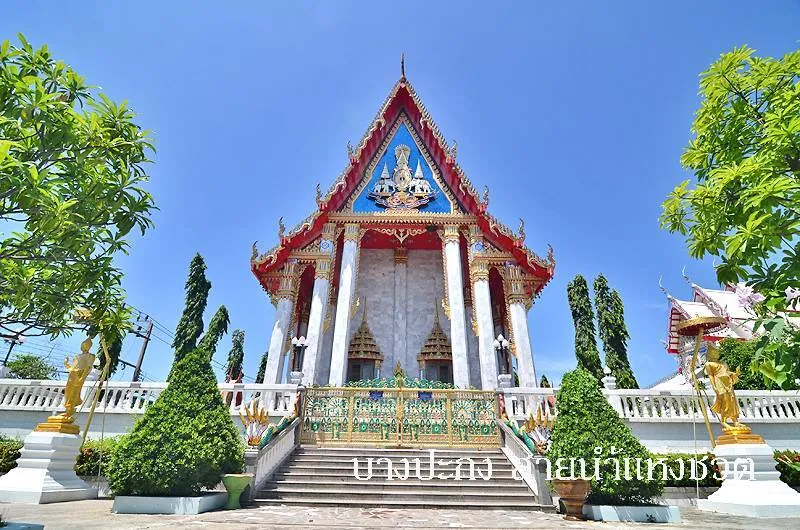
Wat Khongkharam (Wat Bon) in Bang Pakong Subdistrict, Chachoengsao Province, is an old and highly respected temple that local residents recognize as the “upper temple” within the well-known sequence of three temples in the same area: Wat Bon (Upper) – Wat Klang (Middle) – Wat Lang (Lower). The temple stands out for its heritage art and architecture that reflect a transition from the late Ayutthaya period into the early Rattanakosin era. Key features include three swan pillars, three stupas, delicately carved wooden Buddha images, a gilt bronze “royal attire” Buddha image, and a lacquered-and-gilded Tripitaka cabinet decorated in the traditional rod nam technique. Inside the ordination hall, the principal Buddha image is made from fired clay covered with white plaster, lacquer, and gold leaf, with a lap width traditionally described as four sok. In front of the principal image sits “Luang Pho To,” a revered sacred Buddha image that local people frequently visit to pray and make wishes. In a broader sense, the temple serves as an important cultural reference point within the Bang Pakong riverscape, closely tied to community history, traditional water-based trade, and the wider network of temples along the river.
Wat Khongkharam (Wat Bon) is located in Bang Pakong Subdistrict, Bang Pakong District, Chachoengsao Province. It is one of the easiest temples for locals to describe because its identity is anchored in a simple “positional sequence”: the upper temple, the middle temple, and the lower temple. Wat Bon is widely spoken of as the oldest among them. When viewed through the surviving artistic elements – such as the swan pillars, the stupas, and architectural components within the ordination hall – the temple’s reputation as a site associated with the late Ayutthaya period carries strong cultural weight. Temples in the Central Plains river basins typically grew alongside waterways, early settlement patterns, and the expansion of riverside markets. As communities became more established, the temple’s role extended beyond religious rites to become a hub for learning, mutual support, and a shared center that made people feel their community had a common “home base.”
The local name “Wat Bon” is more than a casual nickname. It reflects a straightforward way that residents perceive geography and travel routes. When several temples lie along the same corridor, communities often use directional or positional terms to make communication easier. Wat Bon therefore functions as a practical landmark. Over time, this geographic shorthand evolved into a lasting identity attached to the temple itself. As a result, the story of Wat Bon is rarely told in isolation; it is typically explained together with Wat Klang and Wat Lang as cultural “relatives” within the same subdistrict, connected through shared community life and religious practice.
In terms of monastic administration, Wat Khongkharam is a local community temple under the Mahanikaya order. Publicly available information identifies the current abbot as “Phra Khru Khema Phiram,” who also serves as the subdistrict ecclesiastical head for Bang Pakong. This means the temple’s role is not limited to activities within its own grounds, but also connects to broader Sangha administration at the subdistrict level, along with ongoing cooperation with the local community through religious events and public-benefit activities.
Viewed through tangible heritage, the three swan pillars are among the most visually striking symbolic elements. In Thai temple culture, swan pillars often connect to cosmological concepts and auspicious mythic creatures, while also signaling the sacred domain of the temple precinct in a symbolic way. Having three swan pillars in one place creates a memorable identity that locals frequently use as a simple descriptor: “the upper temple with three swan pillars.” Similarly, the three stupas form a coherent architectural set that carries narrative power. A grouped number can imply ritual meaning and an orderly sacred layout. Even visitors who do not know the full technical details can sense the deliberate design and the significance of the construction or restoration phases that shaped the temple’s present form.
The heart of the experience at Wat Bon is the ordination hall, a space that preserves both faith and artistic traces at once. Inside stands the principal Buddha image, described as being made from fired clay, coated with white plaster, lacquer, and gold leaf, with a lap width recorded as four sok. This description matters because it highlights traditional materials and techniques used by local craftsmen, who often built clay cores before applying plaster and finishing layers to achieve the refined look associated with higher-status religious art. Lacquer and gold leaf represent both reverence and the community’s best offering to the principal image. Meanwhile, the visible plaster layers also reveal the reality of long-term maintenance in Thai temple life: active worship spaces must be cared for and occasionally restored as time passes.
In front of the principal image sits a lacquered-and-gilded Buddha image known locally as “Luang Pho To.” It is regarded as a sacred spiritual anchor for people in the neighborhood. The name “Luang Pho To” appears in many places across Thailand, yet in each community it carries a distinct emotional meaning. It is a familiar, accessible way for residents to identify the temple’s most important image – the one everyone should pay respect to first. In Wat Bon’s local narrative, Luang Pho To is tied to everyday faith stories such as “people come to make wishes,” “people feel calmer after praying,” or “people ask for strength to get through difficult times.” This kind of living faith keeps the temple relevant today, because a temple is not only a museum of the past. It is also a space where people come to manage hope, fear, uncertainty, and new beginnings.
What gives Wat Khongkharam (Wat Bon) stronger cultural-heritage weight is the presence of art objects closely tied to skilled local craftsmanship. These include carved wooden Buddha images that demonstrate woodcarving expertise, which requires both technical mastery and significant time. Such carving is not merely decorative; it functions as a religious visual language linked to auspicious beliefs and protective symbolism. The temple also holds a gilt bronze Buddha image in royal attire, reflecting the artistic concept of the Buddha as a universal sovereign – a way of emphasizing spiritual greatness in parallel with worldly authority, offering worshippers a sense of stability and protection under the umbrella of Buddhism.
Another important item is the Tripitaka cabinet decorated in the traditional rod nam technique, a sophisticated Thai art process involving lacquer, gilding, and controlled washing to reveal golden motifs against a dark ground. A Tripitaka cabinet is not simply a storage unit for scriptures; it symbolizes knowledge, the sanctity of the Dhamma, and the community’s commitment to preserving religious continuity. In traditional Thai society, temples served as educational centers where people learned to read and write under monastic guidance. Having a Tripitaka cabinet therefore also signals that the temple was once – and in many ways remains – a refuge of learning, not only a place of ritual.
When placed within the wider context of Bang Pakong District, the larger picture is that Bang Pakong developed through the Bang Pakong River and its transportation networks, both by water and by road. The river supported early settlement, markets, and trade routes in earlier eras, while modern roads have made temples easier to access. Yet this ease comes with challenges: contemporary visitors often arrive quickly and leave quickly, attention spans can be shorter, and temples compete with more stimulus-heavy attractions. For Wat Bon, meaningful storytelling needs to connect historical value, artistic heritage, and living faith in a way that modern visitors can still emotionally relate to.
Most visits to Wat Bon begin with paying respects inside the ordination hall – first to the principal Buddha image and then to Luang Pho To – followed by exploring other features within the grounds, such as the stupas, swan pillars, and areas where certain art objects are preserved. In the morning, the atmosphere is typically calm and well suited to quiet merit-making, offering alms, or joining temple activities when ceremonies are held. In the late afternoon, local residents often stop by after work, allowing visitors to see Wat Bon as a genuinely living community temple rather than a photo spot alone.
In terms of etiquette, Wat Bon is an active temple that local people still use regularly. Dressing modestly and keeping noise levels appropriate are therefore important – especially inside the ordination hall and areas where monks reside. Respectful conduct is not meant to restrict visitors, but to help visitors “share the space” harmoniously, since people come to temples carrying many different emotions: happiness, grief, fresh starts, or the need for reassurance. Calmness is one of the most valuable things a temple can offer.
If you want a full-day plan that combines worship and a sense of local riverside community, a simple route is to start at Wat Khongkharam (Wat Bon), then continue to Wat Klang Bang Pakong, and later to Wat Hong Thong, which is a major modern landmark in Bang Pakong. After that, you can stop at a riverside market or a local restaurant along the Bang Pakong River. This route helps travelers see the evolution of temples within the same district – from an older temple focused on heritage art and late-Ayutthaya traces, to a more contemporary riverside landmark shaped by the social-media era.
Getting There If you are driving from Bangkok, you can take the motorway or main highways into Bang Pakong District and set your navigation to “Wat Khongkharam (Wat Bon)” in Bang Pakong Subdistrict. The temple is within a community zone and is well positioned for continuing on to other temples in the district. If you are using public transportation, many travelers arrive in Bang Pakong or Chachoengsao town first and then take a local taxi or motorcycle taxi to reach the temple, depending on convenience and itinerary.
| Name | Wat Khongkharam (Wat Bon) |
| Location | Bang Pakong Subdistrict, Bang Pakong District, Chachoengsao Province 24130, Thailand |
| Address (For Maps) | Moo 2, Bang Pakong Subdistrict, Bang Pakong District, Chachoengsao Province 24130, Thailand |
| Place Summary | An old community temple known as the “Upper Temple” of Bang Pakong, featuring three swan pillars, three stupas, and important heritage art objects, centered on the revered Luang Pho To. |
| Highlights | 1) Three swan pillars and three stupas (key symbolic landmarks) 2) Principal Buddha image made from fired clay with plaster, lacquer, and gold leaf (lap width: four sok) 3) “Luang Pho To,” the community’s sacred Buddha image for regular worship and blessings 4) Heritage art: carved wooden Buddha images and a gilt bronze Buddha in royal attire 5) Rod nam lacquer-and-gilded Tripitaka cabinet (traditional Thai craftsmanship) |
| Contact Number | 038-531-510 |
| Abbot / Administrator (Latest) | Phra Khru Khema Phiram |
| Nearby Accommodations | 1) Suntara Wellness Resort & Hotel – approx. 18 km – Tel. 033-590-250 2) JK Living Hotel & Service Apartment Chachoengsao – approx. 20 km – Tel. 092-742-9929 3) Heaven Hotel Chachoengsao – approx. 21 km – Tel. 038-511-150 4) Tree House Chachoengsao – approx. 19 km – Tel. 098-253-7460 5) Bang Pakong Park (Accommodation / Seminar Building) – approx. 6 km – Tel. 081-449-9492 |
| Nearby Attractions | 1) Wat Klang Bang Pakong – approx. 4 km – Tel. 038-531-577 2) Wat Hong Thong – approx. 22 km – Tel. 081-915-5728 3) Wat Sothon Wararam Worawihan – approx. 23 km – Tel. 038-511-048 4) Ban Mai 100-Year Market (Chachoengsao) – approx. 24 km – Tel. 097-259-6438 5) Bang Khla Floating Market – approx. 40 km – Tel. 038-541-027 |
| Nearby Restaurants | 1) Pae Kieng Nam (Bang Pakong Area) – approx. 8 km – Tel. 038-574-444 2) Krua Ban Rim Nam Bang Pakong – approx. 9 km – Tel. 038-834-131 3) Ban Mai Rim Nam (Chachoengsao) – approx. 23 km – Tel. 038-512-064 4) Pu Kao Ae Riverside – approx. 24 km – Tel. 038-511-193 5) The River Barn Chachoengsao – approx. 24 km – Tel. 038-515-892 |
Frequently Asked Questions (FAQ)
Q: Where is Wat Khongkharam (Wat Bon) located?
A: It is located in Bang Pakong Subdistrict, Bang Pakong District, Chachoengsao Province, and is known locally as the “Upper Temple” within the Wat Bon–Wat Klang–Wat Lang sequence.
Q: What makes Wat Bon different from other temples in the area?
A: It is known for three swan pillars, three stupas, heritage art objects such as carved wooden Buddha images and a rod nam Tripitaka cabinet, and the revered Luang Pho To inside the ordination hall.
Q: Who is Luang Pho To, and why do locals come to pray there?
A: Luang Pho To is a lacquered-and-gilded Buddha image placed in front of the principal Buddha image. It is a sacred spiritual anchor for locals who regularly come to pray for blessings and peace of mind.
Q: What is special about the principal Buddha image in the ordination hall?
A: It is described as being made from fired clay, covered with white plaster, lacquer, and gold leaf, with a lap width recorded as four sok, reflecting valuable traditional craftsmanship.
Q: What contact number can visitors use for the temple?
A: The listed contact number is 038-531-510.
 Wat Kongkaram (Wat Bon) Map
 Category:
  Group:
  Tag: ●Wat Kongkaram (Wat Bon)●wat khongkharam ●wat bon bang pakong ●luang pho to ●bang pakong temple ●chachoengsao temples ●buddhist temple thailand ●things to do bang pakong ●temple near bangkok ●thai temple history ●chachoengsao travel Last Update: 4 WeekAgo
Comment
 Nearby Attractions
| Keyword (Advance) |
 Facebook Fanpage
 Region
 Art, Culture and Heritage
 Historical Sites and Monuments(
 Landmarks and Memorials(
 Royal Palace(
 Art, Craft Centres, Tradition(
 Museums(
 Historical Houses and The Ancient City(
 Educational Places
 Museum for Study(
 Library(
 Educational Gardens, Farm(
 University
 Mosque(
 Other religious and spiritural sites(
 Research and Development
 Royal Project(
 Suburban Living
 Village, Community(
 Local Market(
 Floating Market(
 Nature and Wildlife
 National Parks and Marine Reserves(
 Mountain (Doi)(
 Dam, Reservoir, Lake(
 Waterfalls(
 Caves(
 River, Canal(
 Bays and Beaches(
 Islands(
 Other natural attractions(
 Entertainment and Agricultural
 Zoos and Aquariums(
 Animal camps and shows(
 Farm, Parks, Gardens and Ecotourism(
 Spas and Wellness
 Spas and Wellness(
 Travel Articles, Recipes
 Travel Review, Food Review(
 Copyright 2012,