
lovethailand home >Central Travel Attractions >Chachoengsao Travel Attractions >Bang Khla >Sao Changok > Rong Je Pan Kim Yue E Tuah (Ban Moo Vegetarian Shr..
TL;DR: Rong Je Pan Kim Yue E Tuah (Ban Moo Vegetarian Shrine) is located at 99/1 Moo 1, Sao Cha Ngok Subdistrict, Bang Khla District, Chachoengsao 24110, open Daily, hours 08.00 – 17.00.
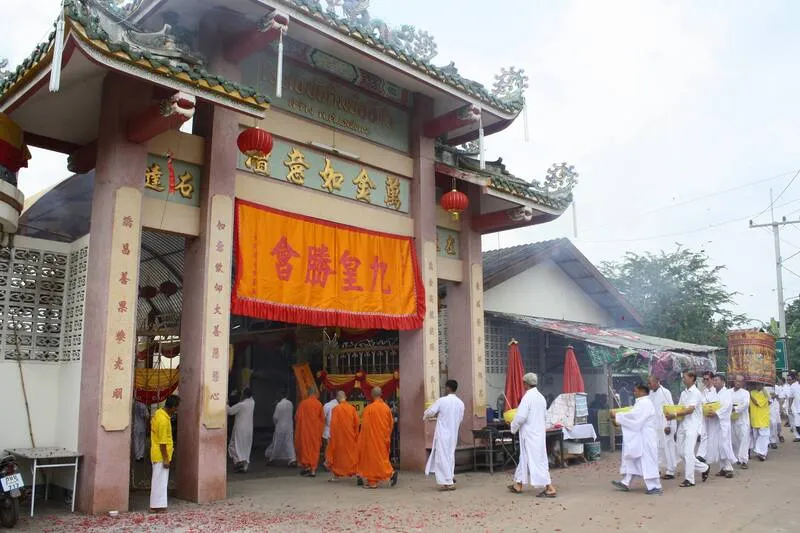
Rong Je Pan Kim Yue E Tuah (Ban Moo Vegetarian Shrine)
Open Days: Daily
Opening Hours: 08.00 – 17.00
Rong Je Pan Kim Yue E Tuah (Ban Moo Vegetarian Shrine) in Sao Cha Ngok Subdistrict, Bang Khla District, Chachoengsao, is a major spiritual center for the local Thai-Chinese community and is widely known for its annual Vegetarian Festival held around October. Every year, large numbers of devotees travel here to observe precepts, wear white clothing, take part in religious rites, and eat vegetarian food in an atmosphere shaped by order, shared discipline, and strong community cooperation. For anyone who wants to experience “kin jay the way a traditional shrine practices it” — where culture, faith, and community life are deeply intertwined — this is considered one of Chachoengsao’s key cultural landmarks.
Rong Je Pan Kim Yue E Tuah — locally familiar as the “Ban Moo Market Vegetarian Shrine” — is located in Sao Cha Ngok Subdistrict, Bang Khla District, Chachoengsao, and is frequently mentioned whenever people talk about “kin jay in Chachoengsao.” The atmosphere here is not simply about stopping by to pay respects. It is a place where devotees intentionally come to keep precepts, calm the mind, and participate in shrine traditions year after year. Many visitors describe the same feeling: even if they do not plan to stay for several days, simply standing in the shrine grounds, seeing people dressed in white moving quietly and respectfully, and catching the scent of vegetarian food from the shrine kitchen makes it immediately clear that this festival carries real “power” and deep meaning for the community.
What makes the Ban Moo Market Vegetarian Shrine culturally significant is that it does not exist in isolation. It has grown together with the “community” and with shared collective memory in Sao Cha Ngok. Academic studies discussing the Ban Moo shrine’s Vegetarian Festival indicate that Sao Cha Ngok has a Thai-Chinese community with settlement history extending for roughly “a century,” and that the festival here is an annual tradition continuously maintained within the social structure of the community. It is not merely seasonal tourism, but a living “system of belief and shared life” that draws both locals and visitors back every year.
When you view the shrine as a ritual space, what people remember most is the presence of the “Hut Jo” (a revered sacred presence) that serves as the spiritual center of ceremonies. In the tradition of vegetarian shrines, “joining the vegetarian festival” is not only about avoiding meat. It is also about training discipline, regulating body and speech, and grounding oneself in precepts shared by the community. The quiet way people walk, speak, dress, and share space becomes a clearer language of faith than words. During the festival, you will see many devotees who intentionally come to stay for periods of practice. Some travel from other provinces, and those who have come once often return every year, as commonly described in local community narratives.
The shrine’s appeal, therefore, lies as much in the “shared experience” as in the sacred dimension. When the festival begins, the space gradually shifts from everyday calm into a ritual environment with its own rhythm — from preparing the grounds and organizing movement, to arranging the vegetarian kitchen, to the key ceremonies scheduled by the shrine. In some years, records and community recollections note rites associated with inviting the principal sacred presence to descend and commence continuous chanting and precept observance throughout the festival period. This is what makes many people feel that coming here helps them “reset their life” rather than simply visiting for photos.
In broad terms, a traditional shrine-based Vegetarian Festival often revolves around three core pillars: “Precepts,” “Ritual,” and “Food.” Precepts provide a behavioral framework that elevates a participant’s intention. Ritual unifies the community and gives precept observance a tangible form. Food both sustains the body and reflects community wisdom, because shrine vegetarian food is not prepared only for sale, but also for “sharing” — supporting everyone’s ability to maintain practice throughout the festival.
If you are new and want to understand how to “participate appropriately,” the simplest approach is to start with respectful dress — especially during the festival when white clothing is commonly worn to maintain order and a sense of shared participation. Then, pay attention to signs or guidance about ritual zones, food-service areas, and waiting/rest areas. A shrine that receives large crowds prioritizes the flow of people so ceremonies can proceed without disruption. Small intentions — silencing your phone, speaking softly, avoiding walking across ceremonial lines, and helping keep the area clean — make communal worship smoother and more respectful.
Another reason the Ban Moo Market Vegetarian Shrine is widely talked about is the strong sense of “continuity” and “community” in its festival. It does not function like a temporary event. It is a yearly rhythm that locals genuinely prepare for — from sourcing ingredients and organizing the kitchen to arranging spaces and welcoming those who come to practice. As you move through the grounds, you often feel a culture of mutual help: elders offering guidance, and younger generations assisting with organization. This makes the shrine a kind of “shared center” where everyone has a role.
From a cultural-travel perspective, the Ban Moo Market Vegetarian Shrine suits visitors who want to see the Vegetarian Festival in a more serious dimension than simply walking an “all-vegetarian food market.” Here, you can observe how belief becomes practice — through quiet conduct, the priority given to ceremonies, and the simple lifestyle many people adopt during precept observance. Outside the festival season, the shrine remains a suitable place to pay respects, make wishes, and learn about Sao Cha Ngok’s Thai-Chinese community identity within Chachoengsao.
For those planning to visit during the October festival period, a practical tip is to allow extra time. Major ceremony periods are more crowded than usual, and some visitors plan to stay for a full day to join multiple activities across different time slots. Families bringing elders or young children should prioritize safety, convenience, and regular breaks. If you intend to observe precepts for several days, prepare personal necessities in advance, since shrine spaces are shared communal environments. Good preparation helps you truly “live with the precepts” rather than simply dropping by and leaving.
In terms of location, the Ban Moo Market Vegetarian Shrine is positioned in a zone where it is easy to plan a connected trip, because Bang Khla District offers important temples, floating markets, and riverside nature along the Bang Pakong River. A shrine visit can therefore be integrated into a 1-day or 2-day Chachoengsao itinerary. Many visitors combine it with Bang Khla Floating Market on weekends, Wat Pak Nam Jo Lo (the golden ubosot), or Wat Pho Bang Khla for the famous bat colony, and then end the day in the city area at places such as Viharn Sien or Wat Sothon Wararam Worawihan. This creates a balanced trip combining faith, culture, and relaxation.
Getting There Visiting Rong Je Pan Kim Yue E Tuah (Ban Moo Market Vegetarian Shrine) is generally most convenient by private car, because it allows flexible planning for multiple stops in Bang Khla. From Chachoengsao city, head toward Bang Khla District and continue into Sao Cha Ngok Subdistrict in the Ban Moo Market area. The shrine is located within the community, so drive carefully, watch for pedestrians, and follow local traffic organization — especially during the festival when visitor numbers increase significantly.
If you travel by public transport, a practical approach is to reach Chachoengsao city first, then connect onward to Bang Khla District and Sao Cha Ngok Subdistrict (often via local songthaews or hired transport depending on service availability at the time). It is strongly recommended to plan both your arrival and return times clearly, especially in the evening or on major ceremony days, because crowd density and route organization can make travel take longer than usual.
One visual feature many visitors appreciate during the festival is the overall “white” atmosphere, which naturally creates a sense of calm and order. If you enjoy documentary-style photography, morning and late afternoon often provide softer light that suits capturing the environment, spatial arrangements, and the rhythms of the shrine kitchen. However, photos should be taken respectfully, without interrupting rituals, and you should avoid close-up shots of participants’ faces without permission to preserve the quiet dignity of the sacred space.
In summary, Rong Je Pan Kim Yue E Tuah (Ban Moo Market Vegetarian Shrine) is a Chachoengsao destination that gives the Vegetarian Festival meaning beyond food menus. It shows the real power of precept observance practiced as a community, reflects a living Thai-Chinese cultural heritage, and demonstrates how faith can organize people toward shared good actions in a tangible way. If you want a serious vegetarian-festival experience and a clearer understanding of Sao Cha Ngok’s cultural roots, visiting this shrine at least once can make “kin jay” feel less like a seasonal trend and more like a lasting memory.
| Name | Rong Je Pan Kim Yue E Tuah (Ban Moo Market Vegetarian Shrine) |
| Address | 99/1 Moo 1, Sao Cha Ngok Subdistrict, Bang Khla District, Chachoengsao 24110 |
| Place Summary | A key vegetarian shrine of the Sao Cha Ngok / Ban Moo Market community, famous for its October Vegetarian Festival. Devotees travel here to observe precepts, wear white clothing, join rituals, and eat vegetarian food in an orderly, faith-centered atmosphere. |
| Highlights | Festival ritual center, white-clothing precept atmosphere, living Thai-Chinese community culture in Sao Cha Ngok, ideal for cultural travel and serious precept observance. |
| Period | Annual Vegetarian Festival around October (based on the Chinese calendar), linked to a long-established Thai-Chinese community in the area. |
| Key Evidence / Elements | Shrine building and ritual areas, vegetarian kitchen / food-service zone during the festival, traditions of wearing white and participating in chanting and precept practice according to the shrine’s schedule. |
| Name Origin / Area | Located in the “Ban Moo Market” community, Sao Cha Ngok Subdistrict, Bang Khla District, a Thai-Chinese community with a strong identity and ongoing vegetarian-festival continuity. |
| Travel (Summary) | Private car: from Chachoengsao city to Bang Khla, then into Sao Cha Ngok Subdistrict (Ban Moo Market area). Public transport: reach Chachoengsao city first, then connect to Bang Khla and Sao Cha Ngok (plan return time carefully). |
| Current Status | Open for worship; visitor numbers increase significantly during the Vegetarian Festival period. |
| Contact Number | 081-861-8470 |
| Fees | No confirmed fee information (generally open to visitors). |
| Facilities | No officially confirmed facilities information (festival periods typically include organized visitor-support areas according to shrine practice). |
| Nearby Tourist Attractions | 1) Bang Khla Floating Market – approx. 12 km – Tel. 038-541-027 2) Wat Bang Krachet Floating Market – approx. 18 km – Tel. 081-826-1279 3) Wat Pak Nam Jo Lo (Golden Ubosot) – approx. 22 km – Tel. 085-398-4555 4) Wat Pho Bang Khla (Bat Colony) – approx. 14 km – Tel. 038-541-027 5) Viharn Sien (Sa Wang Sathadhammasathan) – approx. 38 km – Tel. 038-535-049 |
| Popular Restaurants Nearby | 1) JA-Green (Restaurant / Cafe) – approx. 12 km – Tel. 081-151-5636 2) Bang Khla Cafe & Restaurant – approx. 12 km – Tel. 082-510-4538 3) Plearn Cafe – approx. 16 km – Tel. 099-356-4656 4) Krua Mae Som Kliang (Bang Pakong Riverside) – approx. 33 km – Tel. 086-833-6636 5) Baan Mai Rim Nam (Chachoengsao City) – approx. 36 km – Tel. 038-512-064 |
| Popular Accommodations Nearby | 1) Bang Khla Resort – approx. 20 km – Tel. 038-542-138 2) Tamarindee Stay & Cafe (Bang Khla Riverside) – approx. 20 km – Tel. 065-563-2392 3) Blue Ozone Resort & Spa – approx. 22 km – Tel. 081-611-1144 4) JK Living Hotel & Service Apartment (Chachoengsao City) – approx. 36 km – Tel. 092-742-9929 5) The Wish Hotel & Condo (Chachoengsao City) – approx. 36 km – Tel. 088-521-5234 |
Frequently Asked Questions (FAQ)
Q: Where is Rong Je Pan Kim Yue E Tuah (Ban Moo Market Vegetarian Shrine) located?
A: It is located at 99/1 Moo 1, Sao Cha Ngok Subdistrict, Bang Khla District, Chachoengsao, in the Ban Moo Market community area.
Q: When is the best time to visit to experience the full vegetarian-festival atmosphere?
A: The Vegetarian Festival is generally held around October each year (based on the Chinese calendar). During this period, many devotees observe precepts, wear white clothing, and participate in traditional shrine activities more intensively than on normal days.
Q: If I am new, how should I prepare to visit during the festival?
A: Wear respectful clothing (white is commonly preferred), speak softly, keep your phone silent, respect ritual areas, and bring essential personal items. If you plan to stay for several hours, allow extra time and take breaks as needed.
Q: What are the open days and opening hours?
A: It is open daily from 08.00 – 17.00.
Q: What nearby places can I visit after the shrine to make a full Bang Khla trip?
A: You can continue to Bang Khla Floating Market, Wat Bang Krachet Floating Market, Wat Pho Bang Khla (bat colony), Wat Pak Nam Jo Lo (golden ubosot), or head into the city area for Viharn Sien to combine culture, local life, and photo spots in one trip.
Q: What number should I call to contact the shrine directly?
A: Tel. 081-861-8470
 Category: ●Places of Worship
 Group: ●Other Sacred Sites
Last Update : 7 MonthAgo
 Last Update : 7 MonthAgo
 Click to Access the Navigation Map GPS
Rong Je Pan Kim Yue E Tuah (Ban Moo Vegetarian Shrine) Map
Recommend

 Art, Culture and Heritage
 Historical Sites and Monuments(3)
 Landmarks and Memorials(4)
 Royal Palace(1)
 Art, Craft Centres, Tradition(10)
 Museums(2)
 Historic Homes and Cities(1)
 Educational Places
 Museum for Study(1)
 Library(1)
 Educational Gardens, Farm(2)
 Temple(50)
 Mosque(2)
Other Sacred Sites(7)
Mosque(2)
Other Sacred Sites(7)
 Research and Development
 Royal Project(4)
 Suburban Living
 Village, Community(5)
 Local Market(4)
 Floating Market(1)
 Nature and Wildlife
 National Parks and Marine Reserves(2)
 Mountain (Doi)(1)
 Dam, Reservoir, Lake(6)
 Waterfalls(1)
 Caves(1)
 River, Canal(2)
 Bays and Beaches(1)
 Islands(2)
 Other natural attractions(2)
 Entertainment and Agricultural
 Zoos and Aquariums(1)
 Animal camps and shows(1)
 Farms, Parks and Ecotourism(6)
 Spas and Wellness
 Spas and Wellness(1)
 Travel Articles, Recipes
 Travel Review, Food Review(3)


